
Welcome to “Islam Today,” a Substack series by human rights lawyer, author, and podcaster Qasim Rashid. This series offers a detailed, evidence-based, and accessible exploration of the life of Prophet Muhammad (sa)—who he was, what he taught, and why his life and legacy matter today. If you’re joining us midway through, we warmly invite you to start from Chapter 1 and follow along. Each installment builds on the last, and the full picture is worth the journey.
A man and his son had searched everywhere.
The ZamZam well — that miraculous spring that had once burst forth beneath the feet of the infant Ishmael, that had transformed a barren wasteland into the beating heart of what would become Mecca — had long since been filled in and lost. Generation after generation had searched for it and failed. Friends and neighbors had long since stopped being sympathetic and started being scornful. Who were these two, searching endlessly for something no one else had managed to find?
The son, in a moment of desperate faith, made a vow. If God would help him find the well, and if God would bless him with ten sons who each lived to maturity in his lifetime, he would sacrifice one of those sons for God.
Shortly after that prayer, the well was found. The water flowed again. And in the years that followed, the son was blessed with not one, not five, but ten sons — all of whom reached maturity during his lifetime.
Now came the moment of reckoning. He had made a promise. Ten sons stood before him, all of them alive, all of them his. And one of them was going to die.
Which one? What happened next?
We’ll come back to that in a moment.
By the time we reach this chapter in our story, we have traveled a very long way — from the Big Bang to Adam, from Adam to Noah, from Noah to Abraham, from Abraham through Moses and Jesus. Each prophet carried the same essential message forward into a new time and a new people. And now that message is converging on a specific place: Arabia.
Arabia, in the ancient world, was a land of extraordinary complexity. The Arabs were ethnologically divided into three main groups. The first were the ancient, vanished tribes — Ad, Thamud, Tasm, and Jadis — who disappeared long before the dawn of Islam and are known as the Arab Baida, the Vanished Arabs. The second were the descendants of Qahtan, originally from what is now Yemen, who spread throughout Arabia centuries before the birth of Jesus. They were prosperous, sophisticated, and proud — known as Arabul Ariba, the Pure Arabs. The third were the descendants of Ishmael himself, known as Arabul Mustaribah — the “foreigners,” because Ishmael had come from outside Arabia. It is a remarkable irony of history that a people who had lived in a land for thousands of years were still classified as newcomers.
It was into this world — and specifically into the lineage of Ishmael — that the Prophet Muhammad (sa) would one day be born.
When Abraham and Ishmael rebuilt the Ka’aba on its original site, they offered a prayer together. The Qur’an records it: “And raise up from among them, our Lord, a Messenger from among themselves who may recite unto them Thy signs and teach them the Book and wisdom and may purify them; verily Thou art the Mighty, the Wise.” (2:129)
Muslims believe that prayer was answered in the person of Muhammad (sa) — a fulfillment that came thousands of years after the supplication was first offered. It is a staggering thought: two men, building a house of worship in a desert, praying for a messenger they would never live to see, whose coming would reshape the entire world.
The Ka’aba — Arabic for “cube,” a name that reflects its simple, striking shape — and the ZamZam well together transformed their surrounding area. Water in a desert creates life. Life creates community. Community creates trade. Trade creates civilization. Mecca grew from the site of a miraculous spring into one of the most important cities in the ancient world — a center of faith, commerce, and culture.
One of the first tribes to settle near the Ka’aba was the Jurhum tribe, and it was from this tribe that Ishmael took a wife. Together they had twelve sons. The custodianship of the Ka’aba passed through generations — through Ishmael’s descendants, through periods of political upheaval, through various tribal powers — until it eventually came to rest with a man named Qussaiyy.
Qussaiyy was, by any measure, a remarkable leader. He reunified the scattered descendants of Ishmael, settled them around the Ka’aba in organized quarters, established systems for feeding and providing water to pilgrims, managed the defense of the sanctuary, and created what functioned essentially as a national parliament. It was Qussaiyy who earned the title al-Quraysh — the Congregator. And from this point forward, the tribe that bore his name, the Quraysh, would occupy a central place in Arabian history — and in the story of Prophet Muhammad (sa), who was born among them.
We are now approximately one hundred years before the birth of the Prophet.
Qussaiyy’s grandson, Hashim, expanded the Quraysh’s power and influence across Arabia. And Hashim’s son — Abdul Muttalib — became one of the most celebrated figures in all of Arabian history.
He was the grandfather of Muhammad (sa). And the story of his life reads like something out of legend.
During Abdul Muttalib’s time, a powerful viceroy named Abraha governed Yemen on behalf of the Christian king of Abyssinia. Abraha had constructed a magnificent cathedral in his capital, with the explicit ambition of diverting Arab pilgrims away from the Ka’aba and toward his church. The Arabs — a proud and fiercely independent people — were deeply offended. One of them expressed that offense in the most visceral way possible, by desecrating Abraha’s cathedral.
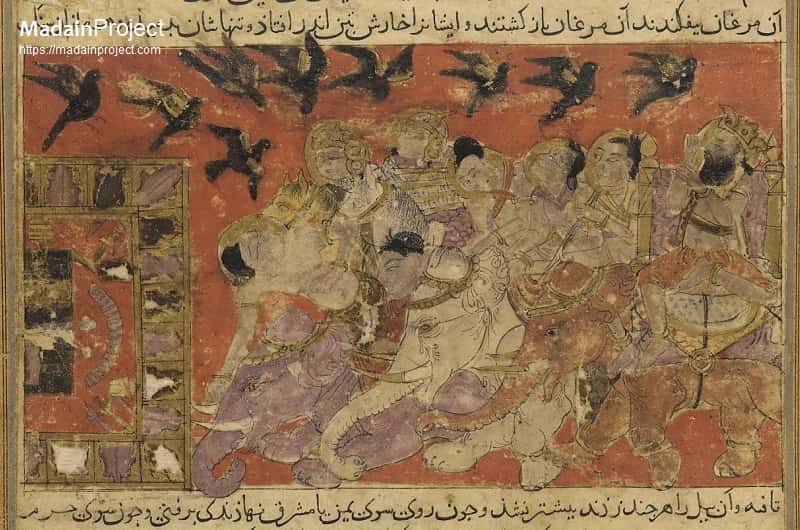
Abraha was enraged. He assembled a massive army and marched on Mecca, determined to destroy the Ka’aba once and for all. His army included war elephants — an almost incomprehensible sight to the people of Arabia, for whom such creatures were the stuff of rumor and legend.
The Quraysh, facing this overwhelming force, made the calculated decision not to fight. They retreated into the surrounding hills. But Abdul Muttalib, the young man who would one day become the grandfather and guardian of Prophet Muhammad (sa), went to negotiate. Abraha received him and offered him a favor. Abdul Muttalib’s request? Return my two hundred camels that your men have taken.
Abraha was stunned. He responded in the following paraphrased words: I have come to destroy your most sacred site — the Ka’aba, the sanctuary of your fathers — and all you ask me for is your camels? I was so impressed by your stature that had you requested me to leave, I may have accepted your request. But seeing that your ask is so small, it seems I have misjudged you.
Abdul Muttalib’s reply has echoed through history: “I am only the master of the camels. The Ka’aba has its own Master, and He will defend it.”
This powerful response demonstrates that Abdul Muttalib held a belief, a firm belief, in a higher power. He took his camels, returned to the Ka’aba, and prayed.
What happened next is recorded in one of the shortest chapters of the Qur’an — Chapter 105 — in language both stark and devastating:
“Hast thou not seen how thy Lord dealt with the people of the elephant? Did He not cause their plot to end in ruin? He sent against them hosts of birds that cast on them pieces of clay, and He made them like straw eaten up.”
In the days after Abdul Muttalib met with Abraha, Abraha’s entire army was destroyed. By what? Remarkably, by birds, by disease, by a force that no military calculation could have anticipated. The entire army was suddenly stricken with a contagious disease, obliterating his entire army. The Ka’aba stood firm, protected by its Protector—just as Abul Muttalib foretold. Mecca was spared. And fifty-three days later, in that same city, in that same year, a child was born who would change the world.
Now we return to the man and his ten sons.
His name was Abdul Muttalib — the same Abdul Muttalib who had faced down Abraha’s army with nothing but faith and two hundred camels. Years before that confrontation, he had made a desperate vow to God: help me find the ZamZam well, grant me ten sons who reach maturity in my lifetime, and I will sacrifice one of them for You.
God had fulfilled His end. The well was found. Ten sons grew to manhood. Now Abdul Muttalib had to fulfill his vow to God.
He brought all ten of his sons to the Ka’aba, along with a priest to cast lots and determine which son would be sacrificed. The lot fell on Abdullah — his youngest, and by all accounts his most beloved child.
Abdul Muttalib was devastated. But the vow was the vow. He prepared to proceed.
His daughters wept. The leading men of Mecca intervened, urging him to find another way. A compromise was proposed: draw lots between Abdullah and ten camels — the traditional blood ransom among the Quraysh. If the lot fell on the camels, Abdullah would be spared.
The lot fell on Abdullah.
They doubled it — twenty camels. Again, the lot fell on Abdullah.
They kept going. Thirty camels. Forty. Fifty. Sixty. Seventy. Eighty. Ninety. Each time, the arrow of fate landed on Abdullah. Each time, the number of camels grew. And each time, a father’s heart broke a little further.
At one hundred camels, the lot finally fell on the camels. Abdullah was free.
From that day forward, one hundred camels became the established ransom for human blood among the Quraysh. The restitution for a wrongful killing. And Abdullah — the boy who had nearly died ten times over by the casting of lots — grew up, and became the father of Muhammad (sa).
The Prophet was not born by accident. His very existence was the product of a near-miracle, a vow, a prayer, and a father’s stubborn love.
Islam teaches that the coming of Muhammad (sa) was not a surprise to history. It was foretold — in the Torah, in the Gospels, and in the scriptures of other faith traditions around the world. This is not a claim made lightly, and it is worth at least briefly examining the evidence directly.
In the Book of Deuteronomy, Moses addresses his people with these words: “The Lord thy God will raise unto thee a Prophet from the midst of thee, of thy brethren, like unto me, unto him ye shall hearken.” (Deuteronomy 18:15)
And God speaks directly to Moses: “I will raise them up a Prophet from among their brethren, like unto thee, and will put my words in his mouth and he shall speak unto them all that I shall command him. And it shall come to pass that whosoever will not hearken unto my words which he shall speak in my name, I will require it of him.” (Deuteronomy 18:18-19)
The phrase “from among their brethren” is significant. Moses was speaking to the Children of Israel — the descendants of Isaac. Their brethren, in the most natural reading of the text, were the descendants of Ishmael. Muslims believe this prophecy points unmistakably to a prophet who would arise from the Ishmaelite line — from Arabia — and that this prophet was Muhammad (sa).
The parallels the text draws are striking. Like Moses, Muhammad (sa) received revelation directly from God. Like Moses, he led his people out of oppression. Like Moses, he was a lawgiver, a statesman, a military leader, and a spiritual guide. Like Moses, his words were not his own — they were placed in his mouth by divine command. The Qur’an itself describes the revelation received by Muhammad (sa) in almost identical terms: “He does not speak of his own desire. It is nothing but revelation revealed.” (53:3-4)
The prayer of Abraham at the Ka’aba. The survival of Abdullah. The prophecies of Moses. Each one a thread. Each one pointing in the same direction.
A messenger was coming. One born of this land, this lineage, this extraordinary chain of events stretching back to the very beginning of human history.
In the next chapter, we step fully into the world that received him — pre-Islamic Arabia, with all its beauty and brutality — to understand the world that Muhammad (sa) was born into, and the world he would spend his life transforming.
The birth is almost upon us.
Next: Chapter 5 — Pre-Islamic Arabia: The World That Awaited a Prophet
If you found this valuable, please share it with someone who might benefit. And if you’re new here, start from Chapter 1 and follow the full journey at Islam Today on Substack.
Comments
Nothing yet. Say the first thing.
Sign in to join the conversation.