
Welcome to “Islam Today,” a Substack series by human rights lawyer, author, and podcaster Qasim Rashid. This series offers a detailed, evidence-based, and accessible exploration of the life of Prophet Muhammad (sa)—who he was, what he taught, and why his life and legacy matter today. If you’re joining us midway through, we warmly invite you to start from Chapter 1 and follow along. Each installment builds on the last, and the full picture is worth the journey.
A young boy was abandoned as a child.
His mother placed him in a basket and sent him down a river — a desperate act of love from a woman with no good options. She hoped that the current might carry her son somewhere safer than where she stood. He was barely new to the world, and already the odds were entirely against him.
He survived. He was found, adopted into wealth, and raised in the lavish courts of a king. But his life of privilege collapsed the day he killed a man. He fled. He wandered. And then, in the wilderness, God found him — or perhaps more accurately, God called him back.
He returned to face the most powerful ruler of his age, carrying nothing but a staff and a command: Let my people go.
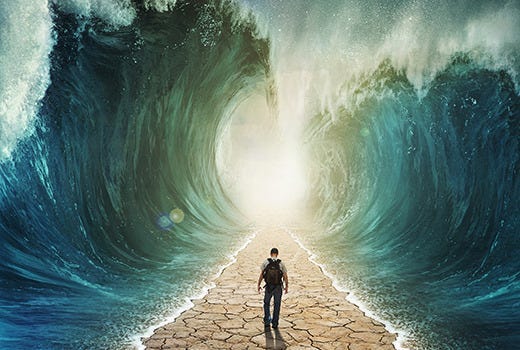
Plague, pestilence, and famine followed. Warning after warning fell upon the land. The king resisted. The king relented. And finally, Moses and his people fled — only to find themselves cornered at the edge of the sea, the king’s army thundering behind them, the water stretching endlessly before them. There was nowhere to run. No plan. No exit. Only the roar of approaching soldiers and the sound of waves.
What happened next?
We’ll come back to that in a moment.
Before we return to the sea, we need to ask a question that sits at the heart of this chapter — and at the heart of much religious skepticism in the modern world: what exactly is a miracle?
The popular assumption is that a miracle is a moment when God breaks His own laws of nature — when physics is suspended, when the impossible becomes possible through divine intervention. But Islam offers a more sophisticated and, frankly, more satisfying answer than that.
The late Mirza Tahir Ahmad, the fourth Khalifa of the Ahmadiyya Muslim Community, addressed this directly. A miracle, he explained, does not mean that God creates a law and then violates it. Think about how any rational lawmaker operates: if you know that extraordinary situations will arise that ordinary laws cannot address, you build exceptions and higher-order provisions into the legal code from the beginning. You don’t break your own law — you apply a higher tier of it.
God, Islam teaches, did exactly this when He created the universe. The laws of nature that we observe and measure are real — but they are not the only laws. There are higher-order laws, less visible and less understood, that can supersede the ones we know. What appears to be a miracle is, in reality, the operation of one of these superior laws overriding a more familiar one.
Consider a simple example: magnetism. A thousand years ago, most people understood gravity — objects fall downward. Full stop. If someone had then created a powerful magnetic field that lifted a metal object into the air, defying gravity, an observer of that era might have called it a miracle, a violation of natural law. But no law was broken. A stronger law — magnetism — simply overrode a weaker one in that moment.
This is the Islamic framework for understanding miracles. The laws of nature are real and inviolable. But they exist in a hierarchy, and what we call miracles are moments when a higher law, one perhaps still unknown to human science, asserts itself with extraordinary precision, at exactly the right moment, in exactly the right circumstances.
And here is perhaps the most important point: miracles are not magic tricks performed to convince skeptics. They never have, and they never will be. Throughout prophetic history, the people who rejected a prophet continued to reject him regardless of the signs they witnessed. Pharaoh watched plague after plague fall upon Egypt and remained unmoved. The miracles were never for him. They were for the believers—moments of divine confirmation that strengthened the faith of those who had already chosen, based on the prophet’s character and righteousness, to believe.
Now we return to the sea.
Moses lowered his staff to the water. And the waters parted.
He and his people crossed through what had been open water, reaching the other side in safety. When Pharaoh’s army pursued them into that same corridor, the waters returned — rapidly and catastrophically — and the army was lost.
How do we understand this through the lens of reason that Islam insists we apply?
The most compelling scientific explanation involves the phenomenon of tidal patterns. Dr. Bruce Parker, former chief scientist of the National Oceanic and Atmospheric Administration’s National Ocean Service, has argued that Moses and the Jewish people most likely crossed during a period of extraordinarily low tide — a natural phenomenon, but one timed with what can only be described as miraculous precision. The subsequent rapid return of the waters is equally supported by natural observation. In Morecambe Bay in Scotland, for instance, locals report that incoming tides can arrive so fast they would overtake and submerge a galloping horse.
No law of nature was broken. But the timing — the perfect, life-saving, army-drowning timing — was nothing short of extraordinary. That is the miracle. Not the suspension of physics, but the hand of God working through physics with a precision no human general could have planned.
And Moses and his people — outnumbered, unarmed, cornered — were saved.
This is, in fact, the pattern Islam identifies across all of prophetic history: the weak overcoming the powerful. The small overcoming the mighty. Feed the facts into any rational calculation, and the weaker party loses every time. Yet, when the hand of God is with a prophet, the expected outcome is reversed — not because the laws of nature are broken, but because something greater is at work, operating through those laws in ways we may not yet fully understand.
In our last chapter, we left a thread unresolved — the story of Abraham being thrown into a fire by those who opposed him, and the Qur’an’s declaration that the fire was “cooled.” It is worth returning to briefly, now that we have a fuller framework for understanding miracles.
The simplest explanation is exactly what it sounds like: the fire was extinguished. Rain, wet fuel, a sudden shift in conditions — any of these could account for it. But there is also a more remarkable scientific phenomenon worth noting: under specific conditions, a “cool flame” can exist — a form of combustion that generates only minimal heat, far below what a typical fire produces. Researchers at the International Space Station have studied this phenomenon with fascination, with one research team leader noting, “We observed something that we didn’t think could exist.” Cool flames are, in the words of one science journalist, “uncommon on Earth, but they do happen.”
Uncommon, but they happen. That is, as it turns out, a reasonable working definition of a miracle. Not impossible — just extraordinary, precisely timed, and impossible to engineer through human effort alone.
We now arrive at one of the most surprising and moving aspects of Islamic theology for many non-Muslim readers: Islam’s profound reverence for Jesus Christ and his mother, Mary.
Islam does not regard Jesus as the Son of God — this is a well-known theological distinction. But what is less well-known is the extraordinary honor Islam accords to both Mary and Jesus, and the remarkable degree to which the Qur’anic account of their story aligns with — and in some ways amplifies — the Gospel narrative.
The Qur’an is, in fact, the only ancient scripture outside of the Gospels themselves that affirms the virgin birth of Jesus Christ. An entire chapter of the Qur’an is named after Mary — Surah Maryam, Chapter 19 — making her the only woman in the entire Qur’an to have a chapter named in her honor.
The account the Qur’an gives of Mary and the birth of Jesus is worth reading in full, because it is deeply human, deeply moving, and far more textured than many people expect:
“And relate the story of Mary as mentioned in the Book. When she withdrew from her people to a place to the east, and screened herself off from them, then We sent Our angel to her, and he appeared to her in the form of a perfect man. She said, ‘I seek refuge with the Gracious God from thee if indeed thou dost fear Him.’” (19:17-18)
Mary’s first instinct upon encountering the angel is fear—she invokes God for protection. This is not a passive figure. This is a woman of deep faith and fierce moral clarity.
The angel reassures her: he has come to give her a righteous son. Her response is immediate and entirely rational: “How can I have a son when no man has touched me, neither have I been unchaste?” (19:21) And the answer she receives acknowledges the strangeness of what is being asked of her, without dismissing it: “Thus it is. But says thy Lord: ‘It is easy for Me.’”
What follows is one of the most tender scenes in all of scripture. Mary, in the pains of childbirth, alone beneath a palm tree, cries out that she wishes she had died before this moment. And a voice reaches her — from beneath her, the Qur’an says — telling her: “Grieve not. Thy Lord has placed a rivulet below thee. And shake towards thyself the trunk of the palm-tree; it will cause fresh ripe dates to fall upon thee. So eat and drink, and cool thy eye.” (19:24-26)
She returns to her people carrying the child. They look at her with accusation and judgment. She says nothing — she points to the infant. And the infant speaks:
“I am a servant of Allah. He has given me the Book, and made me a Prophet; and He has made me blessed wheresoever I may be, and has enjoined upon me Prayer and almsgiving so long as I live; and He has made me dutiful toward my mother, and He has not made me haughty and unblessed. And peace was on me the day I was born, and peace there will be on me the day I shall die, and the day I shall be raised up to life again.” (19:31-34)
This is how Islam introduces Jesus. Not as a political figure. Not as a symbol of division. As a servant of God, a prophet, a man of peace — from his first breath to his last.
The theological differences between Islam and Christianity on the nature of Jesus are real, and they are significant. But the common ground is deeper than most people realize. Muslims and Christians share a reverence for Mary that is unique among the world’s major faiths. They share a belief in the miraculous birth of Jesus. They share a conviction that Jesus was among the greatest human beings who ever lived — a man of extraordinary spiritual power, moral authority, and closeness to God.
These are not small things. In an age when Muslim-Christian relations are so often defined by suspicion and conflict, these shared foundations deserve to be named, honored, and built upon.
Here, then, is where our story stands.
From Adam to Noah. From Abraham to Moses. From Moses to Jesus. A long, unbroken chain of prophets, each one building on the last, each one carrying the same essential message into a new time and a new people: there is One God, human life is sacred, and our purpose on this Earth is to serve the Creator and uplift one another.
And woven through each of these traditions — in the Torah, in the Gospels, and in the scriptures of other faiths — are references to a final prophet who would come with a final law. A messenger sent not to one people in one era, but to all of humanity, for all of time.
Islam teaches that this prophet was foretold. That the thread running from Adam through Ishmael, through the centuries of Arabian history, was always leading somewhere — to someone.
In the next chapter, we begin to examine that evidence: what the Torah and the Gospels actually say about the prophet who was coming, and why Muslims believe those prophecies point unmistakably to Muhammad (sa).
The story is drawing closer to its center. The world is about to change forever.
Next: Chapter 4 — Muhammad (sa) in the Bible: The Prophecies That Point to a Final Law Bearing Prophet
If you found this valuable, please share it with someone who might benefit. And if you’re new here, start from Chapter 1 and follow the full journey at Islam Today on Substack.
Comments
Nothing yet. Say the first thing.
Sign in to join the conversation.