
ROUGH DRAFTS REMINDER
A reminder that I am about to embark upon a cross-country odyssey with my friend Maurice to work on our podcast Rough Drafts. We leave in the next couple of days. We were funded by the People’s Media Fund in the Greater Philadelphia area to interview writers, artists, academics, filmmakers and organizers across the North American continent. Our podcast is broadly about artistic/creative processes, American subjectivity, masculinity, and social movements. We read a lot of books for each episode so readers are encouraged as guests. Check us out everywhere you can stream podcasts like Spotify or Apple Podcasts. We’ll be broadly in the West Coast, the South and the Midwest. We will also be continuing to traverse the East Coast after the fact. If you’d like to be a guest on our podcast or host us, please message me on here or email us at rough.rough.drafts@gmail.com.
I finally published my only political essay under my legal name at the Forge. First of all, I can’t thank Akin enough for his editorial advice. We went through many drafts. I did want to write a bit of a follow-up about the essay to clarify some of the ideas for myself and people on here. If you haven’t read it, here’s the link! You can also read this essay and get the gist, but that article is far better. This will likely be my last post for a month or so as I’ll be on the road doing interviews for my podcast Rough Drafts. I cannot wait.
On this Substack, I write about literature, music, movies, comic books and art. I do write about politics in the sense that everything is political, much to the chagrin of the “apolitical” lit-bros, but I don’t advocate for specific ideologies or tactics unlike many of my contemporaries. If I do advocate for something, it’s probably a healthy skepticism of everything. For those of you who know me outside of this platform, I would be eager to share my politics with you. But I am uninterested in re-litigating left-wing debates online unless it’s in the form of satirical short stories. I regularly encounter leftist influencers on this platform or others who regularly advocate for whatever brand of socialism, communism or anarchism they enjoy. They condemn or endorse shoplifting, voting, marching or whatever other tactic is popular to talk about that day. I am not interested in doing that. I’ll criticize and laud literature forever, but once politics it enters with real world stakes, I am uninterested in the online discourse. The only other time I’ll comment politically is to correct incredibly inaccurate reads of Black history, which remain quite common in an increasingly illiterate moment despite our perceived “information age.” But I’m trying to move away from even engaging in that type of discourse. If you see me doing discourse stuff, comment and tell me to stop!
Awhile ago, I adopted a Luddite perspective for political reasons more than anything else. While not staring at a screen all day adds benefits to my life in numerous other ways, my main criticism related to how phones and social media have destroyed social movement capacity and knowledge. They also inhibit human freedom, but that’s another conversation. That’s why when people will ask me what I think needs to happen, write critiques political figures like Zohran or Hasan, or whatever else, I exit out of the conversation. Again, those are all things I am happy to talk about in real life, but not over the Internet, especially with strangers. Otherwise, my engagement with politics online tends to be unserious, sardonic and absurd.
The tech-critical position is probably one of the most unpopular ones on the Left and society as a whole. It puts you at odds with almost every type of person, regardless of their chosen ideology. My article in the Forge was rejected initially by an editor when it was pitched, likely because of the arguments it made. I lost over ten followers on Instagram the day I posted it. There’s a reason for this. The Left and progressive social movements over the past twenty or so years has sustained themselves increasingly on these platforms. Sometimes, they adopted the platforms first. In some odd ways, they may even see their own destinies tied up with the destinies of our tech-overlords. Perhaps that’s why our moment feels hopeless as the curtain has been pulled back on the insidiousness of tech. But social media and modern social movements have always been joined to some degree at the hip. For example, in 2015, Twitter CEO Jack Dorsey wore a shirt that said “Stay Woke” while talking with Black Lives Matter associated Twitter activist Deray McKesson. It couldn’t be a better representation of our problems now. The situation has only gotten worse.
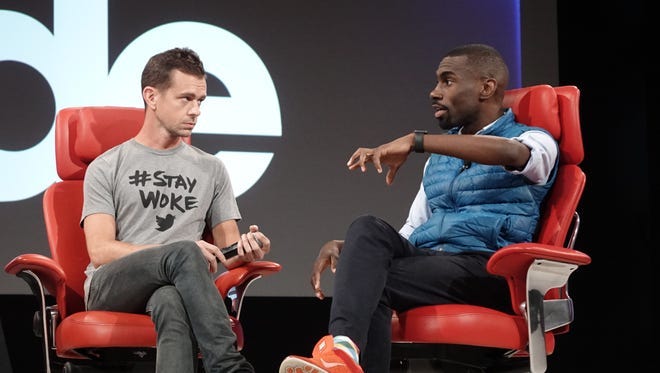
Twitter marketed itself as an ally to social movements against oppression like the Arab Spring and BLM. People understood these social movements as products of these technologies, rather than understanding them as the product of long-standing historical struggles against oppression. Leftist influencers abound everywhere now, you can find every flavor of politics you desire on TikTok. There are even people who build platforms critiquing people like Deray. It’s all a big circle. Until the Left and social movements can recognize the error in understanding VC-funded companies as allies, they will struggle in a variety of ways. I had to realize this conclusion for myself which prompted my separation from these platforms in terms of serious political engagement. I had a couple of comrades who were already off social media that helped encourage my move to a flip-phone.
People develop weird para-social relationships over the Internet. I’ve had people from other continents write “political critiques” of me because they didn’t like a thing I said about a movie. These online para-social relationships for many people are stand-ins for their lack of intellectual relationships in the real world as we live in increasingly atomized times. While I do not think spamming “talk to your neighbors” is always the best idea as some of our neighbors can be people with idiotic or dangerous ideas about the world, but talking to people in real life is always a better option. The sad fact is that most people who encounter leftist ideas now find and exclusively engage with those ideas online. The result is that unless the Left leaves behind the screens, many of them will have little to no commitments politically in their daily lives beyond said screen. I do wonder if the political hot takes mean anything if you don’t do act in any way outside of talking about the latest viral drama. As I’ve written before, my favorite parts about Substack and all social media are when I leave the digital space to meet people outside of the blue screen. I’ve interviewed a bunch of people from Substack and it’s been wonderful. I’d never trade that for more online interactions.
For my article with the Forge, my homie Sarah Thankam Mathews recommended I read a book called Twitter and Tear Gas by Zeynep Tufekci. The book details how social media interacted with protest movements of the early 2010s. She mostly focuses upon stuff like the Arab Spring, but it’s quite applicable to movements like BLM or Occupy. I do a better job talking about her book in the article. In many ways, social media was understood for a long time as a good thing for social movements. It is less clear that this is a consensus now, though I think my position remains radical. While the book isn’t entirely anti-social media, it makes a strong case, at least to me, for why we should treat these technologies with more suspicion. Don’t take my word for it, though, go read it. It’s available online. Anyway, a lot of this has to do with how the leftist influencer (like Deray), buzzy Tweets/Notes and the IG infographic has become the main vector of intellectualism amongst the left. I am not immune to this, another reason I argue strongly against developing your politics online. I will admit that the online nature of politics caused problems in real life organizing spaces I was apart of when I was in my teens and early twenties, so to be real, I’ve always had an aversion to the surveilled nature of the Internet. People will often ask me what I think on this website and I remain intentionally evasive. Am I truly a communist? Am I a socialist? Am I an anarchist? A Black nationalist? Who knows? It doesn’t really matter for my writing about how art and literature makes me feel and it’s historical context. I also have no desire to market my writing based on some niche ideology. Building a platform on the Internet is a different thing than building a political movement. I wrote about this in my piece on the Forge,
“...as the Leftist influencer is focused upon building their individual brand on a platform rather than a collective movement. While building a personal brand is not inherently wrong, as there are many good writers on social networks, the logics of building a brand and building a movement are different. Increasingly over the past fifteen years, Left-leaning influencers now substitute for organizations with political education and strategy in decisive moments. And visibility substitutes for organizing infrastructure and the development of practical skills.”
We all gotta make money, using social media is a way to do that, but if that exists at the detriment of a broader political culture for leftists/progressives/whatever, I think it should questioned. Unfortunately, the nature of all social media platforms even Substack enables people to think less critically. Sitting down and reading W.E.B. DuBois’ Black Reconstruction by yourself or with friends is not the same as reading my note about it even if I am incredibly smart. Individual brands also suck in my opinion for intellectual culture, generally. I believe that political institutions like The Forge or literary institutions like The Metropolitan Review better serve to develop collective political understandings and literary styles, respectively. The individualized political culture of platforms like Substack reduce critical thinking skills, in lieu of real cultures of intellectual debate that are not incentivized by takedowns that fuel the algorithmic money.
One of my favorite novels is American Gods by Neil Gaiman. I’ve reread the book many times in my life. To be clear, Gaiman is a bad person who used his fame and wealth to abuse women, which has left an indelible stain on his work for me. That’s also another essay. Either way, in American Gods, there is a “New God” called Media who talks about how people sacrifice their time to the television. But now the television itself is portable and never-ending. The smartphone and social media should be understood in similar terms to television. The Left, despite it’s supposed critiques of Silicon Valley, still worships at the feet of the tech gods with our ever increasing sacrifices of time and attention. The dire reality is that the tech industry increasingly shapes every part of human life. Nothing is free from it. It dictates our relationships through dating apps, our engagement with the economy, our transportation, our livelihood and almost everything else. Perhaps our it should not dictate how we think through our struggles for human freedom?
I do love writing and sharing my ideas about how literature, art, music and other such things make me feel. I dunno if I’ll always need Substack or the Internet to do that, hopefully one day I won’t. Sometimes those feelings I mentioned relate to my political views, undoubtedly. Despite this, I much happier to live my life similar to the bohemian characters in the novels I enjoy. There is nothing romantic about arguing about politics online with strangers. However, many of my best moments in life were spent arguing with close comrades at parks, bars, restaurants, beaches, cookouts, house parties, porch hangs, and other such things. I cherish those memories. I don’t cherish anything about these screens.
No posts
Comments
Nothing yet. Say the first thing.
Sign in to join the conversation.