
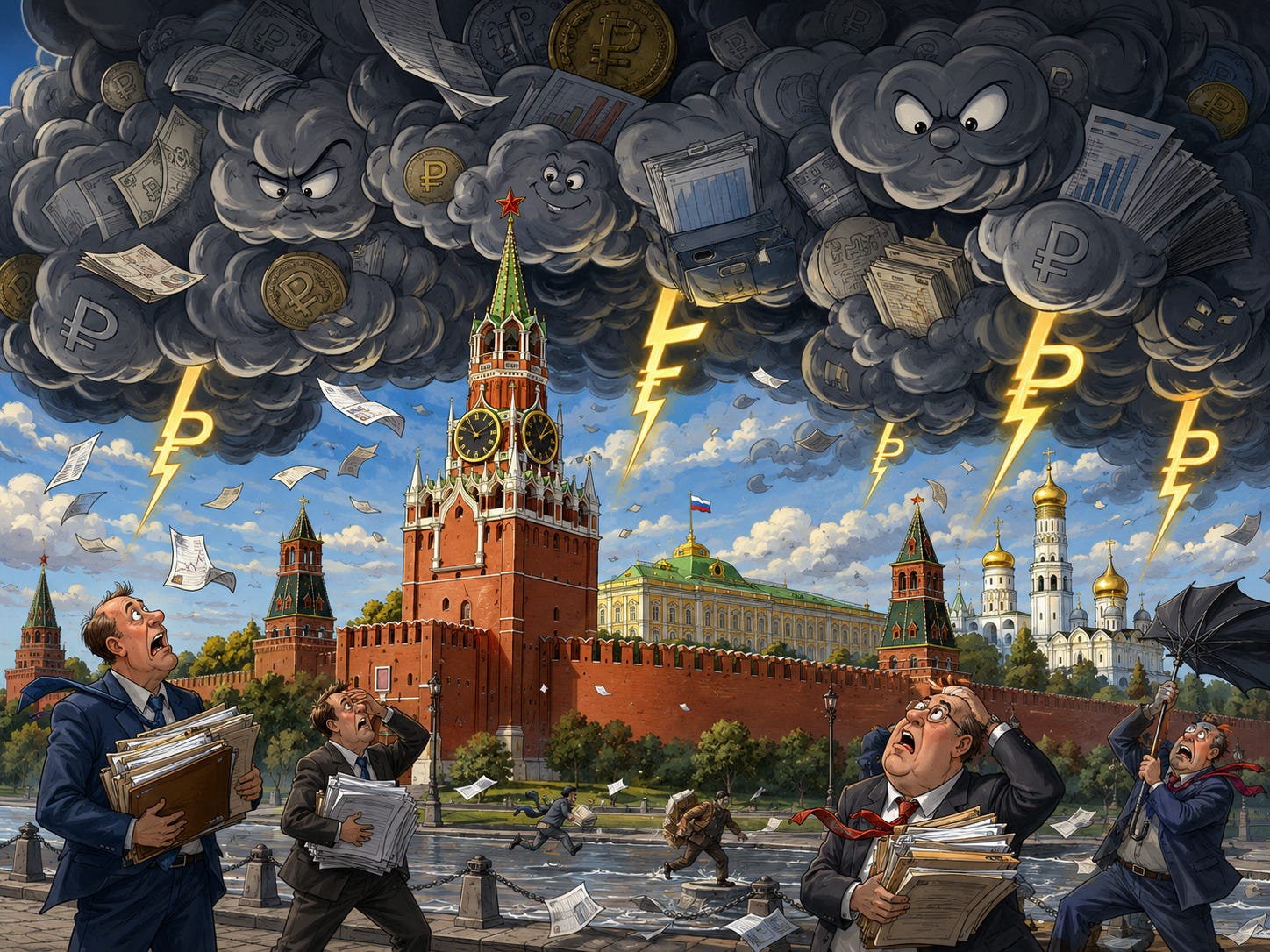
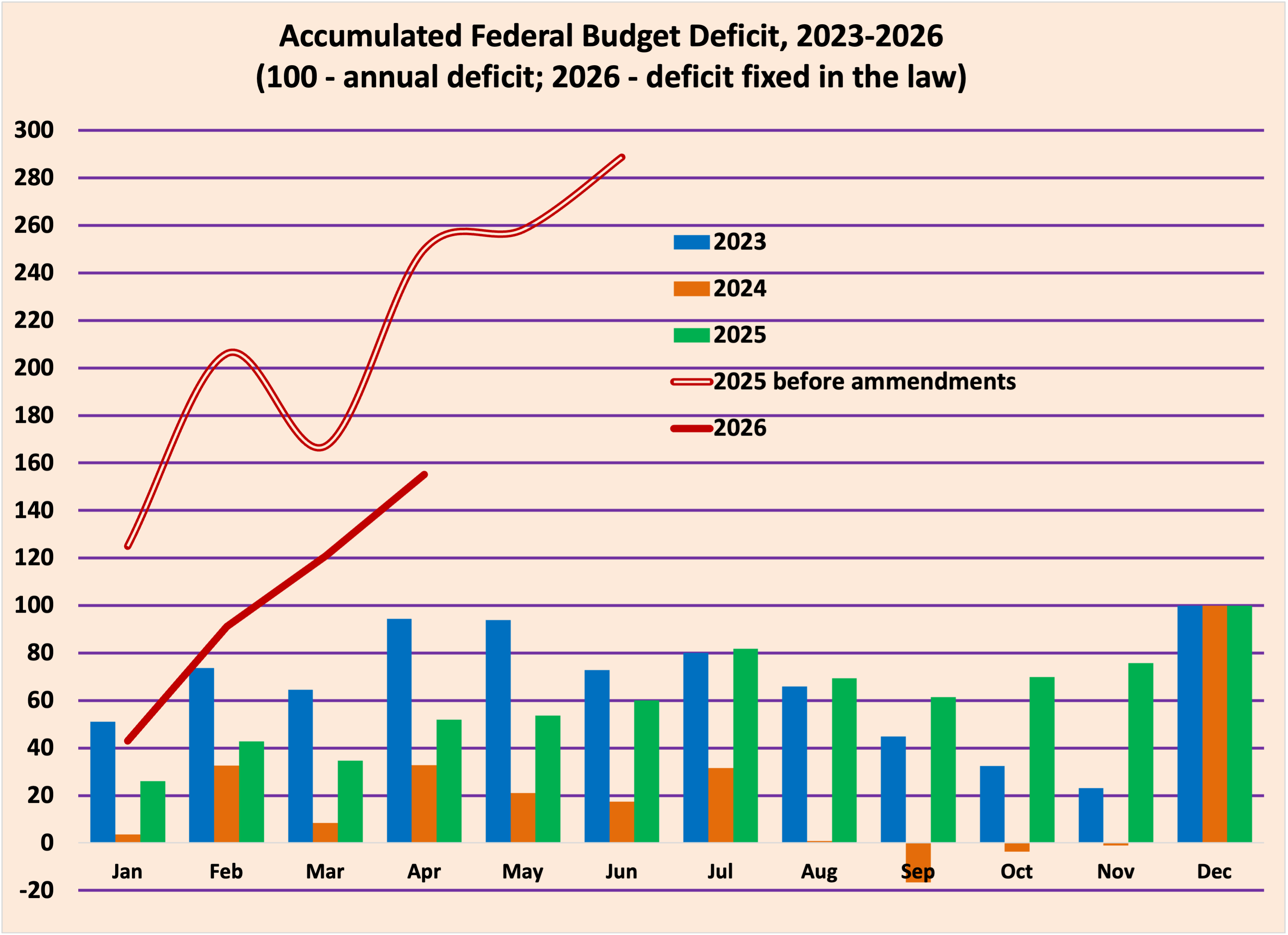
The Ministry of Finance’s assessment of federal budget execution over the first four months paints an even bleaker picture than it did a month ago: the year-to-date deficit has now reached nearly 5.9 trillion rubles, which is 60 percent higher than its annual level set by law. The numbers look alarming—but they do not mean the Kremlin’s financial machine has finally stalled.
1. A budget deficit itself does not mean that the Ministry of Finance has no money. It merely indicates that the government finances its expenditures not through collected revenues, but by some other means (borrowing, use of reserves, privatization). Conditions are favorable for the Ministry of Finance—the Bank of Russia’s steady reduction of the key rate is boosting demand for government debt, for which, prior to the latest rate cut in April, the Ministry of Finance was prepared to pay between 14.5% and 15% per annum. Over four months, the treasury received 1.7 trillion rubles net from the placement of OFZs, accounting for 45% of the annual deficit. The fact that debt service will consume an increasing portion of the budget does not seem to concern the Minister of Finance today.
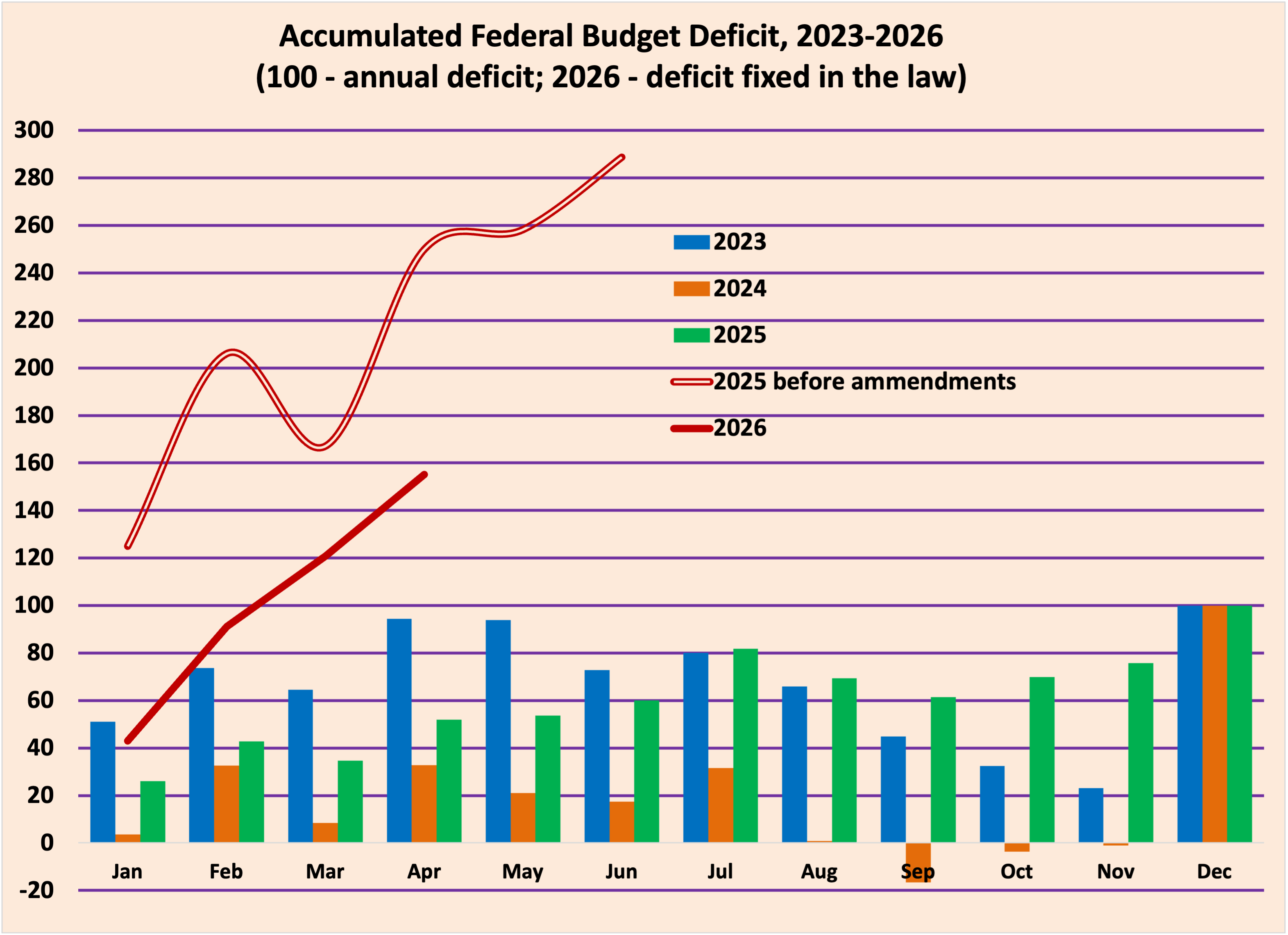
2. Revenue collection is running 3–4 percentage points behind the pace of recent years; in four months, the Ministry of Finance managed to collect 29 percent of the annual target (in the previous two years, this figure was 32–33 percent). However, on the one hand, starting in the second quarter, the increased VAT and income tax rates will take full effect; on the other hand, for at least the next two months (May–June), the treasury will receive a “war premium,” (additional oil-related revenues due to the higher oil prices) which will make the tax collection picture look more respectable.
Something similar happened in 2023, when, after four months, the treasury had received less than 27 percent of annual revenue, but starting in August, budget revenues rose sharply as the dollar exchange rate moved above the 100-ruble mark. Some analysts focus on the year-on-year decline in oil and gas revenues, but this comparison obscures more than it reveals—it does nothing to help analyze this year’s budget. Moreover, this decline is easily explained: the average tax price of oil in the first four months of last year was nearly $63, compared to $50 this year; the average dollar exchange rate at the beginning of last year was 90 rubles, this year it is 78 rubles. The compounding effect of these two shifts—oil prices down roughly 20% and the ruble stronger by about 13%—implies a 30%-plus decline in ruble-denominated oil revenue, which is more or less exactly what we see in the data.
3. If by the end of the year the Ministry of Finance is able to collect the full amount of oil and gas revenues planned for the year (I discussed the likelihood of such a scenario a couple of days ago), then to meet the annual revenue target in the remaining eight months of the year, the treasury will need to generate non-oil and gas revenues averaging 2.75 trillion rubles per month, which is 17% higher than the level at the start of the year. In the previous two years, this growth rate was 15% and 13%. On the one hand, raising tax rates will undoubtedly help the budget; on the other hand, falling inflation and the recession will work against this.
4. The real challenge lies on the expenditure side. Over the past four months, the Ministry of Finance has funded nearly 40% of the annual plan (in 2023–2025, this ranged from 31.9% to 35.4%); on average, this has amounted to 4.4 trillion rubles per month. If the annual budget is not exceeded on the expenditure side, monthly spending for the remainder of the year should amount to 3.3 trillion, i.e., a quarter less; if we take into account the “December bonus”, the traditional end-of-year spending surge (typically 50% above the monthly average), then spending in the coming months should not exceed 70% of the average spending level for January–February. Ambitious.
MY CONCLUSIONS (every reader is free to draw their own or use a third party’s guidance):
· if we take the execution of this year’s budget in accordance with the adopted law as a baseline, the situation appears extremely dire after four months. Moreover, the situation will not improve in the time remaining until the end of the year;
· the Ministry of Finance’s main problems do not lie in the budget deficit—the potential for borrowing on the domestic market is far from exhausted, but the 11 trillion rubles in fiscal reserves available as of early May (3.6 trillion in the liquid part of the National Welfare Fund and 7.4 trillion in bank deposits) will not leave the Kremlin without funds, at least until the end of next year;
· the economy’s shift into recession in the first quarter makes sequestration politically unlikely—while governments can and do cut spending during downturns, the Kremlin has every incentive to avoid austerity that would accelerate the decline, especially when reserves and borrowing capacity remain available. (As a side note, it appears that the higher level of budget spending made the decline in the first quarter less severe);
· the likelihood of the opposite scenario—a budget revision to increase spending—has risen sharply. The underlying logic is straightforward: the Kremlin’s fiscal hierarchy prioritizes sustaining the war effort and domestic political stability over deficit discipline. So long as the tools to finance a wider deficit remain available, there is little reason to expect the Ministry of Finance to choose austerity over expansion.
No posts
Comments
Nothing yet. Say the first thing.
Sign in to join the conversation.