
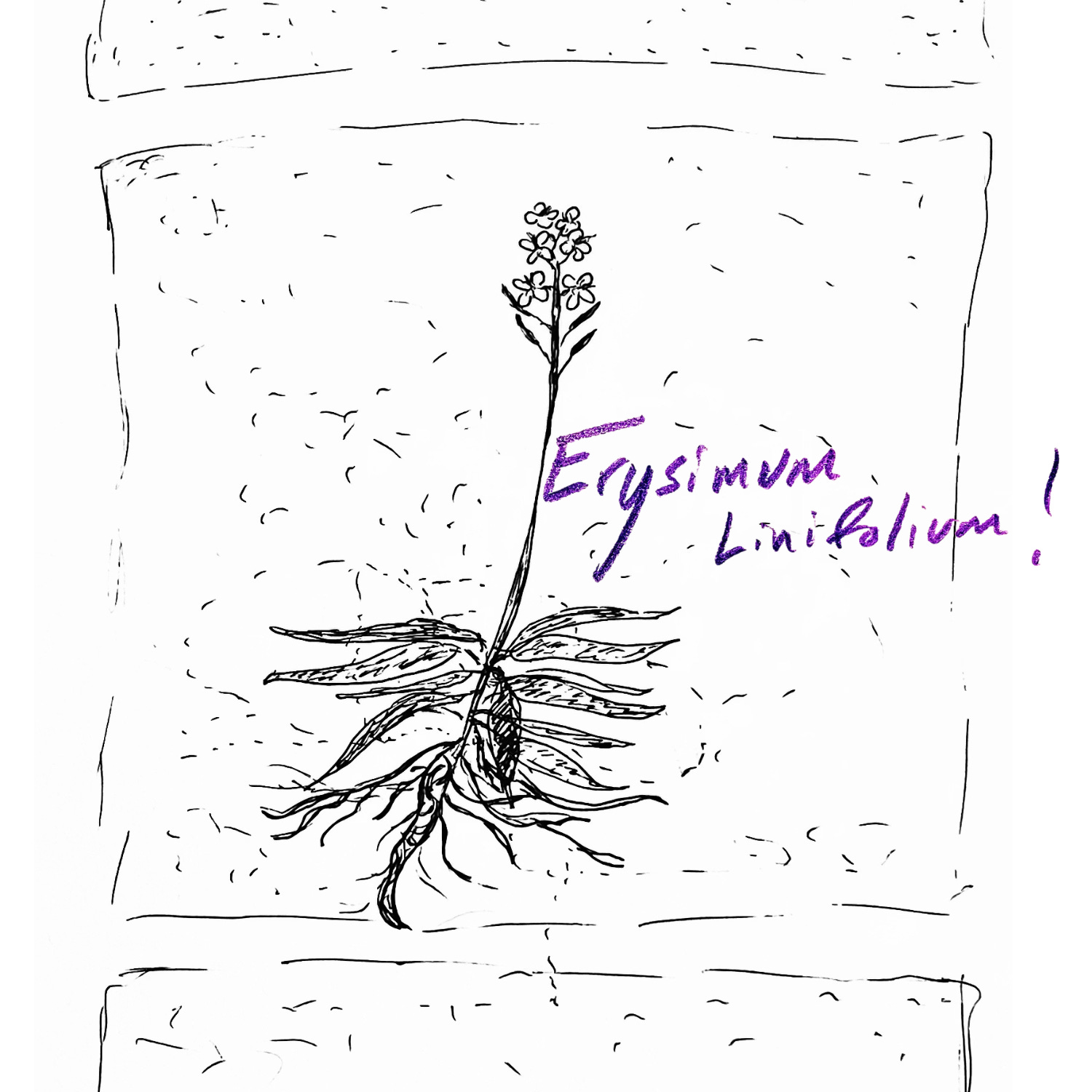
ALSO KNOWN AS: Wallflower, Alpine wallflower (even though it’s not really from the alps), the bred version is bowles mauve
0:00
-11:08
Standing by the side, a wallflower is not nominative, but a form of being with the world. I imagine a wallflower is illustrious despite being completely unwilling to participate in whatever is going on, more like bold wallpaper at the dance.
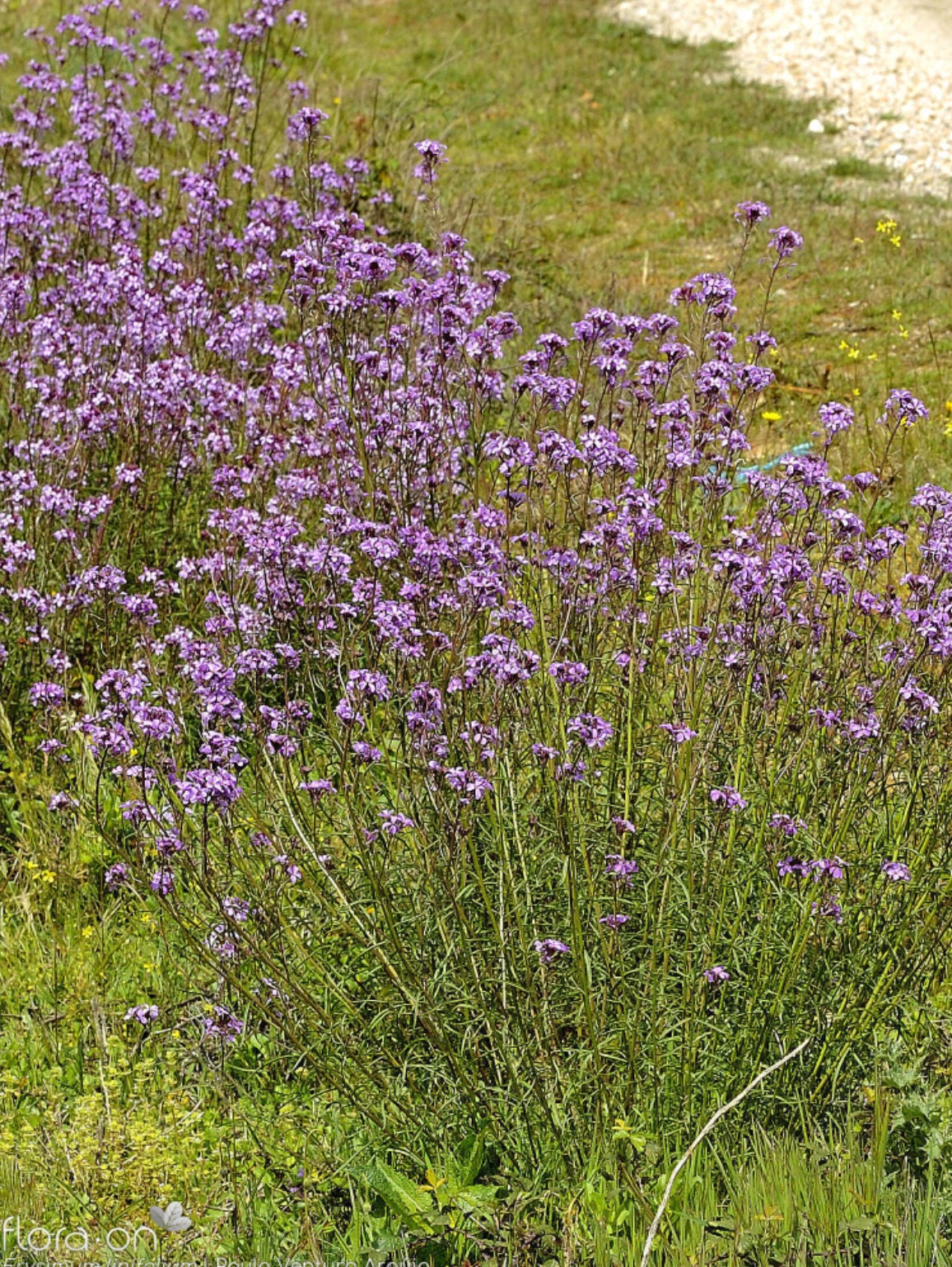
But wallflowers are also real plants. No wonder English gardeners love it. It has a nearly weedy look, a loose and wide look, stemmy with big petals that are either yellow or purple and their smell is sweet. Gardeners cut them back in midsummer because they grow so quickly. They act and look like weeds because they are very nearly are. They are related to some of the weediest of the bunch: the Brassicas. But wallflowers themselves are conservative, tending to their own growth, an individual stem turning up over and over again.
Erysimum linifolium, or the Alpine wallflower, is not aggressive. They don’t overtake their native Spain’s mountains. They hopscotch over the peaks of the Sierra de Gredos and the Northern Cantabrian range. Mountains require plant species to adapt to specific regions, so on a particular massif there may be several species of plant that have adapted to different sides of a mountain.
There in the smallest cracks, in crevices of relief, the wallflower takes root. This place is that of the ancient Basque people who continue to work the land through the traditional caserío of passing down the land through generations. Where wallflowers grow on the mountains, likely the Basque language is still spoken, and nowhere else. Northern Spain is known for the dropping cliffs at the foot of the Bay of Biscay, a body of water separating England from Spain and maintaining the Basque people who, despite all odds, maintain their culture and language while being central in Europe where the massive elimination of indigenous culture worldwide was directed from. Like the plant itself, the culture stands apart, the language is not related to any other language families in the world.
In matting nets of roots, clusters of wallflowers have learned to survive in places by the coast where salt hides in the air and soil. Wallflowers have starlike trichomes that help manage water in extremely dry conditions. There on the mountains, they must be prepared to adapt to a changeable climate. The stems grow long and stringy, even woody at the base and about three feet tall. This plant is related to a whole family of prolific weeds, which are, of course, not really weeds. They are Brassicas and you know them because they are cauliflower and brussels sprouts. The wallflower, like its family members, has terminal clusters of flowers on the raceme that bloom where there is sun in the spring and the fall, bordering the hottest months of the year. Wallflowers are usually purple, or yellow. For the Alpine, they’re generally four purple rounded petals set in an X shape all lined with veins and more delicate than a butterfly wing, but they can be bred for other colors, coral or nectarine, for example. And the leaves are thin and lanceolate. Linofolium means their leaves look like flax leaves, long and dark green. To name a plant after how another plant looks feels deeply uncreative, and possibly cruel, but the name for Erysimum linofolium is known best by the people who live near it.
As it is with Brassica species, the seeds are tucked into a thin silique that looks like it’s been chopped at the elbow. They look like the stems themselves. These seeds have a high concentration of oil. I mean, seeds from the Brassica family are used to make mustard and canola oil.
From traditional Chinese practitioners to Dioscordes, some wallflowers are used to treat, among other ailments, heart disease and bronchitis. However, the cardiac glycosides that protect Erysimum linofolium from nearly all browsing insects make alpine wallflower poisonous. No other Brassica species has this strong a poison. And they have wasabi and mustard. The terribly poisonous foxglove has the same glycosides, which can stop the heart, but in specific and delicate application, these glycosides can start a heart as well.
Still, wallflowers are named after their special ability: superman, wonder woman, flash. Wallflower. They grow out of the mortar of walls. They enjoy working through the labyrinth of rocky soils. So, finding all those flaws in the earnestly built structure they wear it down. A wallflower is not one who is the wall. They use it, they make it alive, they make it be able to see. They make it live, they make it weak.
Botanists disagree whether there are 150 wallflowers or 350. While they look like many mustards, they are adapted to the mountains. In the way of the self conscious wall clingers, these plants aren’t comfortable everywhere. Many wallflowers are specific to hyper localized places and as a result, they are endangered to many of their native homes. Alpine wallflower endangered, despite being bred as a garden variety. Its native range is changing, and as a mountain plant, it can’t travel much higher than it already has gone.
Telling the difference between wallflowers, that’s the art. Many wallflowers are cryptic species, meaning that there is little distinction between species and subtle shifts from one side of the mountain to the other - say. The cryptic species hide in one another as phylogeneticist, E.O. Wiley elucidated. “Cryptic species are species that cannot be diagnosed by morphology, but that act as independent evolutionary lineages in nature.” Wiley goes on to theorize that if species have characteristics that can be changed, then they must be seen as individuals and statements about such plants would be mere historical statements. For cryptic species in particular, they may only differ in their enzyme makeup, or their RNA.
Erysimum linifolium is biennial. The first year they have a thin rosette at the base of the soil and that second year they’ll burst with flowers. As it is with wild plants, they don’t really play by hard and fast rules. Some wallflower taproots may live to bloom again for a summer or two. But not long after that.
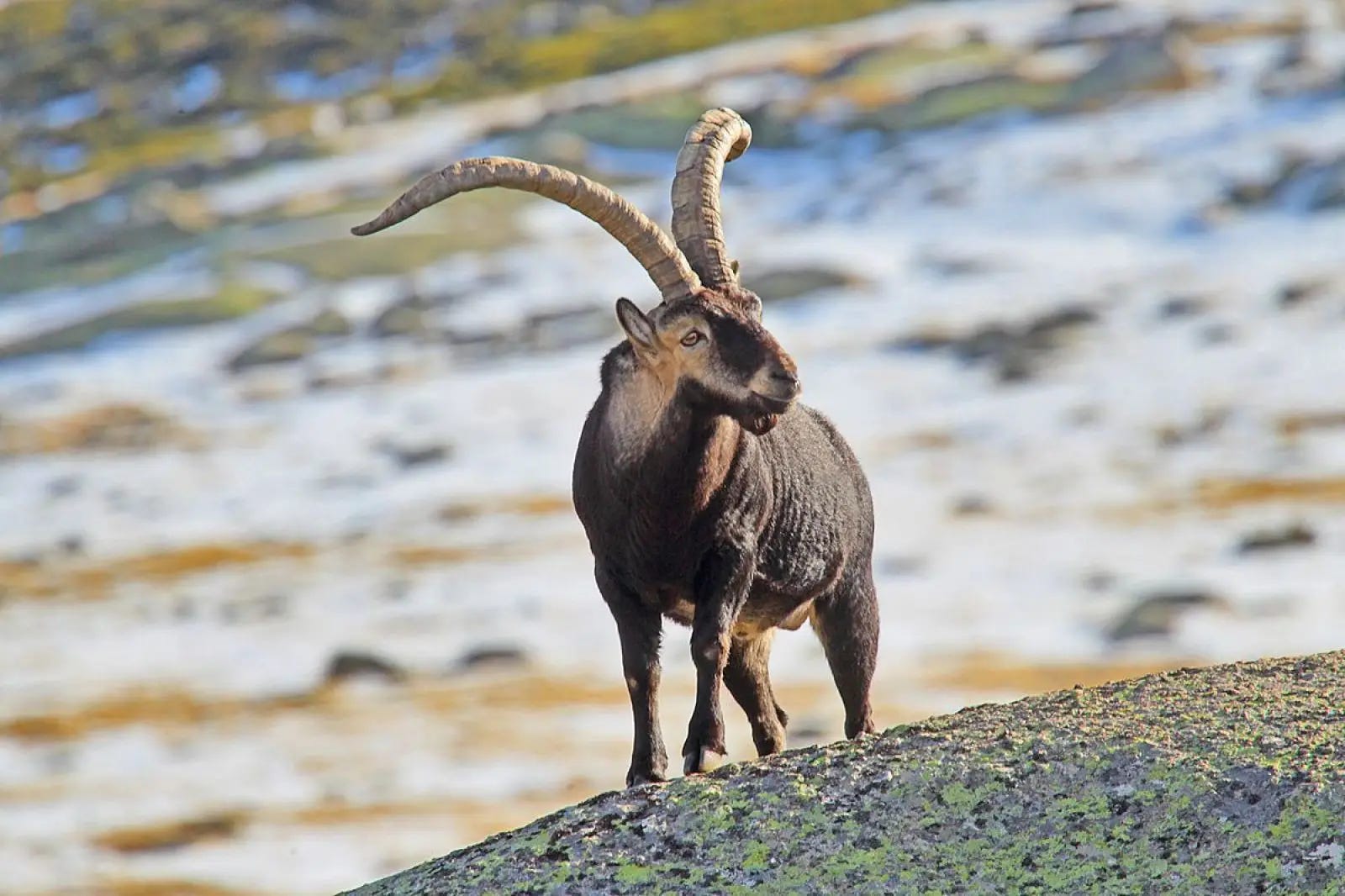
Spread over the dry mountains, this wallflower’s ethnobotanical uses are likely widespread locally, but not known universally. We know that Spanish ibex feed on wallflowers. Wallflower is a larval host to the garden carpet, a feathery butterfly with haphazard black or grey marks. And they’re pollinated by carpenter bees, the cuckoo bee, the Iberian honey bee, and butterflies alike.
There is a practice in Basque Country called Bertsolaritza, a form of improvisational song delivered like a game. The rules are fast: the rhyme and rhythm agreed upon. The only difference is the story, the emotion. Those changes. In a world of bricks another one baked, molded to conform, the immensity of sameness can appear impenetrable. It takes bravery to play between the rules, to find the cracks, to get close enough, to ask the right questions to be able to see the differences. But looking close is a valuable practice, this kind of closeness makes even the hardest object open, receptive, broken maybe. Understanding the unlimited differences that all things possess one passes through the blooming wall. I have a hunch that if you really knew the wallflowers, spent time with their smell, and shared the wind with them, you might feel one from another. When we are intimate, singing our own song, we shake the form open.
myth for wallflower
0:00
-3:23
Forager Friendly?
No! Not even if you can figure out what plant it is.
sources
https://plants.ces.ncsu.edu/plants/erysimum-linifolium/
https://www.gbif.org/species/113590882
https://easyscape.com/species/Erysimum-linifolium%28Alpine-Wallflower%29
https://www.almanac.com/plant/wallflowers
https://www.sciencedirect.com/science/article/abs/pii/S0367253016300317
https://www.sciencedirect.com/science/article/abs/pii/S0367253016300317
https://www.nature.com/nature-index/topics/l4/cryptic-species-diversity-and-taxonomy
https://link.springer.com/article/10.1186/s12870-016-0766-8
Comments
Nothing yet. Say the first thing.
Sign in to join the conversation.