
This week, in honor of Mother’s Day, I have a story about mothers, children, and generosity. And a really, really good book.
The really good book is Nicole Graev Lipson’s Mothers and Other Fictional Characters—a memoir in essays that pulled me in from the moment I read the opening paragraph of the first essay, “Kate Chopin, My Mother, and Me.” To wit:
My mother smoked before she was a mother. In a sepia Polaroid from the early seventies, she holds a cigarette between two lacquered fingertips. She wears, improbably, a catsuit, and her hair falls over her shoulders in glossy waves as she leans into my father, squeezing his cheeks and grinning. He is in trouble—oh, is he in trouble.
I mean… right? The essays are seductive and serious, lyrical and joyful, and the best kind of smart, by which I mean that they weave a deep love of literature with reflections on what fictional mothers can teach us about public and private selves, desire, attachment, gender, and friendship.
The generosity part of the story is that last year, Nicole responded within minutes to my email asking whether she would be willing to blurb Troika with an enthusiastic yes. Which, considering that I was a total stranger, is pretty darn nice. And then, after she wrote a gorgeous blurb and I decided to push my luck and ask whether she might want to be interviewed in Personal Statements, she responded with another enthusiastic yes.
Below are her responses to my emailed questions. I know it’s customary to say that answers have been edited for length and clarity but I did not change a single word and when you read them, you’ll see why.
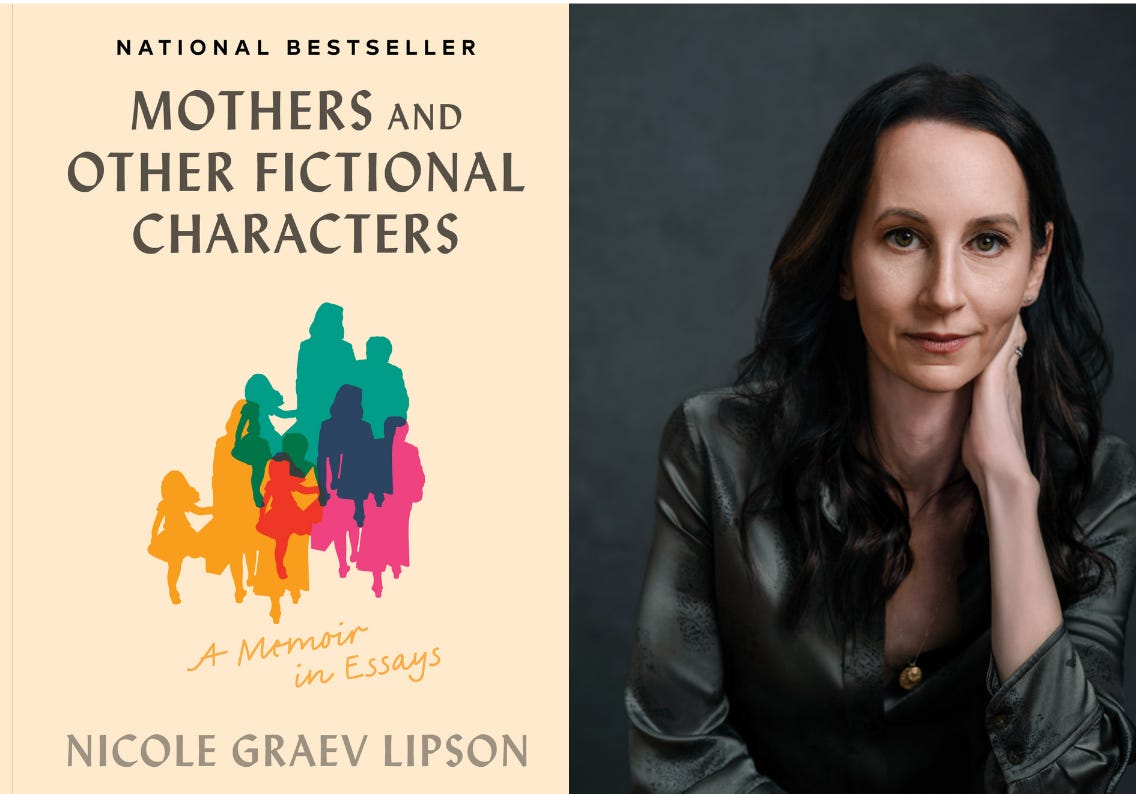
IS: What first prompted you to braid your own experiences with literary works? Did you begin with life and reach for literature, or did the literature give you a framework for writing about your life?
NGL: Nearly everything I write is sparked by a personal experience that has so confused or bewildered me that I can’t stop thinking about it. This can be something as small as a comment my four-year-old daughter once made while I was putting on makeup, or as large as trying to figure out what to do with the three frozen embryos left over from the round of IVF that created my son.
Then, because reading has been such a vital part of my life personally and professionally, it feels really natural to turn to literature to try to make sense of whatever experience I’m exploring. Maybe all bookworms and lifelong readers feel this way, but the boundary between my “reading life” and my “actual life” can feel really porous! Reading is part of living—a big part of it, for me. And so when I’m exploring a personal moment, it doesn’t feel like a big leap to pull in threads from the literary works that have influenced and shaped me.
You write candidly about feeling trapped in pregnancy and early motherhood—a time when, as you write, a woman’s value is often perceived as biological rather than cerebral. Reading about your experiences resonated deeply with my own feelings of entrapment and claustrophobia, both during pregnancy and as a new mother, but I’m curious if you ever worried how writing about those experiences might be received, especially in a culture that still resists maternal ambivalence?
NGL: Honestly, I spent so many years of early motherhood ashamed of some of the feelings my new role aroused in me that by the time I began to write about them I was basically bursting. My shame had transformed, during those years, into anger at the many ways our culture fails to support mothers while simultaneously pushing us to interpret anything but a uniform, joyous embrace of motherhood as a character flaw. I knew that writing about my experience with unvarnished honesty—even if it made me unlikeable on the page at times—was absolutely crucial to the project of his book, both personally and in terms of the story I was trying to tell.
What motivated me to sit down at my desk day after day, no matter how tired or hesitant, was my belief that writing can be a way of cracking through the easy, surface stories we tell about ourselves and others—which are so often stories we’ve been handed by our patriarchal culture. As risky as it felt to do so at times, I was determined to try to normalize some of what we’re taught, as women, is aberrant or shameful, when in reality it’s just a normal, natural part of being human.
The book refuses the familiar binary of motherhood as either self-sacrificing nurturer or selfish shrew. Why do you think that binary persists so stubbornly? And what does literature allow you to say about motherhood that ordinary cultural discourse does not?
NGL: I think that the “angel/ monster” binary of motherhood is just one symptom of our culture’s denial that women are layered, complex, and multidimensional human beings. It shouldn’t be radical in 2026 to assert that women are full human beings! But over and over women are labeled and reduced in ways that obscure our complexity. I believe that the delicate, paper-thin boundary between “angel” and “monster” is a means of keeping women in line. Most of us don’t want to be monsters, and so we effectively become our own enforcers of patriarchy’s rules, monitoring and policing ourselves so as not to fall from grace.
Because literature gives us a portal into the consciousness of others—and because the consciousness of others is always messy and shadowed and layered—it can allow us to see human beings more fully than we typically get to see them in “real” life. There is this ironic way in which fictional characters can feel even more true than actual people, which is why I turned to them again and again while writing my book. I cannot know what the perfectly put-together and smiling mom I pass in the hallway during school drop-off truly thinks and feels, what pain or grief or anger might be concealed behind her appearance. But when I read a Kate Chopin novella or a short story by Alice Munro, I can see straight into the complex minds and hearts of these authors’ mother heroines.
IS: I was particularly struck by the chapter on female friendship, which doesn’t follow a conventional narrative arc. Was that structural choice deliberate? Do you think friendship, especially between women, resists the kind of teleological storytelling we’re taught to expect? (I’m thinking especially about your distinction between platonic and erotic/romantic love and the felt need to clarify that you don’t have “that” kind of relationship with your best friend.)
NGL: Absolutely, yes. I was trying to capture how the story of my decades-long friendship with Sara doesn’t follow the traditional Western story arc, in which conflict rises to a climax and then gives way to falling action. In the years we’ve been friends, there’s been hardly any tension or conflict between us whatsoever, and I was determined to try to capture all that’s intriguing and rich and fascinating about two women friends who care for and support each other. Period. One common narrative about female friendship is that women are wired for rivalry, and that our relationships are likely to devolve into jealousy or competition. Using a nontraditional structure was one way I tried to challenge this tired stereotype.
I was excited to examine what makes my platonic love for Sara feel so very different from my love for my husband, or for my children. My husband and I chose to commit to each other, and we love each other deeply. But I’m not sure the love between two married people can ever fully wrest itself free from its contractual origins—there’s a sort of constant underlying awareness that one must pull their weight and hold up their end of the bargain, and therefore a constant desire not to fall short. And while I love my children with every inch of my being and have spent hours of my life wishing I could literally ingest them, parental love always carries the weight of duty.
Female friendship, in contrast, is a completely voluntary dance between two humans bound by nothing at all but their mutual desire to be there for one another in life. There are ways in which it’s a freer and purer form of love.
IS: You write about moments of anger, exasperation, boredom, and the desire for autonomy alongside deep love. How did you navigate the ethical and emotional risk of including those truths?
NGL: Part of my purpose in writing this book—my main purpose, actually—was to question the invisible boundaries imposed on women. Shame is one of the tools our culture uses to pressure us into compliance. It teaches us to be ashamed of aspects of ourselves and to think of the very things that make us human as unspeakable. On the surface, sharing that I’ve found myself attracted to a man who isn’t my husband, for instance, or that I’ve longed at times to escape from my children, may seem deeply private--but are these things really that personal? What heterosexual, married woman and mother hasn’t felt both of these things at some point? I wonder if some of the feelings I share in my book feel private, in part, because we’ve been taught not to mention them, and so there’s tremendous taboo around them in our culture.
Because I believe that when a woman suppresses her own complexity, she suppresses her humanity, I tried to lay bare my own messy complexity on every page. Did this feel dangerous and frightening at times? Absolutely. But every revelation I include is there to serve a larger purpose, to move the needle in some small way in terms of what we consider acceptable for women to feel and think.
IS: As someone who teaches literature, you spend your professional life reading, interpreting, and teaching your students how to become skillful readers and writers. How do you see the intersection between teaching, mothering, and writing? Do they feel like competing or complementary narratives in your life?
NGL: I think the most vital element I bring to all three of these areas is attention. Raising a child—or teaching a high schooler—requires a near-constant attunement to another human’s physical, emotional, intellectual, and spiritual needs. Growing an essay also requires deep attention, both to the events and memories I’m working to capture, and the words and sentences and images I’m using to capture them.
Parenting and teaching have also helped me appreciate the value of patience and time. You cannot force a child to grow faster, or will a student to learn faster! I’m a very slow writer, and at times this has been really painful. But over time, I’ve come to think of my slowness as a crucial element of my work. Letting an essay accrue bit by bit—often over a period of many months—allows space for my thoughts to deepen, or for real-life experiences to occur that feel mystically relevant to what I’m writing about.
I do my best now to meet myself where I am as I’m writing—just as I’ve always strived to do with my students and children. There are ways my mothering and teaching have made me kinder and gentler to myself as a writer.
Comments
Nothing yet. Say the first thing.
Sign in to join the conversation.