
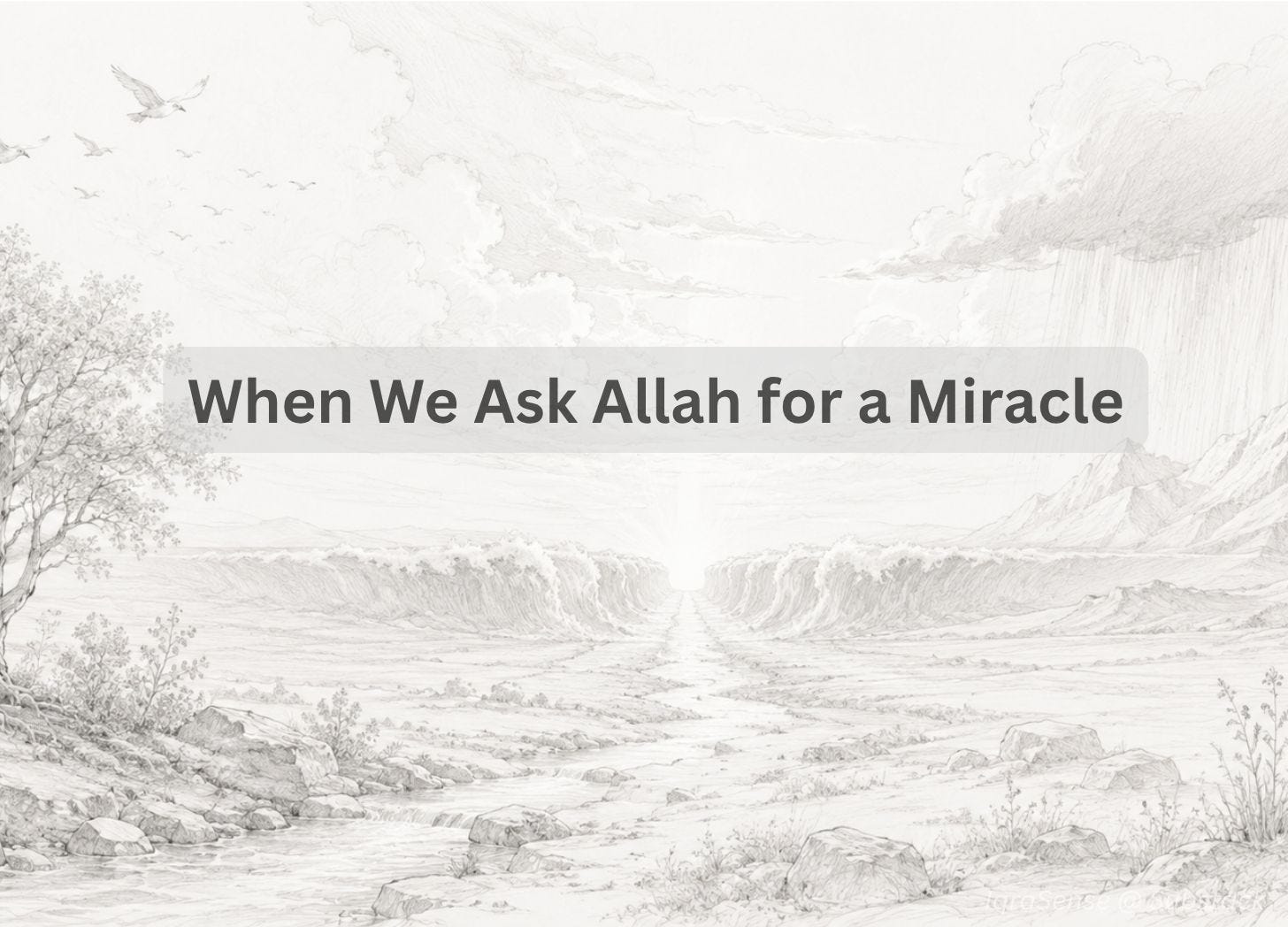
A friend told me recently that he was in serious trouble, and that only a miracle could get him out of it.
I understood him at once, because many of us have been in those situations. Every visible road looks blocked. The diagnosis is bad. The relationship seems past repair. And so on. We conclude that nothing ordinary can save us now. We start looking for some kind of divine intervention.
That is usually what we mean by a miracle: an outcome far outside what we can presently see.
There is nothing wrong with asking Allah for exactly that. We are meant to ask boldly, because nothing is impossible for Allah, the Lord of the Worlds. But “only a miracle can save me” often says less about our situation than about how narrowly we are seeing it. The urgency of the moment narrows our attention until the problem is all we can see. Yes, some losses in this dunya, with its limitations, truly are irreversible. But “I cannot see a way” and “there is no way” are not the same sentence… though the fear brewing within us reads them as one.
So it’s worth asking plainly. What is a miracle? Would one really change us the way we imagine? And should we spend our hard times waiting for one? Let’s explore that in detail.
In the years after revelation, Muslim scholars writing on theology needed a precise term for the extraordinary events Allah grants His prophets as proof of their truthfulness. So, they settled on the word mu’jizah. Yet that technical term is not the word the Quran itself uses. The Quran’s own word is wider: aayah - a sign.
When Prophet Isa (Jesus) (alayhis salam) speaks of forming a bird from clay, healing the blind and the leper, and reviving the dead by Allah’s permission, he calls it an aayah from his Lord. When Prophet Musa’s (alayhis salam) staff becomes a serpent, that too is an aayah. These are events we would unhesitatingly call miracles, but the Quran names them signs. And a sign, by its nature, exists to point at something beyond itself. We don’t stand at a road sign admiring the sign; we follow where it points. And every miracle in the Quran points to Allah, and to the truth of the messenger He sent.
But the Quran also uses aayah, for things we would never call miraculous - the heavens and the earth, the rain, the winds, the animals, the ships, the turning of night into day. “And on the earth are signs for those of assurance, and in yourselves. Then will you not see?” (Surah Adh-Dhariyat, 51:20–21).
This does not flatten the difference between the sea splitting for Prophet Musa (alayhis salam) and the sea moving through its ordinary tides. One is an extraordinary prophetic sign. The other belongs to the steady order of creation. But the Quran does not keep them in separate worlds. Both are signs of the Divine. The trouble is actually on our side: we divide reality into the miraculous and the normal. The Quran asks whether we can read both as the handwriting of the same Author.
So why does the extraordinary move us while the constant leaves us cold? Why is it that we stand under a sky of stars and feel nothing?
That’s because our minds get used to repetition. And the astonishing, seen enough times, slowly reclassifies itself as the expected. A child stares in amazement as an airplane climbs into the sky while the adult beside him scrolls on his phone. The airplane did not become less astonishing. The adult simply grew used to it.
The same erosion of wonder happens to our souls. We live beneath a sky we did not raise, inside bodies we cannot command, kept alive by a heart we never once remembered to beat - and we treat it all as ordinary. We marvel at an unexpected recovery, but never at the plain fact that the body mends its own wounds constantly. We watch dead ground turn green after rain and call it a weather pattern. So, essentially, we opened our eyes to a working world this morning, and nothing seemed miraculous.
To be clear, none of this is an argument against science. Understanding how rain forms or how tissue heals takes nothing away from the wonder of rain or healing; explaining how a sign works does not cancel the sign. Science describes the mechanism. The Quran asks only that we not become so absorbed in the mechanism that we forget the One who wrote it.
Here we reach the heart of it, and a warning the Quran gives directly. When we’re trapped, we tell ourselves that one extraordinary rescue would fix everything - not just the problem, but us. If Allah intervened dramatically, we think, our doubts would dissolve and our faith would never waver again. The Quran tests that hope against the hardest case imaginable: a people who stood before a living Prophet, named the exact miracles they wanted, and still would not have believed even then.
It was the Quraysh. They made their demands - springs, gardens, a house of gold, angels brought down, a ladder into heaven with a book they could read on the way up (Surah Al-Isra, 17:90–93). It looks like a search for proof. A way to stall. And Allah shows how little proof would have mattered: “if We opened to them a gate from the heaven and they continued therein to ascend, they would say, ‘Our eyes have only been dazzled. Rather, we are a people affected by magic’” (Surah Al-Hijr, 15:14–15).
This is something worth noting. Evidence never lands on a blank slate. It falls into a heart already holding something - pride, fear, appetite, status - and a heart determined to keep what it holds will bend even a wonder to protect it. A miracle can overwhelm the eyes without ever reaching the will. It can display power, but it can’t manufacture humility.
And this is exactly where Prophet Ibrahim shows us the other half of the truth. He too asked for a miracle - to be shown how Allah revives the dead. When Allah asked, “Do you not believe?” he answered, “Yes, but [I ask] to reassure my heart” (Surah Al-Baqarah, 2:260). He received his sign, and it steadied him. So the miracle did work on him, where it failed on the Quraysh. The difference was never in the event. It was in the heart that met it. Prophet Ibrahim asked from faith, to deepen it. The Quraysh demanded from resistance, setting spectacle as the price of obedience.
So, the same miracle lands on two hearts and does opposite things.
Which answers our question. The miracle we’re waiting for would do to us only what our heart is already prepared to let it do. If spectacle was never where the transforming power lay, it was never the thing to pin our rescue on either.
So where does this leave us when we are looking for a miracle to get us out of our problems?
We should ask. And ask boldly. We should ask for the cure, the unseen door, the relief when every calculation runs against us. Allah is not bound by our probabilities, and dua for the extraordinary is not a weakness of faith but an exercise of it.
But at the same time, we should not stake our faith on the answer. And we should not sit idle either, waiting for the sea to split while blind to the boat already on the shore and the strength Allah has placed inside us. Here we should notice something remarkable mentioned in the Quran. When Allah chose to deliver the extraordinary, He still asked for the human hand to move, even though the hand changed nothing. Prophet Musa was commanded, “Strike the sea with your staff” (Surah Ash-Shu’ara’, 26:63), and only then did it part. We know a staff by itself cannot split a sea. Maryam, in the middle of a miracle, was told to shake the trunk of the palm so its dates would fall to her (Surah Maryam, 19:25), even though a weak woman shaking a tree cannot make wood give fruit. The action was never the cause. Yet Allah tied the miracle to it. So waiting for a miracle with folded hands is not deep trust. It is its own kind of not-seeing.
We should realize by now that the problem was never a shortage of miracles. If the sky, the body, and the quiet mercies of an ordinary day have all become background noise, why are we so sure that one dramatic rescue would finally open our eyes? If familiarity swallowed the sky, then it would swallow the rescue too.
But a heart that learns to read the daily signs, that sees the beating heart and the greening earth as small miracles in their own right, has done something enormous. It has enlarged its whole picture of Allah. Once we recognize the ordinary as His deliberate work, we begin to grasp that nothing is hard for the One already holding all of it in place, every hour, unnoticed. This is not a promise that everything we want is coming. Rather, it is the end of despair… the quiet certainty that no door is closed to Him, even when we cannot see it open.
When Prophet Ibrahim was cast into the fire, his words - as Ibn ‘Abbas relates in Sahih al-Bukhari - were “Hasbunallahu wa ni’mal-wakeel”: Allah is sufficient for us, and He is the best disposer of affairs. The books of tafsir relate that when Jibreel came to him mid-air and asked if he needed anything, Prophet Ibrahim’s trust ran past every intermediary (including Jibreel) to the Lord Himself - and Allah commanded, “O fire, be coolness and safety upon Ibrahim” (Surah Al-Anbiya, 21:69). And it was the same trust, in the same Lord, when Prophet Ibrahim later left his family in a barren valley with nothing but dua (Surah Ibrahim, 14:37). Facing fire or facing desert, he did not ask for a special category of help. He asked the same Lord, whose power is one constant - because everything delivered by that Lord, dramatic or quiet, is His sign.
This is where the seeing heart arrives - at a better opinion of its Lord. Prophet Muhammad (sallalahu alayhi wasallam) related that Allah says, “I am as My servant thinks of Me” (Sahih al-Bukhari and Sahih Muslim). This is not a guarantee that the world will bend to our wishes if only we believe hard enough. Rather, it is a summons to trust Allah’s mercy, His nearness, His response - to think well of Him, not to think our way into a preferred outcome. The prophets held the highest opinion of Allah and still knew exile, loss, and grief. Their good opinion of Him did not rewrite their circumstances. It changed how they stood inside them.
So the miracle worth wanting is not, in the end, the one that reorders the world. It is the one that reorders the eyes - that lets us recognize Allah in what already surrounds us, ask Him for the impossible without holding our faith hostage to His reply, take every lawful means within reach, and then leave the result where it always rested. In His hands, and not ours.
Because if we cannot see Him in the signs He lays before us every single day, what makes us so sure that one astonishing event – a miracle - would finally teach us how to see?
Comments
Nothing yet. Say the first thing.
Sign in to join the conversation.