
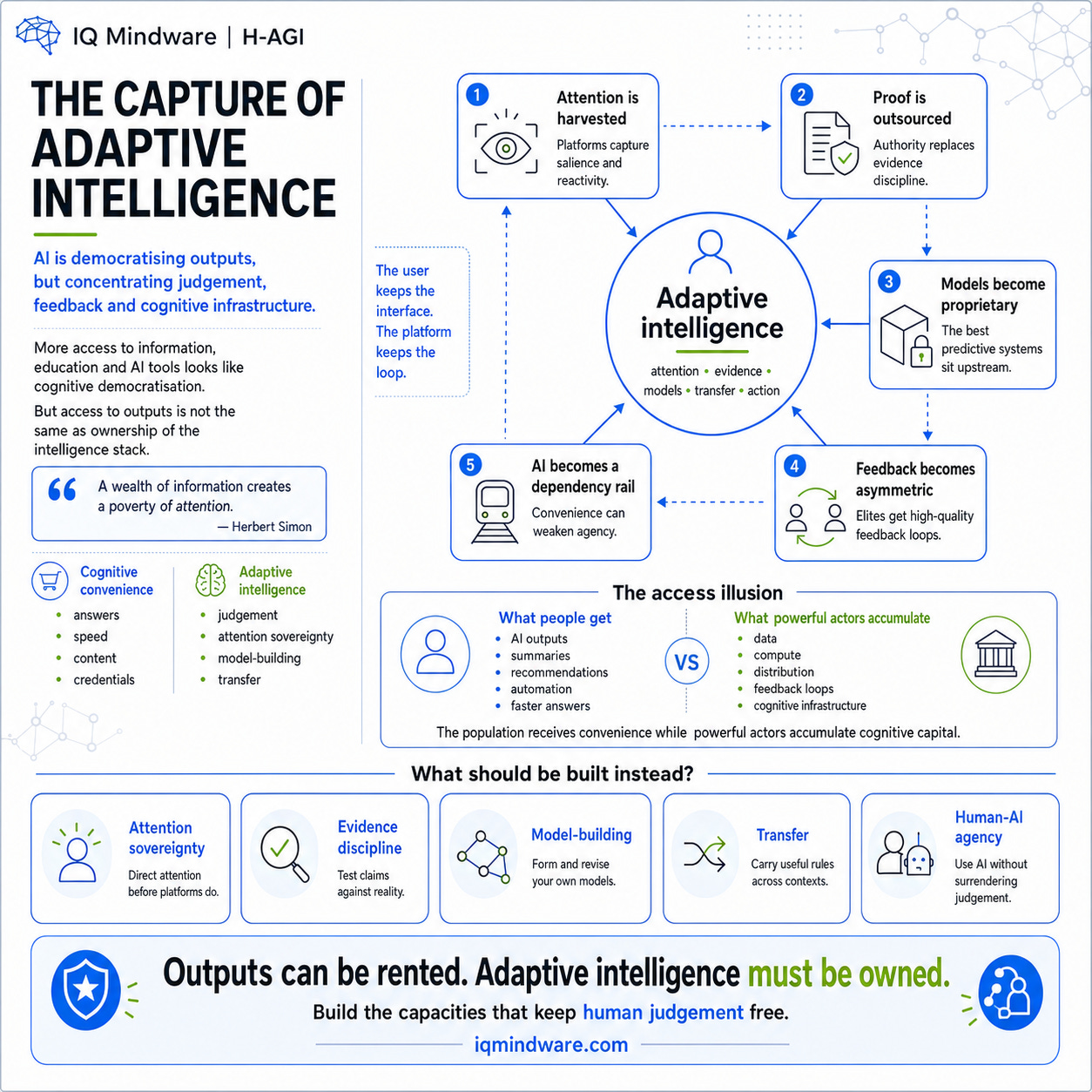
Recent shifts in global econmics appears to be democratising intelligence.
More people have access to information than ever before.
More people have access to education.
More people have access to AI tools.
More people can ask questions, generate summaries, write code, produce images, build documents and search knowledge systems in seconds.
At the surface level, this looks like an explosion of cognitive opportunity.
But there’s a deeper question.
Are people actually gaining adaptive intelligence?
Or are they gaining access to cognitive outputs while the high-value machinery of judgement, feedback, prediction, attention and understanding moves further upstream?
Adaptive intelligence is not just knowledge, fluency, credentials, or access to AI.
That kind of intelligence is touted as a broadly distributed civic resource.
But under modern economic and political dynamics, it can become captured cognitive capital.
AI, cognitive capital, information operations and digital infrastructure are not merely neutral tools. They are compounding power levers. They scale whoever already owns the data, compute, distribution, workflows, institutional trust and feedback loops.
This is the central irony of the AI age:
the population receives more cognitive convenience,
while elite actors accumulate more cognitive infrastructure.
The easy story is that AI democratises intelligence because everyone can now ask better questions.
There is truth in that.
Stanford’s 2026 AI Index reports that generative AI adoption has spread at extraordinary speed. OpenAI’s own research on ChatGPT usage shows that AI is now embedded in everyday life, not just professional work. Pew data also shows growing public use and awareness of AI.
So the access story is real.
But access to a tool is not the same as ownership of the intelligence stack.
A person can use AI every day and still lose agency if the platform owns the interface, the memory, the distribution channel, the model, the data, the rules of visibility and the feedback loop.
They may get answers. But not necessarily judgement.
They may get speed. But not necessarily model-building.
They may get content. But not necessarily attention sovereignty.
They may get credentials. But not necessarily transfer.
They may get AI assistance. But not necessarily control over the cognitive environment in which decisions are made.
This is the difference between cognitive convenience and adaptive intelligence.
Convenience reduces friction.
Adaptive intelligence increases agency.
Adaptive intelligence becomes captured when the high-value parts of cognition move upstream into institutions, platforms and infrastructure owners.
The user keeps the interface.
The platform keeps the loop.
Attention is the entry point of adaptive intelligence.
If you can’t hold attention, you cannot stabilise variables and focus.
If you cann’t stabibilise variables, you cannot test relations.
If you cannot test relations, you cannot update models.
If you cannot update models, you cannot act intelligently under change.
The attention economy monetises this first layer.
Platforms do not merely display information. They shape what enters awareness, what feels urgent, what receives salience, what gets repeated, what becomes socially validated and what disappears.
The French Treasury’s 2025 paper on the attention economy describes digital platforms as business models built around monetising user attention. It also notes negative externalities for productivity, cognitive abilities and mental health.
That matters because attention is not just a personal productivity issue. It is the common resource from which judgement is built.
When attention is continuously fragmented, outrage-tuned, novelty-driven and socially ranked, people do not simply become distracted. They lose stable access to the first layer of adaptive intelligence.
The result is not ignorance. It is reactive cognition.
“What information consumes is rather obvious: it consumes the attention of its recipients. Hence a wealth of information creates a poverty of attention...” Herbert Simon
A second capture mechanism is the outsourcing of proof.
People increasingly rely on institutional proof, algorithmic proof, social proof and identity proof.
What is trending?
What do experts say?
What does the platform rank first?
What does my group believe?
What does the model answer?
What does the credential signal?
None of these are useless. Institutions matter. Expertise matters. AI can help. Social trust is necessary.
But adaptive intelligence requires evidence discipline.
The critical question is not:
“Who says this is true?”
It is:
“What relation is being claimed, what evidence supports it, where does it fail, and what would change my mind?”
When proof is outsourced too completely, people become dependent on authority layers they cannot inspect.
They may know what is approved. But not what is warranted.
The best predictive systems increasingly sit inside corporations, states, intelligence agencies, hedge funds, elite universities and heavily capitalised AI firms.
These actors do not merely consume outputs.
They build feedback machines.
They have data streams, market signals, user behaviour, A/B tests, distribution channels, proprietary models, expert teams, regulatory access, capital and compute.
The OECD’s work on AI infrastructure makes this point very clear. AI systems depend on a complex, capital-intensive stack: chips, data centres, cloud computing, energy, networking and specialised software. The Stanford AI Index also shows concentration in frontier model production, investment, data centres and hardware supply chains.
This is where the “everyone has AI” story becomes misleading.
Everyone may have access to a chatbot.
But not everyone has access to the full prediction-and-feedback stack.
The valuable thing is not simply the model.
It is the loop:
data → model → action → feedback → update → deployment → scale.
That loop is cognitive capital.
Adaptive intelligence depends on feedback quality.
Powerful actors receive fast, structured feedback from markets, capital flows, customer behaviour, internal dashboards, surveillance, experiments and political access.
Ordinary users receive noisy feedback from likes, feeds, comments, metrics, public narratives and algorithmically shaped reputational systems.
One side gets decision intelligence.
The other gets engagement signals.
This is quite a profound asymmetry!
If your feedback is noisy, delayed or manipulated, your models degrade.
If your feedback is fast, high-resolution and tied to real outcomes, your models improve.
That is true for individuals, firms, institutions and states.
The key inequality may therefore be less about who can access information and more about who has access to reality-coupled feedback.
AI can expand judgement. But only if the user retains agency over questions, evidence, memory, workflows and decisions.
Otherwise, it becomes a cognitive prosthetic owned by someone else.
This is the subtle trap. AI can make users feel more capable while making them less independent. It can reduce the cost of producing answers while weakening the habit of building models. It can help people write while reducing pressure to clarify thought It can summarise evidence while obscuring how relevance was selected. It can automate decisions while narrowing the user’s sense of possible options.
The question is not whether AI is good or bad. The question is whether AI strengthens the user’s adaptive loop or replaces it.
A good AI system should make your thinking harder to break.
A bad one makes your dependency smoother.
There is also a softer dilution of adaptive intelligence.
Modern culture tends to reduce intelligence into fragments:
IQ scores,
exam results,
credentials,
productivity hacks,
prompt tricks,
content consumption,
critical thinking slogans,
automation workflows,
personal brands,
and AI outputs.
Each captures part of the picture.
But none captures the living system.
Adaptive intelligence has more of a ‘meta’ feel, and is closer to:
relational abstraction
attention control
relational abstraction
evidence sensitivity
predictive modelling
transfer
action under uncertainty
delayed re-checking.
That is much harder to mass-produce inside conventional education or platform ecosystems.
Why?
Because genuine adaptive intelligence makes people less governable by default frames or scripts.
It trains people to ask questions like:
What variable matters here?
What relation is being claimed?
What evidence would change this?
Where does this rule stop holding?
What path remains open?
Who owns the feedback loop?
What dependency is being created?
What would I notice if the frame itself were wrong?
That kind of cognition is not merely “skilled”. It is ‘sovereign’. There is ‘meta-agency’ ivolved.
The old divide was access to information. We can argue that the new divide is access to adaptive loops.
Information is abundant. Judgement is scarce.
Content is abundant. Attention is scarce.
Answers are abundant. Evidence-guided model-building is scarce.
AI tools are spreading. But the capacity to use AI without capture is uneven.
Recent labour-market evidence already points in this direction of cognitive polarisation. Microsoft’s Work Trend Index frames a divide between “Frontier Firms” and ordinary workers. IMF analysis warns that AI may deepen inequality through capital returns and by complementing already advantaged workers. OECD work emphasises that skills, training and infrastructure strongly shape who benefits.
This is not simply a labour-market issue. It is a cognitive-capital issue. The people and institutions that learn to combine AI with judgement, proprietary data, fast feedback and strategic action will compound.
The people who use AI mainly as an answer machine may become faster without becoming more adaptive - and over time are likely to become less smart, less adaptive.
AI may ‘democratise’ outputs while concentrating the systems that decide which outputs matter.
At IQ Mindware I am concerend with the following capabilities:
The ability to protect and direct attention before external systems define what matters.
The ability to test claims, relations and decisions against reality rather than relying only on social or algorithmic proof.
The ability to form, revise and compare mental models rather than merely consuming outputs.
The ability to carry useful knowledge or cognitive skill across contexts, formats and pressures.
The ability to use AI as useful resistance, not as a dependency rail.
The question of the AI age is not whether people will have access to intelligence.
They will!
The question is what kind.
There is intelligence as output: options, answers, summaries, content, recommendations, automation.
And there is intelligence as agency: attention, judgement, model-building, feedback, transfer, action.
The first can be platformed. The second must be trained. The first can be rented. The second must be owned. The first makes life easier. The second keeps you free!
That is one way of seeing the real stakes of adaptive intelligence now. Intelligence is becoming an increasingly scarce resource: cognitive capital is increasingly concentrated.
💡
Any counter-arguments or other reflections on this argument welcome! - Mark
No posts
Comments
Nothing yet. Say the first thing.
Sign in to join the conversation.