

A good human–AI workflow should leave you with a better mental model, not merely a better output.
Generative AI has made polished output very cheap.
A model can draft the memo, summarise the paper, compare the options, produce the code, map the strategy, generate the counterargument and suggest the next step.
That can be very useful obviously. It helps us be more productive, more efficient, more effective.
But it creates a new cognitive risk: the answer can become better while the thinking behind the answer becomes weaker.
You may end up with a convincing product without being able to say clearly:
what problem is actually being solved;
which evidence supports the conclusion;
which assumptions the conclusion depends on;
where the uncertainty still sits;
what would make the answer wrong;
why this action is preferable to the alternatives.
The result can look like augmented intelligence while quietly becoming outsourced cognition. Our IQ quietly degrades.
The central H-AGI (human-AI general intelligence) question is therefore not:
How much can AI do for me?
It is:
Which parts of the cognitive loop should AI extend, and which parts must remain human-owned to preserve/augment our IQ?
Suppose you ask an AI system whether your business should enter a new market.
It gives you a strong answer. The argument is coherent. The risks are organised. The recommendation feels sensible.
You can copy the result into a strategy document within minutes.
But now remove the AI.
Can you still explain:
the three variables that mattered most;
the evidence behind each variable;
which assumption is carrying the recommendation;
the strongest competing interpretation;
the smallest fact that would change your decision;
what you expect to happen if you act?
If not, you may own the document without owning the model.
That distinction matters because real environments do not remain frozen at the point where an AI produced its answer.
A supplier changes terms. A customer segment behaves differently. A source turns out to be weak. A competitor moves. A deadline shortens. A new constraint appears.
At that point the original output is less valuable than your ability to reconstruct and update the reasoning that produced it. This is model ownership and genuine intelligence.
In a well-designed human–AI system, AI is extremely useful for expanding the cognitive workspace.
It can act as:
external working memory
an organiser of complex information
a generator of alternative scenarios or models
a source of counterarguments and boundary cases
an assumption tracker
a source–claim index
a pre-mortem partner - working backwards from imagined failure
a visualisation tool
These functions increase the range of possibilities the person can inspect. They can make the active model larger, clearer and easier to test.
But AI should not silently take ownership of:
the purpose
the stakes
the ‘must haves’
the acceptable level of risk
the evidence threshold for action
the final committed decision
the real-life action!
the reflection and interpretation of what is worth retaining after acting.
Those are not just missing inputs for the AI to infer. They are part of the human side of the control architecture.
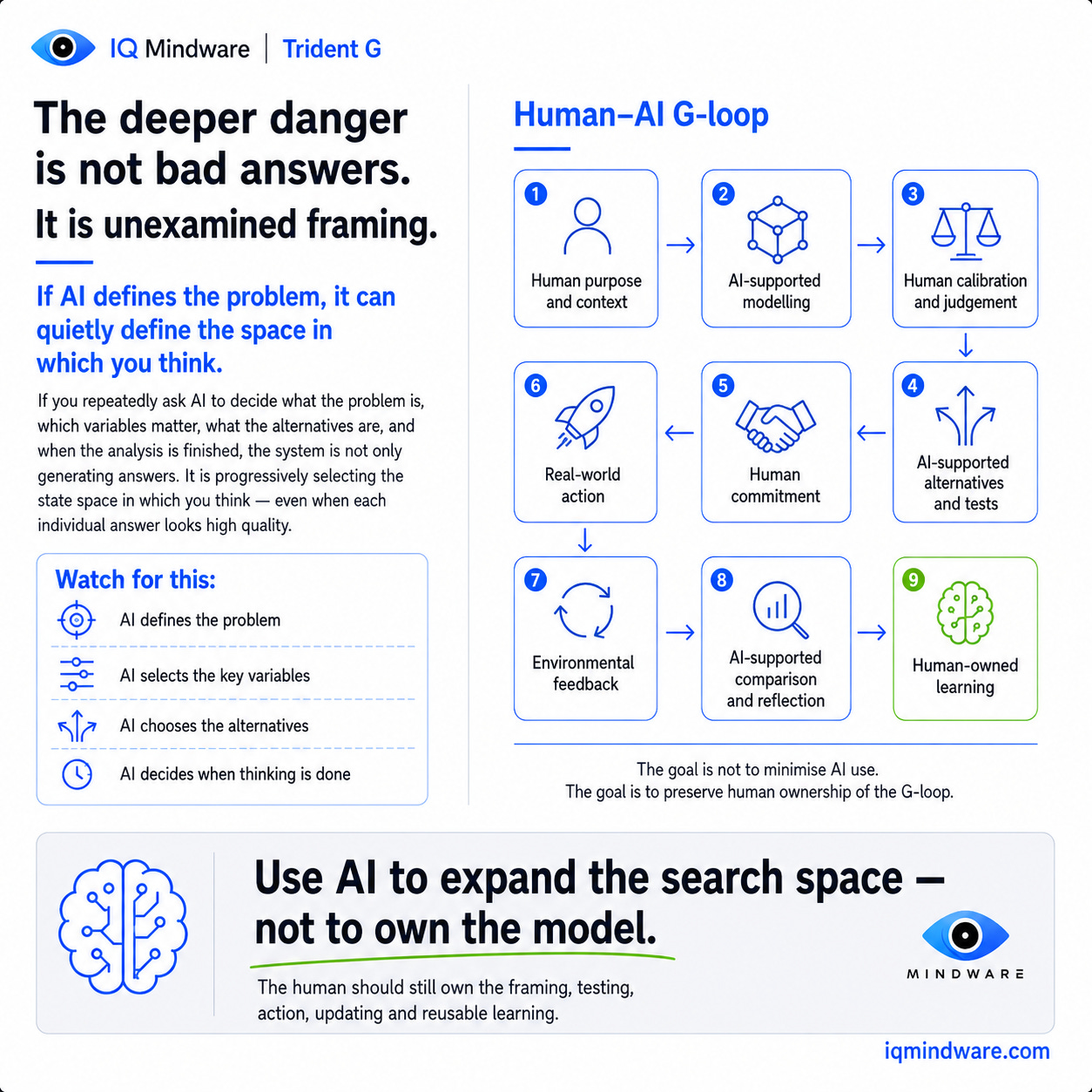
The deeper danger is dependence on unexamined framing.
If you repeatedly ask AI to decide what the problem is, which variables matter, what the alternatives are and when the analysis is finished, the system is not only generating answers.
It is progressively selecting the state space in which you think.
That can happen even when every individual answer is high quality.
The human–AI division of labour should therefore preserve a simple sequence:
human purpose and context → AI-supported modelling → human calibration and judgement → AI-supported alternatives and tests → human commitment → real-world action → environmental feedback → AI-supported comparison and reflection → human-owned learning
The point is not to minimise AI use.
The point is to make sure the human still owns what I call the G-loop: the process by which a situation is framed, tested, acted on, updated and eventually turned into reusable knowledge - that is, crystallised intelligence (Gc).
Before accepting a substantial AI-assisted conclusion, see whether you can answer seven questions in your own words.
Not the topic. The resolution object.
Do I need: understanding? evaluation? a decision? a message? a strategy? a negotiation move? a test?
AI often produces the wrong kind of useful output because the human never specified the kind of closure required - the ‘satisfaction conditions’.
Every decision sits inside constraints. We need to satisfice not optimise.
These may include: time, money, motivation, health, trust, reputation, future options, legalities, relationships. A recommendation that ignores the protected base may be locally clever and globally dumb.
Compress the situation into the smallest set of variables and relations that actually change the next action. For example: Demand appears strong. Acquisition cost is uncertain. Cash runway is limited. The decision is reversible at a smaller scale.
Keep vigilant about source-claim bindings. Ask:
Which source supports this claim?
Which observation supports this assumption?
Which conclusion depends on which condition?
Which evidence is genuinely independent?
This becomes increasingly important when AI combines many sources into one fluent answer. Fluency can hide broken source–claim bindings.
Require one serious disconfirmation attempt.
Ask:
What alternative explains the same facts?
What assumption could break the recommendation?
What evidence am I treating as stronger than it is?
What attractive conclusion does not actually follow?
A model that has never faced this kind of critical testing, falls easy prey to my-side bias, and the general tendency of AI to flatter and support you.
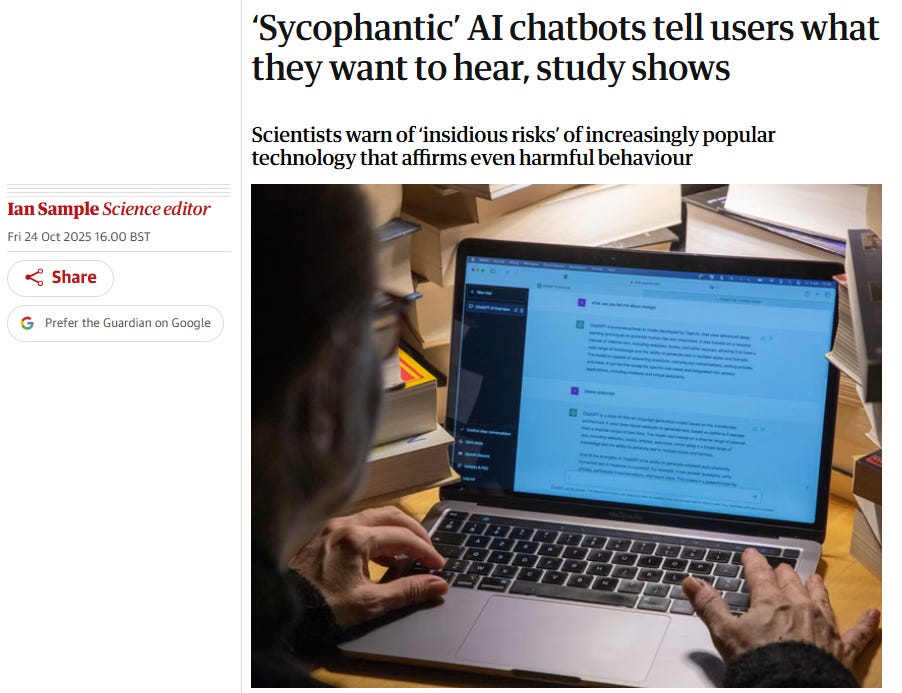
We need to be interested in what’s true - what is the underlying reality - and this should survive critique.
The goal is not perfect understanding.
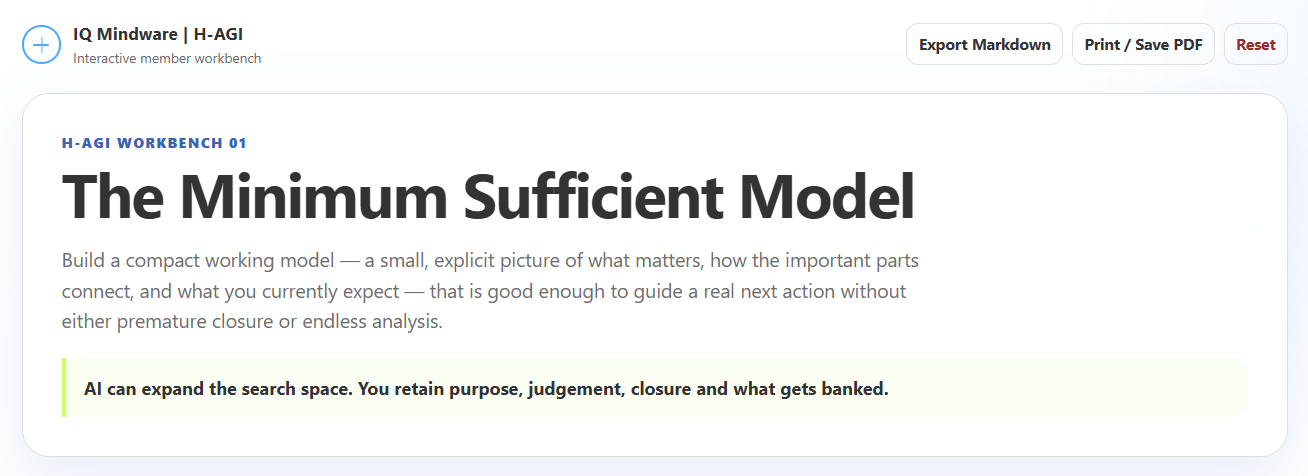
It is a minimum sufficient model: enough structure to guide a proportionate next action.
A useful stopping question is:
Would more information materially change the next action, its safety, or how I interpret the result?
If not, continuing to ask the model may add detail without improving the decision.
Try turning the recommendation into a prediction:
If I do X,
I expect Y,
because Z.
Now the real world can provide information. Without a prediction, an outcome is easy to rationalise after the fact.
With a prediction, the outcome can update the model.
There is one further test that is especially useful.
After completing an important AI-assisted piece of work, close the model and try to reconstruct the reasoning without it.
Can you explain:
the purpose
the key variables/ideas
the main inferences
the strongest uncertainty
the decision rule
the expected outcome
a failure condition
If you can, the AI has probably extended your cognition - true H-AGI.
If you cannot, the AI may have substituted for it - dumbing us down.
A strong human–AI workflow should end by asking:
What is worth retaining from this case? What did I learn?
The answer should usually be smaller than the output.
It may be:
a source-checking rule
a decision threshold
a warning sign
a useful question
a boundary condition
a test that exposed a bad assumption
a reusable way of framing a problem
This is what typically transfers as crystallised intelligence - not the sometimes breath-taking AI output!
There is a follow-up paid Substack with a webapp for the skill-set explored in this article.
No posts
Comments
Nothing yet. Say the first thing.
Sign in to join the conversation.