
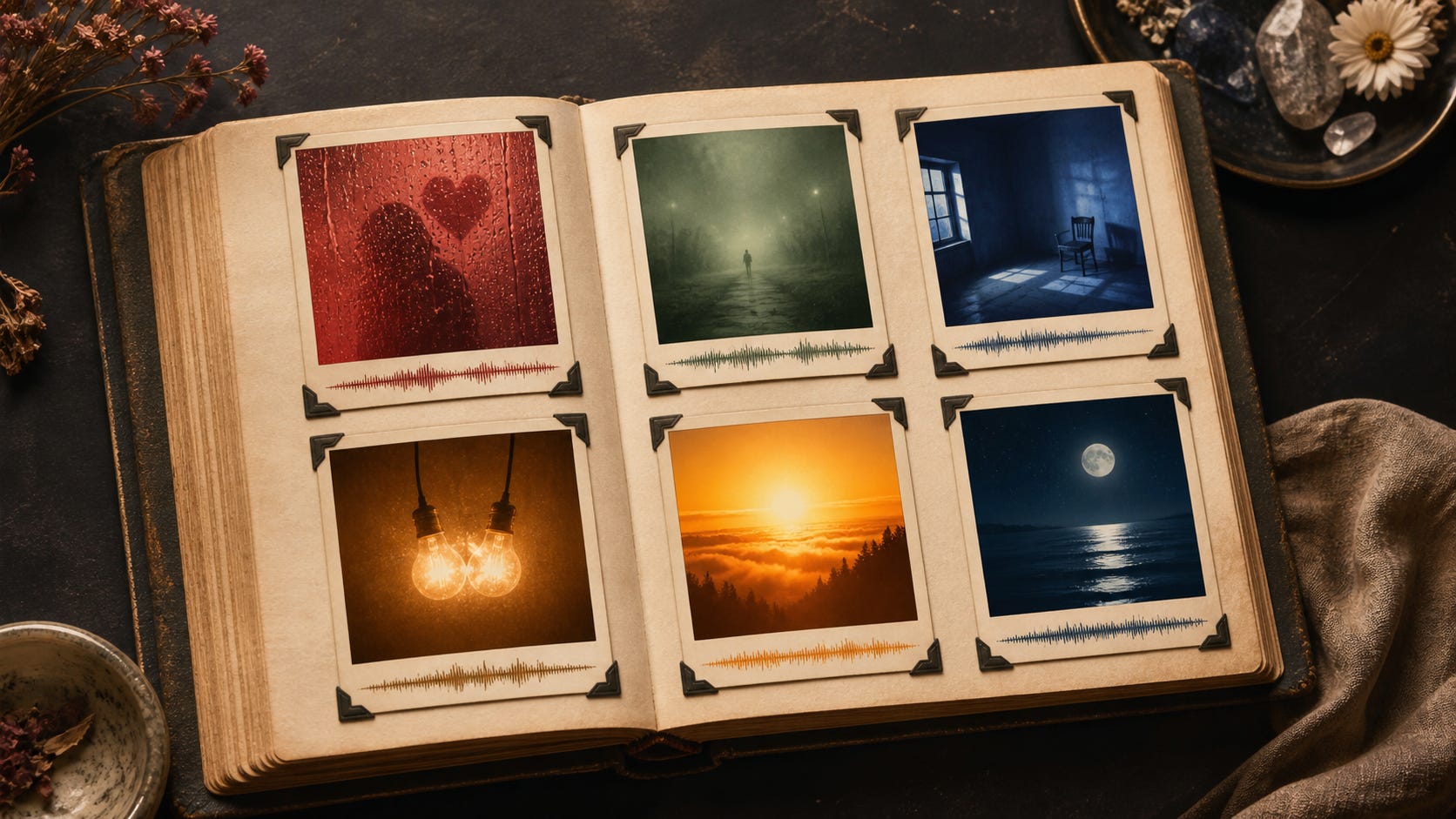
Do you know how to take a photograph? Silly question. Pull out your phone, point it, tap the button. In two seconds, you can keep the memory forever.
A few months ago I was stuck at an airport with a long wait for a flight. I’d just read a quote I really liked, and I wanted to capture it in music somehow. So that’s what I did, sitting at the gate. The song is called Drop.
I didn’t need to book studio time. I didn’t need to find a band and a choir. A feeling passed through me in an airport, and I captured it in music.
AI gave music its iPhone moment. The iPhone put a camera in everybody’s pocket, and suddenly everybody could take decent photos of their own life. This is that, for music — anyone can capture something that’s moving through their mind with a melody and lyrics to match.
It’s not that traditional music doesn’t capture feelings — of course it does.
But there’s something in the fact that anybody can now do it in an hour or a few hours, while the feeling is still fresh in your mind. I’m sure trained musicians have always been able to do this, thanks to years of practice. Now anybody can, sitting in their bedroom, or at a gate in an airport.
So you can capture yesterday’s heartbreak. Last week’s doctor diagnosis. The happiness of an anniversary with someone you love.
Feelings fade. But now we have an instrument that can catch them on the way past.
One correction to my own camera analogy: these photos usually take more than one press of the button. People might work on the song for a while. Adjusting the lyrics, the melody, polishing this or that. You keep refining until it sounds like what you had in your mind. Maybe this makes it more like sculpting than photography. Either way, what you end up with is an encapsulation of a moment, of a feeling, and usually you can capture the whole feeling while it’s still moving through you.
So what do people photograph? A lot of it, generally, is the weather inside. I’ve seen people write songs about memories, about a feeling that’s passing through them, about a frustration. When they’re down, the songs are dark. When they’re high, the songs are happy.
I’m the same.
This past year, from November to February, I was going through a rough stretch — uncertainty, doubt, not knowing what I was doing next. You can see all of it in my music. One of the songs from those months is literally called “Fear, Uncertainty, and Doubt” — it’s dark, it’s haunting, and it captures the uncomfortable feelings I was sitting with that day.
When the second war with Iran happened, I made “Who Cometh” a song based on a bible quote that’s all divine fury and wrath. A war-like song, which is not a thing I normally make. I sat down to create a dance song, but this internal state of mind took over and came out instead.
Other songs from that time have a dark mood. Sweetness Unbound. Low Density. Calm Waters. I Am Out With Lanterns (looking for myself) — the title borrows a line from Emily Dickinson, and it’s literally what I was feeling. You can find all these songs on my profile if you want to check out the weather from back then.
I look at the songs and can see the sadness, the challenges, and the low mood I was in.
It’s just like scrolling through my photo album, except what it captures is not the outer scenery but the inner scenery. The emotions I was feeling, the ride I was on, and the prevailing weather inside.
And when I play those songs back, I’m transported, the same way a travel photo puts me back on a mountain, in a moment of awe in nature, with my friends or family. Here it’s the internal nature, and the music brings me right back just the same.
Not every photo is of a feeling, though. Sometimes you go on a journey with your camera.
Last Saturday, I got on a video call with a close friend to make music together. We spent the first stretch just talking. What vibe are we looking for, what energy, what kind of beats, what does it remind us of, what’s the place of it.
Instrumentals, for me, aren’t informed by a story the way a song with words is — they’re informed by a vibe. These “expedition albums” are each a journey into a place, with a color and a texture that belong to it. Algebra, my first album of this type, is born of a Persian desert at night — the moon, mysterious green light, Middle Eastern scales over house grooves. Dark Meditation, another set, is blue — water, a beach, the moon.
What we were making that Saturday has flavors of the sun and the desert — yellow and red, high heat, white fire — more Morocco, with Brazil and flamenco pulled in. We brought dance styles from different places into it.
Then we generate, and generate, and generate. We change the prompts, we listen, one of us says — Okay, this is what I’m missing, and we move — psytrance to tribal, cinematic to explosive. Some pieces of the prompt stay the same and others change, so it’s like taking steps across a landscape and pressing the shutter to see what it looks like from this angle, from that one. We didn’t decide in advance where we’d land. We were exploring and taking musical photographs as we went along.
A lot of the captures are boring, and we tossed them aside. Sometimes I’d get bored fast, but my friend would keep listening, and a minute in — oh, there’s something interesting in here. And sometimes you can tell from the first second: the density of energy and melody is special, neither of us wants to stop listening, you feel like dancing instead. That’s a great capture. Not necessarily finished — there may be a lot of editing later — but there’s real potential in it.
There are more than 700 generations in that folder right now, with more coming, and from them, a small collection is starting to take shape as a journey album. These are not versions of one song — they’re different songs. One Mediterranean, one Middle Eastern, one Brazilian. It’s like we traveled to a country and took photos the whole way there. The playlist is the travel journal.
What I’m seeing all around me is people narrating their lives this way. Whole journeys, the evolution of their feeling tones, their internal weather, unfolding song by song — like a blog, or an Instagram, where the posts happen to be songs.
And none of it is made intentionally to be a “product.” Some of these songs are seriously polished — people slave for hours or weeks over every little bit of them. That’s not the point. The point is that hardly anybody’s making them as output to satisfy an audience, an algorithm, or to make money. It’s personal music. Here’s my life, right there in front of you. This is what happened last week. This is Tuesday night, while I was depressed. People are not publishing a book — they’re leaving little notes along the way, and each one is like an Instagram post.
Your cousin’s travel photos are likely never going to be in National Geographic. You still want to see them, because you care about your cousin. I don’t especially need a stranger’s vacation album — who cares. But I love seeing my friends’ travel photos because it makes me feel good to see they’re enjoying themselves. And I would want to see the post they share when their cat dies, because then I know they’re going through something meaningful, and I can reach out and offer some support.
If they shared it in a photo, a song, or in words, it’s a form of connection.
This makes this music much more about human connection than about Grammy- or Mozart-level perfection.
If you’ve never experienced writing music or using AI to make some, try a thought experiment. Imagine capturing your last date, frustration at work, or some serious disappointment. What were the feelings going through your mind — the nerves, the hope, whatever it was. How would you take a photo of that?
Music lets you. Journaling can do it too — but people rarely share their private journals. Turn the same words into a song, and it becomes something you can share, something other people can interpret in their own world of things. People rarely write lyrics that speak plainly like “I lost my cat yesterday, and I’m so sad about it” — that’s not a song. Instead, they write rhymes and lyrics and puzzles around it, and the song encodes a private feeling in plain sight, while leaving everything open to interpretation. Maybe that’s why I see people posting songs about things so private they’d never tell anyone straight out. Myself included.
We all have this camera now, and there’s a lot of personal ‘music photography’ from around the world that’s being shared online in our communities.
I find it to be such a musical and fun way to keep in touch with people you care about.
💗🎶
Itai
I+AI is the inside story of the AI music movement — how songs actually get made, who’s making them, and how creation, suddenly open to everyone, is becoming a new way people connect.
I’m Itai: ex-Google/Meta, AI music creator under the name I+AI, and co-founder of Vibya, where we’re building a home to connect people through music.
New here? Subscribe and come along.
Comments
Nothing yet. Say the first thing.
Sign in to join the conversation.