
Every great entrepreneur must start somewhere. If you’re lucky enough to have savings or a rich uncle who can support your business from its launch, consider yourself in the vast minority. Many entrepreneurs around the world start businesses with little to no money, and some start with very few connections in their local startup community. While this may seem daunting, it’s very possible to build something amazing from the ground floor, if you’re willing to put in the work.
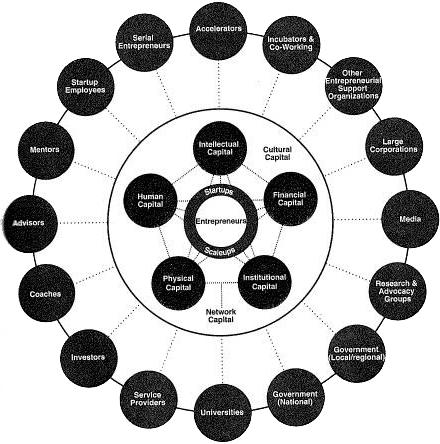
When one thinks of “capital,” money usually springs to mind. However, Brad Feld introduced the concept of the “seven capitals” as part of his books Startup Communities and The Startup Community Way. Funding is just one of the seven capitals in his model – the other six are intellectual, human, physical, institutional, network, and cultural capital. While in the context of his book, these refer to things in the startup community, you can apply the organizations attached to each capital to your own venture. So remember, money is just one part of the entire equation.
Before we touch on using the other six capitals to launch your endeavor, let’s briefly discuss what you can do with minimal funding. Not every business requires a giant pile of cash or a perfect credit score to start. One of the purposes of Lean Startup Methodology is to lead you to a viable business model without investing large sums of money into product development or inventory acquisition. A Minimum Viable Product is a solution you can potentially sell to another business or to a consumer that requires the least amount of materials or funds to produce. If it’s a physical product, you can find ways to source materials for limited cost – second-hand stores, thrift stores, and junkyards might be able to supply your needs in the beginning. Virtual products can be produced using the hardware you already own, whether that is a decent laptop or a modern smartphone. In either case, using your own time is free as well.
Moving beyond the Minimum Viable Product to the second or third version may require more capital or resources. Get reviews from people on version one before you begin working on version two, so you can build a good reputation online. Use these good reviews to support presales of version two. A deposit or a pre-sale on the new version essentially functions as a no-interest loan in order to obtain the supplies and inventory you need. For a virtual product, pre-sales can be used to upgrade your computer hardware or bring on additional talent who can take your software to the next level. If you are able, reinvest as much of profit from version one back into the business.
In the case of virtual products, building and testing ideas has never been less expensive than it is today. Even with the spikes in hardware costs due to the build-out of AI data centers, the amount of raw computing power you have at your fingertips for free or just a few dollars a month would have been unthinkable even 15-20 years ago. If you already sink money into software products, use as many features of those products as possible. If you’re not in a place to subscribe to SaaS products, the free versions of Canva, Google Docs, Claude, and other open-source solutions will get you pretty far. (If you’re not familiar with open-source software, I’ll cover that in a future Substack article.)
How do each of the other six capitals translate when we’re discussing a startup founder rather than the entrepreneurial ecosystem?
Intellectual Capital: What resources exist in your community that can help you learn and upskill? Intellectual capital on an ecosystem level refers to the facilities and people who can help you learn and grow. On an individual level, intellectual capital is measured by the availability of resources at libraries, schools, colleges, and universities that are accessible to you for little to no cost. Public libraries are a great starting point for founders with few resources, as many of these facilities not only have access to reading material on business topics, but also offer computer time, printing, and other business-related services, sometimes for free. Some university libraries also have access to more expensive databases and services not available to the general Internet that can be used to perform basic market and competitive research.
Human Capital: In the case of a startup or small business, human capital refers to employees. In the case of a startup founder, human capital is the people with whom you surround yourself. These are the co-founders who can help you take your idea, make it real, and make it scalable. One of the main reasons that startups fail is due to misaligned team dynamics, so this is something that, if done correctly, can get you farther than any amount of money can get you at the beginning of the startup journey.
Physical Capital: When you start with minimal resources, you start with minimal physical capital. On an ecosystem level, this refers to the built environment in a startup community – the storefronts, factories, and coworking spaces that make up your city. It also refers to the infrastructure of an area, such as the availability and cost of high-speed Internet, reliable electricity, and water service. While there isn’t much you can do on an individual level about this, consider this capital when picking a location for your startup in order to minimize your costs.
Institutional Capital: When you’re starting with nearly nothing, you may feel as though you have no institutional capital. However, most people have a checking account at a local bank or credit union, and if you can find your local library, city hall usually is a short walk or bus ride away. Americans have more institutional capital than they think, but it requires a little bit of effort to navigate bureaucracy. If you, as a new founder, want to increase your personal institutional capital or want to find ways to cut through red tape, it will involve a bit of networking.
Network Capital: Other than human capital, network capital is probably the most important personal capital you can expend. This capital has the greatest amount of overlap between the ecosystem level and the personal level. It doesn’t matter how large your network is – it matters how connected each node in the network is to each other node. Superconnectors have the greatest advantage in this category, and those who have the ability to become superconnectors over time place a close second. If you have minimal resources when starting a business, find ways to become a superconnector and find the superconnectors in your community.
Cultural Capital: In the context of a startup community, cultural capital refers to the community in which a startup exists. Is the area friendly to new ideas? Are the long-time business owners helpful? When a startup begins to scale, what kinds of amenities does the area offer that would help attract the best talent to relocate there? The cultural capital of a startup community will directly affect your ability to find people who can help you reach the next level. Your personal cultural capital involves your willingness to try new things and embrace others with different ideas than your own. Consider your personal beliefs and attitudes when thinking about cultural capital, and whether those are congruent with building something from the ground up.
It’s not impossible to start something with minimal resources, but it takes a bit of work to gain the momentum you need to launch. The great thing is that everyone has the same 24 hours each day – how you use those 24 hours is the difference between success and failure. Seek out entrepreneurial events in your area and make connections. If networking is hard for you, bring a friend along. Don’t be afraid to ask questions in order to gain opportunities. The worst someone can say is “no.” Plant as many seeds of opportunity as possible – you never know which ones will grow!
No posts
Comments
Nothing yet. Say the first thing.
Sign in to join the conversation.