
I was never good at physics. Or maths or chemistry, despite the fact that both my parents are engineers. But of all the subjects that involved formulas, physics had a particular talent for making me wonder what I was doing there and, more importantly, what possible use I would ever have for all those letters arranged in an order I was supposed to memorise.
Later, when I discovered endurance sports, I finally found a use for at least one of those formulas:
distance = speed × time
Even then, as I wrote in ULTRA, I mostly use calculations to distract myself from pain and discomfort.
“Each pedal stroke feels like I’m turning the entire universe.
I try to stop thinking about anything. The maths - time, speed, distance - no longer helps. I was never good at maths anyway. I remember numbers and attempt to calculate them, but only because they distract me enough to forget the pain. But now, any number other than zero seems like infinity to me.
The road meanders up and down like a roller coaster. All roads in Sweden are like that. The speed I gain on the descent isn’t enough to carry me through the inertia of the climb. The darkness deepens. The beam of light from the car’s headlights behind me gradually narrows and dims. Before me, the road rises and looks like Everest merging with a black sky devoid of moon and stars.”
In endurance sports, you spend a lot of time alone with your thoughts. Sometimes you follow them; other times you try to shut them down by focusing on the training, the race, your breathing, or the next kilometre. But there are also plenty of moments when the body quietly gets on with the job and the mind is free to wander, without direction and without any idea where it might end up.
I was in one of those moments at HUB Trail.
#57 — About HUB Trail
·
Aug 11
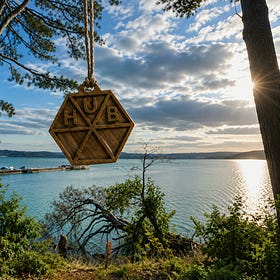
I woke up at six in the morning, before the alarm went off, even though the start wasn’t until ten. But the butterflies in my stomach had already started fluttering at the thought of the 40-plus kilometres ahead of me, on a route I didn’t know at all and that was almost entirely off-road. I’m not a trail runner and, as I’ve admitted before, I have a fai…
My legs were running along the coast while my thoughts wandered somewhere else, and I wasn’t paying much attention to either. At some point, I looked at my watch and realised I had already covered fourteen kilometres. I was pleased and surprised at the same time because, in my body, they felt more like seven. I wasn’t tired, I didn’t feel like I was pushing, and I hadn’t had that familiar sensation of counting down the kilometres to the finish. They had simply passed.
And then the formula came back to me.
Distance, speed, time.
Except this time I didn’t put any numbers into it or start doing calculations. Instead, I started thinking about people, about the encounters that happen over the course of a life, and about the distance two people can travel together.
In running, we tend to talk about pace rather than speed. About the pace you can comfortably sustain over a certain distance and, more importantly, the difference between how fast you can run and how fast you can continue running.
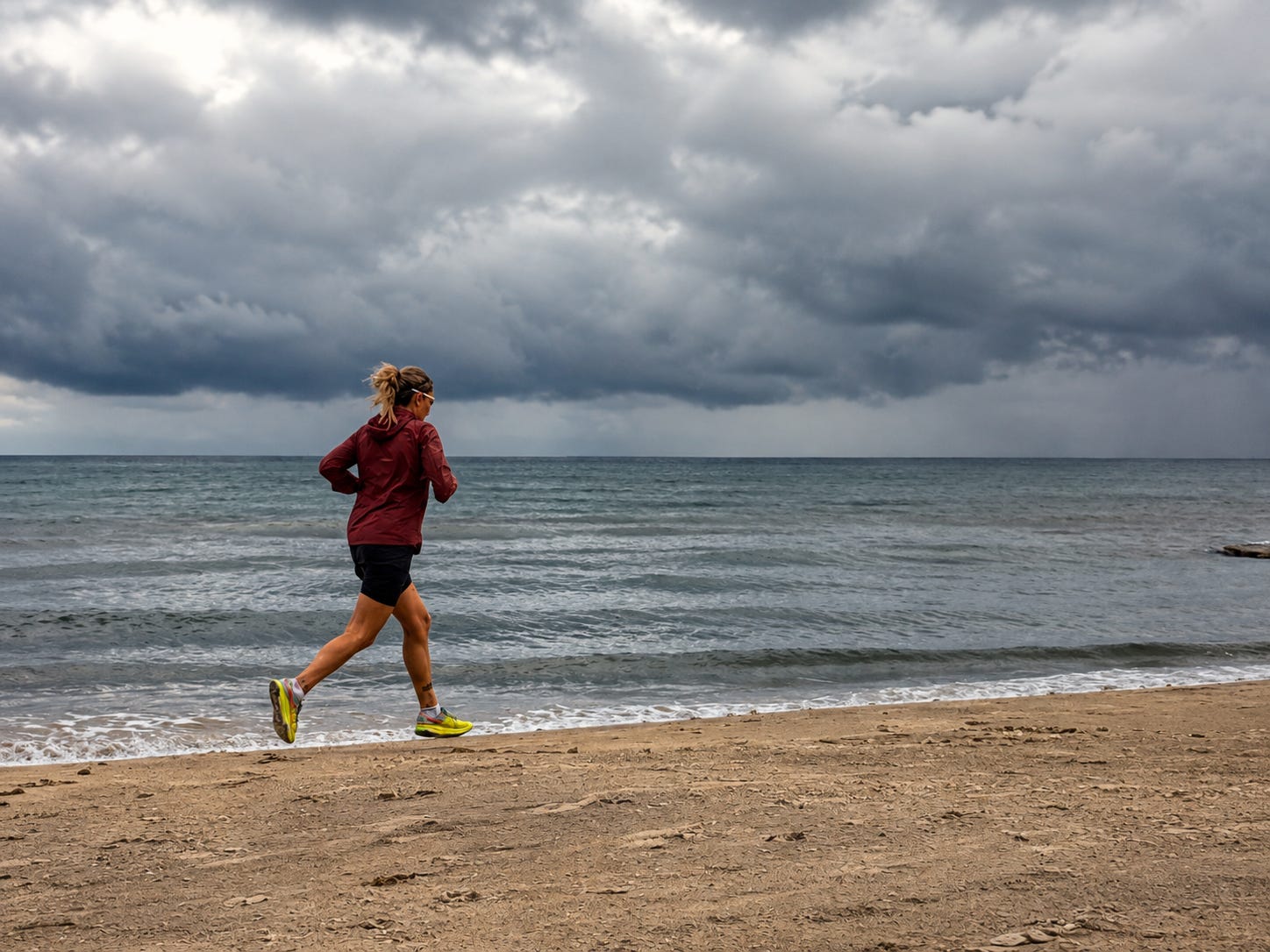
Suppose two people set off together. One runs comfortably at five minutes per kilometre, the other at six. The slower runner can speed up and, for a while, will probably manage to keep up. But after a kilometre or two, perhaps even after only a few hundred metres, breathing becomes harder, conversation disappears, muscles begin to burn, and all their energy narrows down to one thing: not falling behind.
You can do this for a while. You might even convince yourself that this is your new pace. But there is an essential difference between what you can sustain temporarily and what you can carry for a long distance. Eventually, no matter how hard you try, you will slow down, because you cannot run forever at someone else’s pace.
The adjustment in the other direction seems easier. The faster runner can slow down without running out of breath or feeling their body demand that they stop. But if they have to do it all the time, if they are always waiting or holding back the impulse to move ahead, eventually they too will feel that they are no longer running at their own pace.
Perhaps this is where synchronisation between two people begins: not when one pushes to keep up and the other holds back to wait, but when they find a shared pace that feels natural enough for both of them that neither has to give up too much of themselves in order to keep moving alongside the other.
That pace will not always remain the same, because neither do we.
Anyone who runs knows there are days when your legs seem to move almost by themselves and days when every kilometre is a struggle. On a long run with someone else, sometimes you are the one waiting and sometimes you are the one being waited for. Sometimes you pull the other person along; sometimes you let yourself be pulled. Synchronisation doesn’t mean two people moving at exactly the same speed all the time. It means being able to find each other again, despite all those changes, and settle back into a shared pace.
But pace — speed, in the language of the formula — is only one part of the equation.
There is also time.
Two people can find the perfect pace and still meet at a moment when one is ready to go a very long way while the other is only there for part of the journey. Sometimes the problem isn’t the pace. It’s the timing. And the fact that their time together was short doesn’t mean that the distance they covered together was worth any less.
Perhaps that is why I’m not convinced duration is the best measure of what happens between two people. You can spend ten years in a relationship that is flat, repetitive, or simply exhausting without feeling that you have moved very far at all. And you can have three intense, clear, full months in which something settles into place, something opens up, or something propels you ten steps forward.
Time measures how long it lasted, not the beauty of the journey.
Maybe physics did have something to teach me after all. Or perhaps endurance has its own way of taking formulas I never quite understood and turning them into questions about life.
We don’t have to run at the same speed. We only need to find a pace at which we can keep moving together without forgetting to enjoy the journey.
Pace decides how we move together. Time decides how long. And from the two comes the distance.
If these words resonated with you, subscribe.
And if you think they might help someone, share them.
See you on the road.
— Ioana
triathlete. nomad. writer. on the road.
Comments
Nothing yet. Say the first thing.
Sign in to join the conversation.