
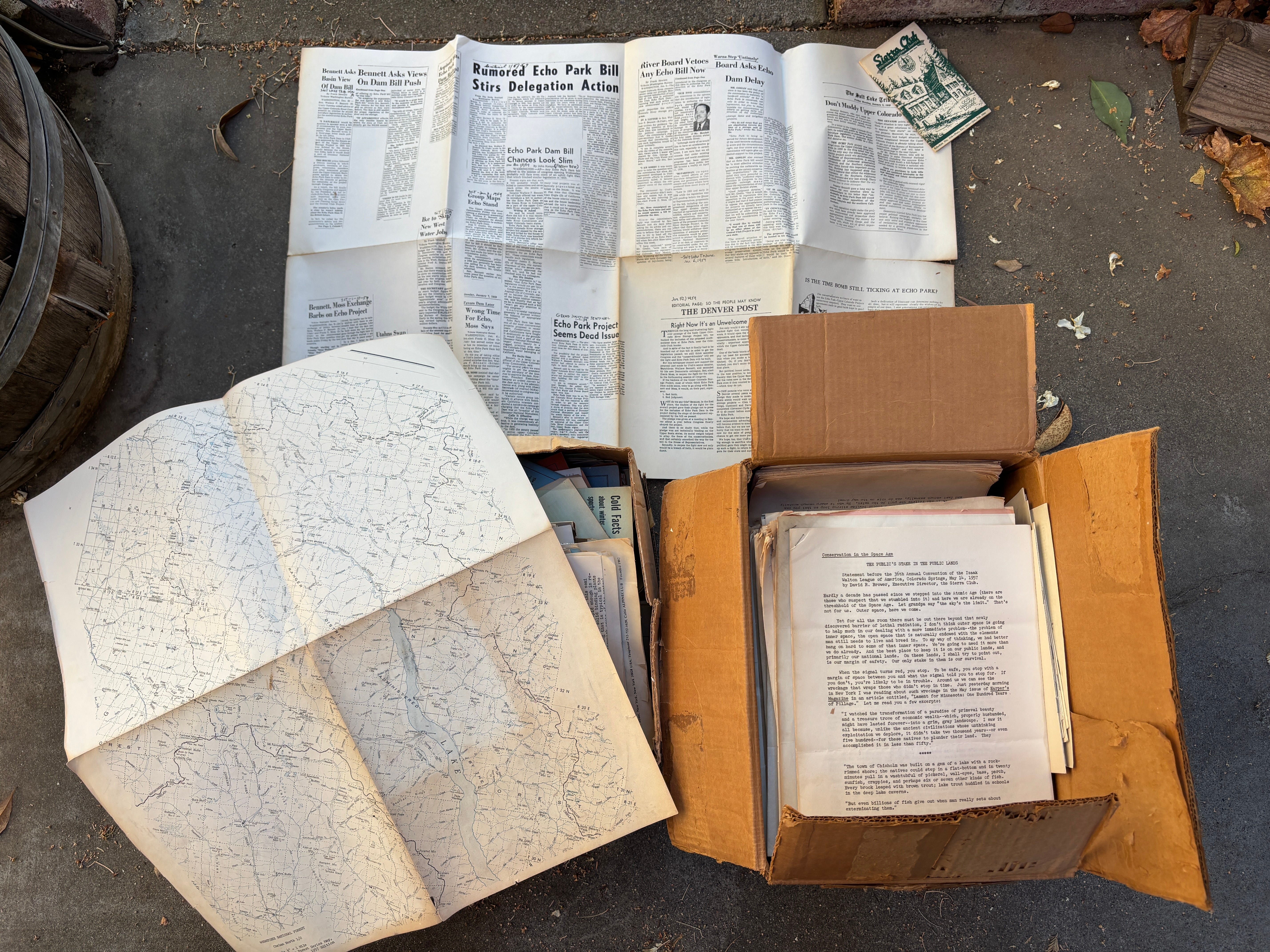
A couple of months ago, I went to an antique fair in Sacramento and came home with a few boxes of unsorted conservation papers (Sierra Club, American Alpine Club and more) from the 1960s and beyond. I found the boxes on a table, and I started talking to the vendor, who had little information about the contents, part of a larger collection of items he had picked from a storage unit he purchased.
The documents were rich in history: congressional testimony, maps, meeting minutes, pamphlets. He sold the four boxes to me for $1 each. Little by little, I’m starting to sift through them. More to come on what’s inside!
But for now, I wanted to share my excitement, tinged with a little unease. How analog it can feel to be poring over old documents, surrounded by an enormous amount of digital information and the availability of facts within seconds.
Over the past couple months, as I’ve moved deeper into book work and revisited my own research, I’ve been thinking a lot about archives, and more broadly, information and knowledge (especially as these things relate to water).
It’s a weird time to do anything involving knowledge generation. The economics of it are changing faster than we can keep up. Somehow, even the word “generation” has become loaded, with generative AI models crawling through centuries of creations.
But for all the information AI has to offer, I’ve come to the conclusion that, in many cases, it miraculously, somehow, still only peeks into our world, humanity, and shared history. For me, nothing illuminates this more than going through archival materials in person.
When I was starting as a journalist, one of the books that was important for me was James Fallows’ “Breaking the News,” a critique of the industry. In it, he discusses the “streetlight effect,” a cognitive bias that sends us searching for things in places where its the easiest, though not necessarily the most optimal.
In the example, a drunk person searches for his keys under a streetlight, even though he knows he lost his keys in a dark park nearby. He’s under the streetlight because it’s easy to go there. Journalists tend to do this, and I claim no innocence. They go where there is less friction and to trending topics where clicks are likely. This is rewarded in many ways by our attention economy, the pressures to produce content, and it is now reflected through (and amplified by) AI.
With so many calls to incorporate AI into workflows, I’ve been thinking about the cautionary streetlight metaphor. AI amplifies what we have seen under a light and it goes a step further, using existing data to interpolate and generate through the dark gaps. This can be legitimately useful in the appropriate setting. But I find it amusing when you Google something obscure and qualitative, and the AI Preview tries hard to come up with an answer, any certain answer, even if there isn’t one.
These gaps are a healthy sign. They reflect the reality that information comes from sources on the ground, not from the top down. There are things we don’t know, and some of what we don’t know has yet to actually be learned and absorbed. It’s sitting out of our peripheral view, maybe even in someone’s garage.
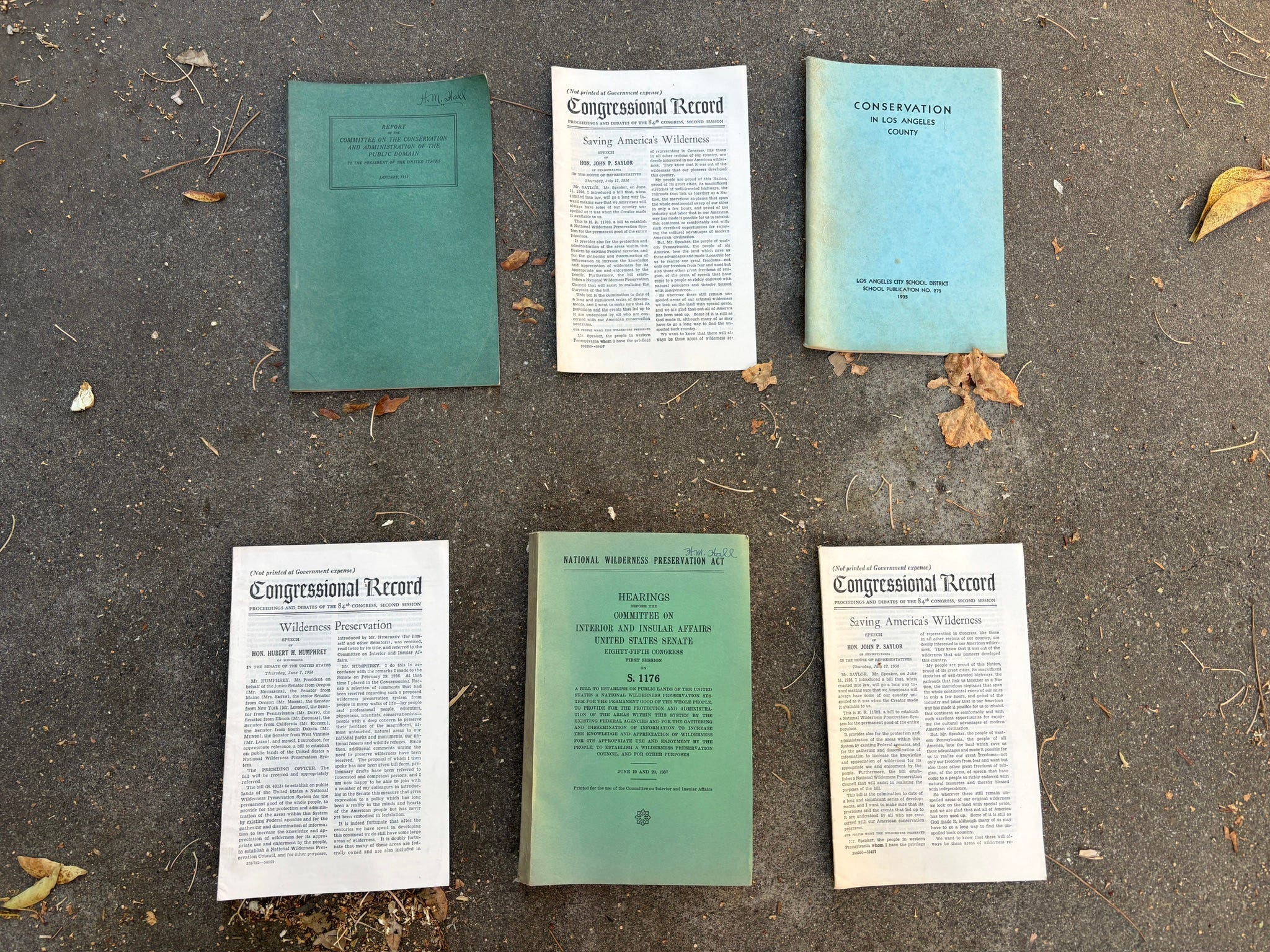
The boxes were a healthy and happy reminder of why, even if it feels analog or old-fashioned, the friction-filled, repetitive, and time-consuming work of documentary research still matters so much, maybe even more than ever. The truth is often messy, nuanced, and ambiguous, and it takes work to untangle data to better understand it.
That this data is distributed on the ground, in archives, in fading boxes, literal nooks and crannies, post-it notes, and letters is a feature not a bug. It takes going through these kind of documents to fill gaps and understand how we got to where we are.
In contrast to an AI search, you are not going to be guaranteed to come away from an archive with a clean and certain answer, which can be genuinely frustrating, but there is something democratizing about that, too. It means that information is spread out everywhere, even at antique fairs, and it takes work to go out and find it.
First, thank you for reading this far. And a fair question.
Along with other methods (interviews being a major one), documentary research can be a foundational in which you can understand how water flows and why. Much of the West, though not all, uses first-come, first-served roles to prioritize water. Under such rules, your right to use water literally hinges on historical timing and context.
The past weighs heavily on water rights.
In some cases, archival material like maps, letters, testimony, and journals can prove determinative of if you can access water, how much, and in what manner. But it goes beyond that. Archives of all sorts, whether they are sitting in a garage or are sorted at a library, provide texture, atmosphere, relational information, and a snapshot of the impulses, motivations, concerns of times, places, people, and geographies.
This is valuable in understanding water systems, because while they are governed by formal legal frameworks, they also bend to social, economic, and political pressures.
I’ve been lucky to visit a few library archives in the course of my work. I even had the special honor of being the first person to do research at the excellent UNLV Special Collections after they closed during the first COVID-19 lockdown.
The archive I visited that day focused on water in the Southwest not through the eyes of someone with power — lead negotiators of land sales and water exchanges — but from the periphery, through the lens of a devoted environmentalist. And yet that lens was immensely valuable in giving me a deeper understanding of the dynamics of the issue, far surpassing what a Google search (now AI search) could offer.
I’ve also had busts. A few years later, I visited a library to pull files on Miller & Lux, the industrial ranching corporation of the late-19th Century. I locked away my water bottle and went into the reading room. Hoping to find revealing correspondence, I sifted through painfully dull procedural telegrams. Another time, I ended up with folders of itemized receipts, and it was hard to find any immediate value.
Yet the time spent reading them did not go to waste. The cumulative impact gave me a sense of the tone, priorities, and context of a time period, which proved valuable in writing later on. I guess what I’m saying is, as I’ve been grappling with how AI should or should not be integrated into workflows, I’ve been reminded that friction often is a place where new learning happens. So on that note, never forget to keep on digging!
This is an important week in Colorado River management. The federal government is stepping in with cuts and a shortage plan after negotiators failed to reach a consensus deal on new rules to share the over-allocated river in a drier future.
This week, the Department of Interior is expected to release a framework intended to address shortages over the next decade, according to what has been reported. That 10-year framework is expected to include re-evaluation periods every two years.
The framework leaves open the possibility that states could still reach a long-term deal to reconcile the river’s historic overallocation of water rights on paper that do not match the realities of a shrinking annual supply. But, for years, the states have been threatening to take those core issues to court. And the framework may not forestall the possibility of a lawsuit among the seven states and water users in the basin.
The L.A. Times has a good piece on what you might expect:
The Times has learned that federal officials have agreed with an offer made earlier this year by California, Arizona and Nevada to reduce what they take from the river by at least 3.2 million acre-feet between now and the end of 2028.
Under the plan, California will cut its use of Colorado River water by about 12% through 2028, Arizona will take about 31% less and Nevada 28% less, according to two officials at state and local agencies who spoke anonymously since details of an announcement are still being finalized.
It will also be important to watch how these cuts are funded, the nature of the cuts (temporary vs. permanent), and the role of federal funding. With cuts in the past, Lake Mead has served as something of a bank account, where water can be saved to benefit the system as a whole and individual water users. It’s worth watching what happens to conserved water in the system, and how it is credited and accounted for.
POLITICO’s Annie Snider reports on a last-minute idea from the federal government to claim control over conserved water, allowing them to move water conserved from one state to another, “prompting mass anxiety among negotiators.”
If you have the time, this is an excellent breakdown on the state of play.
The West’s snow drought was bad. A warmer climate made it more likely. (KUNC)
Arizona’s San Pedro River runs dry for the second time in 122 years (Arizona Republic)
California Scientists Find Early Warning Sign of Irreversible Groundwater Damage (KQED)
Beavers in Las Vegas? A secret garden in Sin City spotlights river restoration success (Nevada Current)
No posts
Comments
Nothing yet. Say the first thing.
Sign in to join the conversation.