
[My apologies for the delay in updates. I’ve been busy working on my Invisible Universe book. More on that soon!]
Over the past year, many researchers and writers (myself included) have stepped forward to highlight the value of science, especially the kinds of studies that are difficult to pursue without collective, public support. Much of that value comes in the form of concrete societal impacts: We need detailed data and informed analysis to improve health and to address environmental threats, for instance.
But science is crucial, too, for its less tangible impact on our perception, our emotions, and our sense of values.
A scientific perspective cultivates a sense of wonder that enriches every part of our lives. That sense of wonder also functions as a bridge between the individual and society as a whole. The entire scientific enterprise makes more sense once you cross that bridge. Wonder links the most esoteric-seeming scientific investigations with simple experiences that are available to all of us, using little more than our focused attention.
Wonder is as accessible as looking up at the Moon in the sky.
I’d been thinking a lot about the Moon recently when I was invited to give a presentation at Innisfree Garden, a delightful sculpture park and stroll garden in Millbrook, New York. The curator at Innisfree invited me to give a presentation at one of their evening skywatching events and asked what I wanted to talk about. I chose to talk about the big, bright rock hanging above us. This column builds on some of the ideas I shared during my talk.
The Moon is such a common sight that we rarely stop to think about how marvelously strange it is. The more attention you pay to it, though, the stranger and more intriguing it becomes. (You can keep tabs on the phase and location of tonight’s Moon at this NASA site.)
Earth’s natural satellite is an endless source of wonder. All you have to do is look up, open your eyes, and open your mind.
That is One Weird Rock
Behind the Moon’s familiar face (is it a man? a woman? a rabbit?) lies a whole collection of oddities, each of which leads to its own fabulous path of discovery.
For starters, it is odd that we have a moon at all. Among the other inner planets, Mercury and Venus have no moons at all, and Mars has only two tiny satellites, possibly captured asteroids. The Moon is nothing like them.
It is odd, too, that the Moon is so large. Jupiter’s biggest moon is about 1/30th its diameter. Uranus’s biggest moon is about 1/30th its diameter. Our Moon is more than 1/4th the diameter of Earth. The moons of the giant planets almost certainly formed along with them, much as they formed along with the Sun. That doesn’t appear to be the case for the Moon.
The dynamics of the Earth-Moon system suggest that the two cannot have formed together. Chemical evidence from the Apollo lunar samples, on the other hand, argue that the Earth and Moon cannot have formed separately. So where did the Moon come from?
In 1946, more than decades before Apollo 11, a Canadian geologist named Reginald Daly proposed that the Moon might have formed as a result of a “tangential, slicing, collision” between the early Earth and a large “planetoid.” This conjecture, known as the giant-impact hypothesis, is now regarded as by far the most plausible explanation of the Moon’s origin.
(During his lifetime, incidentally, Daly was much better known for his work mapping the geology of Canada along the 49th parallel and for studying the structure of Earth’s crust. Breakthrough ideas are not always obvious at the time.)
In its modern version, the giant-impact hypothesis holds that a Mars-size protoplanet, called Theia, collided with Earth soon after its formation 4.5 billion years ago; I’ve included a computer simulation below. The impact would have liquefied the outer layers of our planet and ejected a mix of Earth and Theia material into orbit, some of which then coalesced into the Moon. Some remnants of Theia may also still exist deep inside Earth, evident as anomalous “blobs” of rock sitting just above our planet’s core.
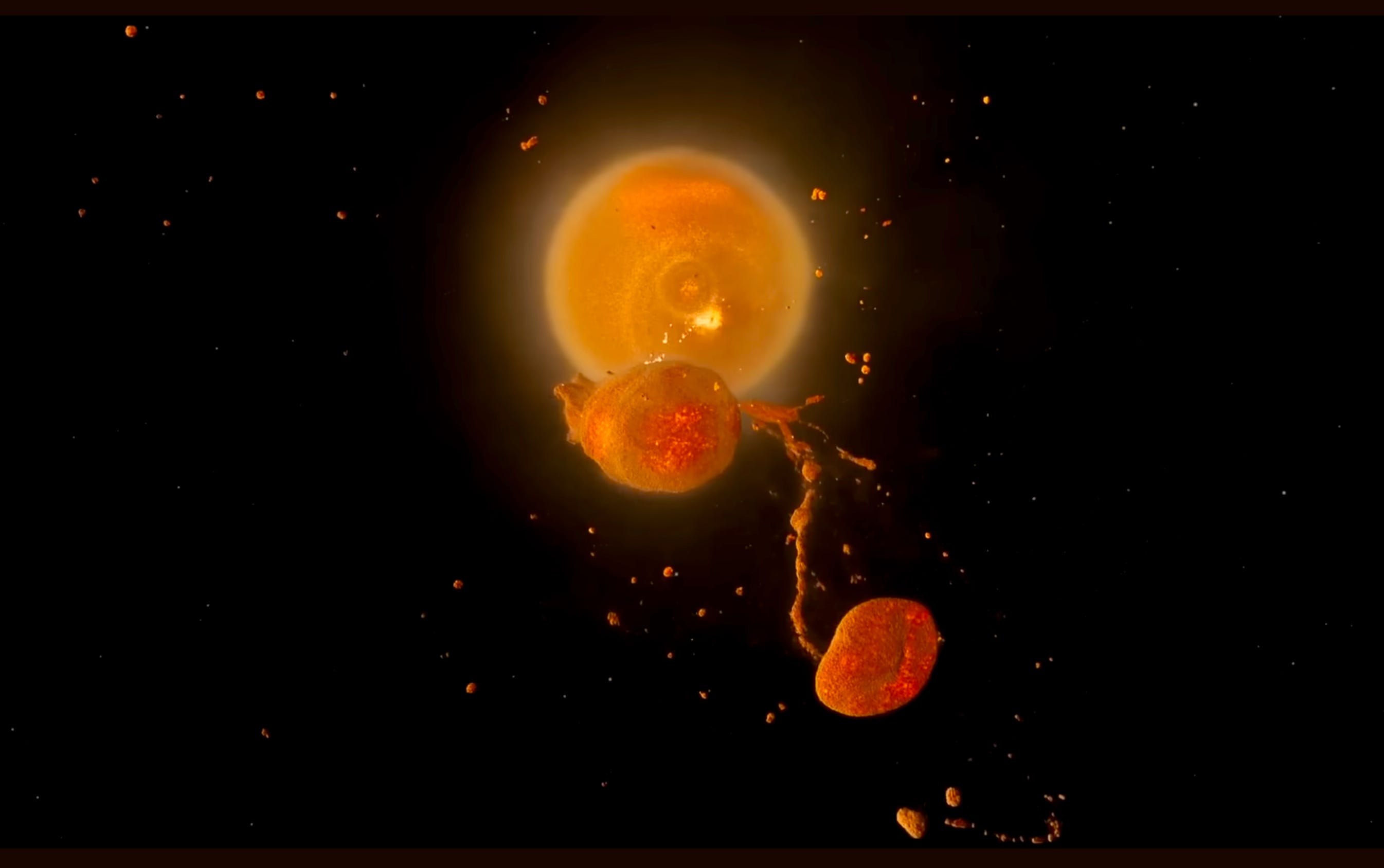
The giant-impact hypothesis has two notable implications. First, it indicates that the early solar system was a messy place, rife with collisions and catastrophes. That image fits well with the modern understanding of how planets form. Other giant impacts might have stripped off much of Mercury’s crust and knocked Uranus sideways. Current models of the early solar system indicate that one or more planets might have been ejected entirely, sent off to wander on their own through our galaxy.
Second, the giant-impact hypothesis indicates the huge importance of contingency. As it happened, Theia struck our planet and created the Moon. If its orbit had been slightly different, it might have struck Venus instead. What would Earth be like in that case? The exact answer is unknowable, but it’s safe to say that our world would be very different than it is today—quite possibly not habitable at all.
The Moon is a reminder of how lucky we are.
Could We Live Without It?
Long after its formation, the Moon has continued to influence our planet. A few scientists (along with a lot of eager journalists) have gone so far as to suggest that life could not exist here without the Moon. That seems unlikely, but you cannot avoid feeling the role of the Moon in your daily life.
If you live near the shore, you experience a twice-a-day cycle of high and low tides that are primarily caused by the gravity of the Moon. There would be solar tides regardless, but the Moon’s influence is significantly greater. Lunar tides were even stronger early in Earth’s history, when the Moon was close to us. That stirring of Earth’s oceans undoubtedly had an effect on the evolution of ocean life, though how much of an effect is a matter of considerable debate.
Even if you are far from the ocean, you feel the consequences of lunar tides all the time. Over billions of years, those tides have slowed Earth’s rotation, giving us our 24-hour day. Without the Moon, the day would be much faster. The pull of the Moon also seems to stabilize the tilt of Earth’s axis, keeping the pattern of seasons relatively constant over geologic time.
Without the Moon, the day would be significantly shorter, and Earth’s climate might go through much more extreme cycles. Once again, it’s impossible to know how that might have changed life on Earth, but you can safely assume that the events leading up to the emergence of humans would have been different…or maybe nothing quite like us ever would have evolved.
By chance, the Moon happens to appear almost the exact same size in the sky as the Sun. That coincidence is not in any way essential to human life, but it undoubtedly has had a profound influence on human society. Every religion and mythology has taken note of solar eclipses, when day turns to night. Eclipses helped guide the development of early calendars, as did the cycle of lunar phases. More recently, a solar eclipse in 1919 was instrumental in establishing the validity of Einstein’s general theory of relativity.
The Moon is a reminder of how many different paths our lives and our culture could have followed.
Bashes and Flashes
Take a look at the Moon through a small telescope or a simple pair of binoculars and you can see that it is covered with impact craters. Heck, you don’t even need any optical aid. Just glance at the dark markings of the lunar “seas.” Those are ancient lava flows that formed around the locations of ancient impacts.
There is nothing uniquely vulnerable about the Moon. Earth has been struck by asteroids just as often. More often, in fact, since it is a larger target with a stronger gravitational pull. (And no, the Moon does not act as a shield protecting us from impacts; just look at how small it appears compared to the rest of the sky and you can see why that idea makes no sense.)
When you glance at the Moon, then, you get an instant visual summary of how vulnerable we are. We don’t see craters all over the Earth because our atmosphere vaporizes small rocks before they hit the ground, and out dynamic planet—plate tectonics, weathering, and the action of life—erases even giant impacts over millions of years. But yes, we have been struck repeatedly. Just ask your local Tyrannosaurus rex.
And the hits keep coming. NASA’s Lunar Reconnaissance Orbiter, which has been circling the Moon since 2009, has documented the formation of hundreds of lunar craters, some as large as 20 meters (60 feet) wide. That’s right: We can now see brand-new craters as they form!
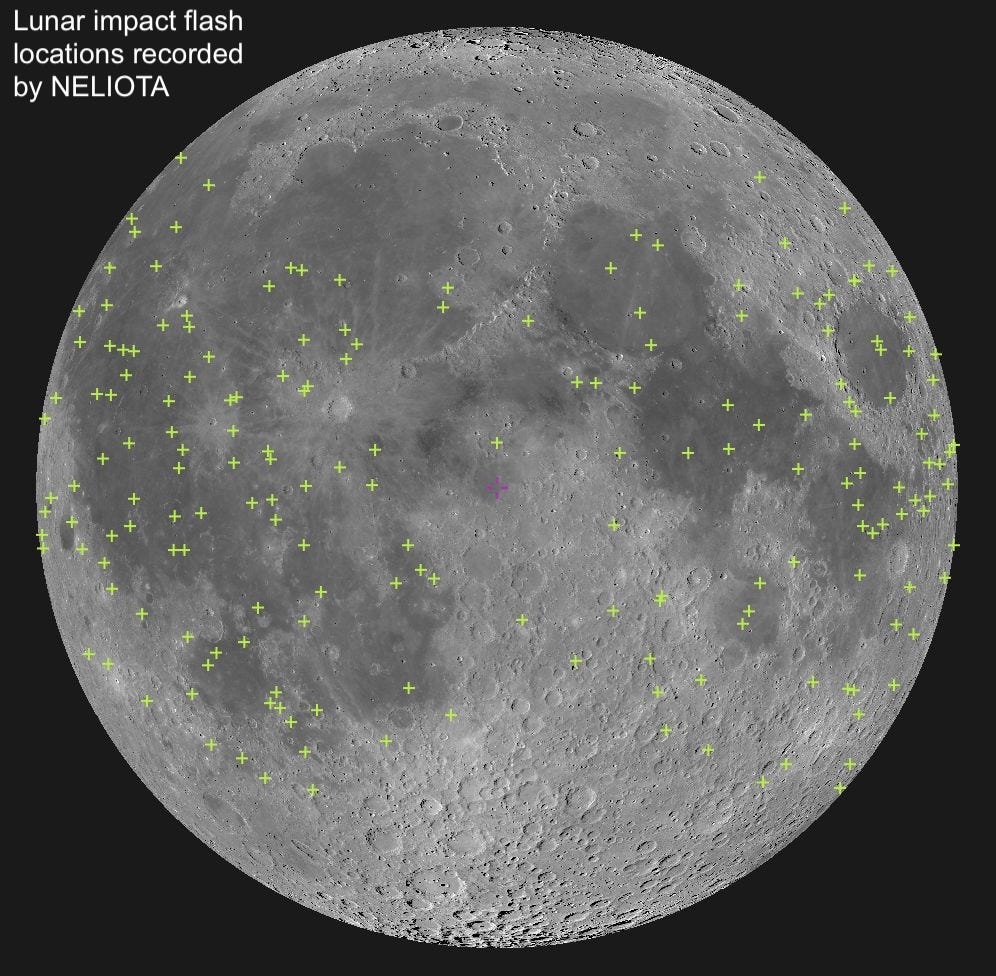
We can even witness the impacts as they happen. A golf-ball-size meteoroid packs enough kinetic energy to vaporize a bit of the lunar surface and generate an incandescent flash of light that can easily be seen from Earth. NASA and the European Space Agency now have dedicated programs to monitor the Moon for such impact flashes. The ESA project, called NELIOTA, has mapped 204 impacts over the past 8 years (see above), or about once every 2 weeks.
Now that we know what to look like, amateur astronomers are capturing more and more lunar impact flashes with their cameras as well. One unusually large impact, in 2013, was bright enough that it could have been seen with the naked eye from Earth—assuming someone was looking at just the right place and time to catch the split-second event against the bright surface of the Moon.
What is striking (bad pun, sorry) about these observations is how easy and obvious they are. Impact flashes happen all the time on the Moon. To bring them into view, all we had to do is watch the Moon closely, using dedicated observatories and smart image-monitoring software.
You can see small, incoming space rocks all the time on Earth, too. On our planet, they disintegrate in the atmosphere, safely depositing their energy dozens of kilometers above your head. Fortunately, that’s the kind of solar system we live in: Harmless impacts happen all the time, but large, life-threatening impacts are extremely rare.
Still, the risk of a major impact is not zero, which is why astronomers have set up sky-monitoring cameras, designed an asteroid-surveying space telescope, and studied how to deflect potentially dangerous objects out there. Consider that one more message of wonder: We live in an endlessly dynamic universe but, by using our clever human brains, we can protect ourselves from danger and find beauty and insight in the chaos.
Something to think about the next time you look at the Moon.
No posts
Comments
Nothing yet. Say the first thing.
Sign in to join the conversation.