
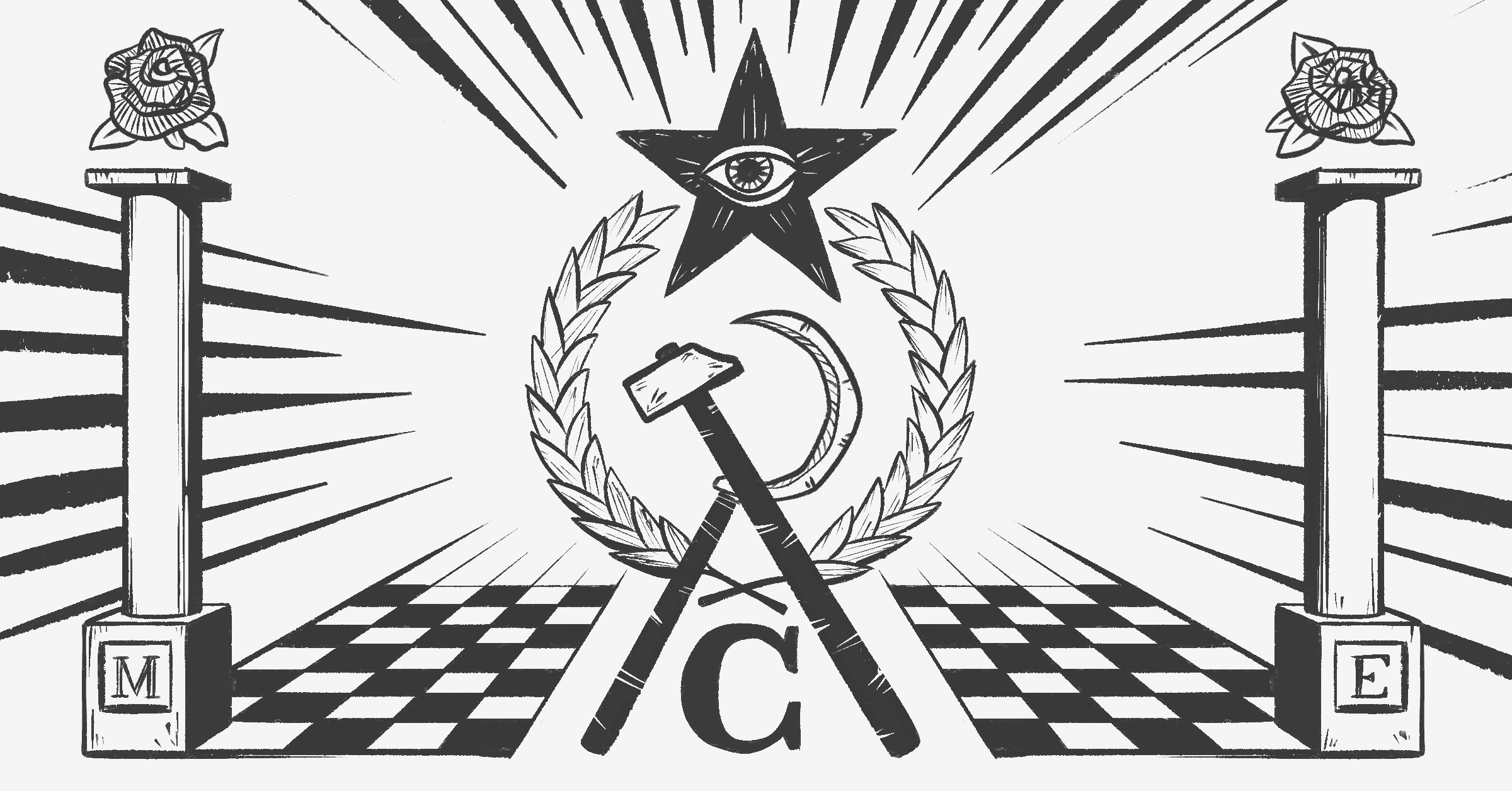
As you know, I’ve been interested in secret societies lately. When we think of fraternal societies in the United States, we generally think of the eccentric social clubs of which there were once so many, in which upwardly mobile middle class men would cement their status and strengthen their social bonds through the age-old method of doing ridiculous things and pretending to take them seriously.
Vivian Gornick studies a very different sort of fraternal organization in her classic work of oral history, The Romance of American Communism. On its face, the Communist Party of the United States may bear little resemblance to groups like the Elks or the Oddfellows: it was a political organization, and not a social one; the bulk of its members’ time was therefore spent in political work rather than in networking or hazing rituals; it had a centralized leadership and enforced party discipline; and, unlike just about all of those social clubs, it was never segregated by gender or race.
But Gornick’s book has little to say about the Party’s political history: it doesn’t dwell on the ins and outs of its policy or its campaigns. Instead, Gornick explores the impact that membership had on the emotional lives of its members and presents a fascinating portrait of the psychological effect that membership to such a party had on individual lives.
The experience was not always a positive one. After Stalin took control in Russia, the international Party became tied to the national interests of an authoritarian government. The hazings that were carried out — struggle sessions and internal trials — were performed not to form and strengthen social bonds but to enforce party discipline. Most incredibly, at one point the entire middle layer of Party leadership was ordered to “go underground” — abandoning their lives and families, they took new identities, and drifted from place to place like ghosts. Almost all of the former members interviewed by Gornick left the Party when the repression of Stalin’s rule became impossible to ignore. For most, the moment came with Nikita Krushchev’s “Secret Speech” denouncing the crimes of Stalin’s regime in 1956.
And yet, no matter what else they experienced as members or the terms on which they left, Gornick’s subjects express an almost universal nostalgia for the unity and sense of common purpose that their affiliation granted them. In their descriptions of the “integration”, “connection,” and “wholeness” that they felt as members of the Party, the sense of loss is inescapable:
“The years when I was a Communist, bar none, were the best of my life. The relation for me between the personal and the historical was intense, deeply felt, fully realized. Now, I live an entirely personal life, removed from the larger world… I’ve made my peace with my life, but I have no illusions that I live a life of larger meaning.”
This sense of connection extended not only to each other, but to the world, and to what they called “the throttle of history.” Jim Holbrook lived in poverty in rural Nebraska, Kentucky, and West Virginia; but as a member of the Party, he tells Gornick how he felt himself “piped into Joe Stalin!” “You were at the end of a long line,” he says, “but you were at the end of a line.”
Set aside for a moment that this direct line communicated only one way, or that anyone who succeeded in attracting Stalin’s attention would probably regret having done so: bask in the power of that sense of connection. Who — other than another politician or a corporate lobbyist — could even pretend to believe that they have a line to Joe Biden? The elected president of a constitutional democracy, he is as distant from us as the King from a medieval ploughman.
These testimonies provide a sharp contradiction to the stereotype of the political activist as a dogmatic automaton. A former slaughterhouse worker portrays his conversion in terms of a spiritual — perhaps even a physical — rebirth, as if awakening not meerely class consciousness but consciousness itself: as if “I’d never seen anything before, and now all of a sudden I was seeing everything.”
It shouldn’t come as a surprise, therefore, that the collapse of the Party brought an equally violent transition. Having experienced such an intoxicating sense of connection to the world, for many the loss brought with it a crushing and tragic feeling of diminution. As one former member put it:
“People now long for community, they’re dying for lack of it. Community can’t be legislated. It’s an organic sense of things that comes up out of the social earth. It’s a commonly shared ideal. That’s what it is. Nothing else will ever create community. And we had it. We had it in every conscious as well as unconscious response to ourselves, to each other, to the world we were living in, and the world we were making. Right, wrong, errors, blind pro-Sovietism, democratic centralism, the lot notwithstanding. In our lives, as Communists, we had community. We had integration. We had that civilizing sense of connectedness, it’s the heart and soul of all civilized life. It wasn’t just good wine in our veins, that life, it was ambrosia.”
Margaret Thatcher famously claimed that there was “no such thing” as society. But increasingly, I wonder if the reverse may be true: not that there is no such thing as an individual, but that no individual can exist apart from the functions that a society provides. We cannot generate meaning or value or purpose as individuals, but only as members of a community; and if no real community of reciprocal relationships presents itself, then we react destructively, like an animal beating its head against the cage of a Victorian zoo.
I recently met a man who works as a “retirement longevity and transition coach.” His work, which he described to me enthusiastically and in great detail, appeared to involve scheduling social and physical activities for people who retire young from the financial industry, like a camp counselor for adults. My heart welled with sadness to picture these strange, broken creatures who have all the money in the world, but who need to pay a stranger to take them to play pickleball.
Probably you’ve been inspired to foster a feeling of community by sharing this post:
In a hyper-individualized society, even the crisis of isolation is diagnosed in individualized terms. Through socializing and exercise, the retirement coach offers to extend his clients’ lives. But for the sense of alienation, for the loss of that feeling of agency over one’s life and one’s society and history itself, he can do nothing. Indeed, by turning that hunger for community into one more financial transaction, he’s almost certainly making it worse.
Conversation and exercise are all very well, but I don’t think anything can replace that sense of living “a life of larger meaning” that derived not only from being in a group with people, but from playing an active role in the motion of history. Today, only the hopelessly deluded could feel that their hands are on the throttle of history, and we suffer from the loss.
No posts
Comments
Nothing yet. Say the first thing.
Sign in to join the conversation.