
My son loves playing video games. His favorite one is Minecraft.

The goal is to kill the ender dragon. You don’t beat the dragon in one move. The fight sits at the very end of the game, and getting there is a long slog of mining, trying, and dying, again and again.
Almost everyone’s first dragon kills them, because nobody tells you it heals itself off the crystals sitting on top of those pillars. So you respawn. You bring more arrows this time. You shoot the crystals down first, then go after the dragon. Try, watch what happens, change the plan, go again.
This is an agentic loop:
The goal is clearly defined
You play and try different options to reach that goal.
You observe the result. As long as the goal is not reached you keep playing.
That first sentence is not a detail. You have a measurable and clear success condition.
So what’s the problem?
The cleanest example of an agent that genuinely works is one a lot of us already have: Claude Code/Cowork.
You give it a clear and measurable goal. Build me a landing page with these three sections, a working email signup, a dark-mode toggle.
Then it goes. It writes the code, runs it, hits an error, fixes the error, runs it again, checks the toggle, and keeps looping until the thing works. You didn’t stand over each step. You set the goal and it closed the gap.
The secret of the agent is the combo of goal and loop.
Why does this work so well?
Because software comes with a dead-dragon moment built in. The tests pass or they don’t. The button works or it’s broken. Success is a hard fact you can check, so the agent always knows whether it’s finished or needs one more loop. Tests going green is its version of the dragon falling out of the sky.
That’s the secret. Agents shine where the finish line is concrete and a machine can check it without a human squinting at the screen.
When we look at what an agent is, in Claude, it can be shown like this:
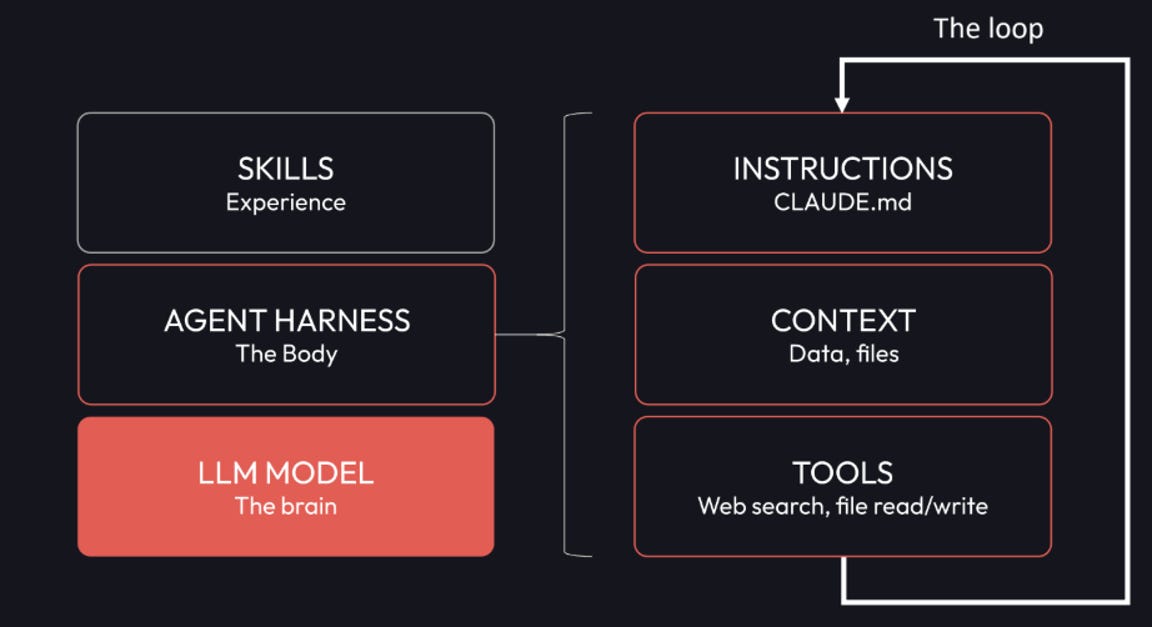
Claude Code, OpenClaw, Perplexity Computer are all agent harnesses.
You use them to build and do stuff.
But building a company where each C-level suite is an agent is hype. Automating my entire workflow with agents is hype.
As I’ll show you below, you don’t need agents to fix everything.
Let’s dive deeper.
Here’s a system I run.
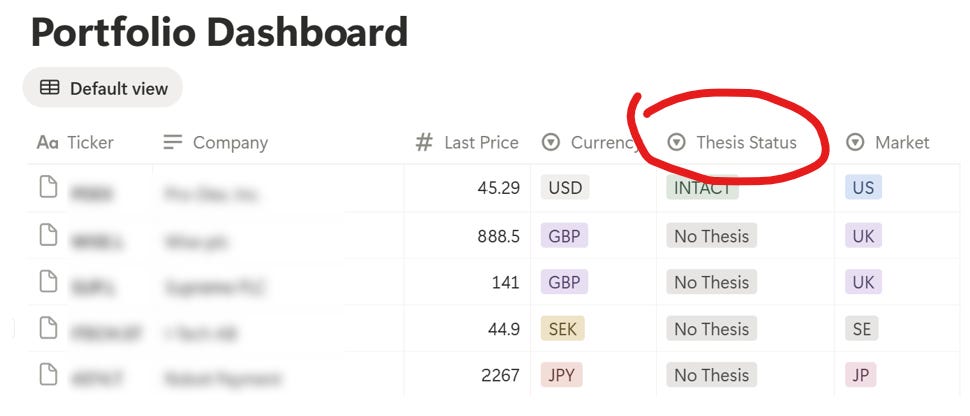
Every Monday at 7am a job fires on my Mac Mini. It pulls every new scrap of information on every stock I own: filings, insider trades, earnings, the news flow. It updates a file for each company, lines that file up against the thesis I wrote the day I bought the stock, and tells me one of three things.
The thesis is intact.
It’s under stress.
Or it’s broken.
No babysitting. No loop, I have to sit and watch. It runs, it writes its report, I read it with my coffee.
This is a skill, not an agent. It runs the same recipe every week, and that sameness is exactly why I trust it. (you can learn how to build a skill here)
It’s predictable. When it does something odd, I can open it up and see why. It does the boring, heavy data work and hands me back the one piece that actually needs a human: what do I do about a stressed thesis?
That call is mine.
It’s my money.
I don’t need an agent here. That skill is doing all the work.
Anthropic defines agents as follows:
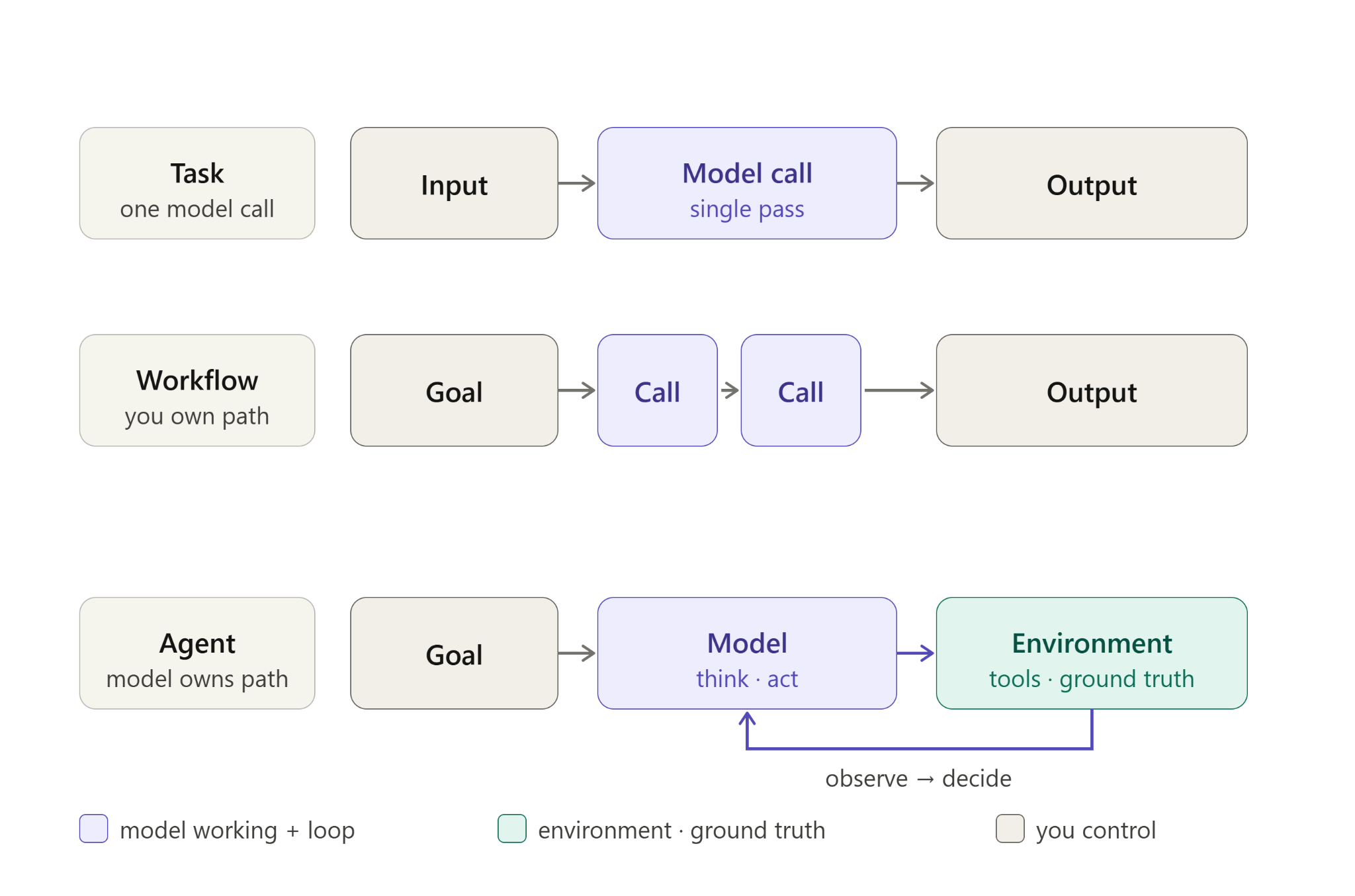
Let’s break down the above schematic with an example: Producing an equity research report
Single task: You prompt to create a report on a company. The model gets called and delivers you an output. This is what most people do.
Workflow: The goal is: A structured output of an equity research report. The model will act on a list of instructions. At a certain point, you will get your report. This is a Claude skill like the example you’ve seen above.
The agent has a loop where it observes and decides. The model will choose the actions it needs to achieve the goal. Just like my son, he will try, fail and try again.
The big difference is that it will monitor its environment and reloop if necessary.
A build agent will produce an output just like a skill
An optimization agent will monitor some variables and keep looping
A typical example of an optimization agent: A landing page agent which reads visitor and conversion data, and which will continue optimizing and changing the landing page until a certain conversation rate is met.
For equity research, an optimization agent is a lot more difficult to design.
We talk about loops and goals here, but there are not to be confused with the /loop and /goal command in Claude Code. The principles are similar though.
Strip the hype off and the rule is simple. You need an agent when two things are true at the same time.
The goal is concrete. You can say what “done” looks like before you start.
And you can check “done” without yourself in the room. The system has its own dead-dragon moment.
For a while I tried to talk myself into upgrading my skills into an agent. Let it go investigate the stressed names on its own. Let it draft a sell call, set a price target. But the skill already pulls the data. It already does the evaluation. So what does the loop actually add?
More moving parts. More ways to break. A judgment call (”should I sell?”) that looks autonomous, when I’d override it half the time anyway. There’s no dead-dragon moment in selling a stock. There’s just me, deciding.
If you only learn how to build high quality skills, and maybe automate them so that they run automatically, you’ll cover probably 80-90% of your needs.
And these are not agents. These are automated structured workflows.
A true agent is much harder to build. So you would be spending a lot of time to cover 10 or 20% of your remaining needs.
Most people building agents right now are solving the wrong problem. They’re trying to automate judgment, the one thing that’s actually theirs to keep, instead of building better tools to support it.
Always make sure you steer the machine. Claude prepares. You judge. Especially in equity analysis, this is important.
So focus on building high quality skills. Add structure. Add depth. Don’t focus on building your Warren Buffett agent that runs an entire analysis without you.
It’s a waste of time.
Here’s our previous guide on how to build skills.
There are skills, and then there are institutional grade skills that you can actually use for equity analysis.
I’ll write about the difference between them in the future.
May the markets be with you, always!
Kevin
No posts
Comments
Nothing yet. Say the first thing.
Sign in to join the conversation.