
This time, a completely different perspective on investing. And for a change, within the borders of our homeland, with options on Dutch stocks . We attempt to explain the how and why in the text below. Furthermore, we can say that we are very enthusiastic about this type of option and are on the hunt for more stocks where this is a good opportunity.
Stocks and bonds
Dividend:This actually has a negative effect on the call option in the long term. After all, the option price decreases with every payout. However, because investors buy the stock for the dividend, we believe that this effect will be offset by a higher share price in the future, as more investors are willing to pay a higher price for the coming years. Furthermore, the stock market rises by an average of 7% per year, so provided we do not experience serious crises, the capital gain will equal the dividend payout.
Share buyback: Is very favorable for a long-term call option. After all, the buyback reduces the number of shares, which increases earnings per share. As a result, investors will be more inclined to buy the stock, leading to a higher share price. A higher price means a higher price for our call option.
Debt reduction: This is also very beneficial for the option premium. This is because earnings per share increase simply because fewer costs are incurred in repaying the debt.
In short, these three can be summarized by the term SHAREHOLDER YIELD. We have written several articles about this in the past, which you can probably find on the website if you are interested.
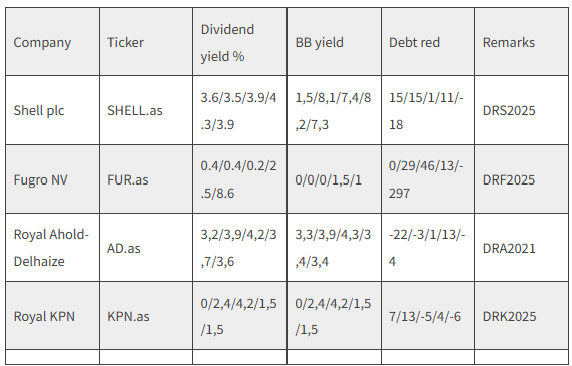
We analyze Shell, KPN, Ahold-Delhaize, and Fugro. In the following table, listed next to each figure is the dividend yield, the percentage of share buybacks (BB-yield), and the debt reduction (Debt red). The figures are for the period 2021–2025 and are presented in chronological order.
Remarks:
DRS2025: In 2025, Shell has increased its debt for the following reasons:
1. Large expenditures on shareholders (buybacks + dividends). Shell increased its debt despite strong cash flow because it made very large capital distributions: $3.5 billion in share buybacks in Q2 2025 and $2.1 billion in cash dividends in the same period. These expenditures exceeded the free cash flow Shell wanted to preserve, causing net debt to rise.
2.Lease additions through acquisitions (including Pavilion Energy). Shell’s net debt increased partly due to lease additions: $1.3 billion in lease additions, primarily from the Pavilion Energy acquisition. Lease obligations are included in Shell’s net debt, causing the debt position to rise automatically. Furthermore, we believe the company was preparing for the acquisition of Arc Resources.
3. Loan drawdowns due to Nigeria divestment. Shell raised additional financing for transactions involving Nigeria: Loan drawdowns related to the Nigeria onshore divestment. This temporarily increased the debt.
4. Accounting post-tax loss (NL pension fund adjustment). Shell warned of an additional increase in gearing due to: $4.654 billion post-tax loss from a Dutch pension fund adjustment, which would increase gearing by +0.4 percentage points. This is not “real” cash debt, but an accounting obligation that increases the debt statistics.
5. Strategic debt restructuring (2025 debt exchange). Shell carried out a major $6.35 billion debt exchange: $6.22 billion in European debt was moved to the US finance subsidiary. Goal: optimize capital structure, better align debt with revenue locations.
Companies and industry
DRF2025: In 2025, Fugro has increased its debt for the following reasons:
1. Free cash flow plummeted deep into the red (–€437 million). Fugro posted a negative free cash flow of €437 million in 2025. This is the main reason that debt exploded. Negative FCF means: Fugro had to borrow to finance operations and debt increases.
2. Revenue fell sharply due to offshore wind collapse (–€427 million). Revenue decreased by €427 million, of which €380 million was directly due to the crash in offshore wind. Lower revenue means less cash, resulting in higher debt.
3. Capex was extremely high (€248 million). Fugro invested €248 million in 2025, much higher than normal. High investments + low revenue = additional financing requirement, causing debt to rise.
4. Operational cash flow collapsed (from €405 million to €175 million). Operational cash flow before working capital fell from €405.8 million to €175.3 million. This is a halving; Fugro could no longer finance capex internally, causing debt to rise.
5. Working capital increased (fewer advance payments, more project delays). Fugro reported higher working capital, which further weakened cash flow. More working capital = money tied up in projects = additional debt.
6. Backlog decreased (–5.7%), less future cash certainty. The order book fell to €1.396 billion, –5.7%. A lower backlog means less cash visibility, leading banks to demand higher buffers, causing debt to rise.
7. Structural market downturn in renewables (from 38% to 26% of revenue). The contribution of renewables fell from 38% to 26%. This is a structural decline; Fugro had to reorganize, and costs and debt increased.
DRA2021: Ahold Delhaize increased its debt in 2021 for the following reasons:
1. Major investments (Capex €2.4 billion). Ahold reported €2.4 billion in cash capital expenditure in 2021, a very high level for a food retailer. This included: expansion of online capacity (bol.com, e-commerce fulfilment), store renovations, supply chain automation, and IT infrastructure.
2. Acquisitions that required additional financing. Ahold made several acquisitions in 2021, including: FreshDirect (US), 71 stores from Southeastern Grocers (Food Lion), and 38 DEEN stores (NL).
3. Major one-off payments (pension & tax). Ahold had strong operational cash flow in 2021 but had to pay two large one-off items: €170 million for a US pension liability and €380 million for a disputed tax claim. These payments were made directly from cash flow and reduced free cash flow from €2.2 billion to €1.6 billion.
4. Online growth required additional financing. Online revenue grew 38.2% in 2021. This required: additional fulfillment centers, higher logistics costs, and more IT investments.
5. Strategic choice: shareholder policy. Ahold implemented a €1 billion buyback program in 2021.
DRK2025: KPN increased its debt in 2025 for the following reasons:
1. Higher interest expenses (due to rising interest rates), resulting in lower FCF and higher debt. CFO.nl reports that free cash flow decreased in Q2 2025 due to higher interest expenses.
2. Higher tax payments put direct pressure on the cash position. The same source indicates that higher taxes lowered the FCF.
3. Working capital deteriorated (timing of payments & receivables). CFO.nl explicitly states that a temporary imbalance in working capital put pressure on free cash flow.
4. Very high investments in fiber (Capex €592 million in H1 2025). In H1 2025, KPN invested €592 million (20.5% of revenue) in infrastructure, primarily fiber.
5. Acquisitions (Youfone, Althio) with integration costs + financing. The EBITDA growth in 2025 was partly due to acquisitions (Youfone, Althio).
6. Buybacks (€250 million program), this results in higher debt. KPN announced a €250 million share buyback for 2025.
Shellis the king of share buybacks. It also regularly reduces its debt, unless there is a good reason to do so. The dividend is reasonably high and is increased slightly each year. The latter could be unfavorable, but we believe the effect is not too severe. This makes this stock the best of the 4 stocks to buy as a long-term option.
Fugro.Looking at the figures, this company is holding its worst cards. Nevertheless, we expect the biggest share price explosion here. Why? The negative sentiment surrounding the company has passed its peak; we believe that they are slowly putting their house in order and that oil will become the company’s largest sector, where it has traditionally excelled. Furthermore, infrastructure will contribute the necessary revenue.
Ahold . The motto here is that food products always do well. So if you can get cheap options, you can simply buy them. The company is buying back its own shares, which is favorable for an option. Furthermore, it has a reasonably good dividend; this can work against the option, especially if sales in the USA disappoint, putting pressure on the share price in the coming years. They take on debt to make acquisitions; this is good, as they are inclined to pay it off in the years that follow. After Shell, we consider this the second best stock to take out a long-term call option on.
KPN. This telecom giant is also buying back enough of its own shares to have a positive effect on long-term call options. The company also only takes on debt when making acquisitions; otherwise, it is generally inclined to pay off the debt. It is worth noting, however, that this is necessary given the level of total debt is quite worrying. Everywhere we find the third-best stock for buying long-term options at the moment; furthermore, the options are also very low in price.
Volatility = the spread of possible future prices. The greater the spread, the greater the chance that the price will end well above the strike price. For a call, this means: a greater chance of a large profit and no additional downside (losses remain limited to the premium).
Why the effect is much greater on long calls: In Black-Scholes, the Vega (volatility sensitivity) is:
Vega=S⋅T0,5⋅N′(d1)
Where: T = time to expiration and N’(d1) = probability density. Important: Vega rises by √T, so: 1 year → √1 = 1; 5 years → √5 ≈ 2.24 and 10 years → √10 ≈ 3.16. A 10-year call reacts 3 times as strongly to volatility as a 1-year call.
Why long calls are almost becoming “volatility assets” : With long maturities: time value dominates, intrinsic value is low, and volatility determines the price almost entirely.
Volatility increases the premium of a long-term call extremely strongly, because the time horizon is large enough to convert the extra uncertainty into a much greater chance of a high payoff, and Vega grows by √T. As a result, buying during low volatility is truly an advantage.
Time is the enemy of a call option, as it eats away at the premium, so to speak. Every day, the option Greek Theta eats away a very small amount. Therefore, if the stock price remains the same, the option premium will decrease. We must take this into account, especially when we are one year away from the expiration date.
Time is also a friend. This is because we can wait for volatility and price gains. You can easily be off by 1 or 2 years regarding the profit of the stock you expect.
Now is a good time to buy long-term call options, as volatility is low. Dutch stocks offer a number of very long-term options on the Amsterdam Stock Exchange. We now hold the call options for all four stocks. Members can view these via the following link: Over My Shoulder Stocks and Options Bought & Sold – Investor Assistance Pro
If you would like to become a member, you can register here: Pricing – Investor Assistance Pro. We are also currently active on Substack; members proficient in English are better off registering here. We are continuously developing this site; see the following link: Investor Assistance Pro Substack | Substack
Companies and industry
(31) Investor-Assistance-Pro – YouTube
The motto remains: Patience, the commodities bull market is in full swing!
Comments
Nothing yet. Say the first thing.
Sign in to join the conversation.