

Disclaimer: This newsletter is not financial advice it is for educational purposes only. Please DO NOT take this newsletter as a buy or sell signal.
Below is a checklist I normally use when analysing a company’s fundamental health. If the company meets my criteria it will be colour-coded in green and if it fails to meet my criteria it will be colour-coded in red which means I need to investigate further and ask myself why this is the case.
As you can see below there is 1 red box and I am going to explain it:
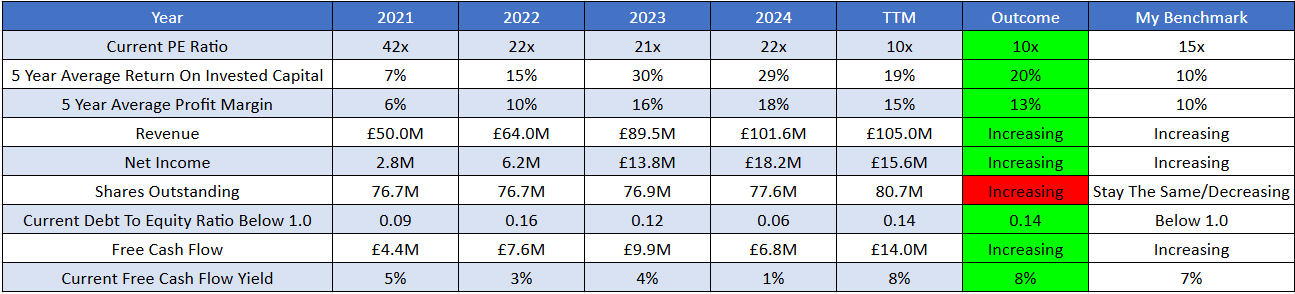
Shares Outstanding - When analysing a company I prefer the number of shares outstanding to remain stable or decrease over time. In the case of Warpaint their shares outstanding have increased by 5.22% over the last five years which is minimal and I am not particularly concerned about it. The reason Warpaint's share outstanding has increased is that in December 2024 the company announced a share issuance to raise up to £15 million (including a proposed retail offer) at £ 5.10 per share. The purpose of this share issue was to raise capital to fund the £13.9 million acquisition of Brand Architekts Group PLC.
Founded in 1992 by Sam Bazini and Eoin Macleod, Warpaint produces and sells cosmetics. Warpaint London’s business is organised into two main parts. The first is branded products which feature their popular makeup and beauty lines like W7, Technic, Super Facialist, and Man’stuff. The second is the close-out section which deals with Warpaint’s non-branded products. Warpaint offers a wide variety of products for consumers including makeup, skincare, self-tan products, and male grooming supplies. Beyond simply selling these products Warpaint also handles wholesale trade and provides supply chain support. They deliver their goods to customers by selling to large businesses such as supermarkets, distributors, and major retail chains across many regions including the UK, the US, Australia, New Zealand, and Europe.
Home products - The Branded Segment is the most valuable part of Warpaint’s business and the primary reason for its high growth potential. This segment focuses entirely on brands that Warpaint owns and manages with flagship names including W7 (colour cosmetics) and Technic (strong in gifting). Following the 2025 acquisition of Brand Architekts this segment expanded to include popular names like Super Facialist and Dirty Works which moved Warpaint beyond just makeup into adjacent, high-frequency categories like skincare. The whole purpose of this segment is to establish long-term market share and brand equity. Warpaint leverages its asset-light model and low marketing spend to offer high-quality on-trend alternatives to premium brands at very affordable prices. This value positioning is a key competitive advantage particularly during economic downturns as consumers consistently trade down to these resilient brands. Since the margins here are high and growing this segment is the primary source of Warpaint’s increasing overall profitability.
Seasonal products- The close-out segment represents Warpaint’s historical foundation and serves a very different function. In this segment Warpaint acts as a specialist trader by purchasing clearance, end-of-line, or overstock cosmetic and fragrance products from other manufacturers and retailers at deeply discounted prices. This allows the original manufacturers to quickly clear inventory and make room for new lines. Warpaint then takes this surplus stock which they often repackage or relabel and resells it quickly to discount outlets, wholesalers, or smaller secondary retailers seeking bargains. The profit margins in the Close-out segment are generally lower than in the branded segment but the sales turnover is fast and opportunistic making it a reliable source of quick cash flow for the business. This segment is less about long-term growth and more about cash generation and maintaining deep market intelligence. By constantly dealing with third-party inventory Warpaint’s management team gains valuable insights into industry pricing, product trends, and overall market demand which it can then use to inform the rapid development of its high-margin W7 and Technic-branded lines.
When evaluating management I judge the CEO based on several factors such as experience, capital-allocation skills, and Incentives. In this section I will discuss whether management’s incentives are aligned with shareholders.
Experience- Samuel Bazini is the Chief Executive Officer (CEO) and an Executive Director at Warpaint a position he has held since January 2020. Before Samuel Bazini became the CEO of Warpaint he served as a Joint Chief Executive Officer alongside co-founder Eoin Macleod. Samuel Bazini’s career began when he left school at 16 where he started in a cosmetics warehouse and later sold cosmetics directly at London street markets. In 1981 he set up his own business of buying and selling close-out and end-of-line cosmetics. In 1992 he formally partnered with Eoin Macleod to develop the business that led to the creation of the W7 brand. Samuel Bazini is responsible for driving the company’s corporate strategy which focuses on global distribution expansion, profitable growth, and overseeing day-to-day operations. His deep founder-level industry knowledge and significant shareholding (he directly owns about 19.8% of the company) provide strong continuity and alignment with shareholder interests.
Below is an image illustrating the current experience of Warpaint board members:
Capital Allocation- Capital allocation is very important when judging management because I want them to create value for shareholders not destroy it. So far Warpaint has done a great job with capital allocation because they are providing value back to shareholders by reinvesting in the business to further expand their presence and paying dividends.
Warpaint currently pays a dividend with a yield of 6.22%. This dividend is sustainable because it only covers 63% of the company’s free cash flow.
Incentive- This is important because if the current board is buying shares of their own business it indicates that management believes the stock is undervalued and is confident in the company’s long-term prospects.
As you can see below 9 individuals and 10 companies have bought Warpaint shares in the last 12 months and 8 companies have sold Warpaint shares.
Bull Case - The first bull case is Warpaint Growing Profit Margins and Strong Financial Position. Warpaint operates with zero debt and holds a significant amount of cash which gives it stability and flexibility. Warpaint has successfully increased its profit margins over the years by selling more of its own higher-profit brands such as W7 and by managing its supply chain efficiently. This means that for every pound the company earns in sales a larger percentage of that money is turning into actual profit which makes the whole business fundamentally more valuable.
Bull Case- The second bull case is Securing Major Global Store Space. Warpaint’s biggest advantage is its success in securing permanent shelf space in huge retail chains worldwide. Warpaint has recently launched or expanded its presence at major names such as CVS in the United States as well as Superdrug, Tesco, and Boots in the UK. Getting these positions is very hard for competitors and acts as a strong wall protecting Warpaint’s business. Securing these long-term contracts provides a clear, predictable path for future revenue growth as the company rolls out more products into more stores over the next few years.
Bull Case- The third bull case is Smart Growth Through Acquisition. Warpaint has shown its strategic intelligence by acquiring Brand Architekts. This deal is important because it immediately diversified Warpaint beyond just makeup by adding popular skincare and personal care brands like Super Facialist. This moves Warpaint into products that customers buy more frequently throughout the year.
Bear Case- The first bear case is High Risk from Digital and Fast-Fashion Competitors. The biggest threat to Warpaint comes from the rapid rise of online companies like Shein and Temu. These companies can copy Warpaint’s low-price makeup and beauty products even faster and often sell them cheaper because they don’t need expensive physical store space. Warpaint’s whole business is based on offering value but these digital giants can beat them on price and speed.
Bear Case- The second bear case is Extreme Dependence on a Few Large Retail Chains. While securing shelf space in places like CVS and Tesco, Warpaint is dependent on a few very customers. These retailers have immense power and can instantly force Warpaint to lower their prices or spend more on promotion which can directly squeeze Warpaint’s profit margins. If just one of these major retailers decides to reduce its stock or stop selling Warpaint products the company’s sales and revenue would be significantly hurt.
Bear Case- The third bear case is Vulnerability to Supply Chain Disruptions and Tariffs. Warpaint keeps its costs low by relying heavily on manufacturing products in Asia. This reliance makes the company vulnerable to global events. Any new tariffs (taxes on imported goods) imposed by the UK or the US or any major disruption to global shipping due to international conflict could instantly remove Warpaint’s crucial cost advantage.
In this section I will discuss valuation. Using some basic metrics I will compare Warpaint to its industry rivals and determine whether the company is cheap relative to its peers. Then I will value Warpaint using a discounted cash flow model to determine a price I am willing to pay based on its expected growth rate and my desired return of 15%.
As shown below Warpaint scored 5/6 while Elf Beauty scored 1/6. Both companies have excellent fundamentals. Below but I am going to highlight the key differences between the companies:
Business Model - Warpaint uses a traditional two-segment model that balances high-margin branded sales with opportunistic trading. Their primary focus is on the branded segment where they sell their own lines like W7 and Technicm and recently added skincare brands like Super Facialist. A unique feature of Warpaint is its smaller close-out segment where they buy and resell third-party excess stock to generate quick cash and build market knowledge. Warpaint’s business structure is asset-light as it outsources manufacturing and focuses mainly on product design, packaging, and distribution to major physical retailers.
Elf Beauty uses a purely branded/direct-to-consumer and mass-retail model driven by a strong digital approach. Their core strategy is to drive viral marketing through social media platforms like TikTok. Elf Beauty has a much higher gross profit margin than Warpaint meaning they keep a larger percentage of revenue after manufacturing costs.
Market Reach - Warpaint’s market reach is primarily international and distributor-led with a strong history in the UK and Europe. The company has successfully secured shelf space in major UK supermarkets and drugstores such as Tesco and Superdrug and has expanded across Europe with retailers like Normal and Etos. While Warpaint is growing fast in the US through chains like CVS and Five Below its international growth often relies on local distributors to get products onto shelves. This approach means growth is steady and channel-based aiming for broad physical availability.
Elf Beauty is overwhelmingly dominant in the United States where it is a leading mass makeup brand and has established partnerships with key retailers. While Elf Beauty is actively expanding internationally into Europe through Superdrug and Boots in the UK its global presence is built on leveraging its powerful social media virality to create demand before moving into new countries.
Product Offering- Warpaint’s product offering is centred on value and replication within colour cosmetics and gifting. Its core W7 brand is known for offering high-quality, affordable alternatives to prestige makeup. The Technic brand focuses heavily on seasonal gift sets,# which drive large orders during holiday periods. The company has recently diversified by acquiring brands like Super Facialist which will add skincare and personal care to its portfolio but its core identity remains rooted in colour cosmetics.
Elf Beauty offers a broad range of cosmetics and skincare products under several brands. Elf Beauty is known for its extreme affordability with many hero products priced around $10 while also pushing into higher price points. Their product strategy is defined by rapid, viral innovation with new products launched quickly based on social media trends and consumer feedback. This focus on being digitally relevant and continuously launching hero products is central to their offering.

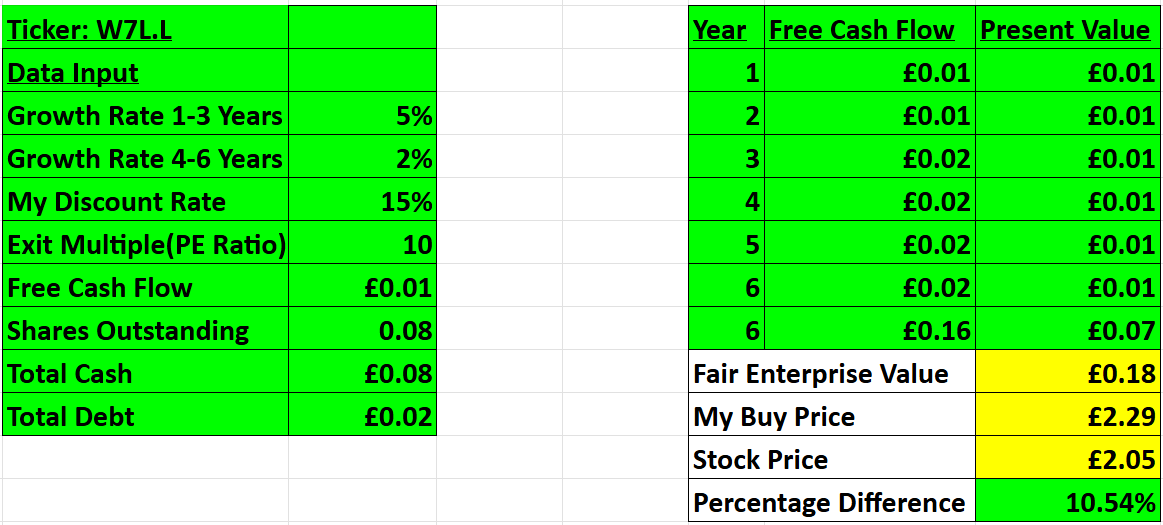
As you can see based on my conservative assumption Warpaint is looking to grow 7% over the long run so I went conservative and assumed a 5% growth in the first 1-3 years then the growth will slow down to 2% 4-6 years out. In my assumption I also went with an exit multiple of 10x earnings which is below the historical average at which Warpaint has traded. Based on my assumption I have come to a buy price of £2.29 compared to the current stock price of £2.02 which means right now Warpaint is trading below its intrinsic value.
Thanks for reading my newsletter on Warpaint.
Disclaimer: This newsletter is not financial advice. This is for educational purposes only so please DO NOT take this as a buy or sell signal.
Remember to subscribe, share, and comment below if you find this newsletter insightful. Your support helps me continue my work.
No posts
Comments
Nothing yet. Say the first thing.
Sign in to join the conversation.