
Welcome to the paid version of Investing in AI. This week we are looking at Constellation Energy through an AI lens. Please remember we are AI people, not financial people, and so do your own research before investing. Disclosure: We do not hold a position in Constellation.
Constellation spent 2024 and 2025 being valued on a story: that AI would make firm, carbon-free megawatts scarce and that the largest U.S. nuclear operator would capture the scarcity rent. Q2 2026 is the quarter where that story started converting into contract paper — roughly a gigawatt of new long-term nuclear agreements at an average tenor of 18.5 years, two important regulatory blockers cleared at Crane, and guidance raised at the midpoint.
The longer-run share-price trend went the other way. That divergence is the investment question. The bull case is that a business whose earnings are increasingly contracted and partly inflation-linked should not trade like a merchant generator. The bear case is that the new contracts start in 2029, the enhanced 30–40% of the earnings framework still depends on power prices, and the regulatory framework that makes co-location work has not been written yet.
The AI trade has moved down the stack twice. First it was accelerators, then it was the physical infrastructure around them — memory, optics, cooling, interconnect. The third move is the one the industry is living through now: the binding constraint is no longer silicon but electricity, and specifically electricity that arrives continuously, at a known price, on a schedule an operator can plan a data centre around.
The arithmetic is unforgiving, but the forecast range is wide. One 2026-vintage sector scenario puts U.S. data-centre peak demand near 76 GW in 2026 and roughly 134 GW by 2030, versus about 50 GW in 2024. On that scenario, the 2024–2030 increment alone exceeds Constellation’s roughly 55 GW fleet. Interconnection queues also contain a very large volume of proposed generation, while typical project timelines can stretch for years. Figure 1 should therefore be read as an illustrative demand scenario, not a single-point industry consensus.
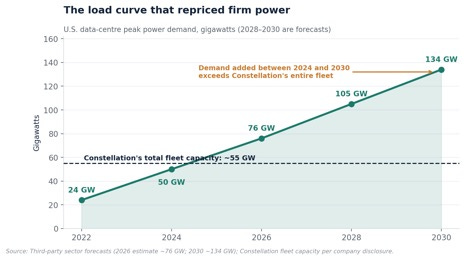
Figure 1. The demand increment between 2024 and 2030 is larger than Constellation’s entire generating fleet. 2028–2030 are third-party forecasts, not company guidance.
That gap between demand growth and deliverable supply is what reprices existing generation. A hyperscaler cannot build a nuclear plant; the lead time is ten to fifteen years. What it can do is contract for output from plants that already exist, are already interconnected, and already run above 90% of their theoretical maximum. Constellation is the largest single pool of exactly that asset in the United States.
Comments
Nothing yet. Say the first thing.
Sign in to join the conversation.