
“Welcome to the jungle, we got fun and games / We got everything you want, honey, we know the names” – Guns N’ Roses
What surprised many about Haypp’s Q2’26 results was the announcement that the company had begun business in the Kingdom of Saudi Arabia. The Q2 call was the first time it was mentioned aloud, understandably resulting in questions during the Q&A. These operations weren’t entirely out of the blue, though, as expansion into the region was somewhat hinted at within the company’s prior reporting.
Haypp’s FY 2025 report stated:
During the financial year, Haypp Group AB established a new wholly owned subsidiary, Haypp MEA Holdings Ltd. The cash outflow related to the incorporation is reflected entirely as goodwill of KSEK 885.
This subsidiary is located in the United Arab Emirates, specifically the Dubai International Financial Centre. The DIFC does not require companies to have a local partner. It also incentivizes company residence by offering zero corporate tax and the benefit of double taxation treaties across the UAE, as well as similar treaties between the UAE and other Gulf Cooperation Council (GCC) members.
Haypp’s report from its 2026 General Meeting stated:
The meeting finally resolved to approve the adoption of a new long-term share-based incentive program in the wholly-owned subsidiary Haypp MEA Holdings Ltd in the Dubai International Financial Centre, including the transfer of rights pertaining to up to 42 percent of the shares in the subsidiary. The program aims to attract and retain key individuals in the local operations and is directed towards directors, officers, employees and/or consultants of the subsidiary. The rights vest on a monthly basis over four years, subject to continued employment or engagement within the group, and may thereafter be converted into shares free of charge provided that certain performance targets are met.
This statement makes several things clear. First, the willingness to part with 42% of the subsidiary conveys the implicit understanding that pursuing goals in related markets requires working with locals who have expert knowledge of how to navigate. Second, the cadence at which those rights vest suggests that, while still in the early days, Haypp Group has a roadmap in place. The KSA business launched roughly one month ago. Other statements made during the Q2 call provide context as to why:
KSA is one of the largest nicotine pouch markets in the world, and continues to grow rapidly.
The regulatory environment for nicotine pouches in KSA is very stable.
Users are beginning to show greater bulk-buying behavior, a positive precursor to the success of Haypp’s online retail model.
Based on Haypp’s observations, consumer behavior in KSA mirrors that of Scandinavia ten years ago and that of the United States and United Kingdom of 3-4 years ago. In other words, if this endeavor is going to succeed, it is prudent to assume it will not be overnight.
While not covered on the call, other readily available information helps paint the picture. Haypp Group is now operating a website, haypp(dot)sa, for the KSA market. Although appearing remarkably similar to its other ecommerce sites, two things stand out:
The site does not use the same base infrastructure as the other sites, such as Magento in the U.S. or Easyfy in Europe. Instead, it runs on Shopify, which is less robust but standard for launches into new markets for speed and convenience. It is reasonable to think that positive momentum and reaching a particular scale would lead to migrating this site to the infrastructure used elsewhere.
Unlike other markets, where Haypp provides a vast assortment of brands, only one brand is available: DZRT. This is a notable contrast. To make sense of it, you have to look back a few years.
Saudi Arabia’s Public Investment Fund (PIF) is a sovereign wealth fund that has existed for more than half a century. It was reorganized in 2015, giving control to the Council of Economic and Development Affairs, chaired by Crown Prince Mohammed bin Salman (MBS). In 2016, MBS announced Saudi Vision 2030, a program for economic and social reform. Saudi Vision 2030 comprises three phases. The first phase, 2016-2020, focused on restructuring the regulatory landscape. The second, 2021-2025, accelerated alternative investments and focused on private sector growth. The third, present-2030, aims to finalize certain large-scale projects and become a world leader beyond oil.
Associated investments have grown into quite a list. One portfolio holding, and the most relevant here, is Badael Company, established in mid-2023 by Saudi Arabia’s PIF. Badael means “Alternatives” in Arabic. The company serves Saudi Vision 2030 by acting as a vehicle to reduce smoking and reduce smoke-related disease by developing and manufacturing alternative nicotine products. DZRT is a brand of nicotine pouches owned by Badael Company.
One of Badael’s initial goals was to help one million smokers quit by 2032. Saudi Vision 2030 mandates that Badael’s entire manufacturing process must occur within the Kingdom, including sourcing raw materials locally. In 2024, the company began to scale up production capacity. Mid-year, it needed to open a second facility. By the end of the year, the first full year of operation, the number of smokers assisted had already reached 400,000. The company has continued to ramp production, and as of last report, the company has now helped an estimated 700,000 adults transition away from smoking. Badael now believes it will reach its original target by the end of 2026.
What is the source of such rapid success? DZRT comes in a wide range of strengths, including 0mg, 3mg, 4mg, 6mg, 7mg, and 10mg. The brand also comes in a wide range of flavors, including those specifically based on regional profiles across Saudi Arabia. Those factors certainly play their roles, but the most overwhelming factor is the government’s prioritization of health impact over commercial motives. The product is viewed as a cessation tool, but is not burdened by the need for a prescription or other barriers to adoption. DZRT’s media champions the product’s virtues: cleaner, discreet, no smell, and socially courteous, since there is no smoke.
With the government’s backing, DZRT’s position in the Saudi market is wholly dominant. However, a black market for unlicensed, imported brands still exists, despite meaningful penalties. Moving forward, a greater crackdown on illicit products is reasonable to expect. At the same time, it remains to be seen to what extent the Saudi government welcomes other nicotine pouches onto the market, given its interest in protecting local manufacturing and its own brand. Regardless, the market, considering its size, rapid growth, and the difficulties of establishing business therein, represents a truly unique opportunity for the welcomed, registered, fully-compliant operator Haypp.
We could stop there, but, against my better judgment, and at the risk of getting over our skis, allow me to introduce a hypothetical. Saudi Arabia’s PIF established Badael with a health-impact focus. However, all aspects under the PIF’s control also consider the economic impacts, especially with regard to the goal of diversifying the Kingdom away from oil. With the rapid adoption of nicotine pouches around the world showing no end, might the PIF be interested in growing DZRT into a global brand? And if so, might Haypp Group be an optimal partner to help facilitate such an ambitious goal? There are plenty of ways to dream up how such could play out. Let us pause the speculation and remember Haypp has barely just entered this new frontier.
Last quarter’s note on Haypp Group covered three central ideas:
New disclosures and recasts could be misinterpreted, understating growth potential (an increase explored in the FY’25 note Haypp Group: Acceleration.)
Some of those disclosures, such as around gross profit and Media & Insights, do not capture how the company is weaponizing its advantages.
Those advantages are well-suited to a calm environment, but truly excel in a chaotic ‘jungle’ environment densely populated by rapidly evolving competition.
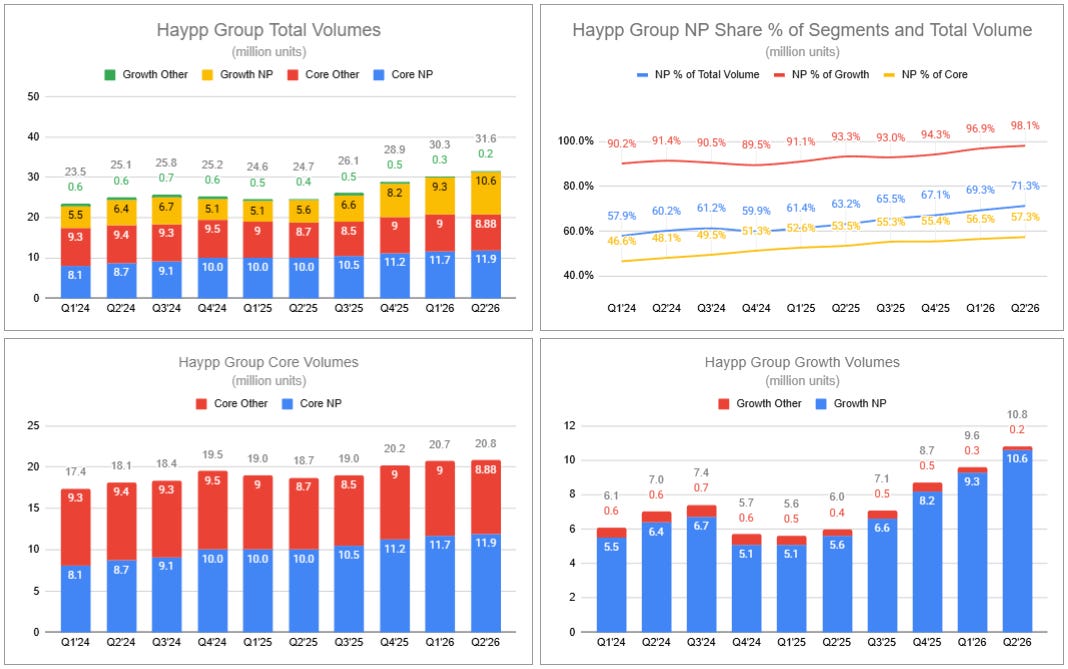
Haypp Group’s Q2’26 results conveniently aligned with those three points, leaving little in the way of surprise and making review fairly straightforward. The company stressed that Q2’26 was the fastest growth in volumes and sales since becoming public. Volumes for Core, Growth, and Group were up by 11.3%, 80.1%, and 28%, respectively. The group’s net sales increased by 27.7%. While the Growth Markets certainly contributed in a very real way, growing sales by 57.3%, the more mature Core Markets were no slouch either, which grew sales by 18.2%. But then again, there is the other side of the coin.
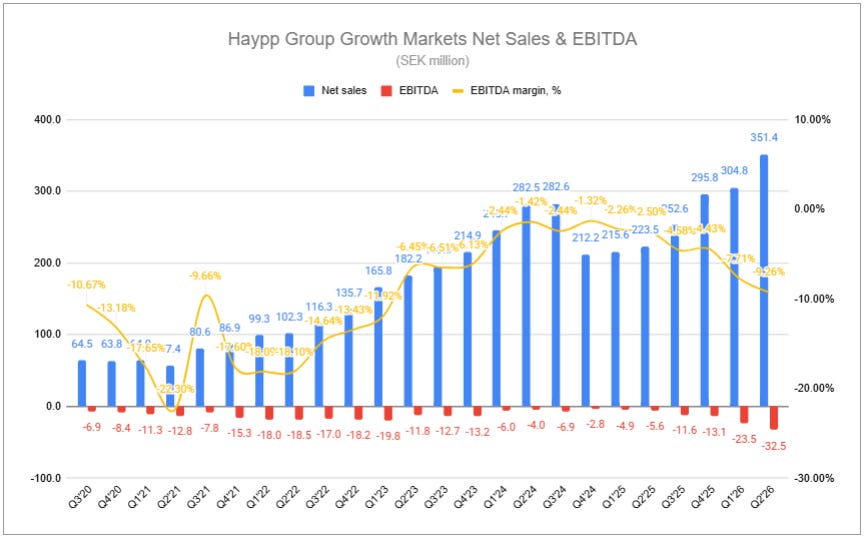
The easiest critique stems from the EBITDA margin in the group’s Growth Markets segment. It collapsed to -9.26% in Q2’26. The direction that the segment margin has headed is not the only consideration. We must also look at the magnitude of the losses. EBITDA was SEK -32.5m, not too far off from the losses of SEK -35.1m that were incurred by the segment for the entirety of 2025.
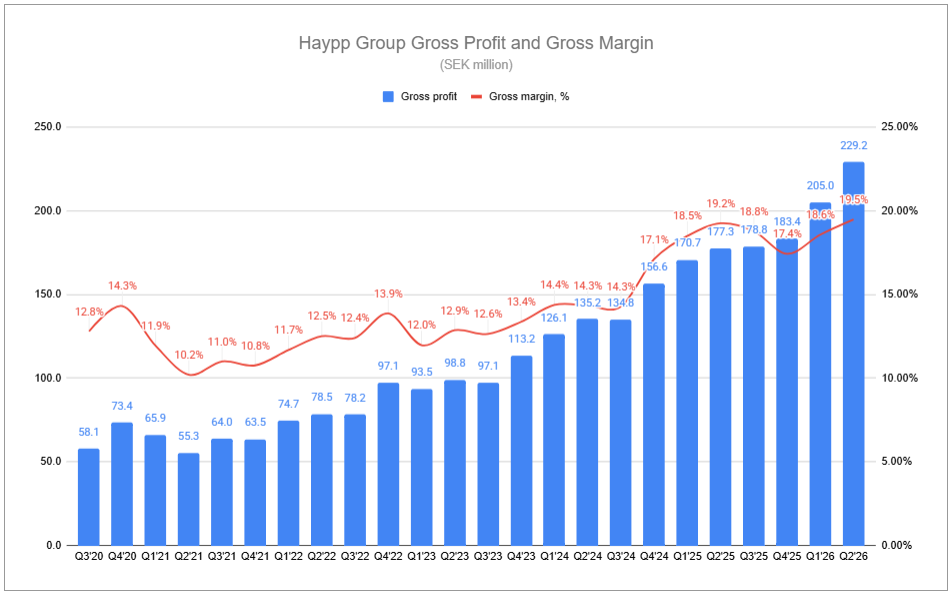
I cannot fault the casual observer for being alarmed by those latter figures. However, there is no alarm here. The growth rates of consumers, sales, and volumes provide confidence that the elevated rate of investment is not just working, but working exceedingly well. The underlying drivers, including active consumers, number of orders, and average order value, all continue to march higher, feeding into, and fed by, Media & Insights. The very impressive output comes with the quarter’s highest gross margin the group has seen, at 19.5%.
Haypp Group has been engaged in its land grab strategy for more than a year. We are still in the very early innings of those efforts paying off. A single sentence uttered during Haypp’s Q2’26 call succinctly captures the opportunity ahead:
Gavin O’Dowd:
This U.S. environment is becoming analogous to the environment which began in Sweden and Norway approximately 6 years ago and is an environment we have had strong success in.
When thinking about how the U.S. is evolving, I’d like to focus on two key areas:
Comments
Nothing yet. Say the first thing.
Sign in to join the conversation.