

Postel law states that:
Be conservative in what you send, be liberal in what you accept
Let’s break it down:

Taking client-server architecture as an example, this means:
Ensure the API responses strictly adhere to the defined specification.
Avoid adding unnecessary fields or data in responses that might cause confusion.
Use clear and consistent formats for dates, strings, numbers, etc.
Below is an example where this gets “violated”:
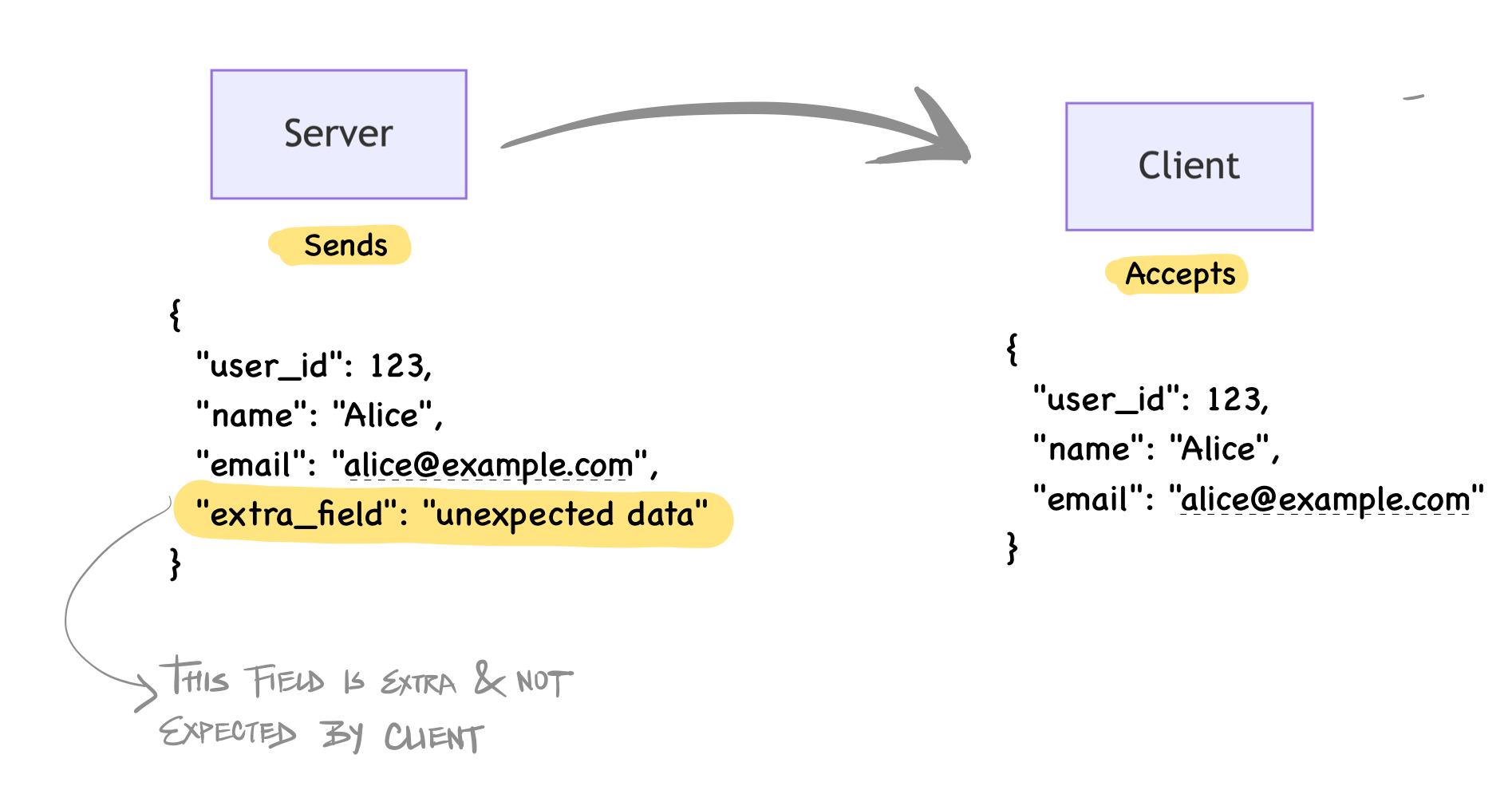
The server sends an extra field in the payload that the client does not expect - not conservative.

Allow clients to send data slightly outside the expected format, as long as it can be interpreted without ambiguity or errors.
Handle missing fields gracefully by using default values or ignoring unrecognized fields instead of rejecting the request outright.
Support backward compatibility when adding new fields or features.
An anti-example of this is something I experienced a few days back:
I was exploring Hugging Face blogs and for no reason thought of tinkering with the page parameter in the URL.

With p=0, it should show page 0 of the blog - and it does.

But if p=-1, it gives up - and doesn’t show any article other than the first one.

Ideally:
page should be max(p, 0)Here:
Hugging Face fails to be liberal in accepting requests
Other real-world examples could be:

Eg: Google / Bing
Search engines handle poorly structured or misspelled queries gracefully:
Searching for "whats teh time" still gives accurate results.
Invalid or extra URL parameters (like tracking codes) are often ignored.

Eg: Microsoft Word / Google Docs
Word processors open slightly corrupted or outdated document formats and attempt to recover data.

Eg: Google Maps / Apple Maps
These apps correct small user input errors:
If you search for “Starbukcs,” Google Maps suggests “Starbucks.”
Extra or invalid query parameters in URLs don’t break functionality.
Thanks for reading. Until next time
Comments
Nothing yet. Say the first thing.
Sign in to join the conversation.