
Every story begins as an identity battle.
Before the hero can change, they must first reveal the identity they are trapped inside.
In the Intuitive Screenwriting model, the first stage of a feature film is governed by the Warrior → Fool archetypal dynamic.
This is the stage of wounds, conflict, resistance, and the first glimpse of another possibility.
All three steps in the first act carry the quality of Fire: the birth of a hero, the birth of a heart’s desire, and the birth of a new idea, the moment when a journey begins and exploration truly takes off.
The Warrior/Hero, as the first archetype, is all about being born: having the power to stand up and say, “I am who I am.” It is about seeing oneself “naked” for the first time, or simply seeing oneself again after a long time, and saying: “Oh, that’s me. I’m unique. There is no one else in the world like me. I need to honor that. I need to protect myself, including my wounds.” With that recognition comes pure, raw life force, but in a world inhabited by others, each with an identity and boundaries of their own, self-assertion creates conflict. That often means war. This is where the problem begins, and where the story enters its first stage.
Structurally, conflict is generated through archetypal opposition, as you have already seen in the stages and genres. More precisely, the split we recognize in the psyche and build into the story exists on two levels: between archetypes on the Wheel and within the archetypes themselves. In the stages, as in the four-act model, the Persona of the Defining Archetype comes into conflict with the Shadow of the Opposing Archetype, while the two archetypes also represent different levels of the psyche.
Applied to the exposition, the Wheel shows that the first ten to twelve minutes of a film should be read through the Warrior (EGO) Persona → Fool (SELF) Shadow opposition.
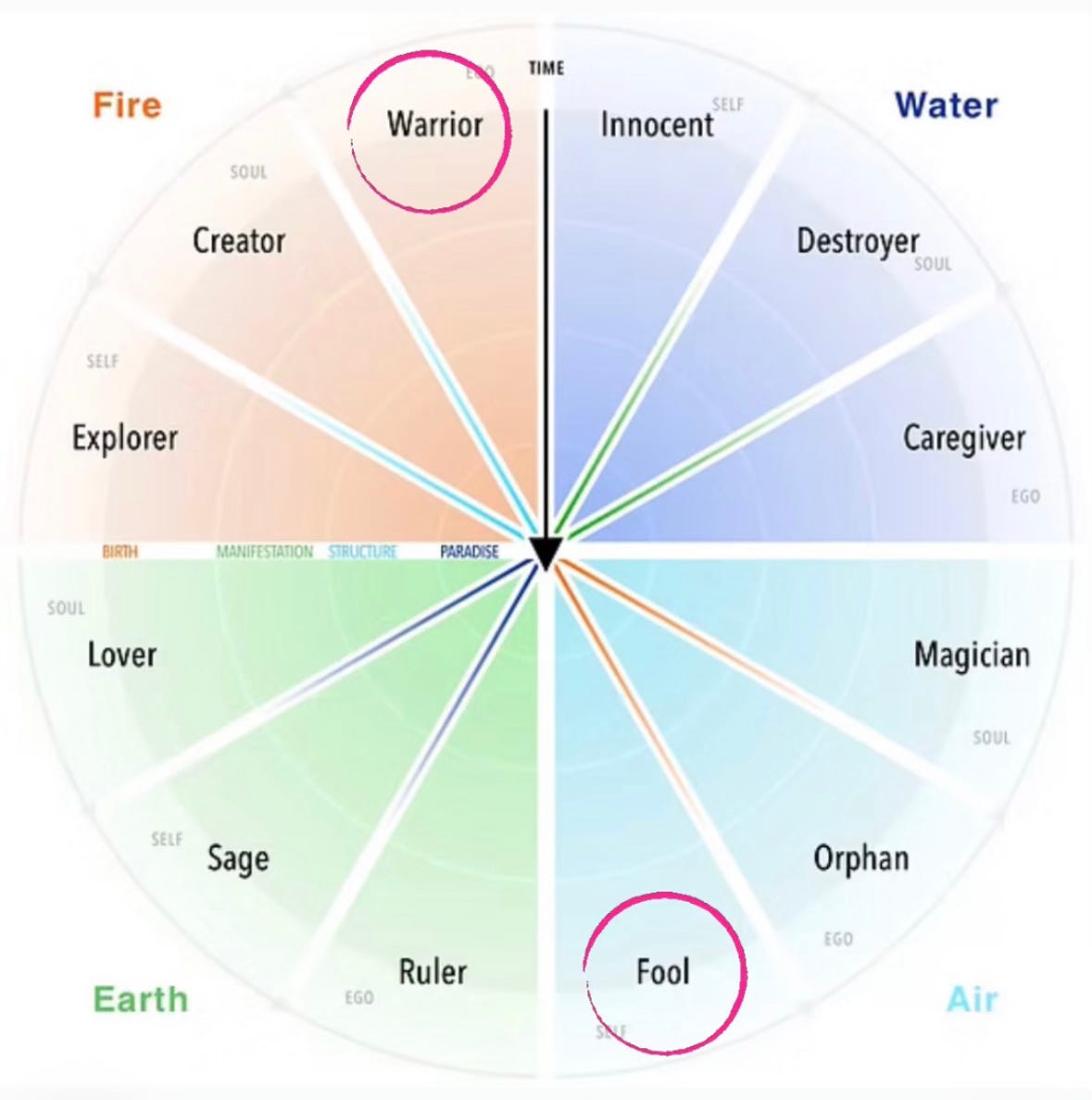
The Warrior Persona tells us that the problem lies at the core of who we are, or rather, in who we believe ourselves to be or even pretend to be. The first answer is “I am.” But the deeper conflict appears when “I am” encounters “you and me,” and ultimately “another me.” At the beginning, this “I am” is rarely integrated. It is usually a hardened or wounded version of the self, one the ego has learned to protect. A hero born from Fire may possess strength or even aggression, but that energy is often used to build walls, defend boundaries, or defeat whoever seems to threaten them. The outer struggle reflects the inner one: although this identity already causes pain, the ego can still find every reason to remain in the fight and stay alone. This is not a recipe for happiness.
That is why the Warrior must encounter its reflection in the Fool Shadow: the identity it has been defending is incomplete.
In its integrated form, the Fool is playful and curious, a true bridge archetype. It moves quickly, learns constantly, crosses between the known and the unknown, between light and darkness, and certainly doesn’t like to be alone. At this stage, this fluidity appears through its Trickster Shadow: it questions certainty, crosses boundaries even when uninvited, deceives, provokes, and exposes contradictions.
The Fool offers no answers to the stubborn Warrior. It holds up a mirror in which the identity the ego recognizes begins to waver, while something hidden on the other side starts to show through. This is the first crack in the Warrior’s conviction: “Perhaps you are not only who you think you are. Perhaps you are also what you have learned to hide.”
Show this. Use the Trickster mirror to reveal this divided identity within a scene. The split may emerge through an encounter with a potential love interest or within a relationship that already exists. It may be rooted in a psychological complex or arise between two versions of the same person at different points in time. It may also lie in the protagonist’s relationship to reality itself.
In The Birds, Melanie may try to deceive us, just as she tries to deceive Mitch. But she is not merely a carefree seductress who wants to remain in control. Beneath that mask is a vulnerable woman who longs for intimacy and belonging.
In Force Majeure, Ebba is the wife and mother who would rather hold on to the image of a perfect family on holiday, yet she already senses that her husband, Tomas, is not fully there and that the structure built around them is not as stable as it appears.
In The Piano Teacher, Erika is divided between the talented but unfulfilled pianist who has devoted her professional life to her students and the adult woman who has never separated from her mother.
In Aftersun, we already meet both Sophies: one is the eleven-year-old daughter who is still with her father without truly understanding him; the other is the adult woman who returns in memory to their final holiday, trying to see the man she has lost with new eyes.
In Solaris, Kris is divided between the scientist who travels to a distant planet in search of rational answers and the man who already carries within himself a deeper truth he does not yet recognize.
Both identities, one carried by the Warrior Persona and the other by the Fool Shadow, claim the protagonist, yet neither represents an integrated self.
Formula:
Warrior (EGO) Persona → Fool (SELF) Shadow
The pain of who I am is caused by identification with one side of a divided self.
In The Writer’s Journey, the hero begins in the Ordinary World. But as we have just seen, the world where we first meet the hero is anything but ordinary. It is in fact the Battlefield. We may long for peace and innocence (the Innocent archetype), but we always begin with some form of inner conflict.
In the exposition, that conflict finds its way into the outer world. Some characters are broke (Sunset Boulevard), some live in impossible conditions (Capernaum), some can’t bear their place in the world (Persona), and some can’t stand the Matrix.
The Battlefield may also be personified by the main antagonist or an opponent, an external, often magnified reflection of what remains hidden in Shadow. Remember the mothers in Fish Tank and The Piano Teacher, the spouse in Duel, Thulsa Doom in Conan the Barbarian, Tai Lung as Po’s dark counterpart in Kung Fu Panda, and Berton, whose testimony confronts Kris’s rational certainty in Solaris.
We can also think of the Battlefield as the part of the story where we establish the full list of conflicts: everything that has gone wrong, remained unresolved, or become impossible to live with, both within the hero and in the world around them.
In some (yin) stories, the identity conflict is activated through a wound carried in Shadow. It may originate in abandonment or the absence of care, in loss, death, or violence, or in the loss of innocence and basic security. The wound may have been carried since childhood, or it may be inflicted before our eyes, so that its very creation becomes part of the exposition. In such stories, the Ordinary World may resemble a personal hell.
In other (yang) stories, the identity conflict is activated when the protagonist can no longer suppress an unfulfilled desire. In Kung Fu Panda, Po dreams of becoming a kung fu warrior. In Sunset Boulevard, Joe Gillis wants to become a successful screenwriter, but his scripts do not sell, and he is about to leave Hollywood. Even though the conflict does not arise directly from a wound, the gap between the protagonist’s present life and the identity they long for is enough to establish the Battlefield.
What’s also important to say is that the exposition is probably the hardest part to write. Yes, the ending is tough, and so is the build-up to the last act turning point, but without understanding your hero’s central identity conflict, how it shapes the structure, and the final identity the hero is moving toward, you simply can’t write an exposition that will support the rest of the story.
The first ten pages are also your ticket to getting someone to read the rest of the script. My advice: stay with this part as long as you need, but always be prepared to come back to it again and again. Rewriting is part of the process.
Let me conclude this lesson with the paradox the Fool brings to this stage. Although the Battlefield is built on conflict, the hero’s journey is not ultimately about winning the fight. It begins with the possibility of letting go of the identity the ego has learned to defend. That is the moment of pure potential. Only when the fighting stops can real transformation toward an authentic identity begin.
This is expressed beautifully in the following passage from Stalker:
“Let everything that’s been planned come true. Let them believe. And let them have a laugh at their passions. Because what they call passion actually is not some emotional energy, but just the friction between their souls and the outside world. And most important, let them believe in themselves. Let them be helpless like children, because weakness is a great thing, and strength is nothing. When a man is just born, he is weak and flexible. When he dies, he is hard and insensitive. When a tree is growing, it’s tender and pliant. But when it’s dry and hard, it dies. Hardness and strength are death’s companions. Pliancy and weakness are expressions of the freshness of being. Because what has hardened will never win.”
—— Stalker (1979), directed by Andrei Tarkovsky, with a screenplay by Arkady and Boris Strugatsky.
WOUNDS AND UNFULFILLED DESIRES
Define your hero’s central identity conflict: the identity they defend and the identity hidden in Shadow.
Define the wound they need to heal from or the unfulfilled desire they can no longer suppress.
Define the weaknesses or fears they need to outgrow.
CONFLICTS
Make an inventory of your hero’s internal and external conflicts: this is what you want your hero to eventually overcome.
Identify the people or forces involved in those conflicts.
Define the opponent or antagonist your hero must face on the Battlefield.
Show this. Build your scenes around it. And always keep in mind the endpoint of transformation: the authentic identity your hero is moving toward.
This article explores Stage 1 of the Intuitive Screenwriting Wheel.
For an overview of the complete 12-stage progression, see:
12 Archetypal Stages of Intuitive Screenwriting
·
Apr 20
Readers who have been following Intuitive Screenwriting from the beginning know that this series has been devoted to uncovering the archetypal wheel developed by the author as a matrix of story and psyche. So far, we have seen how it reveals the archetypal axes, the four-act structure, and the first articulation of linear transformation. What follows no…
In the next article, we will look at how the Warrior → Fool dynamic appears in actual film openings.
Future stages will be published as part of the paid series.
No posts
Comments
Nothing yet. Say the first thing.
Sign in to join the conversation.