
It's a Sunday afternoon.
You have nowhere to be. No plans, no obligations, nothing pulling at you from the outside. The kind of day that, if you described it to the right person, would sound like a dream.
And it is. Mostly.
Except for the small, persistent voice that keeps asking if you should be doing something with this. Calling someone. Being somewhere. Filling it.
You ignore the voice. You make coffee. You sit down somewhere comfortable and let the quiet settle over you like a blanket you've been waiting all week to find.
Your shoulders drop. You hadn't noticed they were up.
There's something that happens in solitude that's difficult to explain to someone who doesn't need it the way you do.
It's not about being antisocial. It's not about disliking people — you probably love yours deeply, think about them often, carry them with you everywhere you go. It's not even about being tired, though tired is part of it.
It's about something more fundamental than rest.
It's about the particular relief of being with only yourself. No performance required. No reading of the room. No quiet background monitoring of how you're coming across, whether you said that right, whether your face did something strange when you heard that piece of news.
Just you. Just the room. Just the afternoon light doing what it does across the floor.
Here's something worth knowing about how your brain actually works.
Introverts have a higher baseline level of cortical arousal. In plain terms: your brain is already more active at rest than most people's. It's running more in the background — processing, replaying, connecting, noticing. Social environments don't energize you the way they do an extrovert because you're not starting from empty. You're starting from nearly full.
Every conversation, every room, every interaction adds to something that's already going.
So when you come home and close the door and feel that particular exhale — that's not weakness. That's not you being difficult. That's a brain that has been doing more work than anyone around you realized, finally getting permission to stop.
Solitude isn't where you retreat. It's where you recover the resources that make everything else possible.
But there's more to it than recovery. That's the part that gets underestimated.
Because solitude, for an introvert, isn't just about subtracting stimulation. It's about what becomes available when the noise clears.
You think better alone. Not because you're smarter alone — but because your best thinking needs space to move. It needs time to arrive. It doesn't perform on command in a busy room; it surfaces slowly, quietly, when nothing is competing for your attention.
The ideas you have in the shower. The solutions that appear on a long walk. The clarity that comes at ten o'clock at night when the day has finally gone still.
That's not coincidence. That's your mind doing what it was made to do.
Your inner life is genuinely loud. There are things happening in there — thoughts, feelings, observations, half-formed ideas that haven't found their words yet — that simply cannot be heard over the sound of everything else. Solitude is the only volume level low enough.
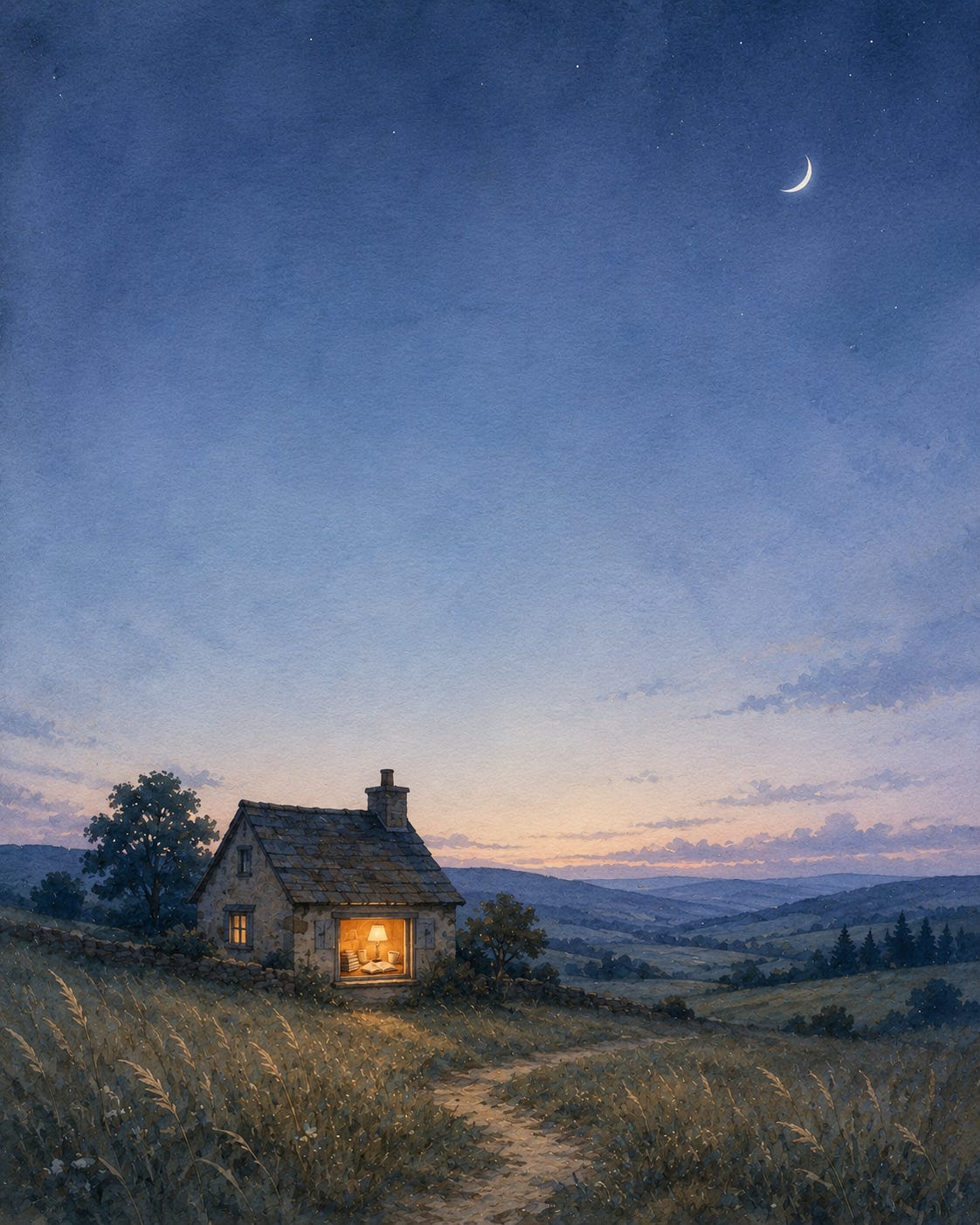
And then there's the emotional dimension of it. The part that's harder to justify out loud.
You like your own company.
You've probably felt strange about that at different points in your life — like it was something you weren't supposed to admit, or something that would be misread as arrogance or isolation or some variety of brokenness. The world has a particular suspicion of people who genuinely enjoy being alone.
But here's what's actually true: you have an interior life that is rich and specific and endlessly interesting to inhabit. Not because you're detached from reality — but because you notice things. You turn them over. You live inside your own experience with a fullness that most people only catch glimpses of.
There is company in that. Real company.
Not the performing self. Not the self that's tracking the room and choosing words carefully and trying to be what the moment needs. The self that exists before all of that. The one that thinks in long, unhurried thoughts. The one that finds a sentence beautiful. The one that gets moved by things quietly, privately, without needing to share it in real time.
That self lives in the quiet. It is only ever fully present there.
I want to say something about the guilt. Because you probably feel it, and it's worth naming.
The guilt of saying no. The guilt of the quiet Saturday that you could have spent with people who love you. The guilt of needing more solitude than the people around you seem to need, of having a threshold that others find hard to understand, of sometimes feeling most like yourself when you are completely alone.
That guilt comes from somewhere real — a world that was largely designed by and for people who work differently than you do. A world that treats availability as a virtue and stillness as a problem. A world where "staying in on a weekend" has always carried a faint suggestion of failure.
But you're not failing when you choose the quiet.
You're choosing the conditions under which you actually function. The conditions under which you become the most present version of yourself — for your work, for the people you love, for the life you're trying to build.
An instrument needs to be tuned before it's played. What that looks like from the outside — the silence, the stillness, the apparent inactivity — has nothing to do with what's actually happening.
What helped me: I stopped framing my need for solitude as something to explain. Not to other people — but to myself. I stopped treating every quiet evening as a compromise I'd made with my own limitations. I started recognizing it for what it actually is.
Not absence. Not avoidance.
A practice. A necessary one.
So if it's a Sunday afternoon, and you have nowhere to be, and you're sitting somewhere comfortable with something warm to drink, and the quiet has settled over you like a blanket you've been waiting all week to find —
Let it.
You're not hiding from your life. You're returning to the part of yourself that makes it worth living.
That's not something to defend. That's not something to explain. That's just you, knowing what you need. And finally, slowly, giving it to yourself.
Written for every introvert who ever felt like they needed to apologize for needing the quiet — you never did.
P.s.
Introverts' Intro will always be free. Every single piece, every reflection, every word – free. Always.
Because I know what it feels like to move through a world that doesn't quite understand how you're wired. To hold so much inside and never find the right place to put it down. And I know the quiet relief of finally reading something that says exactly what you've been feeling but never had the words for.
That feeling of being seen without having to explain yourself is something every introvert deserves access to. No paywalls. No exceptions.
But if my writing has ever found you at the right moment, if something here has made you feel a little less alone, a little more understood, a little lighter than before — and you want to show that it meant something to you, you're welcome to buy me a coffee.
Not because you have to. But because knowing that these words are landing somewhere, that they're actually making a difference in another introvert's life — that means everything to me.
It's what keeps me writing. Thank you for being here. Truly.
See you in the next one.
— Yousra from Introverts Intro 🌸
Comments
Nothing yet. Say the first thing.
Sign in to join the conversation.