
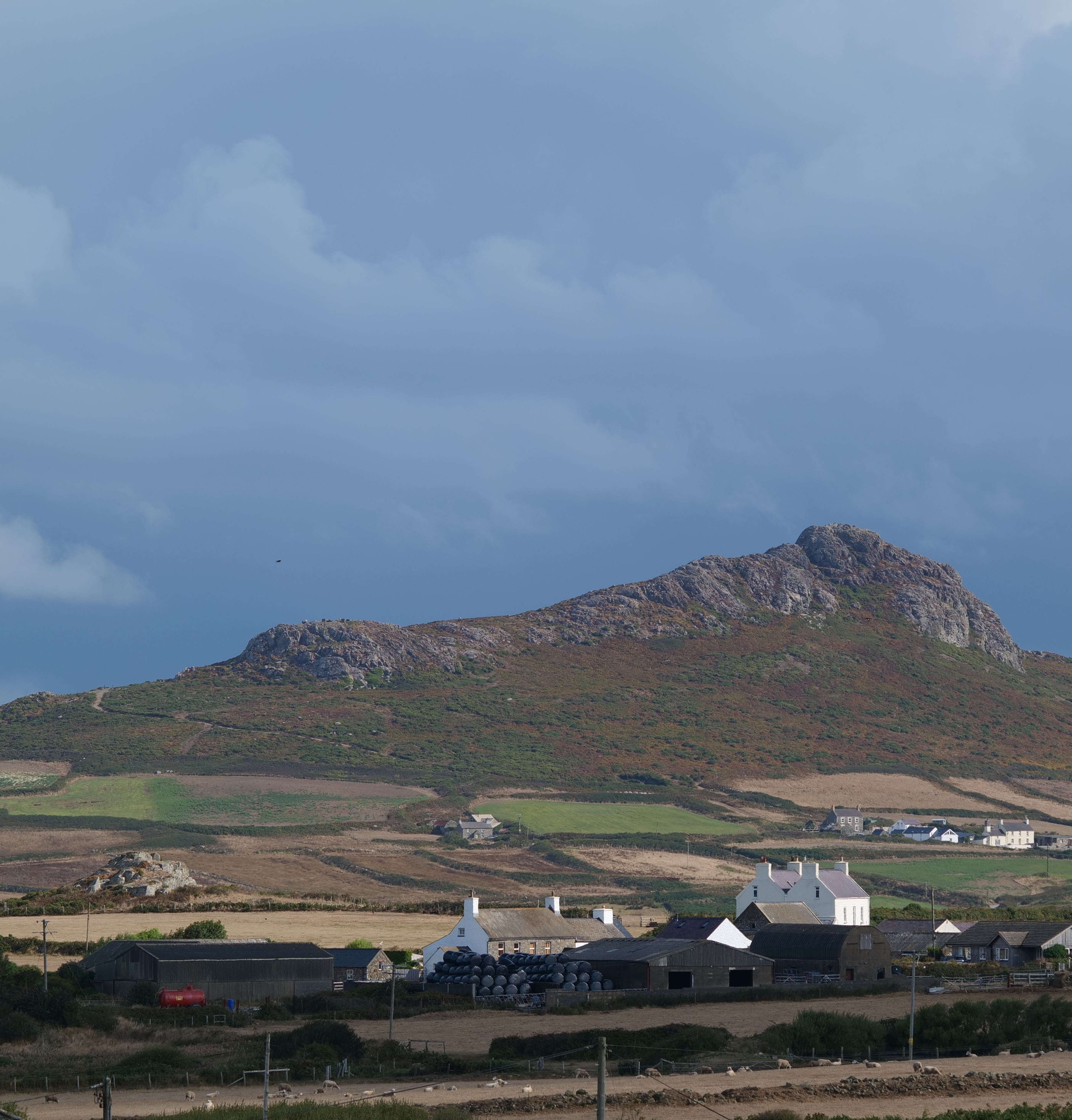
Friends,
This place and I already have a history, if you think of history in terms of transformation.
Early July was the time of wildflowers, more than I’ve ever before seen in a single place. Of those I can name (I need training on this subject): sea thrift, sea campion, kidney vetch, bird’s-foot trefoil were everywhere. Two weeks later and the drought had taken its toll, the many-coloured land was yellow and brown. On the beaches all was well, the long, warm summer lingered in the laughter of children. But on the headland summer passed at an unnatural speed. I started to worry about the ponies who graze up there. The streams and pools they drink from had run dry.
At home Hanter Hill burned for the second time in a year, then a third, sending a smoke haze into our house. Llangattock mountain, 30 miles away, threw up a cloud of smoke which stretched across the western horizon and blotted out our view of the eclipse. The birds disappeared, the woods went silent. The copper beech tree that leans over our house began to shed its leaves two months early. The tree is drought-stressed, dropping leaves to survive.
On the news people are complaining about the hosepipe ban, and about decades of underinvestment, leaking pipes and inadequate water infrastructure. Meanwhile the drought has caused wild fruit trees to shrivel and drop their fruit; insects have disappeared; earthworms have been forced deeper into the soil. Starvation time for birds. A mid-July visit to Knepp, the poster child for rewilding in this country, revealed a silent land. I’ve never seen so little wildlife. Autumn, even if we have months of rain, will be hard for the birds. Winter harder still. Have you been to the woods lately? Have you heard the silence?
The seabirds have barely noticed the drought. Warm water has brought millions of sand-eels and fish. The shearwaters are still foraging successfully in huge numbers. So too the gannets and kittiwakes, with one colony managing three broods. Gulls reel and plunge over the rocks in Ramsey Sound, glutting themselves. Grey seals are breeding early, the calls of seal pups audible in their favourite coves.
This week has seen a return to normal weather. I’m up on the cliffs in the pouring rain, trying to collect footage for a film. With no real shelter, no trees at all, I’m squeezing into rock crevices, hiding beneath the capstone of a Stone Age tomb, or walking down to the sea caves. Ramsey Sound is whipping up in the winds. The islands are not so welcoming now. The lighthouse beacon at South Bishop is looking more and more what it is: a warning.
Stay away.
My campsite — as basic as it gets, with no electricity, a toilet without a light bulb, and ice-cold showers — is a steep field topped by a craggy tor, facing west into the strengthening wind. I’m starting to dream about caravans, or, better, cottages with wood-burning stoves. They’re out of budget, unfortunately. Cold showers for me for the next two months.
I’m about to pack my tent away, but I’ve noticed a blur approaching beneath a dark cloud. A heavy shower coming. I’ll sit it out, finish this post instead.
I’m sitting in my car, parked on a sloping field facing the bay. I’m wearing a fleece and jacket and I had to buy a woolly hat yesterday. Not freezing, but after weeks of high temperatures my body seems a little shocked at the sudden dip. A young family walks across the field, all of the little ones dressed in puffa jackets, hoods up.
The sea is grey with a far-off scrape of turquoise. White caps stipple the surface. Last night I sat on the headland as the sun set and everything was orange, graduating to burnt umber. The waves rolling towards the cliffs seemed to burn. But today I could be looking out across the Barents Sea or the Sea of Okhotsk — one of those places you imagine the sun never warms. I sometimes forget, and that’s been easy these past months, that this too is a northerly place. Set off west from Pen Dal-aderyn, a mile from where I sit, and, though you’ll skirt Skibbereen, the next land is Newfoundland.
In my country we wait for the weather to pass — the rain, the heat, the cold — knowing that better weather will come soon. We wait for things to get back to normal, though what is normal on this temperate island is change. Change, usually gentle enough to create this green and pleasant land. But this past year has shown us that the meteorological peaks and troughs can now be violent and unrelenting. At what point does abnormal weather become the climate we live in? Probably most people of my age never thought they’d experience it. Climate change was in the distance somewhere. Somebody else’s problem. They’d sort it out.
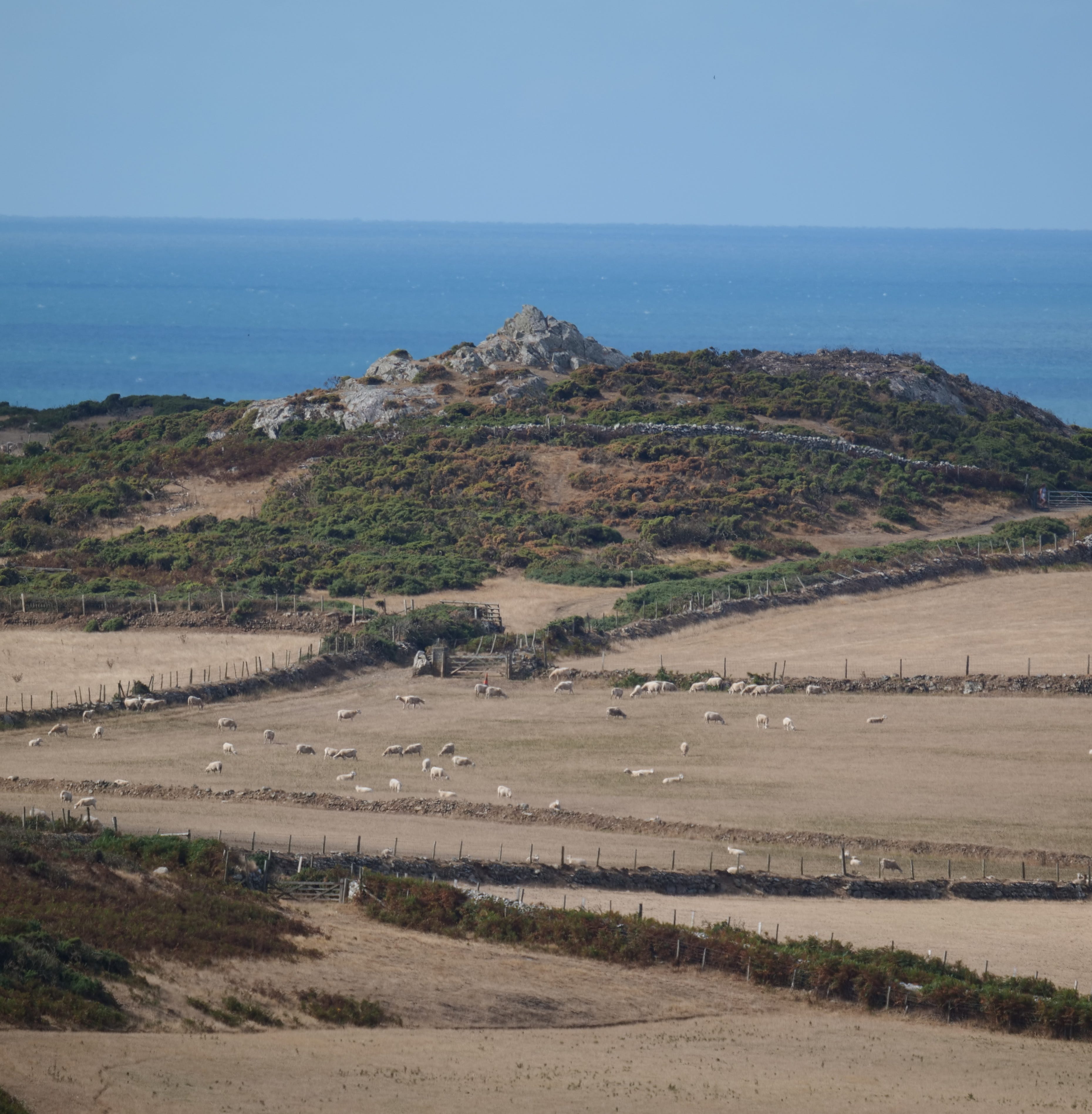
Between the sea and this field are several carns, little islands of rock, some of them 600 million years old, the only constant landmarks in the place. Everything around them transforms continually. They’re each surrounded by a fringe of deep green and purple: bracken, gorse, heather. Around those are the scissored fields, all now a pale tan colour, the way they look after a harsh winter. Farmhouses are dotted here and there, in the Pembrokeshire style: squat, whitewashed, chimneys at both ends of mortar-covered roofs. Many look run-down, not just weather-beaten. Some of the old barns are dilapidated, stacked with haylage or hay bales for the coming winter. There is very little livestock in the fields. Pembrokeshire is known for its cattle but, scanning the landscape to the horizon with my binoculars, I can only see one small herd. The farmers here had a bad winter. They’ve now had a bad summer. Another winter like the last one will be hard on them.
There’s a sign on the footpath as you walk from the car park at Whitesands Bay towards St David’s Head. It reads “Beware, Fire Risk is High.” Perhaps less so now the rain has arrived. The place has had a couple of soakings in the past few days and there are more on the way. Like the one approaching now.
But it could have burned. This beautiful place with all its rare wildflowers, insects and birds, its ancient walls and tombs.
It could have burned.
Next week, for paid subscribers, a collection of images and sounds from St David’s Head on one of the most spectacular evenings I’ve witnessed. I hope you can join me.
Thanks for reading.
J
Comments
Nothing yet. Say the first thing.
Sign in to join the conversation.