
Welcome to The Long and the Short — a show where you can expect an honest take on trading, something you won’t hear elsewhere.
The year was 2008. It was January when I applied for what was touted to be the largest IPO the Indian market had ever seen — Reliance Power. For once, I actually got an allocation, which almost never happened for me otherwise.
The issue closed oversubscribed nearly 73 times. There was real euphoria around it. And then, on 11 February, it listed — right into a market that had already started cracking a few weeks earlier. The stock briefly touched a high, and then just fell apart. It closed the day 17% below the issue price. It never really recovered from there.
But why am I telling you this story? Because looking back, I was being completely naive — blindly applying for an IPO because everyone else was, with zero understanding of what I was actually buying into. And I paid for that stupidity.
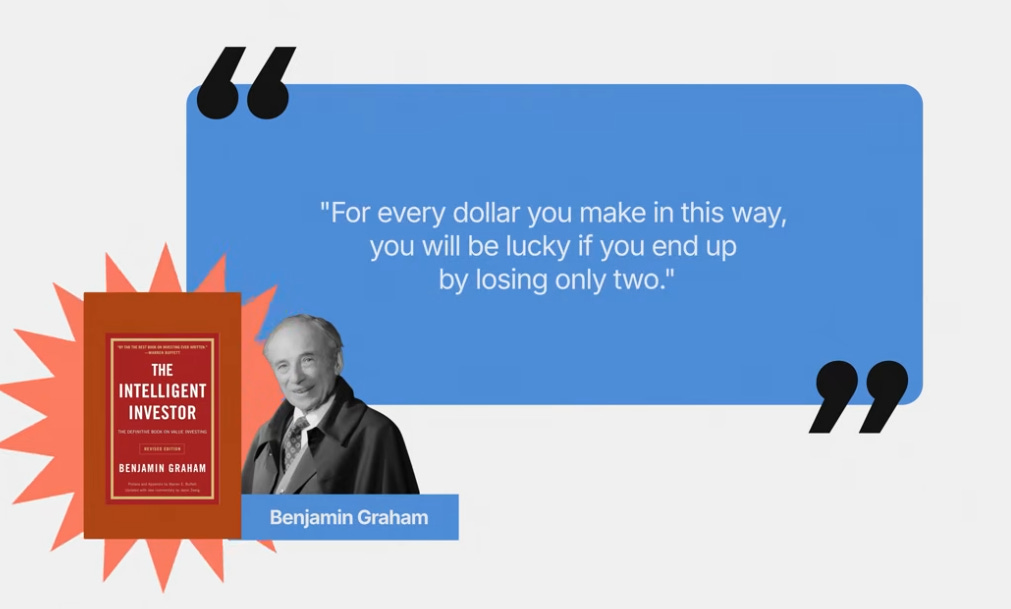
A few years later, I was reading Benjamin Graham’s The Intelligent Investor and ran into a line that took me straight back to 2008. Graham writes in the context of new listings: “For every dollar you make in this way, you will be lucky if you end up by losing only two.”
That was it. That was exactly it.
That line sent me down the rabbit hole — trying to actually understand what an IPO is, mechanically, and whether the people applying for them, on average, come out ahead or behind. Almost nothing seems to have changed since then. The mad rush to chase the listing pop, and the outcomes that usually follow it — both are still exactly the same game, seventeen years later. I’ll show you the data.
Disclaimer: The examples and ideas shared here are strictly for educational and illustrative purposes only. Nothing discussed should be construed as a recommendation, investment advice, or a solicitation to trade. Trading in stocks and derivatives involves significant risk and can result in complete loss of capital.
Let’s start by explaining the IPO process. This can get a little long, but it’s key to understanding the whole IPO dynamic.
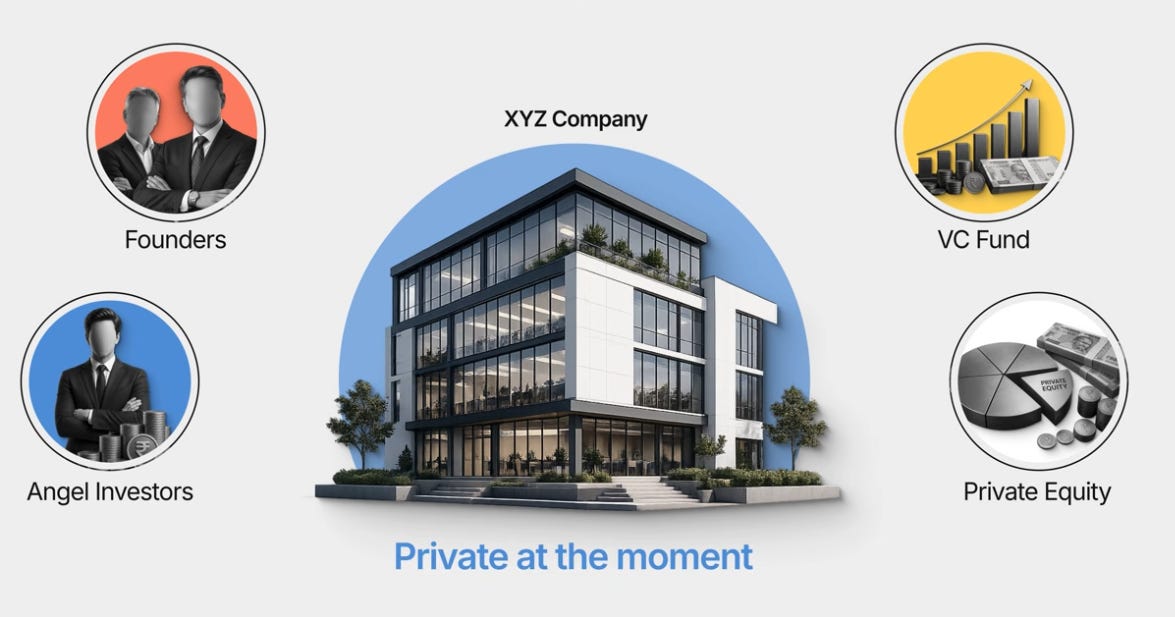
A company starts out private. It has founders who started it, and along the way, probably took on outside money — angel investors early on, then a venture capital fund or two, maybe a private equity round later. Each one of these investors owns a slice of the company, sitting on what’s called the cap table. Those shares are not traded in a market. If a VC wants to sell their stake, they can’t just log into an app and hit sell — they have to find another private buyer, negotiate a price, and hope the shareholder agreement even allows it. That illiquidity is a key aspect of this story. Private ownership is real ownership, but it’s frozen. An IPO is a mechanism to unfreeze it.
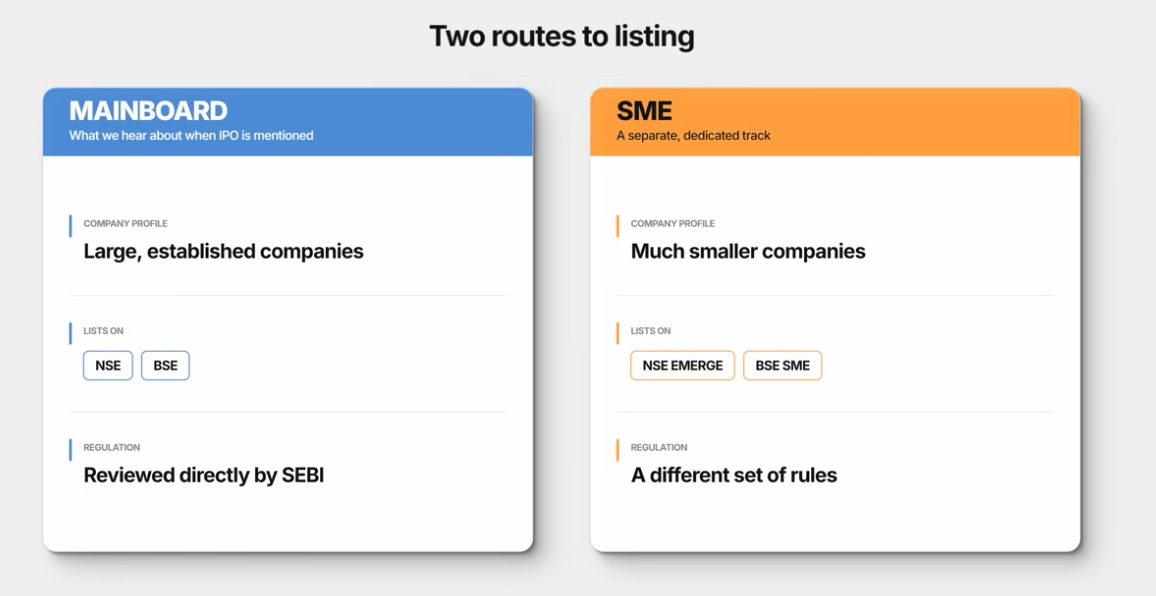
In India, there are two distinct paths a company can take to get listed. The Mainboard IPO — large, established companies listed on the main NSE and BSE exchanges, reviewed directly by SEBI — and the SME IPO, a separate dedicated track for much smaller companies, listed on NSE Emerge or BSE SME, with a different set of rules. For this episode, we’re focusing almost entirely on the Mainboard — that’s where the bulk of the money goes.
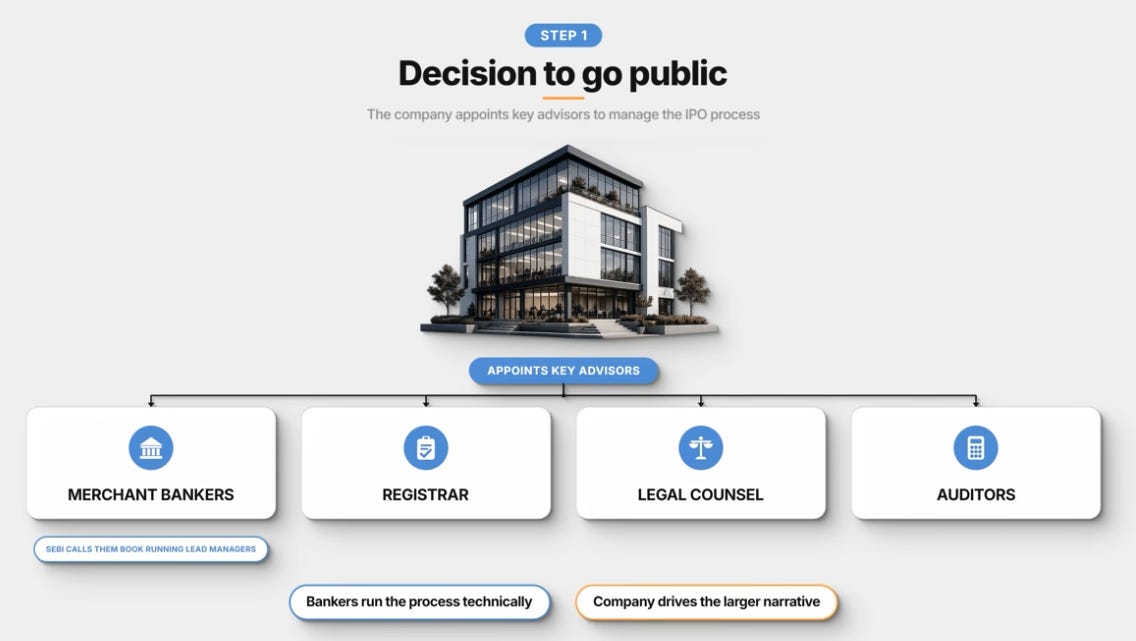
Step 1: The company decides to go public and appoints one or more merchant bankers — SEBI calls them Book Running Lead Managers — along with a registrar, legal counsel, and auditors.
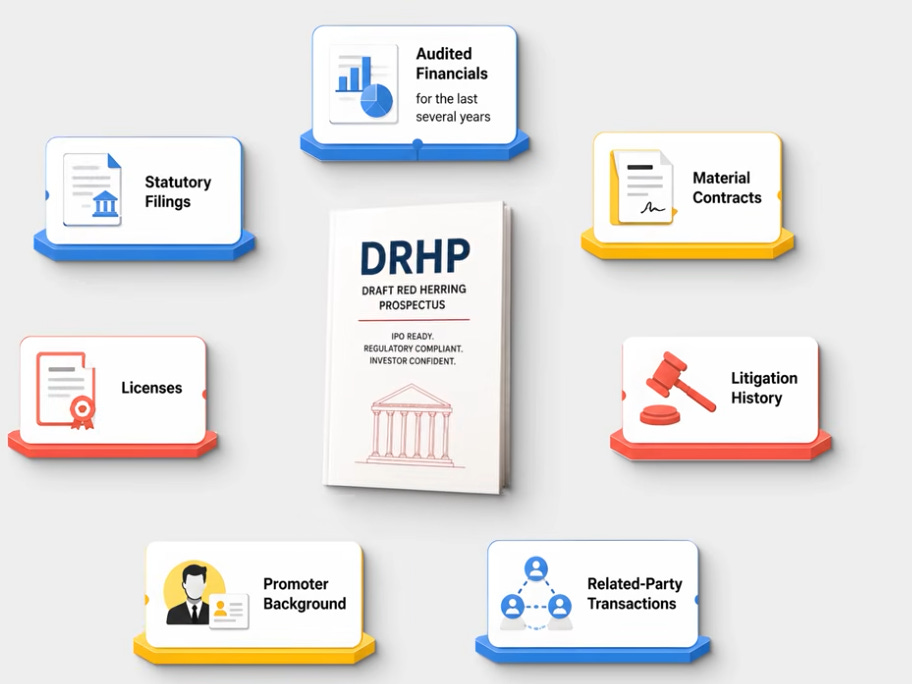
Step 2: Due diligence. The bankers and lawyers go through everything — audited financials for the last several years, every material contract, litigation history, related-party transactions, promoter background, licenses, statutory filings. This all feeds into a document called the DRHP — the Draft Red Herring Prospectus. Think of it as the company’s entire life story, laid bare, with every risk factor listed out precisely so no investor can later say “nobody told me.”
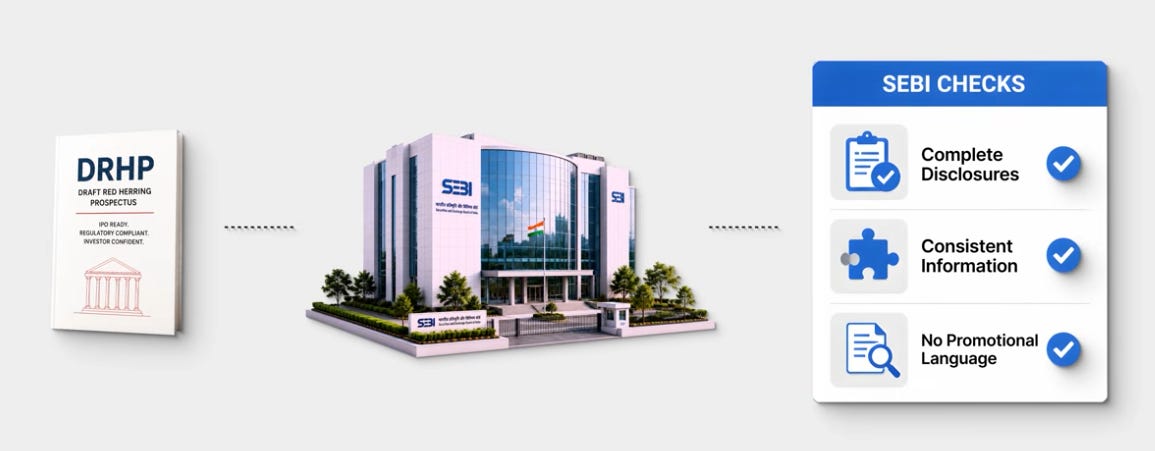
Step 3: The DRHP goes to SEBI for review, typically taking one to three months, sometimes longer.
To qualify for the Mainboard in the first place, a company needs to clear one of two bars.
The Profitability Route — the classic, conservative approach. Net tangible assets of at least ₹3 crore in each of the preceding three years, and average operating profit of at least ₹15 crore in three of the preceding five years. The company has to prove it’s actually running a profitable business, consistently, for years, before it can raise money from the public.
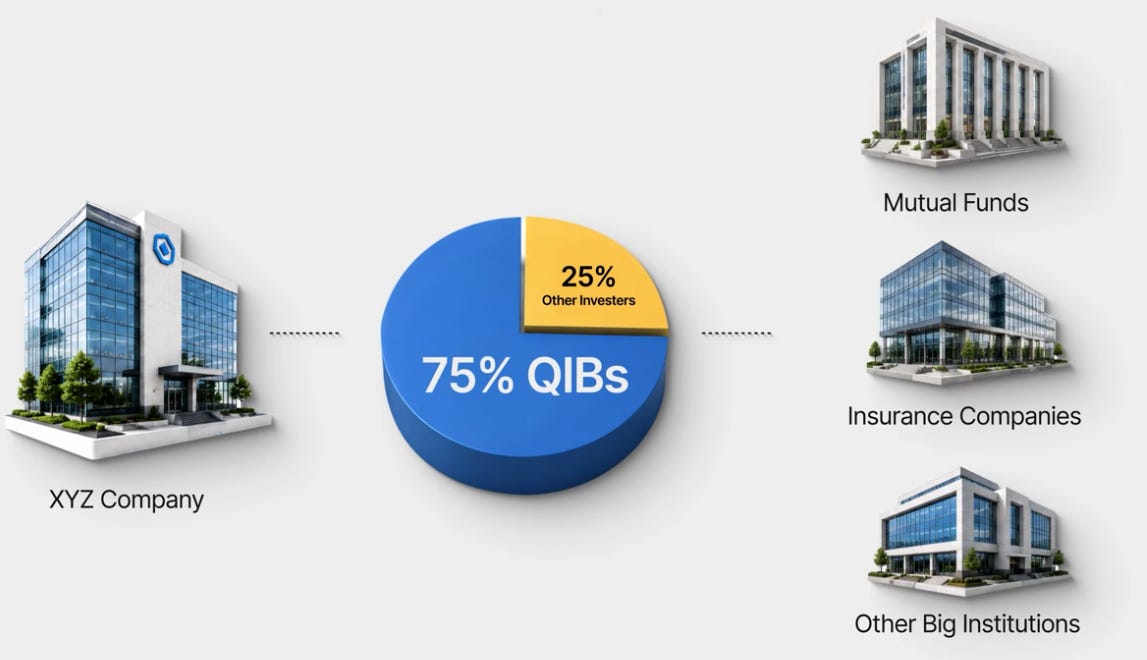
The QIB Route — this exists for companies that don’t have that kind of profit history, like many new-age tech and platform businesses. Zomato and Swiggy listed through this route. Instead of proving a profit track record, the company has to allocate at least 75% of the issue to Qualified Institutional Buyers — mutual funds, insurance companies, and similar large, sophisticated institutions. The logic: if these institutions, who have the resources to do serious due diligence, are willing to put up 75% of the money, that itself serves as the credibility signal. If that 75% threshold isn’t met, the entire issue is refunded.

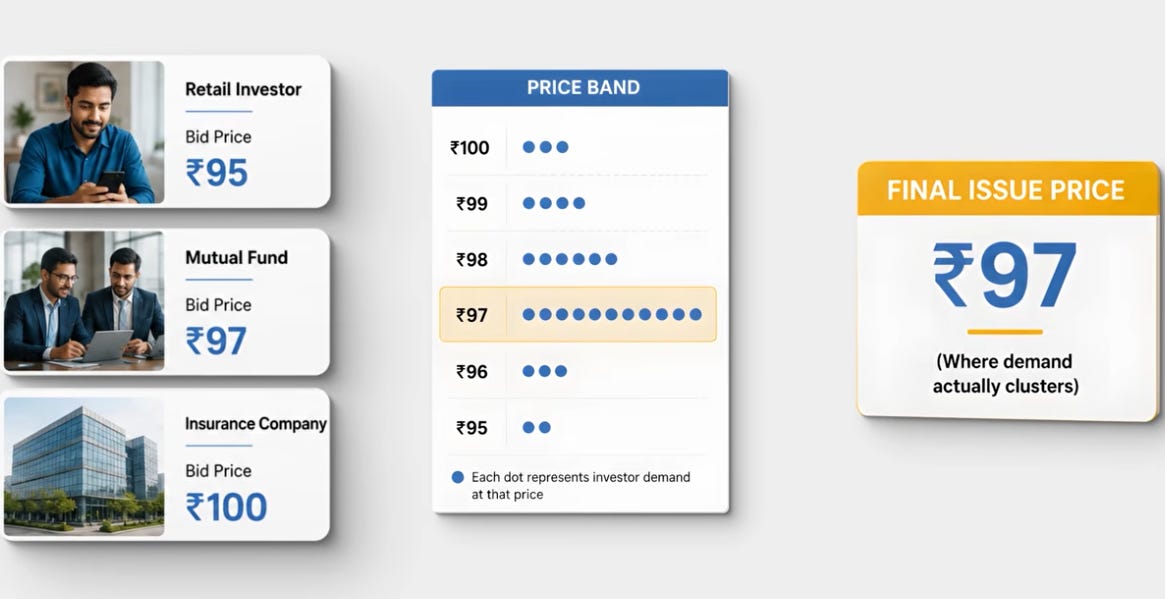
Once SEBI clears the DRHP, it becomes the RHP (Red Herring Prospectus), which carries the actual price band (say ₹95 to ₹100). A day before the issue opens, a chunk goes to anchor investors: large institutions committing at least ₹10 crore each, whose participation is meant to signal quality and help anchor the price.
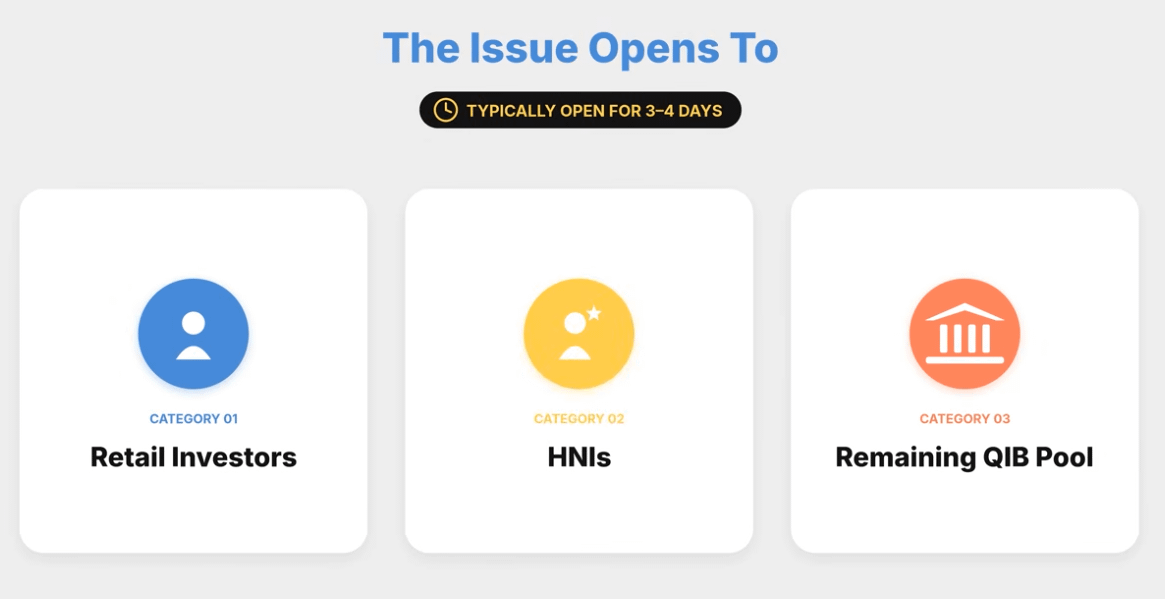
Then the issue opens to retail, HNIs, and the rest of the QIB pool, typically for three to four days, and book-building happens. Investors bid within the price band, and the final issue price is set based on where demand actually clusters, not necessarily at the top of the band.
Your money doesn’t leave your account when you apply — it just gets blocked via ASBA until allotment is decided.
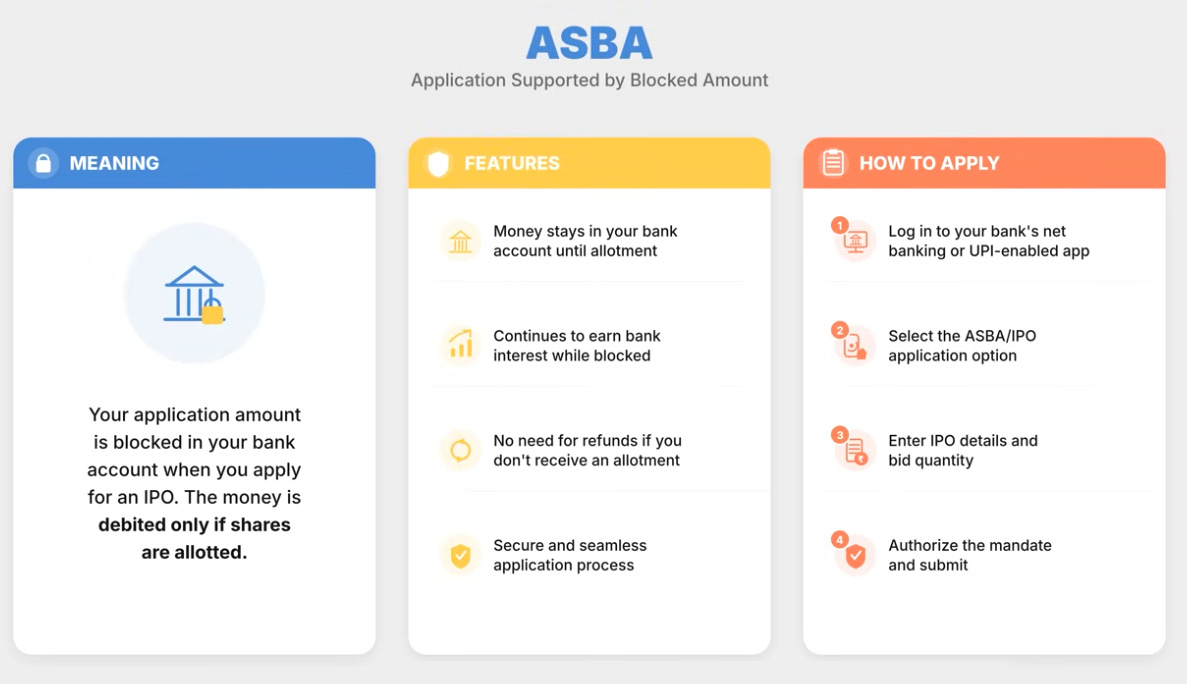
If the issue is oversubscribed, allotment for retail is essentially a lottery run by the registrar. If you don’t get shares, the block is released, and your money comes back untouched. Shares that do get allotted then list on the exchange — typically within three days of the issue closing — and that opening trade is the listing price, discovered fresh on the open market.
Almost every time an IPO opens, you’ll hear about the Grey Market Premium — GMP. People say an IPO has a GMP of ₹100 or ₹200, almost as if that guarantees a strong listing gain.
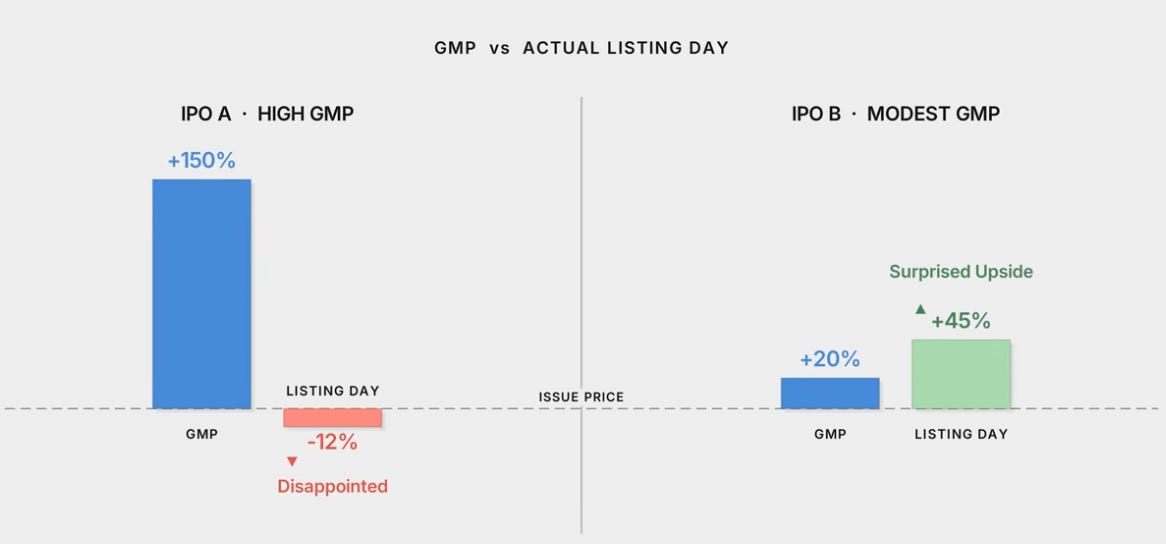
The reality: the grey market is unofficial, unregulated by SEBI, and based on a relatively small set of participants. We’ve seen IPOs with high GMPs disappoint on listing day, and others with modest GMPs surprise on the upside. Treat GMP as a sentiment indicator — not as a prediction of where the stock will list.
A few reasons why retail investors chase IPOs relentlessly.
The lottery ticket mentality. Many look at IPOs as chances to sell allotments immediately on listing day to capture short-term gains. This is the fundamental driver.
Cheap and effortless participation. With minimum lot sizes around ₹15,000 and two-click UPI mandates, entering the primary market is accessible to almost anyone.
Zero financial friction. The ASBA system keeps your application money in your bank account — where it continues earning interest — until shares are actually allotted. This zero-risk setup fuels a speculative “listing gain” mentality.
Constant FOMO. Relentless coverage from brokers, news channels, and financial influencers supercharges the cycle, often giving even mediocre companies far more hype than their fundamentals justify.
Evaluating businesses for long-term compounding is the last priority for most applicants.
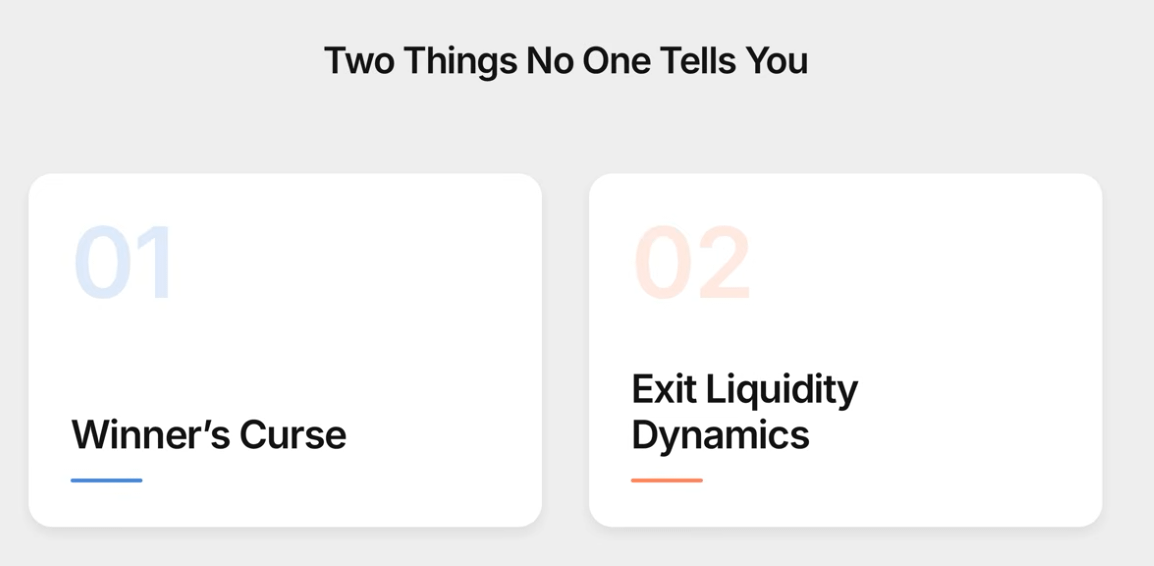
Here are two key aspects of the IPO market that almost nobody talks about.
If an IPO is priced correctly or assumed to be underpriced — and therefore likely to pop — informed institutional investors will swarm the offering. The issue becomes heavily oversubscribed, and because of rationing, your odds of getting a meaningful allotment are tiny.
Conversely, if an IPO is overpriced and fundamentally weak, the “smart money” stays away. The issue ends up undersubscribed, and the underwriter is more than happy to give you 100% of the allotment you requested.
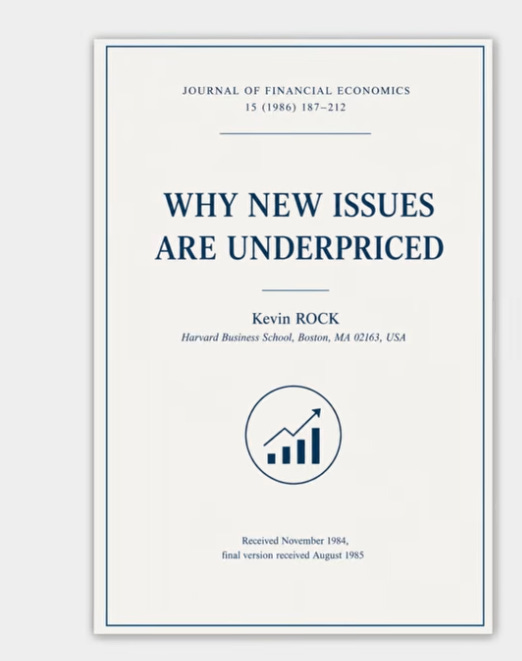
As Kevin Rock demonstrated in his seminal 1986 research, when you “win” a full allotment in an IPO, you have effectively been cursed — you’ve been handed the shares that the informed players rejected. Retail investors are structurally excluded from the “good” deals and forced to hold the “lemons.” Your win at allotment is actually a curse.
When a company goes public, it’s often not about raising capital for growth. It is an exit event. Early venture capitalists and private equity investors have held illiquid, risky stakes for years. For them, the IPO is the liquidity event they’ve been waiting for — the moment they can finally cash out.

As Pagano, Panetta, and Zingales documented in their empirical study, IPOs are often associated with equity sales by controlling shareholders. In the primary market, these insiders are looking to monetise their success at peak cyclical valuations.
When you buy into an IPO, you are essentially providing exit liquidity for early-stage backers. You are stepping into a game where the company has already been priced by people who have held the asset for years. The IPO market is designed to benefit the issuer, not the retail buyer.
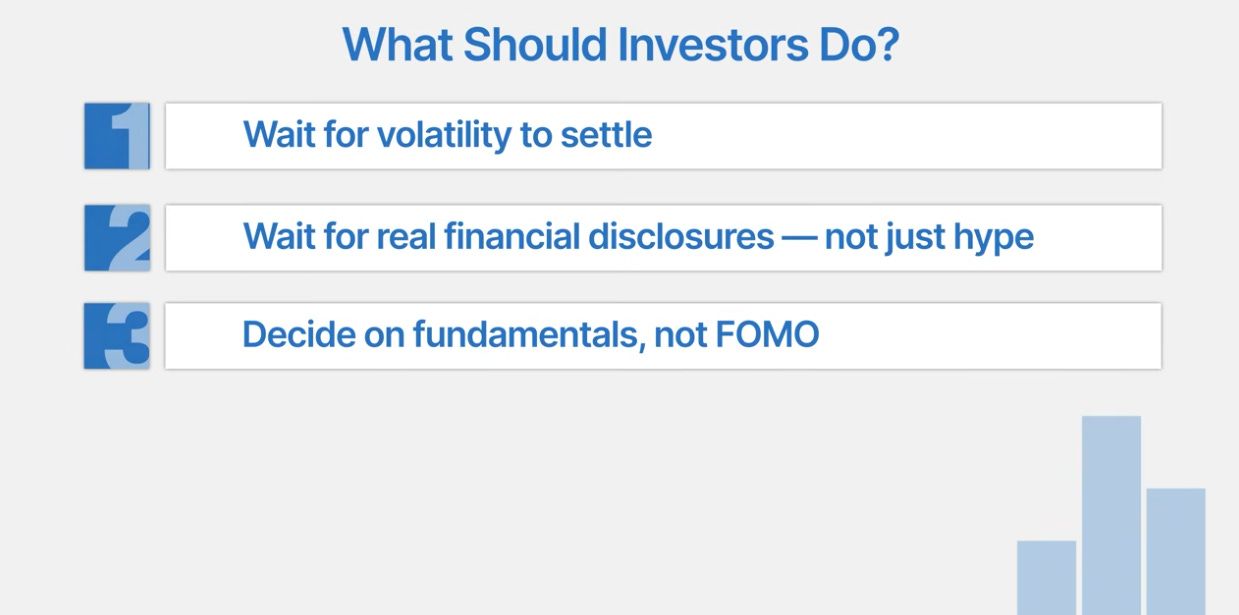
Understanding this structural reality is key. The most rational move for a secondary market investor is often to wait — let the initial volatility subside, wait for a quarter or two of public financial disclosures, and let the winner’s curse play itself out.
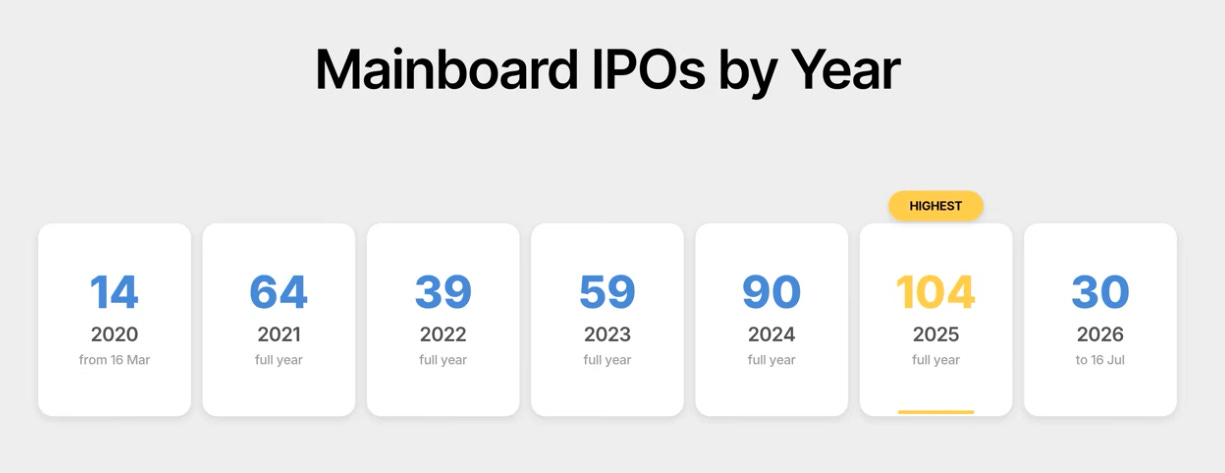
All Mainboard IPOs between 2020 and mid-July 2026 — 400 in total. SME IPOs are excluded as they follow a different listing framework. Where companies underwent a bonus issue or stock split, both the IPO issue price and current share price have been adjusted to ensure apples-to-apples comparisons.
Since the COVID bull market began in March 2020, India has seen 400 Mainboard IPOs. After just 14 in 2020, activity picked up sharply with 64 in 2021. Issuance slowed in 2022 before rebounding to 90 in 2024 and a record 104 in 2025. It’s often said that IPOs only flood the market during a raging bull market — but despite the broader market going almost nowhere over the last two years, companies continued to come to market in record numbers. Even in a lacklustre 2026, 30 listings had already happened by mid-July.
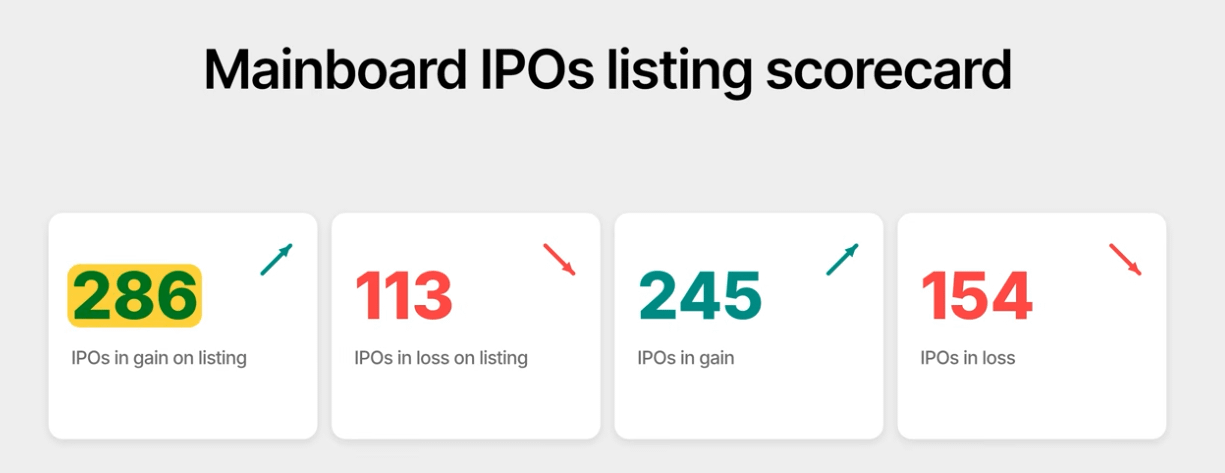
Out of 400 Mainboard IPOs in the dataset, 286 closed above their allotment price on listing day, while 113 closed below it. Roughly 7 out of every 10 Mainboard IPOs delivered a listing gain.
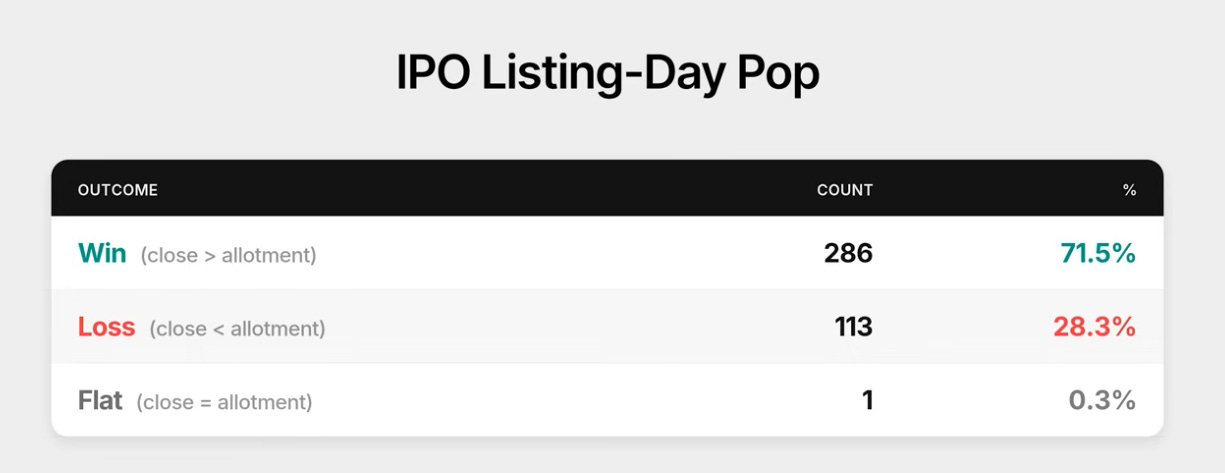
So historically, investors who received an allotment and exited on listing day would, more often than not, have made a profit.
But that’s only one part of the story. As of 17 July 2026, 245 IPOs are still trading above their issue price, while 154 are trading below it. Listing-day performance and long-term performance can be very different.
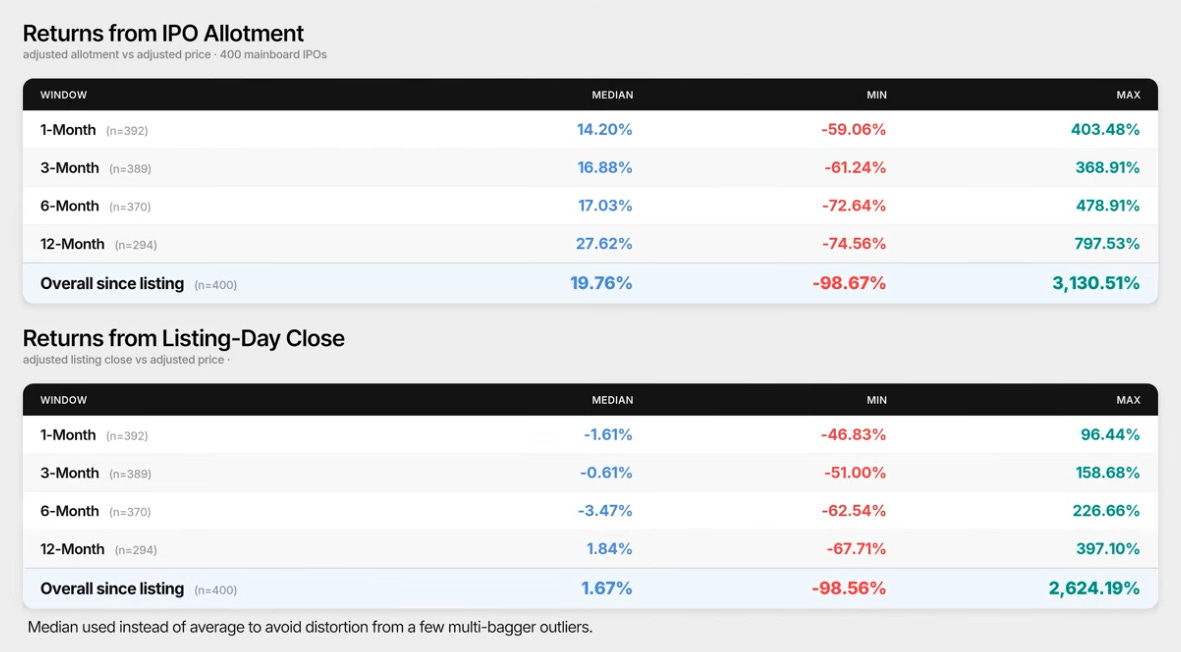
(Median used instead of average to avoid distortion from a few multi-bagger outliers.)
Two tables tell very different stories. The first assumes you received an IPO allotment — returns calculated from the adjusted issue price to the adjusted market price after one month, three months, six months, one year, and as of today. The second assumes you didn’t receive an allotment and instead bought at the closing price on listing day — which is the more realistic scenario for most people.
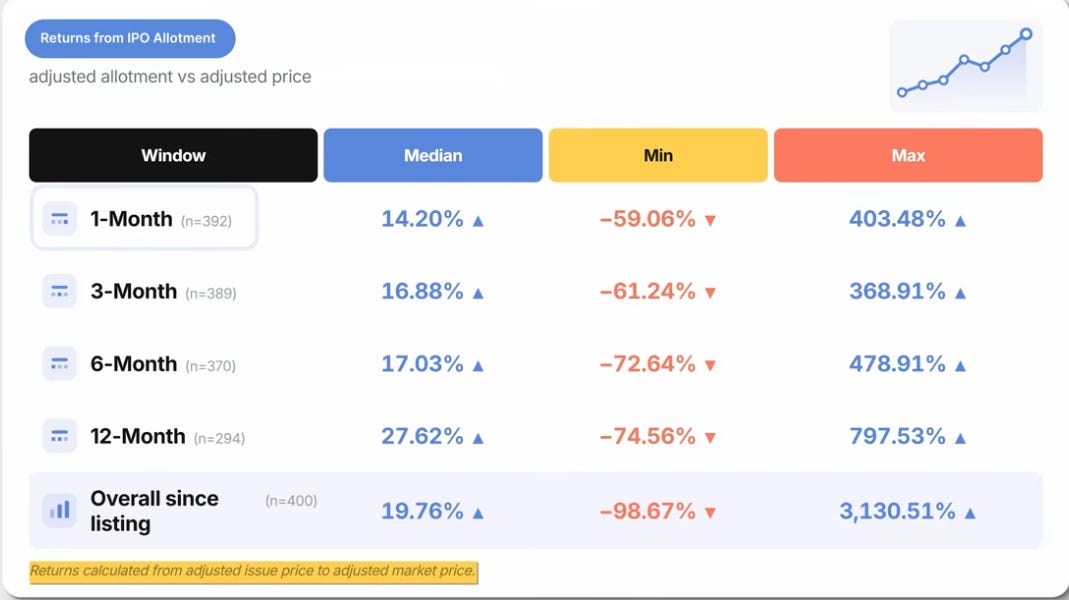
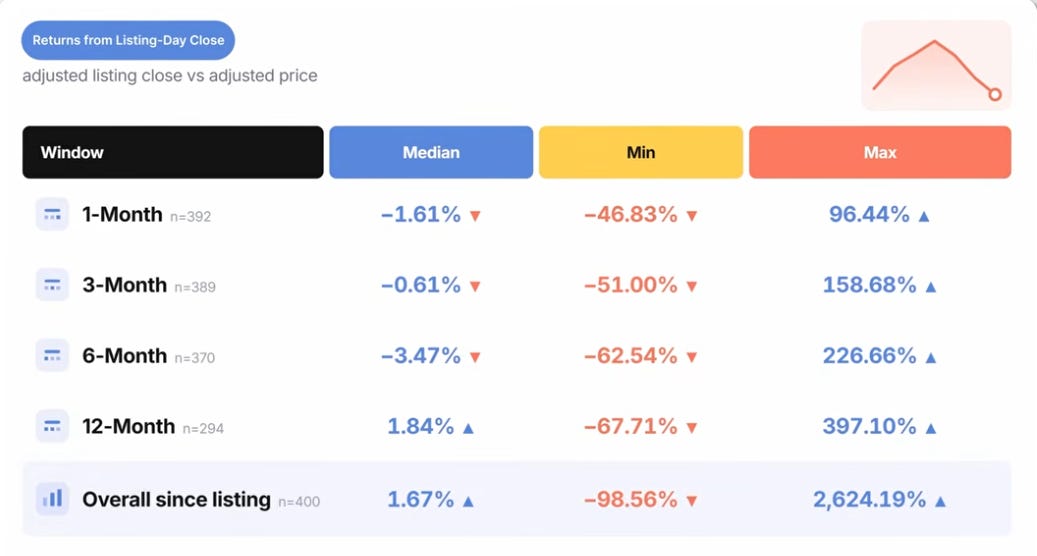
The median returns in the second scenario are much, much lower, even turning negative over several holding periods. If you missed the IPO and bought after the listing frenzy, your experience was, on average, very different from those who got an allotment.
One last data point: the maximum return column shows one IPO delivering a staggering return of over 3,000% from its issue price. Do you know which company it is? Leave your guess in the comments.
The biggest IPO winners have become household names — I’m sure most of you have heard of every company on the winners list. Companies that perform exceptionally well receive constant media coverage, analyst attention, and social media buzz. When share prices keep hitting new highs, everyone wants to talk about them.
I’m willing to bet that most of you haven’t heard of many of the biggest losers. Before putting together this analysis, I hadn’t heard of several of them either. And that’s precisely the point. The biggest IPO winners become household names, while the biggest losers quietly fade into obscurity. Some of these companies have destroyed almost all investor capital, falling as much as 99% from their issue price.

“A falling tree makes more noise than a growing forest.” In the IPO market, the opposite often seems true. Success is so loud that it gets all the headlines. Failure is surprisingly quiet — making it easy for us to remember only the winners and believe IPOs are always a great investment.
Not every IPO is a bad investment. Around 7 out of 10 Mainboard IPOs delivered a listing gain, and some have gone on to become extraordinary wealth creators.
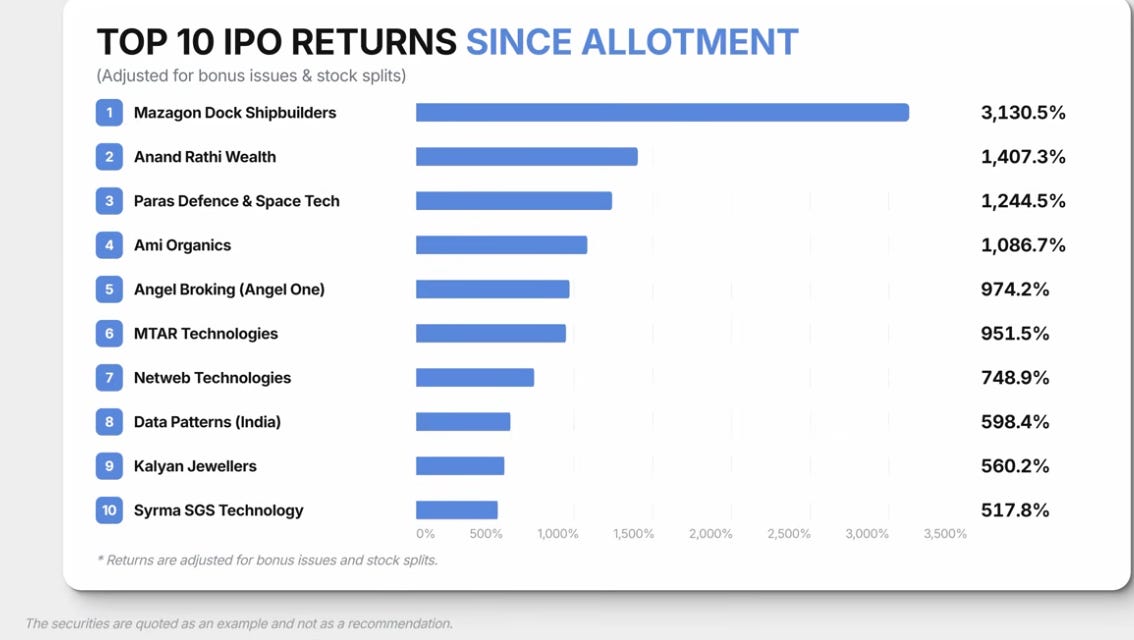
But chasing every IPO simply because it’s popular or because the Grey Market Premium looks attractive isn’t a strategy. Behind every Mazagon Dock, there are companies that have destroyed 70, 80, even 99% of investor capital.
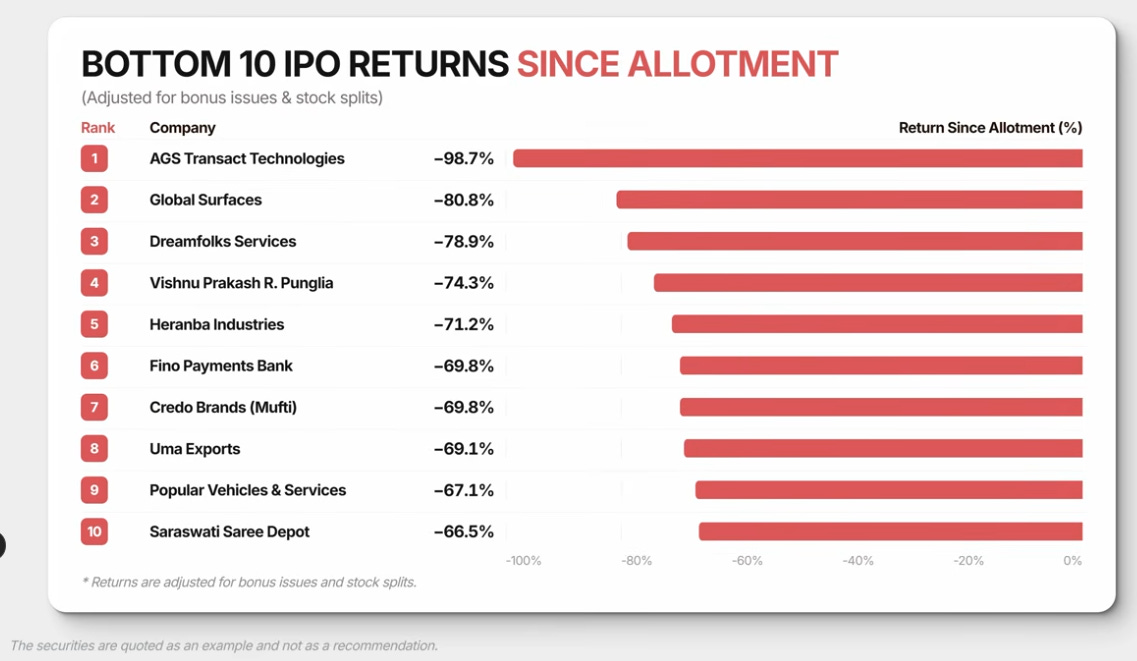
The biggest lesson isn’t that you should avoid IPOs altogether. Be more selective and serious about it. Listing gains are real, but unless you want to commit more capital post-listing, chasing the pop alone isn’t a great idea.
Evaluate an IPO the same way you would any other business: understand what you’re buying, why it’s being sold, and whether the price makes sense.
And perhaps that’s Benjamin Graham’s lesson from all those years ago — don’t let the excitement of a new listing replace good investing principles.
If you have any questions, feel free to ask them in the comments — we’ll be happy to answer.
Till then — take care and trade safe.
No posts
Comments
Nothing yet. Say the first thing.
Sign in to join the conversation.