
In June 2026, La scena del contemporaneo / The Scene of the Contemporary will take shape as an exhibition and an art photography catalogue featuring images by Mario Cresci created within the studios of Francesco Bocchini, Chiara Lecca, Nicola Samorì and Alessandro Roma. The following text is an excerpt from the catalogue essay I wrote for the project, conceived under my artistic direction.
What does it mean to enter an artist’s studio? What treasure do we imagine we might find within its rooms? Behind these apparently simple questions lies an expectation: the idea that crossing its threshold might grant us privileged access to the work, that the encounter with a whole series of clues, imagined as passe-partout, might open a passage into it. Unless, more prosaically, the artist’s studio is nothing more than a simple workspace — functional, contingent, interchangeable. Is its mythology, then, merely a projection of the gaze of those who enter it from the outside?
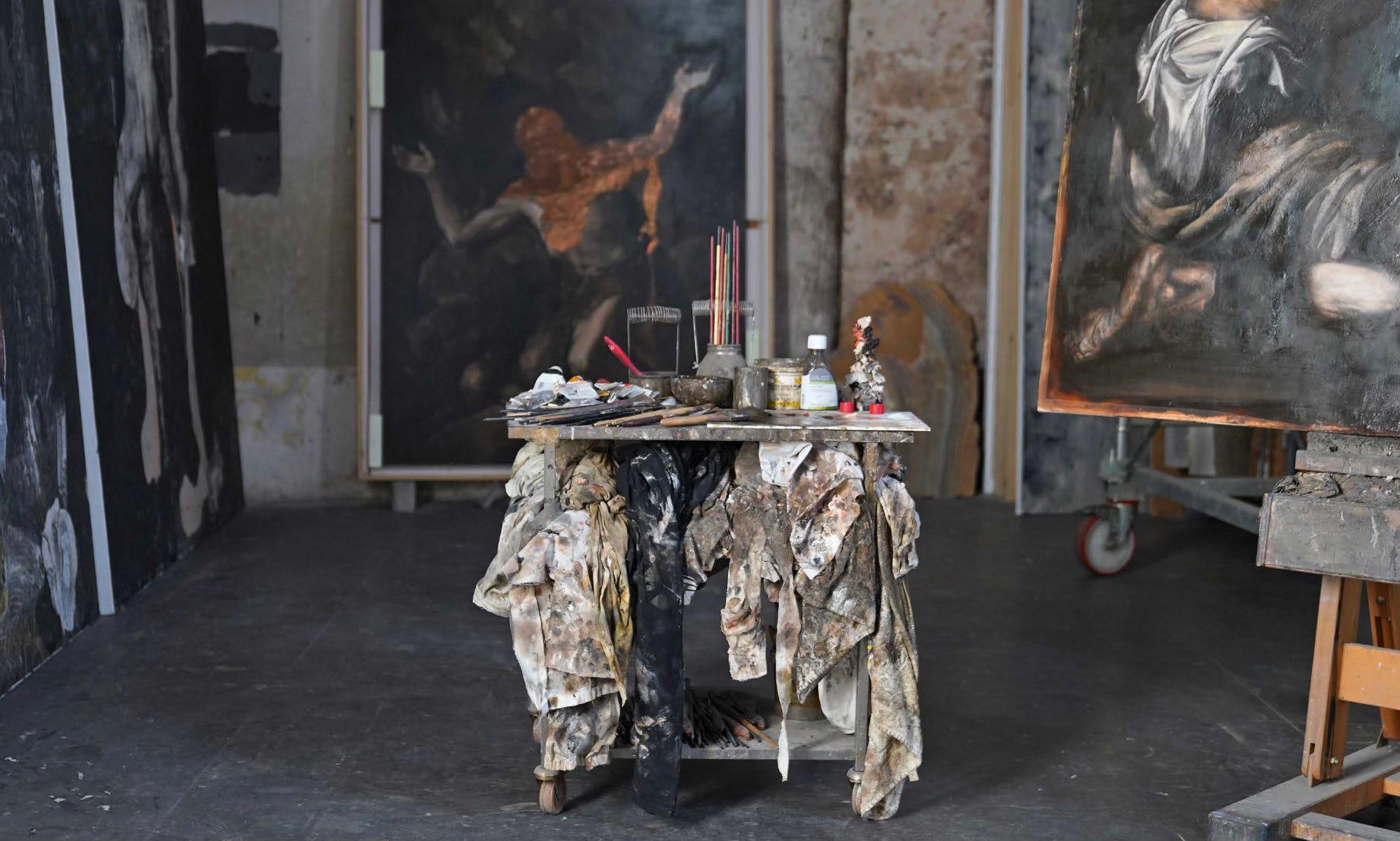
A sacred place for some, a workshop for others, the studio remains a container dense with reality — no truer, no deeper, than the works it holds. And yet, much like the works themselves, it is bound to a vision, oriented toward reaffirming it, toward bearing witness to it, in its totality as much as in every single detail.
From this perspective, the atelier acts as an epistemic device: a network of contiguous and, at the same time, unrelated signs. Objects, books, clippings, tools, sketches, images. Things forgotten in a corner, others placed in full view. Whether governed by a manic order or appearing before our eyes as a chaotic and undisciplined forge, the studio seems invariably to establish itself as an extension of the work, a porous field of resonances and inferences.
A useful resonance comes from William Kentridge’s reading of Philip Guston’s The Studio (1969). What interests Kentridge is not simply the iconography of the artist’s workspace — the easel, the brushes, the palette, the curtain — but the way the painting stages the studio as a process of transformation.
In his words, the studio is a place where the world is invited in, fragmented, rearranged, and then sent back out into the world.
Seen from this perspective, the studio is no longer merely the place where the work is made. It becomes the site where the world is broken down into signs, matter, images, gestures, residues — and where these fragments begin to assume another order.
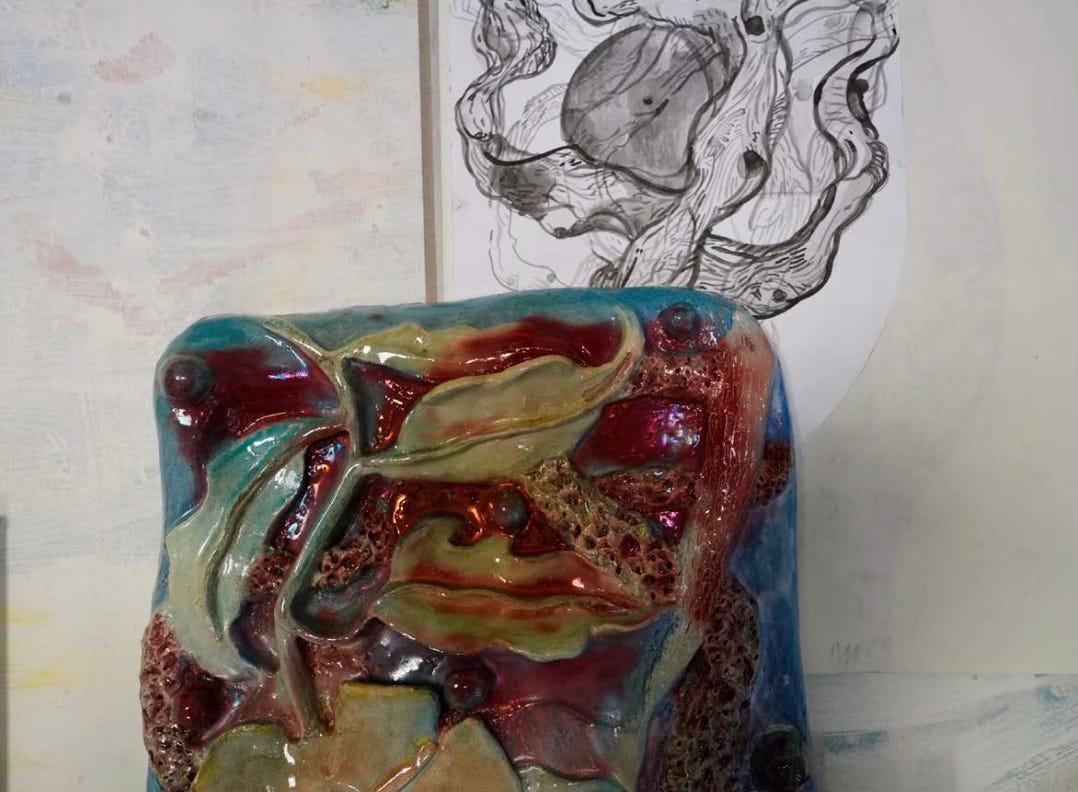
Within these walls, making measures itself against the resistance of matter; thought is set in motion and, with it, friction, until the final release that every act of creation inevitably carries with it. Within them, the industriousness of daily routine and its opacities, its dead time, find the possibility of unfolding, of being transmuted into form.
Insofar as it acts as a system that projects and condenses an integral vision, even when that vision appears disjointed — and perhaps all the more so — the studio may be considered a kind of materialized mental theatre. And every element it contains — including the arrangement of works and materials — ultimately appears as the singular expression of a broader matrix, in which all the inputs that contribute to the construction of a work converge. Hyperbolically, one might think of the studio as an ur-work, where every detail preserves and reflects the whole — where the singular is multiple, and vice versa.
This text is an excerpt from the essay La scena primaria, written for the catalogue of La scena del contemporaneo / The Scene of the Contemporary, a curatorial project dedicated to the artist’s studio as a primary site of contemporary art research.
No posts
Comments
Nothing yet. Say the first thing.
Sign in to join the conversation.