
A version of this piece was originally published by GovInsider, as part of an overall series of articles around GovMesh 4.0 - held jointly by interweave and GovInsider in Singapore earlier this year.
Governments around the world have seen a significant increase in the amount of data that they collect. However, the use of this increased data in policymaking has not always kept pace.
It is this gap that the United Nations Development Programme (UNDP) is seeking to address through a range of initiatives, including efforts to help governments systematically integrate data into public policy making.
UNDP Global Center Singapore’s Acting Head, Carla Gomez-Briones, told GovMesh that “we have more data available now than at any other point in history, yet it is frequently underutilized in public policy”.
She highlighted that around 90 per cent of the world’s data has been created in the past few years, with the surge driven by advances in emerging technologies.
New data sources have also emerged beyond conventional data - including spatial data, sensor data, commercial data, and data generated from everyday digital devices.
“This presents a new challenge and opportunity for governments: how to manage large volumes of data and integrate them into decision making?”, she said.
In this context, she highlighted the Data to Policy Initiative, designed to support policymakers in grasping the fundamentals of data-driven decision-making.
Gomez-Briones began her presentation by outlining the role of the UNDP Global Center in Singapore - a hub for technology, innovation, and sustainable development.
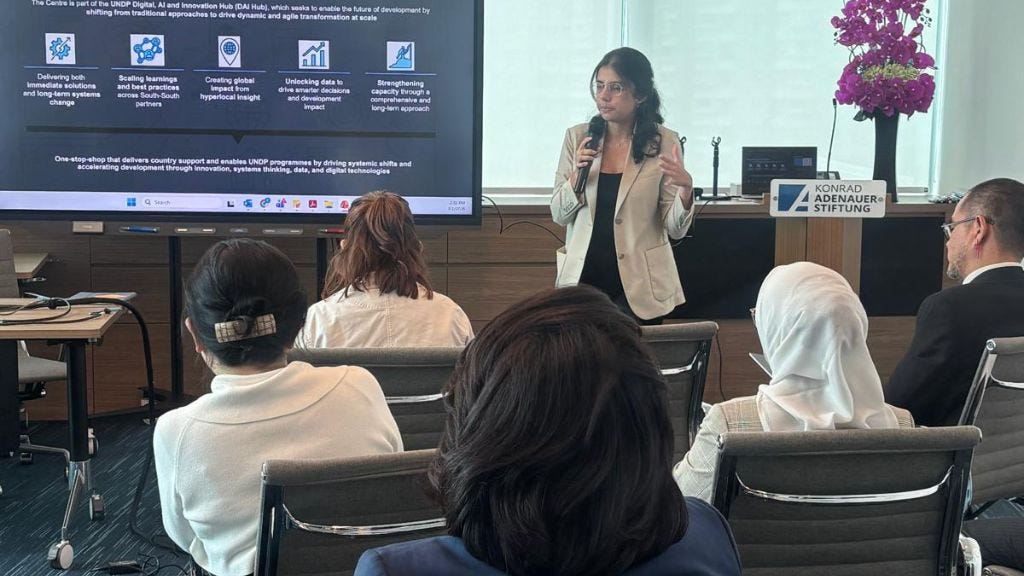
UNDP Global Center Singapore’s Acting Head, Carla Gomez-Briones, presenting at GovMesh
Established in partnership with the Government of Singapore, the center works with a wide range of partners in the country, from government ministries to global platforms such as the World Cities Summit and Asia Tech x Singapore (ATX).
Collaborations also extend to emerging areas such as AI readiness assessments as well as digital trust and safety.
Singapore, Gomez-Briones explained, offers a mature ecosystem - from strong institutions and partners to technological capabilities - that could be leveraged to support developing countries in their own development journeys.
She noted that “we see this as a two-way collaboration, harnessing the Republic’s vibrant ecosystem to support our country offices, while bringing lessons and perspectives from across our global network to enrich partnerships here in Singapore”.
One example of this work is the Data to Policy Initiative, developed with the support of the German Federal Ministry for Economic Cooperation and Development (BMZ) and the European Union (EU).
Beyond technical challenges, a key barrier in fully utilizing data in the hands of public sector entities is the misalignment between data and decision-making processes.
Incentives, institutional structures, and workflows do not always support or enable the use of data in policymaking, Gomez-Briones said.
UNDP and its partners have launched the initiative with a view to creating a global knowledge ecosystem to support governments to leverage traditional and emerging data sources effectively, responsibly, and sustainably.
There are four pillars in the initiative.
Data to Policy Navigator: A comprehensive guide to help policymakers integrate data into decision-making processes, focusing on embedding data into real policy workflows rather than standalone analysis. It covers areas such as problem framing with data perspectives, data access, exchange, governance, and visualization - including privacy and regulatory considerations.
Training: UNDP also provides interactive trainings based on a “whole-of-government” approach and the data-informed policymaking methodology featured on the navigator, bringing together agencies such as statistical offices and finance ministries to align data use across government and data sharing between institutions.
Community: Enabling policymakers to connect, share, and learn from global practices. “We are very much focused on solutions and on creating connections between countries by creating a community of practice,” Gomez-Briones added.
Projects: Working with policymakers to integrate data into their policy design. Gomez-Briones shared an example from Moldova, which began with a small pilot before scaling up to a national strategy.
Through its four pillars, UNDP aims to create a global knowledge ecosystem, where policymakers can learn and exchange their experience on data-informed decision-making.
This helps to surface actionable insights on how governments can leverage the power of data to prioritize, design, and deliver for people and the planet.
During the Q&A session, GovMesh’s participants raised questions about the target users of data-informed policy.
Gomez-Briones explained that UNDP’s presence in around 170 countries allows the organization to work closely with governments towards achieving their national development priorities.
“By engaging ministries, we can work with officials who are able to implement the initiatives,” she said.
However, she underlined that politics would remain a critical factor. Even with strong technical capacity, initiatives may falter without leadership support and understanding.
As a result, UNDP designed its training programmes to target both technical officials and senior leaders, with the balance adjusted depending on the country’s context and readiness.
Gomez-Briones encouraged participants to explore the Data to Policy Initiative online, highlighting opportunities to engage with its tools, contribute insights, and connect with a growing global community.
Comments
Nothing yet. Say the first thing.
Sign in to join the conversation.