
Alexandra Coleman was a senior chartered electrical engineer at Arup when she first noticed the pattern.
Across multiple large-scale infrastructure projects, she watched six different consultancies produce six different risk assessments — environmental, structural, electrical, regulatory, financial, insurance — and not one of them talked to the others. Each report was thorough on its own terms. None of them modelled what happened when their risks collided.
The power consultant didn't know about the permit delay. The insurance underwriter didn't see the grid constraint. The environmental assessor didn't talk to the structural engineer about what salt air corrosion would do to the cooling infrastructure over a ten-year debt tenor. The lender's credit team got a stack of PDFs that each said "manageable risk" and signed off on a number that was, in practice, a guess dressed in professional formatting.
Alexandra saw it because she was the engineer sitting between the workstreams, watching risks interact in ways nobody was modelling. A grid approval runs late, so the construction timeline slips. The timeline slips, so the off-taker renegotiates. Revenue projections change. The DSCR covenant gets tight. None of it showed up in the financial model, because the model assumed these risks existed in isolation.
They don't.
She filed the insight away. Then she went and helped build BeZero Carbon, a global carbon ratings agency that raised over $50 million during her tenure as Chief Engineering Officer. The entire company was built on one premise: a market works better when risk is quantified and independently assessed. BeZero took an opaque, qualitative market and made it legible. Capital reorganised around the signal.
Then the AI compute boom happened.
Capital flooded into data centres. $7trn in annual capex projected by 2030, growing at 26 percent a year. And Alexandra recognised the same structural gap she'd been staring at for a decade: an enormous, fast-moving asset class, financed by sophisticated institutional capital, priced on risk data that doesn't exist.
She started Azraq.
There's a useful exercise if you work in project finance or credit risk. Pull up the financial model for any data centre deal you've underwritten in the last two years. Look at the depreciation schedule. Look at the equipment useful life assumptions.
Now ask yourself: does this model know the difference between a facility in Frankfurt and a facility in Doha?
It almost certainly doesn't. But the difference is enormous.
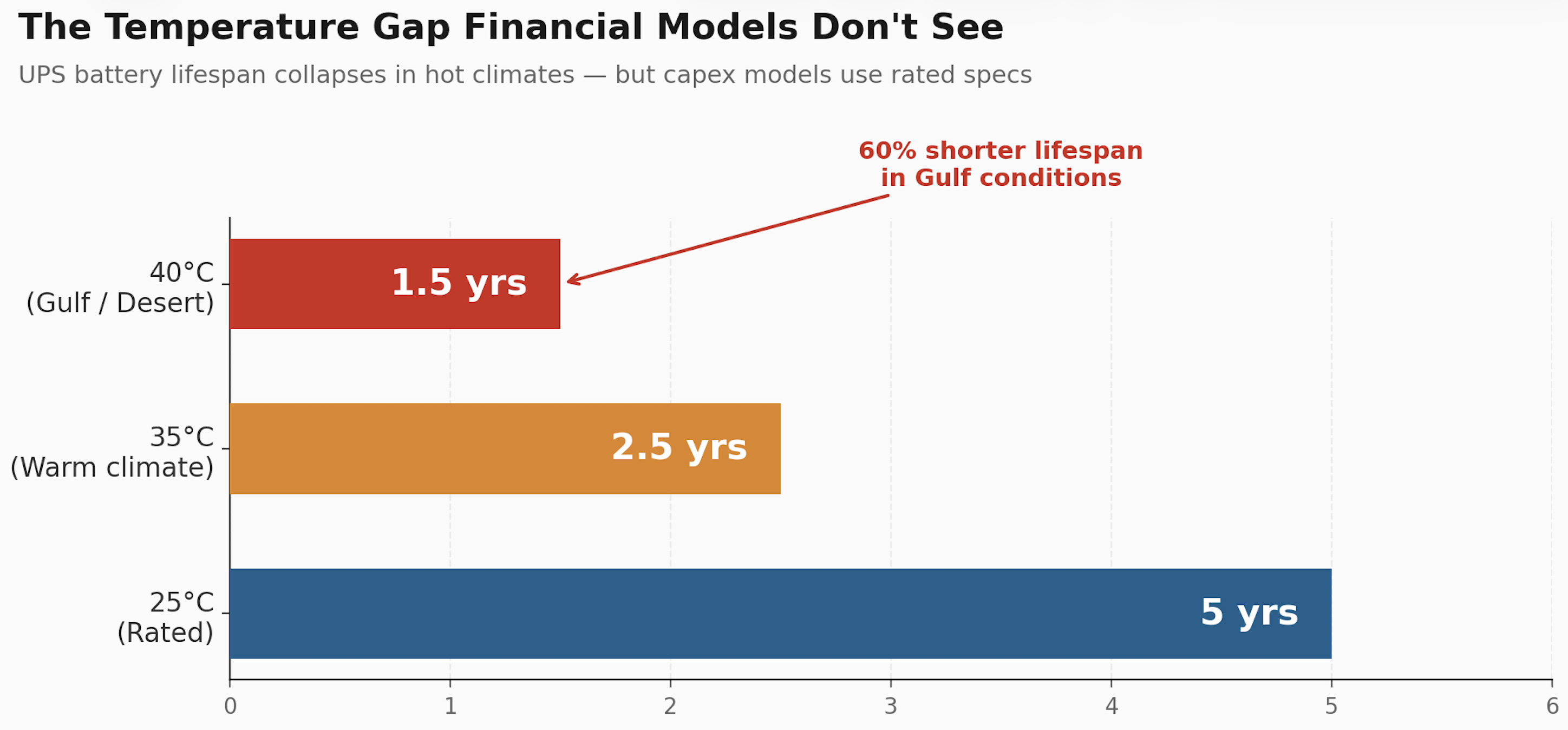
A UPS battery rated for five years at 25°C will last two and a half years at 35°C and less than eighteen months at 40°C. That's not a rounding error. That's a 60 percent reduction in battery life that shows up nowhere in the capex replacement schedule of a standard financial model. In the Gulf, where ambient temperatures routinely exceed 45°C and humidity can swing from 20 to 90 percent in the same week, the ASHRAE curves that underpin most equipment lifetime assumptions simply don't hold. Corrosion from salt air in coastal environments — Abu Dhabi, Dammam, Mumbai, Jakarta — can halve the rated lifespan of unprotected switchgear and transformers.
Or look at cooling architecture. Most financial models treat power capacity as fungible — 50 megawatts is 50 megawatts. But in a high-density AI training facility running thousands of GPUs at 700 watts each, 40 percent or more of total power draw goes to cooling alone. If the facility wasn't designed for liquid cooling, you don't have a 50-megawatt data centre. You have a stranded asset with a beautiful power contract it can't fully monetise. Thousands of megawatts of contracted capacity globally are already sitting behind this thermal bottleneck.
Or look at water. A single large data centre in an arid climate can consume five million gallons per day. When Qatar, Saudi Arabia, or Arizona face water allocation decisions, a data centre is not going to win that fight against agriculture or residential supply. Water curtailment risk doesn't appear in any standard credit model. But it is the single fastest path to forced operational downtime in water-stressed regions — and those are precisely the regions where the largest new builds are being planned.
Or look at the grid. Utilities are projecting five to seven year interconnection delays for new high-voltage connections. Data centres need to be operational in eighteen to thirty-six months. In West London, data centres have absorbed so much grid capacity that new housing developments can't get connected until 2037. The financial model says "grid connection: confirmed." The reality is that designed capacity and delivered capacity are two completely different numbers.
These are not edge cases. These are the standard operating conditions of the fastest-growing data centre markets in the world.
A billion-dollar SPV built on assumptions that don't account for how salt air eats switchgear, how desert dust degrades cooling performance, how water scarcity forces shutdowns, how grid delays strand capital — that is not a sophisticated financial instrument. It is an expensive guess. And the people writing the cheques are starting to notice.
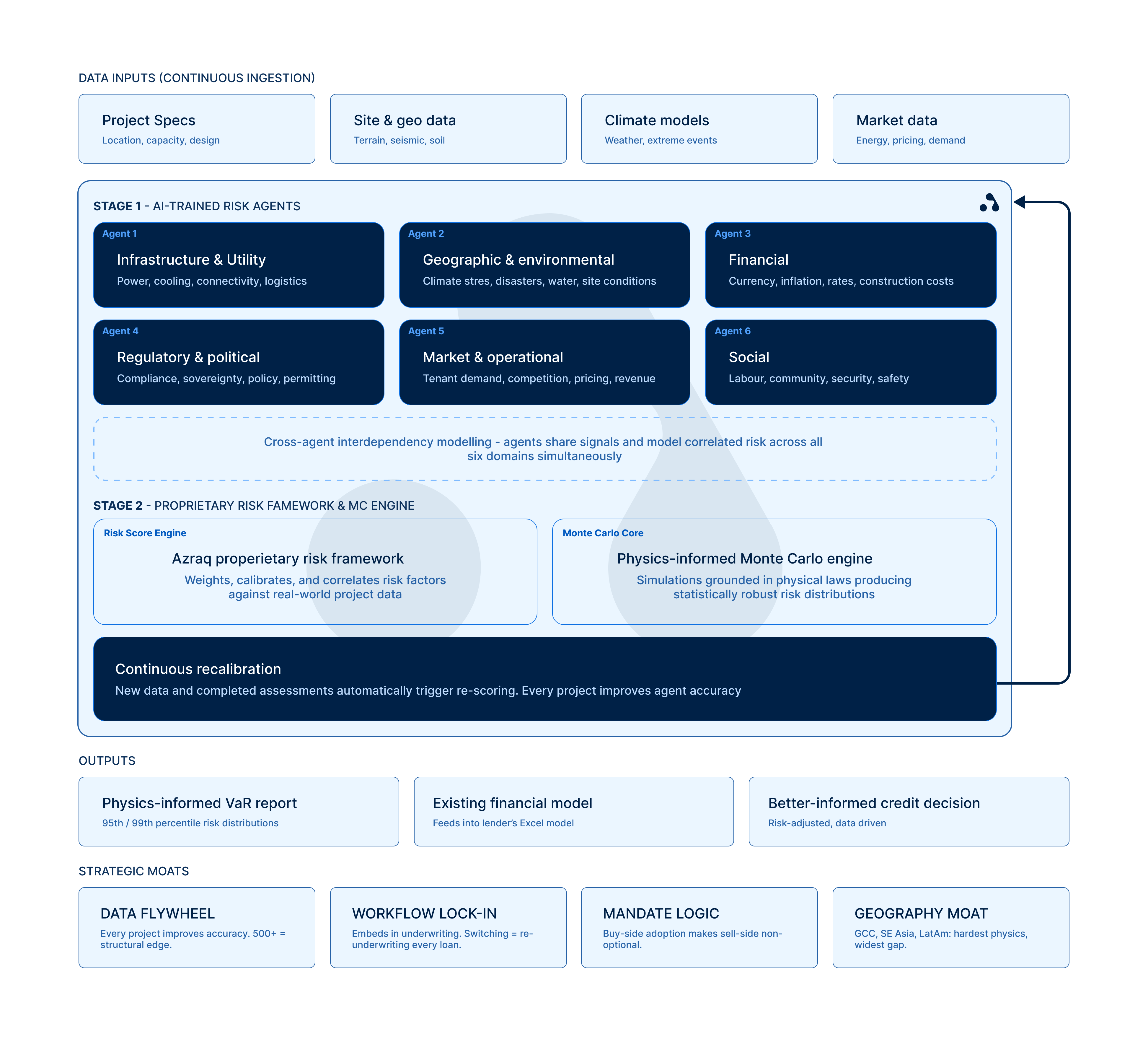
At the core of Azraq is what Alexandra calls a physics-informed probabilistic AI engine.
This is not a spreadsheet with three scenarios. It's not a consultancy opinion with caveats. It is six AI agents, each trained on a specific risk domain, working across a 600 line-item risk framework calibrated for different data centre types, geographies, and climate conditions. The agents model the interdependencies — how a permit delay compounds a delivery overrun, how a grid constraint interacts with a cooling system choice, how a three-month slip becomes a twelve-month slip becomes a credit default.
The phrase "physics-informed" is doing real work. Traditional financial models treat risk factors as independent variables with linear sensitivities. Stress the revenue line by 10 percent, stress the cost line by 10 percent, see what happens to DSCR. That's fine for a bond. It is inadequate for an infrastructure asset where risks propagate like forces in a physical system — where a flood zone reclassification triggers a site relocation that triggers a six-month delay that triggers an off-taker walkaway that triggers a covenant breach.
The cascade is the risk. And the cascade is what Azraq's engine models.
Data comes from two sources. Open-source intelligence — GIS tools mapping power infrastructure, cooling systems, fibre networks, flood zones, grid availability, climate projections. And proprietary operational data from developers, operators, and lenders who feed real-world performance data into the platform. Azraq gets access because operators need what the platform gives back: if you're a developer trying to close financing, a lender-grade risk report that accounts for site-specific physics is the single most valuable document you can produce.
The baseline assumptions are calibrated by subject matter experts — the kind of knowledge that lives in the heads of people who've spent twenty years watching transformers corrode in coastal environments or cooling systems fail in desert heat. Coleman's engine encodes that expertise into replicable, auditable probabilistic models.
The output is a Value at Risk assessment at the 95th and 99th percentile confidence intervals. It tells a lender: here is what your actual downside exposure looks like, not the one your spreadsheet assumed.
Phase one is live now: a secure web-based workflow producing automated, lender-grade risk reports, with models being calibrated against real pilot projects. Phase two is the network: an interactive dashboard with API-connected live data feeds, portfolio analytics, and marketplace infrastructure connecting sell-side operators with buy-side capital through shared risk intelligence.
The technology matters. But the technology is not the moat.
Every project Azraq assesses makes the platform harder to compete with. Every assessment creates a training record — inputs entered, risks flagged, actual outcomes observed. After fifty projects, the model is meaningfully calibrated against reality. After five hundred, it is structurally superior to any new entrant. Not because of better algorithms. Because of better data.
The physics-informed engine learns the actual decision trees between each data point and its impact on value at risk. The accuracy compounds in a way that no competitor can shortcut, because they won't have access to the underlying asset data. Think of Bloomberg's bond settlement record — a live dataset built over decades that cannot be purchased or reconstructed from the outside.
Then there's workflow lock-in. Once a lender builds Azraq outputs into their credit decision process, the methodology becomes embedded in their underwriting chain. Switching isn't a software decision. It's a re-underwriting of every loan in the portfolio. The analogy is MSCI index inclusion — once embedded in the process, the platform becomes the process.
Then there's geography. The GCC, Southeast Asia, and Latin America are experiencing the fastest data centre growth globally, and they face the most severe environmental and infrastructure constraints. These are the markets where traditional risk models break down most completely — and where Azraq's physics-informed approach creates the widest performance gap.
And there's the mandate logic. Once lenders build Azraq into their credit approval process, every developer and operator who needs that capital must produce an Azraq risk score. Buy-side adoption makes sell-side adoption non-optional. The platform creates its own distribution.
SoftBank, Amazon, Google, and others are taking on significant debt to finance AI infrastructure at a moment when geopolitical instability is raising borrowing costs and pushing capital toward safer assets. Private credit funds exposed to tech are seeing redemption pressure. AI compute economics remain largely unproven at scale.
When debt-fuelled technology booms unravel, they unravel fast.
Independent, forward-looking risk assessment that identifies hidden leverage, flags refinancing risk early, and prices actual project viability rather than growth narratives — that isn't a nice-to-have. It's the missing piece of the capital stack.
When risk is mispriced, capital flows to the wrong places. Projects that should get funded don't, because lenders can't differentiate between good sites and bad ones. Projects that shouldn't get funded do, because the models said the risk was manageable and nobody checked whether the physics agreed.
Alexandra Coleman, Founders of Azraq
Ollie Graham-Yooll & Karan Pinto , The Utopia Studio Co-Builders
No posts
Comments
Nothing yet. Say the first thing.
Sign in to join the conversation.