
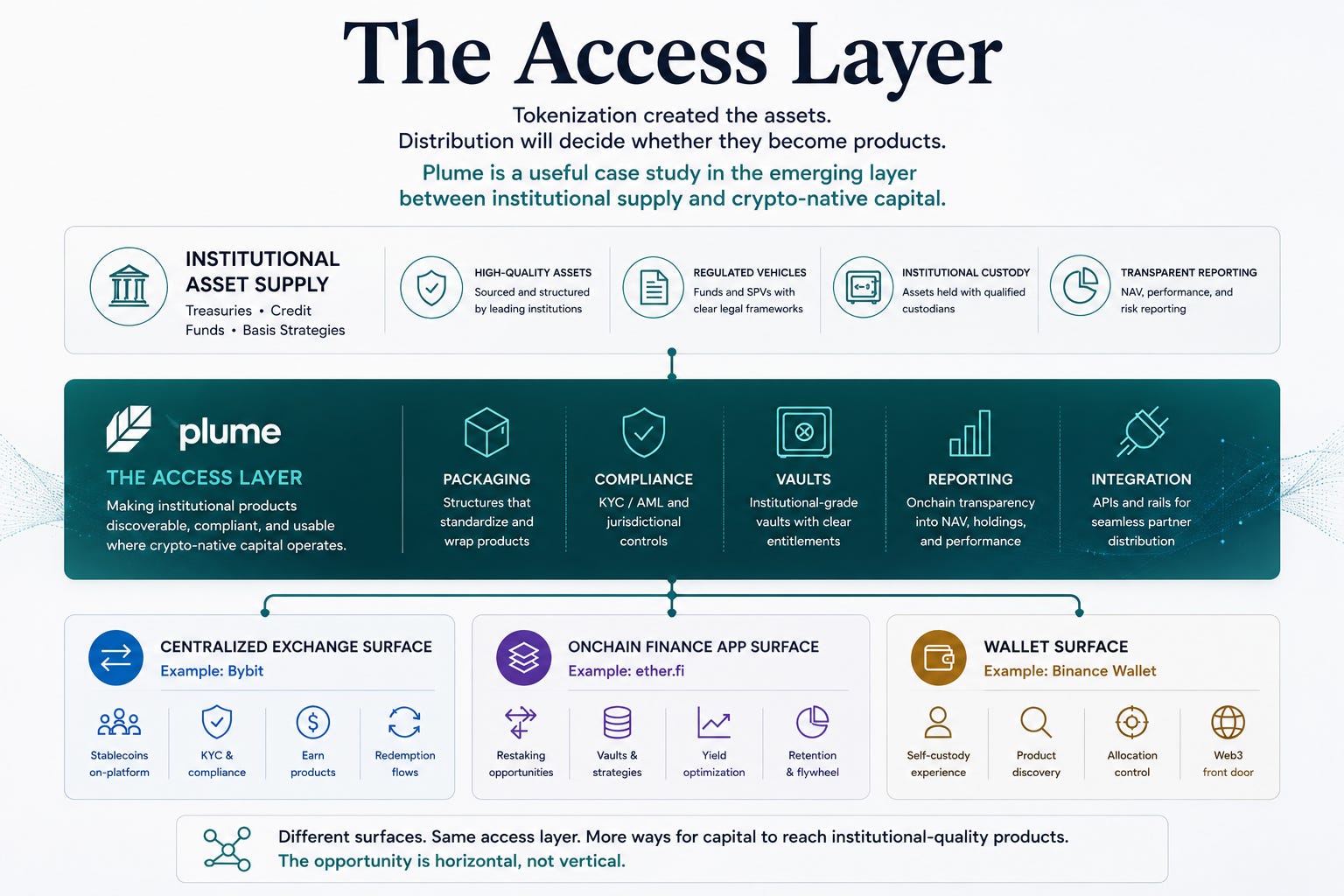
Tokenization turns assets into inventory. Distribution turns inventory into revenue. Access is what lets those two sides meet.
The real-world asset (RWA) market spent its first few years proving the basic technical point that traditional financial instruments can be represented on a blockchain. Sovereign debt, private credit facilities, corporate bonds, and fund shares have all been wrapped, minted, and deployed across public and private ledgers. This technical validation was necessary, but it was never going to be enough to build a functioning market.
A tokenized asset does not automatically become a liquid or usable product simply because it lives onchain. Minting a token is functionally equivalent to moving manufactured goods into a warehouse. The balance sheet cost of holding the asset arrives immediately, while the revenue remains entirely theoretical until a buyer shows up.
In capital markets, value rarely stays with the party that merely manufactures the asset. Value accrues to the teams that control distribution, aggregate capital, enforce compliance, manage risk, and provide clean access at the exact moment an investor is ready to allocate.
The RWA market is maturing. Much of the market still measures progress by what has been minted, missing the more important commercial shift. The useful question is no longer what can be brought onchain. The harder question is where and how those products are accessed once stablecoin holders, asset managers, and institutional allocators decide to put capital to work.
Consider the structural setup of traditional asset management. BlackRock, Vanguard, and Fidelity do not succeed merely because they create index funds or credit vehicles. Hundreds of firms can construct identical portfolios of short-dated Treasuries or corporate debt. Their dominant market positions stem from distribution rails: inclusion in workplace 401(k) menus, wealth management platforms, broker-dealer trading desks, and custody interfaces where capital naturally resides.
Crypto is subject to the same economic gravity. An onchain vault containing high-quality credit or sovereign paper is effectively invisible if an allocator cannot discover it, onboard smoothly, verify its compliance with relevant laws, and execute a subscription within their primary operating environment.
When an industry focuses exclusively on asset creation, it risks mistaking supply for demand. The digital asset ecosystem now holds billions in tokenized treasuries and credit. Yet much of this value sits in static, isolated pools. This represents a structural friction between where those assets are manufactured and where active capital sits waiting to allocate.
The initial wave of RWA development focused almost entirely on tokenizing high-quality, cash-equivalent assets. Short-dated U.S. Treasuries were the obvious starting point, offering a familiar source of low-duration government yield in a higher-rate environment. The plumbing was straightforward: take collateral, park it with a traditional custodian, issue a digital representation, and pass the yield to the token holder.
That process created the digital asset object, but it rarely created a finished financial product.
To understand why issuance alone falls short, it helps to look at the full sequence required to bring an institutional asset to market:
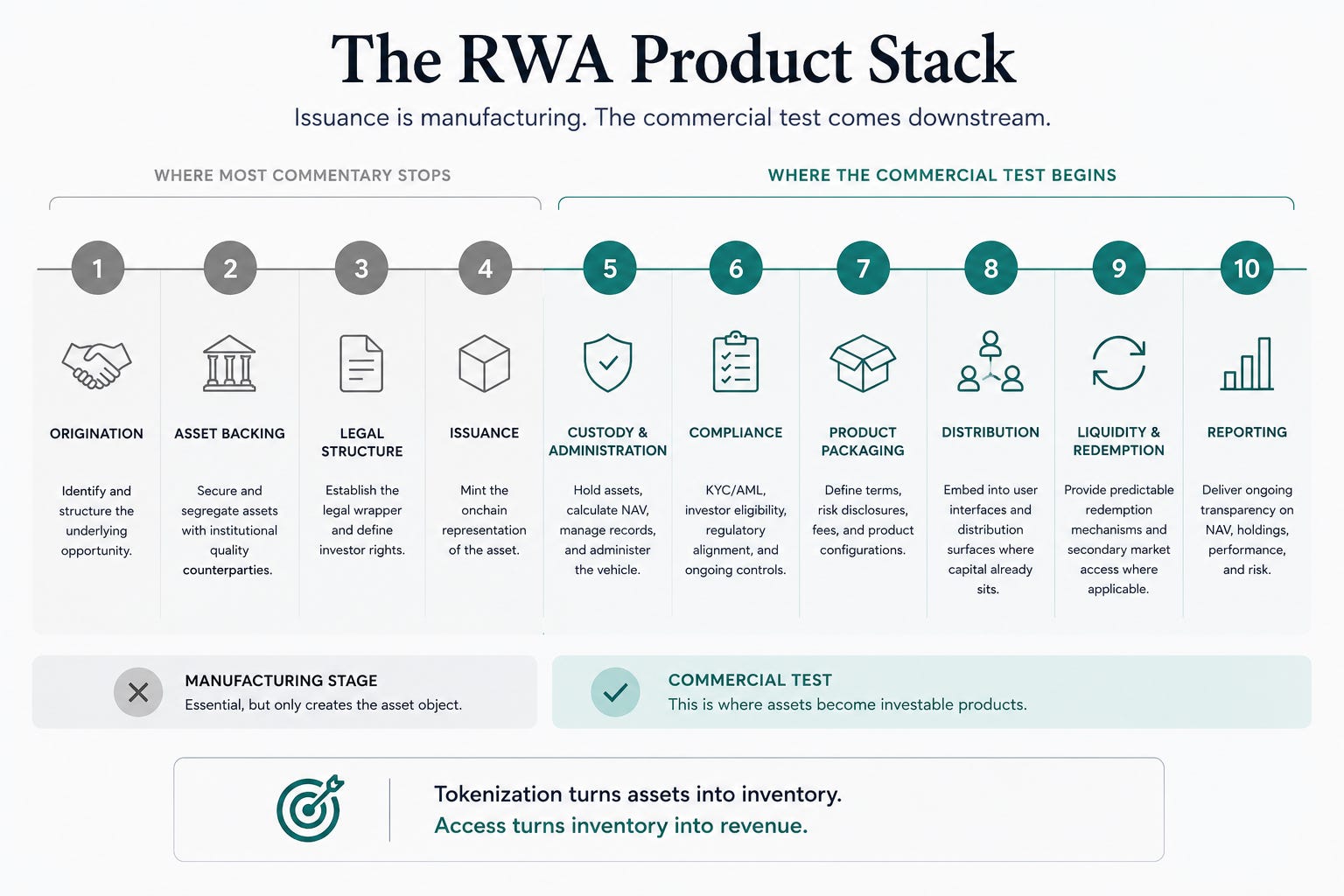
Most RWA commentary over-indexes on the first four steps of this chain. Issuance is essential, but it is closer to manufacturing. The commercial test for any asset comes downstream. Can the asset be packaged into a legal structure, routed through compliance, embedded into active user interfaces, redeemed on predictable terms, and reported on without manual reconciliation?
In traditional finance, the asset creation layer is heavily decoupled from distribution. A fund sponsor hires a law firm to draft a prospectus, an administrator to calculate Net Asset Value (NAV), a transfer agent to track share ownership, and a custodian to hold the physical or digital assets. But none of those entities gather assets on their own. The fund relies on wholesale distributors, clearing platforms, and wealth managers to connect the product with buyers.
In crypto, early RWA issuers attempted to collapse this entire chain into a single proprietary application. They built bespoke websites where users were expected to complete custom identity verification, wire fiat currency or transfer stablecoins, receive a non-transferable token, and log into a dedicated dashboard to monitor yield.
This vertically integrated model works for a small cohort of early adopters or institutional pilots. It fails when trying to scale across retail trading apps, corporate treasuries, and decentralized protocols. Investors do not want to manage twenty separate logins and bespoke KYC processes across twenty different asset issuers. They want standardized products delivered directly into the interfaces they already use every day.
Phase one of the RWA market solved token issuance. Phase two must solve product integration.
Capital markets businesses have taught us that manufacturing a product and distributing it are different businesses.
A fund can exist without gathering assets, just as an attractive credit strategy can easily miss its target market. Crypto is rediscovering this constraint. Capital rarely searches for yield in a vacuum because it tends to concentrate inside specific user surfaces.
Today, crypto shelf space lives across three main surfaces:
Centralized Exchanges: High-volume venues where stablecoin balances, trading activity, and user relationships already concentrate.
Self-Custodial Wallets: The main entry point for Web3, serving as the default front door for storage, token swaps, and yield discovery.
Onchain Finance Applications: High-volume savings, restaking, and wealth management protocols where active crypto-native balance sheets look for returns.
Yield products that require capital to leave these familiar environments lose users at every step. Forcing an investor to exit their preferred app, complete redundant identity checks on an unfamiliar portal, transfer-in funds, and manage new wallet permissions breaks the distribution loop.
The RWA market does not just need more tokenized assets. It needs infrastructure that makes institutional products distribution-ready. That is the difference between an asset object and a financial product.
An asset object can sit onchain, technically valid but commercially stranded. A financial product has a legal claim, an onboarding path, a compliance perimeter, a reporting process, a redemption mechanism, and a distribution surface where capital can actually find it.
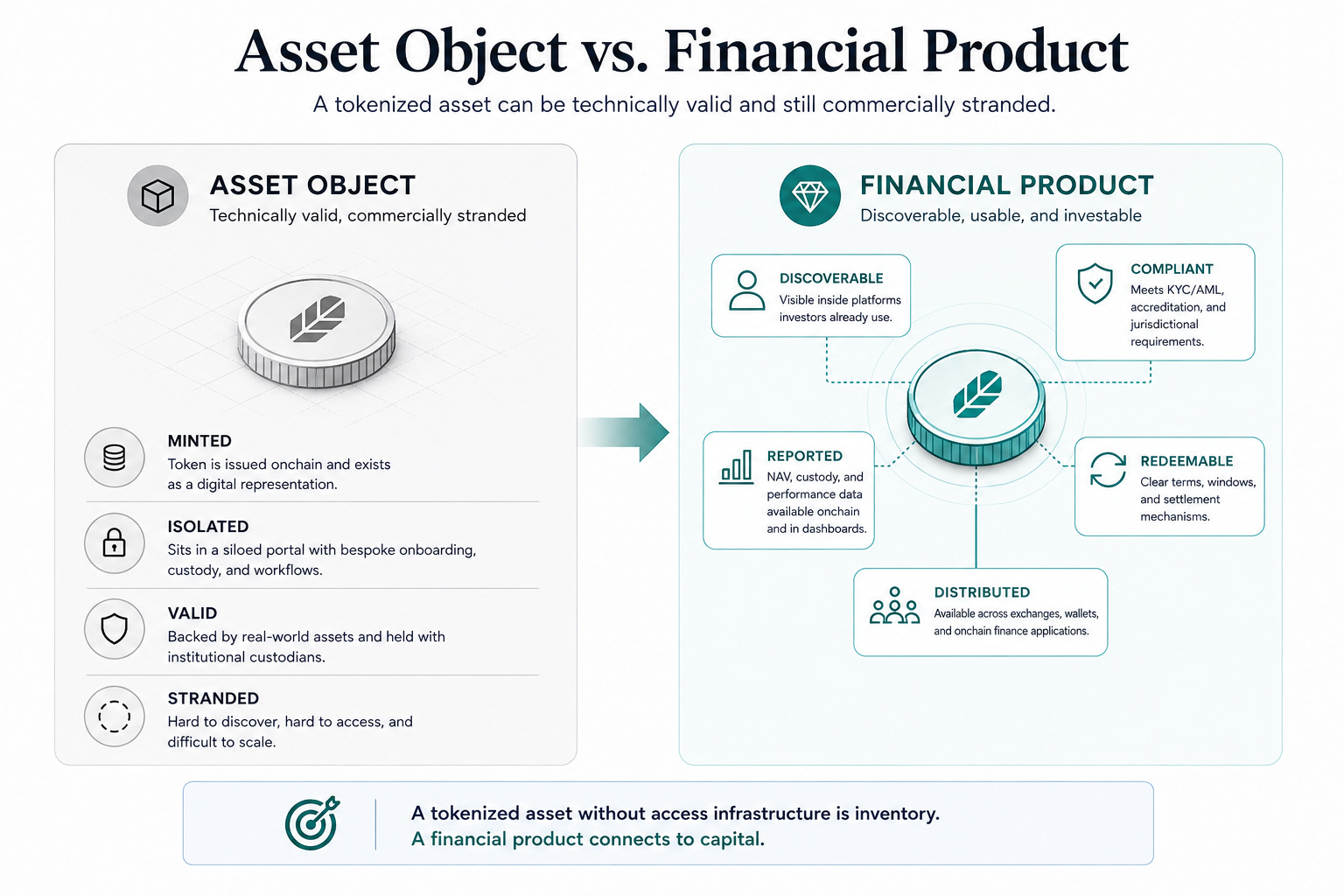
That is where access becomes the real bottleneck.
To understand how distribution channels operate, observe how capital moves within crypto ecosystem balance sheets. A centralized exchange user keeping stablecoins on-platform is seeking simple yield without the friction of withdrawal fees, gas management, or self-custody risk. A self-custodial wallet user prioritizes direct asset ownership and rapid execution across decentralized applications. A restaking protocol user is focused on optimizing risk-adjusted yields across complex, automated smart contracts.
Each distribution surface comes with distinct user expectations, compliance boundaries, and operational constraints. An asset issuer cannot address all three channels with a single rigid smart contract or a uniform legal wrapper. The infrastructure connecting asset supply to these distribution channels must be flexible enough to package products appropriately for each surface while maintaining strict compliance behind the scenes.
This bottleneck is what makes Plume worth watching. Rather than positioning itself as another general-purpose blockchain or a single-asset portal, Plume is building around the access layer between institutional asset supply and crypto-native distribution channels.
That structure matters because it keeps the focus on access rather than tokenization alone. Plume aims to occupy a coordination role by packaging institutional products so they can move through crypto-native distribution channels without each venue rebuilding the stack. Through Nest and the architecture associated with Kimber, Plume focuses on the compliance routing and integration work that determines whether tokenized assets reach users. Other entities handle underlying asset management and custody, allowing specialized providers to manage portfolios while standardizing how those products meet distribution channels.
Access requires solving several layers at once.
Legal Access sets up vehicles that let capital flow into underlying funds while maintaining clear AML, KYC, and jurisdiction rules.
Operational Access standardizes deposit, issuance, batching, and settlement mechanics so distributors do not have to build custom infrastructure for every asset.
UX Access allows users to allocate directly through their existing exchange, wallet, or application interface using standard stablecoins.
Reporting Access delivers clean visibility into Net Asset Value, custody status, reconciliation, and performance tracking.
This shifts the incentive structure for both sides of the market. Building direct integration pipelines into dozens of exchanges and wallets is expensive and outside an asset manager’s core competency. For a distributor, such as a major exchange or wallet application, vetting individual fund legal structures and smart contracts is a massive operational burden. A standardized access layer resolves this structural mismatch between conservative institutions and digital asset platforms.
Three recent integrations linked to Plume show how institutional products can be formatted for different distribution channels. Each surface reaches a distinct pool of capital with its own user habits and risk profiles.
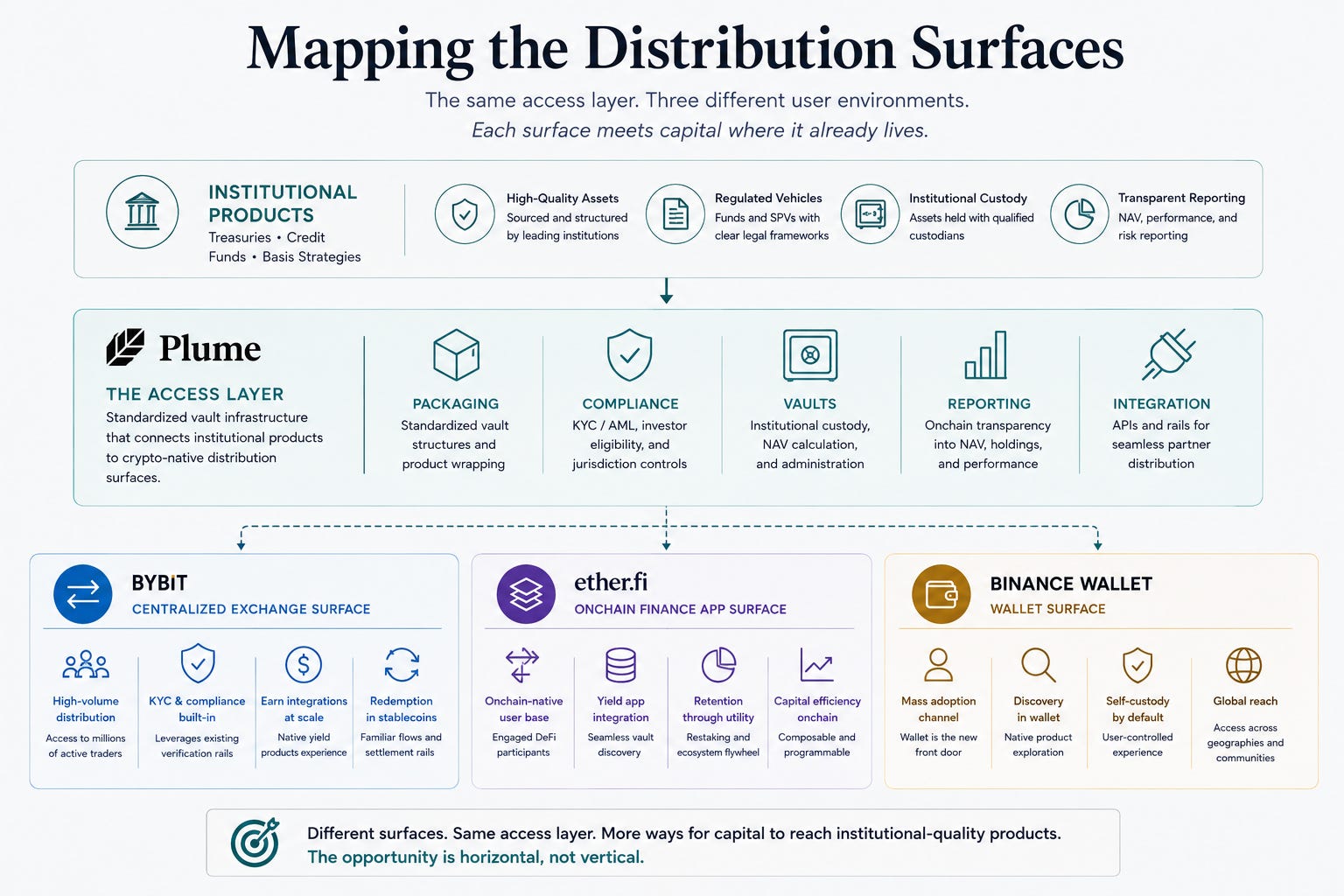
The strongest, most detailed proof point of this setup in production is Bybit’s RWA Earn platform. Bybit’s own product documentation details the operating mechanics, roles, and underlying asset structures.
In this setup, Bybit manages the user interface, identity verification, eligibility checks, and stablecoin collection. Orders are batched and routed through Nest into DigiFT, a Singapore MAS-licensed digital securities venue responsible for legal structuring, tokenization, smart contract deployment, and settlement.
The underlying economic exposure comes from traditional asset managers: PIMCO manages the PIMCO Dynamic Income Opportunities Fund (PDO) for credit exposure, while CMB International manages the CMBI Investment Grade Bond Fund. Custody of the underlying assets remains offchain with established institutional custodians, including State Street Bank and CMB Wing Lung Trustee.
This structure gives crypto users access to institutional fund exposure without falsely claiming to offer an instantly liquid Treasury token. Subscriptions are batched in 24-hour cycles, returns depend on daily NAV appreciation of underlying fund shares, and redemptions follow standard settlement windows rather than continuous, instant execution.
Bybit operates as the primary user touchpoint. The exchange user sees a clear yield figure, submits USDC, and receives an onchain-tracked RWA balance within their account without needing to bridge funds to another chain or interact with external wallet prompts.
While exchanges serve active traders and retail savers, onchain finance apps cater to native crypto allocators.
Plume and ether.fi announced an RWA vault integration designed to make Plume-linked exposure accessible through the ether.fi interface. The integration was presented as a way to bring real-world yield into the same application where users already manage liquid staking and restaking positions. Public announcements cited a $100M allocation commitment into a dedicated Plume Nest Vault.
This channel embeds real-world yield directly into a crypto balance-sheet manager. Users looking for yield do not need to off-ramp to fiat or open a traditional brokerage account; they can allocate capital from the app where their digital assets already reside.
For onchain protocols, offering RWA yield is a customer retention strategy. When crypto yields compress during quiet market cycles, capital tends to exit decentralized finance protocols in search of returns elsewhere. By embedding institutional real-world yield directly into non-custodial vault structures, protocols like ether.fi can retain user deposits onchain across different market environments.
The third distribution surface is the self-custodial wallet. Wallets are evolving from basic storage tools into active financial portals.
Plume announced that its nBASIS strategy vault became accessible through Binance Wallet. The nBASIS vault is designed to capture market-neutral basis yield, built on underlying exposure to fund vehicles associated with Bitwise (USCC) and Invesco (USTB).
Placing a strategy vault inside a wallet interface simplifies discovery and allocation into a single step. The wallet acts as the digital front door, letting eligible users access structured yield strategies without leaving their self-custodial setup.
By comparing these three surfaces, a clear pattern emerges. None of these distribution venues built their own underlying fund strategies, hired credit underwriting teams, or set up proprietary tokenization entities. Instead, they plugged into standardized vault infrastructure that handled the underlying asset packaging.
That pattern is not limited to these three examples. Bybit, ether.fi, and Binance Wallet represent the first visible surface area of a broader distribution model across exchanges, wallets, onchain finance apps, fintech interfaces, treasury tools, and other environments where stablecoin capital already sits. The more scalable version of the RWA market is not one where every venue rebuilds the institutional stack. It is one where access infrastructure lets products move across many trusted user surfaces.
Adding a product to a wallet menu is only the visible access layer. Beneath the interface, institutional capital evaluates an access architecture on six operational realities: the legal nature of the user’s claim, underlying asset backing, compliance enforcement, settlement mechanics, NAV reconciliation, and bankruptcy isolation.
The cleaner way to understand the structure is to separate the roles. Nest, including Plume Vaults, as another way to access the Nest platform, is where users access institutional assets that have traditionally been gated. Plume Network is the blockchain infrastructure powering that platform and enabling permissionless interaction with users. Kimber Labs is the developer behind both.
The structural goal of proper access is to separate distribution software from asset custody and legal ownership. Without clear answers on those operational details, a distribution integration is just a front-end wrapper sitting on top of an unverified back office.
This is where much of the RWA conversation gets confused. A product being listed inside a high-traffic wallet or exchange improves discovery and subscription access. It does not automatically create two-sided, secondary-market liquidity.
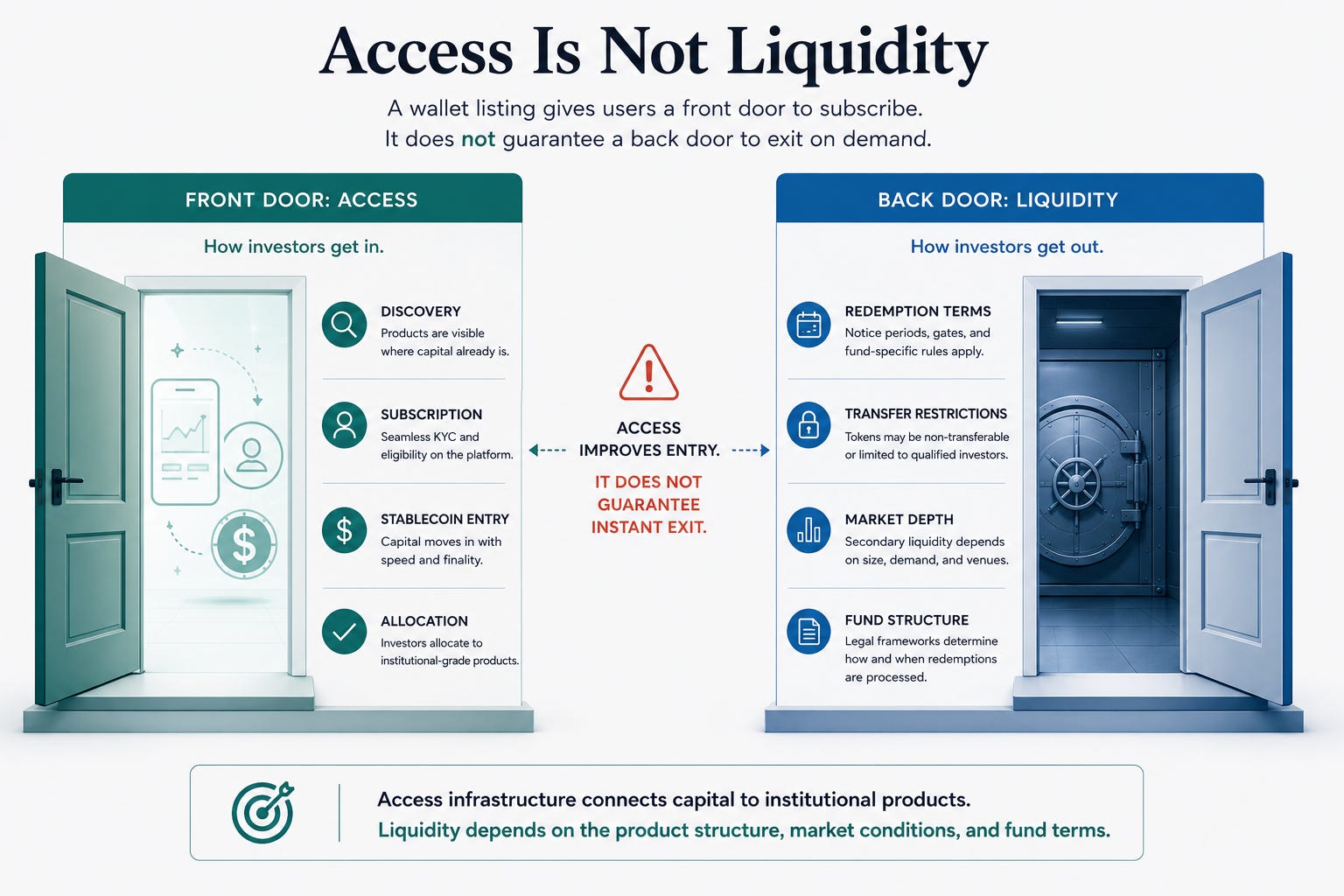
Continuous liquidity requires active market makers, real trading volume, clear price discovery, and unrestricted transferability. Most institutional RWA products have none of those things today. Instead, they operate under real structural constraints:
Batching and Order Execution: Subscriptions and redemptions do not happen instantly. As documented in Bybit’s RWA Earn, orders are aggregated and processed on set schedules.
Redemption Windows: Getting capital out of a fund product takes time. Redemptions typically take anywhere from one to seven business days under normal conditions, and they can take longer if underlying fund terms require it.
Transfer Restrictions: Regulated asset tokens rely on strict allowlists. An investor cannot simply transfer an RWA token to an unapproved wallet or drop it into an arbitrary automated market maker pool without violating compliance rules.
Underlying Asset Terms: The liquidity of any tokenized asset is ultimately capped by the liquidity of what sits underneath it. A tokenized private credit pool or corporate bond fund cannot offer instant dollar liquidity during a market panic unless a market maker is willing to stand in and absorb the risk.
A wallet listing gives users a front door to subscribe. It does not guarantee a back door to exit on demand. Access solves primary distribution. Liquidity remains a function of asset quality, market depth, and fund terms.
This distinction is crucial for portfolio managers and treasury teams. In crypto, users have grown accustomed to instant, 24/7 liquidity across decentralized exchanges and lending markets. Applying those same expectations to tokenized real-world assets is dangerous.
When an asset consists of underlying corporate bonds, illiquid private loans, or daily-NAV mutual fund shares, instantaneous onchain redemption is physically impossible without a liquidity buffer or a market maker taking principal risk.
Responsible access infrastructure makes these settlement timelines transparent to the user up front rather than engineering an illusion of continuous liquidity that breaks under stress. Primary access allows capital to enter and exit on defined, orderly terms. Conflating that orderly primary redemption mechanism with deep secondary market liquidity leads to mispriced risk.
As the RWA market shifts focus from tokenization to access, the setup across the industry changes.
Asset managers do not need to build proprietary dApps, manage Web3 infrastructure, or acquire retail crypto users directly. Their core job remains portfolio management and strategy execution. By relying on standardized access rails, investment managers can plug products into crypto distribution channels without rebuilding their tech stacks.
Distributors do not need to become fund managers. Exchanges, wallets, and apps can focus on user experience, identity checks, and front-end interface, while leaving fund packaging, custody, and token mechanics to specialized infrastructure.
The asset creation layer will stay fragmented across hundreds of individual tokenization portals, fund issuers, and local legal structures. But the access layer is likely to consolidate around a few infrastructure teams that can reliably connect fragmented supply with distribution channels.
As a result, competition in the RWA space will shift from who can tokenize the most assets to who can secure the best distribution shelf space. Asset managers will compete for placement inside major exchanges and Web3 wallets based on net yield, risk profile, and transparency.
Distribution surfaces will compete for user deposits based on product variety, trust, and user experience. The access infrastructure sitting in the middle becomes the critical pipe that enables this modern institutional marketplace to function.
Real-world assets have reached an important junction. The era of proving that a Treasury bond or credit facility can be represented onchain is giving way to a more practical question: who can make those products accessible, understandable, and useful inside the places where capital already sits?
In asset management, product manufacturing often commoditizes faster than distribution. Shelf space and access control the economics. Tokenization made real-world assets programmable. Access will determine whether they become usable markets.
Disclosure: I am a partner at Primal Capital, which is an investor in Plume. This note was not paid for or sponsored by Plume or any affiliated party.
No posts
Comments
Nothing yet. Say the first thing.
Sign in to join the conversation.