
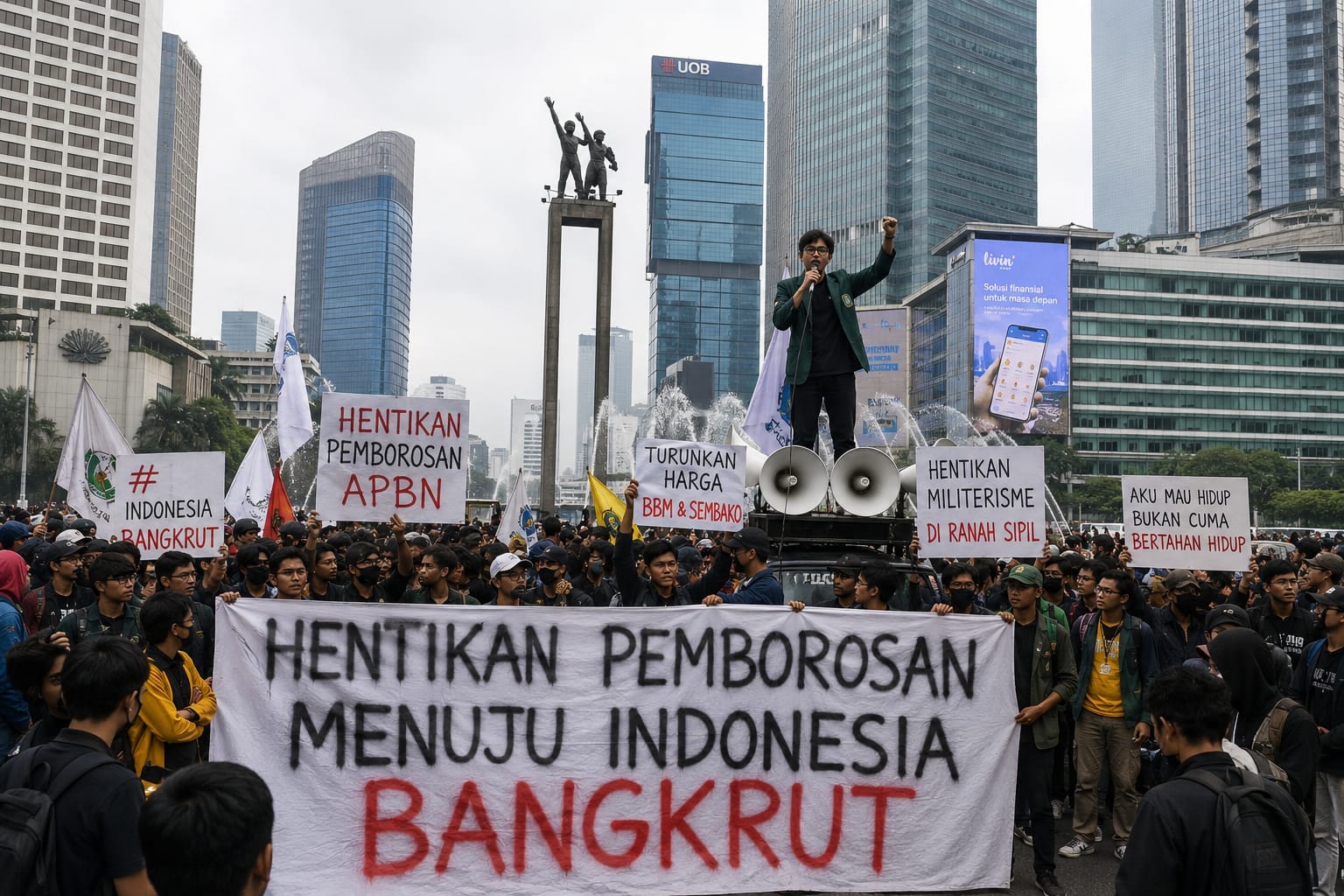
The One Piece flag is flying once more. Hundreds of university students took to the streets of multiple cities on 15 June, including Jakarta, Bandung, North Sumatra and South Sumatra, to protest against “the government’s costly flagship programs and the state of the economy”, reports The Jakarta Post.
Moving under the slogans Menuju Indonesia Bangkrut (“Indonesia is heading for bankruptcy”) and Tata Ulang Indonesia (“Reorganising Indonesia”), the students started protesting on 12 June after the prices of two widely used fuels abruptly raised by 32%.
Demonstrators faced heavy police and military presence, with more than 6,000 security forces deployed to block access to the Hotel Indonesia traffic circle, a key landmark in Jakarta.
“People will not be silent, they will speak out when they cannot eat, cannot work, cannot have a decent life”, a student protester told Associated Press. “That is the simple reason why we are taking to the streets today.”
The protest centred on six demands, including lower fuel prices, a clear strategy to strengthen the rupiah, economic improvement, and an end to the Red and White Cooperatives programme and President Prabowo Subianto’s flagship Free Nutritious Meals programme, which costs 268 trillion rupiah (€13 billion / $15 billion) annually.
The free meals initiative was intended to tackle malnutrition and stimulate the economy. It was a centrepiece of Prabowo’s agenda and figured heavily in his 2024 presidential campaign.
However, “it has been dogged by mass poisonings and allegations of corruption”, explains Panay News. A probe led to the dismissal of the programme’s director.
“We have noted points that need to be improved and evaluated in the future regarding various things that we consider odd in the country today, such as the MBG [Free Nutritious Meals] and KDMP [Red and White Village Cooperative] programs,” declared Muhammad Abdi, coordinator of the student action in Jakarta, on 15 June (via BBC Indonesia).
The student promises “a follow-up movement” and “a series of actions” in the future if the government “ignores or shows no progress on these demands” by 19 June.
The fresh wave of student protests comes less than a year after the violent anti-government protests in August last year, which were sparked by the death of a delivery rider and fuelled by anger over elite rule and alleged state mismanagement.
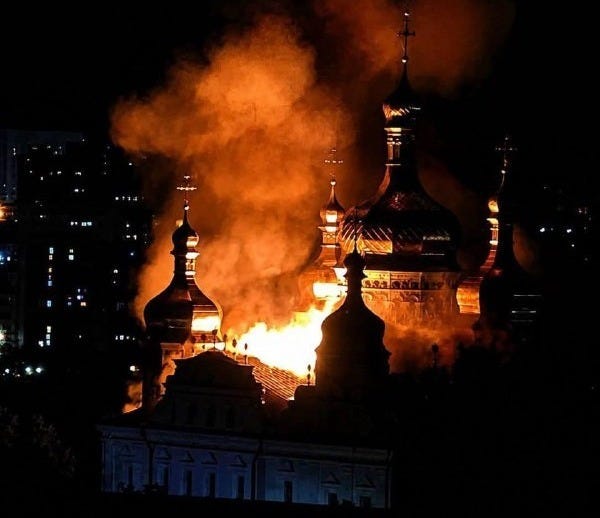
Kyiv’s 11th-century monastery hit by Russian strike: Kyiv’s Dormition Cathedral, located in the Kyiv Pechersk Lavra, was heavily damaged and its roof was set ablaze during Russian strikes in Kyiv on 15 June. The 11th-century Kyiv Pechersk Lavra, a jewel from the Byzantine era that is home to a “labyrinthine monastery and cave complex that holds some of Ukraine’s most revered shrines and relics”, as described by the Kyiv Independent, was hit by one of the 70 missiles and 611 drones that struck Ukraine overnight. Five people were killed in the capital, including “two children and a pregnant woman”, and 35 others injured, according to Kyiv Mayor Vitaliy Klitschko. The death toll climbed to 11 nationwide. Russian strikes also targeted the Mystetskyi Arsenal, a museum and art exhibition complex located in front of the monastery, as well as the Dovzhenko National Film Studio, one of the oldest and largest film studios in Ukraine.
Former Bangladesh police chief arrested in Dubai: Dubai Police arrested former inspector general of the Bangladesh Police Benazir Ahmed on 12 June under an Interpol Red Notice, after the former police chief fled the country in May 2024 “alongside his wife and three daughters amid an investigation into the accumulation of illegal wealth”, reports Dhaka Tribune. A close ally of former autocratic leader Sheikh Hasina, Benazir Ahmed is facing six major domestic lawsuits concerning massive corruption, passport fraud, and the illegal accumulation of multi-million-dollar assets. “Beyond the corruption allegations, Benazir, also a former chief of the Rapid Action Battalion (Rab), is facing trial before the International Crimes Tribunal (ICT) in a crimes against humanity case linked to enforced disappearances and torture at the Task Force for Interrogation (TFI) cell”, adds The Daily Star.
Deep-sea “whale necropolis” discovered in Indian Ocean: A research team from the Chinese Academy of Sciences piloting the manned submersible Fendouzhe has discovered the world’s largest, deepest and oldest whale graveyard. The study, published in Nature on 10 June, maps five active whale falls and 476 fossil sites scattered across a 1,200-kilometre (745-mile) corridor of the Diamantina Fracture Zone, situated up to 7,000 metres beneath the southeastern Indian Ocean. “Isotopic dating shows that whale falls in this region have occurred since at least 5.3 million years ago”, the researchers wrote in Nature. Most of the fossils belong to deep-diving beaked whales, and include a newly identified extinct species: the Pterocetus diamantinae. “There may be more than 10 million whale carcasses in the area,” said Peng Xiaotong, a professor at the Chinese Academy of Sciences’ Institute of Deep-Sea Science and Engineering (IDSSE). If you prefer images, Nature made a video about the discovery.

Overwhelming deluge in central Canada: The town of Stonewall in Manitoba, central Canada, declared a state of local emergency on 11 June following flash floods triggered by 255 mm (10 inches) of rainfall overnight. This deluge was “one of the worst overnight rainfalls ever in Manitoba’s history” according to local news, completely overwhelming Stonewall’s drainage network. “Never seen anything like this,” Danielle Boonstra, who co-owned a strawberry farm, declared to CBC. “My parents that have lived here for years and years and have owned this farm since it started. It has never seen this much rain.” The historic storm also produced a confirmed tornado in the nearby town of Ste. Anne, as well as peak wind gusts of 130 kmh (81 mph), leaving 25,000 people without power.
Strong El Niño weather pattern officially confirmed: The U.S. National Oceanic and Atmospheric Administration (NOAA) officially confirmed on 11 June the arrival of a powerful El Niño event. Striking a planet already suffering from severe fossil fuel pollution, meteorologists warn this natural climate cycle is developing with unprecedented speed. Deep-ocean heat content anomalies in the equatorial Pacific are currently double those recorded at this point in the 2023–2024 cycle. The warm, deep waters of an El Niño affect weather patterns by bringing “a lot of extra heat to the surface, fueling a lot of extreme events for a lot of places around the world,” Clark University climate scientist Abby Frazier told the Associated Press, noting that things can “get dire very quickly” across the Pacific. NOAA models predict a 63% chance of this event exceeding the 2°C threshold by late autumn, which “would rank among the largest El Niño events in the historical record going back to 1950.” According to the Copernicus Climate Change Service estimate, global warming will reach the infamous threshold of 1.5°C by January 2029.
Severe storms rip through central Europe: Thunderstorms swept across the northern Adriatic on 10 June, dropping hail the size of golf balls and unleashing wind gusts of up to 105 kmh (65 mph). The storms caused severe damage to over 150 buildings in more than 50 municipalities in Slovenia. The municipality of Komenda, northern the capital, Ljubljana, was hit hardest, with the local fire department reporting damage to over 100 properties. “It’s not just the roofs that were damaged, but there are also a large number of walls on houses that are near collapse, and the repairs needed will be very extensive”, said Komenda Mayor Jurij Kern (via The Slovenia Times). Moving eastwards overnight into 11 June, the storm struck northern Croatia, shattering the roofs of buildings at a local hospital and dropping intense, short-duration rainfall that triggered flash flooding.

Refugees fleeing the civil war in Sudan continue to pour in at the border with Chad.
Since the conflict began in April 2023, an estimated 14 million have fled their homes, including 4.4 million crossing into neighbouring countries, according to the United Nations. They still don’t know when they will be able to go back home.
Thanks for reading,
Take care.
No posts
Comments
Nothing yet. Say the first thing.
Sign in to join the conversation.