
Special & fun news! ☀️ About a year ago, we released My Baby’s First Climate Book: Batteries to kick off the series. This month, My Baby’s Second Climate Book: Solar is officially here, by Darren Lim and Nicholas Yiu!
Perfect for kids (and the adults reading with them). If you have a little one, or know someone who does, check it out. To celebrate the launch, we’re also doing a giveaway!

Our friends at Volta Foundation have been doing great work for the battery industry. One of its new initiatives are member-led committees, which bring people together to tackle important topics and produce something useful for the industry. We have the pleasure of sharing the first report from its Workforce Readiness & Development Committee, which set out to answer: How many workers are needed for battery manufacturing?
Back in 2024, the Faraday Institution predicted that in the UK 180,000 full time jobs would be supported across battery manufacturing, EV production, R&D and associated supply chains in 2025, increasing up to 270,000 in 2040. In the town of Skellefteå in Sweden, the Northvolt gigafactory was expected to create 3,000 direct jobs and an additional 10,000 indirect jobs, which caused a house price increase of 20% between 2021 and 2022 in the city. These are all big numbers, with big consequences attached for each of those lives and the overall economy.
We ran analysis back in 2023 on gigafactory revenues showing the majority of gigafactories reporting razor thin profits at 1-3%, with larger companies able to hit up to 10%. To even hit these however, having both the right talent and size of workforce is crucial: the former requiring years of foresight and investment often at the state level and the latter requiring infrastructure planning (water, housing, schools…) on a community by community basis.
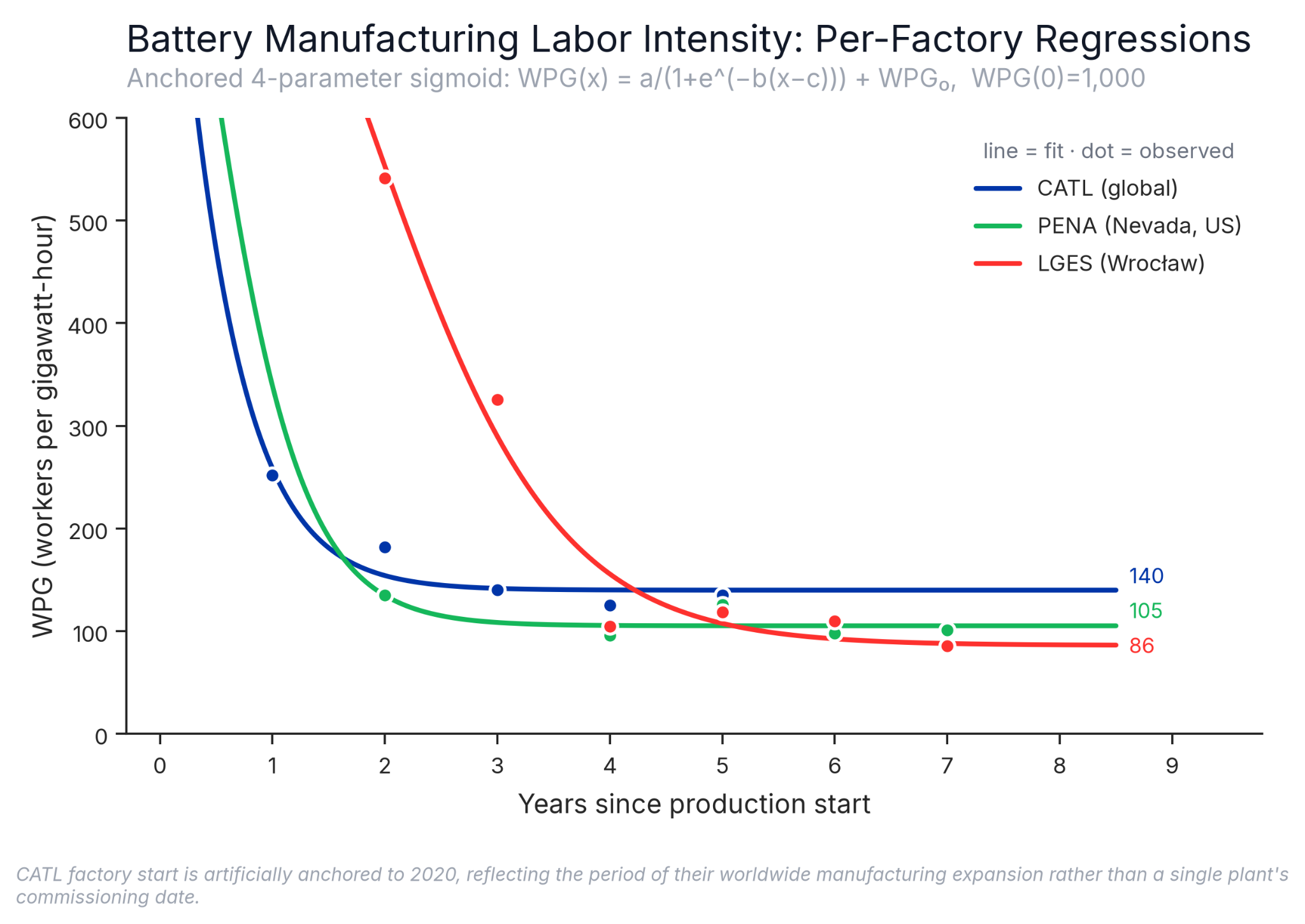
These numbers all needed an update, and Volta has pared all of these questions down to focus on the number of jobs created per GWh of direct cell production. You can read the full report here, but here’s the punchline: 130 direct employees per GWh of annual cell production.
The definition has 3 major assumptions:
cell manufacturing
steady state (not ramp up period)
direct employment only i.e. on payroll (production operations, engineering and maintenance, quality, support functions and management), no construction and contractors
The committee developed the benchmark using data from 3 brandname operations: LG Energy Solution Poland, Panasonic Energy of North America in Nevada, CATL (various sites).
Okay… what should someone actually do with that information?
1. If you’re running a cell manufacturing operation, start with 130 as an external reference then adjust for your factory.
Treat the benchmark as a useful starting point for a staffing model, and build in factors on how your factory differs from the operations in Volta’s analysis. Use this as a common reference against which to understand your own staffing assumptions.
New chemistry and form factors may require more R&D and scale-up support.
Different equipment/processes require different team sizes/structures.
Automated machines will mean fewer operators, but maybe more controls and maintenance specialists.
A first time factory will need a lot more people per GWh compared to established players building more factories.
Contractors/consultants can reduce direct headcount without reducing total labor.
Adjacent manufacturing experience may make hiring and training easier.
Established producers can reuse existing processes, people and know-how.
Tracking workers per GWh over time will become a useful metric of whether the factory is actually becoming more productive, rather than simply getting bigger and more bloated.
2. If you’re part of the local government, community, or educational programs, map out the economic opportunity as well as workforce limitations, understand them and act on any issues.
There’s a huge element of job creation and economic opportunity for local government - but intertwined with all of the infrastructure and attraction that skilled labour needs - gigafactory announcement is also a housing, transportation and workforce development question. Can the region actually supply the workforce implied by its industrial ambitions? How many workers with transferable manufacturing experience already live within commuting distance? Which employers will the plant recruit from? Is the factory creating new talent, attracting it from elsewhere or simply rearranging the region’s existing workforce?
An interesting example here is following the collapse of Northvolt, a little bit further north in Sweden had a new large industrial project in the form of green steel company Stegra. In a difficult region to hire, the Northvolt-trained manufacturing base was a key target for their scaling ambitions.
The challenge is not producing generic “battery workers” but building realistic pipelines for operators, technicians, engineers and R&D staff, each with different training times and potential feeder industries, and in large numbers such as Wroclaw, Poland, where LG has created 7,000 direct jobs. This foresight matters because an experienced workforce is itself part of a region’s manufacturing advantage. The US Department of Energy identified mature supply chains and experienced workers as competitive advantages held by established Asian battery-manufacturing regions.
3. If you’re an investor, look at the gap between announced capacity and operating reality.
A company proposing 10 GWh of production is not just proposing a large building full of equipment, but an organization of 1300 direct employees.
That opens up a bunch of due diligence questions. When will those people be recruited? How long will training take? Does the surrounding labor market have the required skills? And does the labor assumed in the financial model look remotely similar to what operating factories require? How much will it cost?
Workforce assumptions can reveal execution risk:
A plan that assumes mature-factory labor productivity from the first year → overly optimistic assumptions about utilization, yield and production learning.
Unusually high staffing may indicate that the company expects a more complex process or a prolonged ramp → higher burn, more risk.
Read Volta’s full report here!
🌞 Thanks for reading!
📧 For tips, feedback, or inquiries - reach out
📣 For newsletter sponsorships - click here
Comments
Nothing yet. Say the first thing.
Sign in to join the conversation.