
For the past few years, I thought I was closing in on the answer.
I’d decluttered my home, simplified my routines, become more intentional about what I bought and more thoughtful about what I let into my life. I’d spent a lot of time interrogating my own habits, trying to understand my relationship with consumption and figuring out what actually mattered to me.
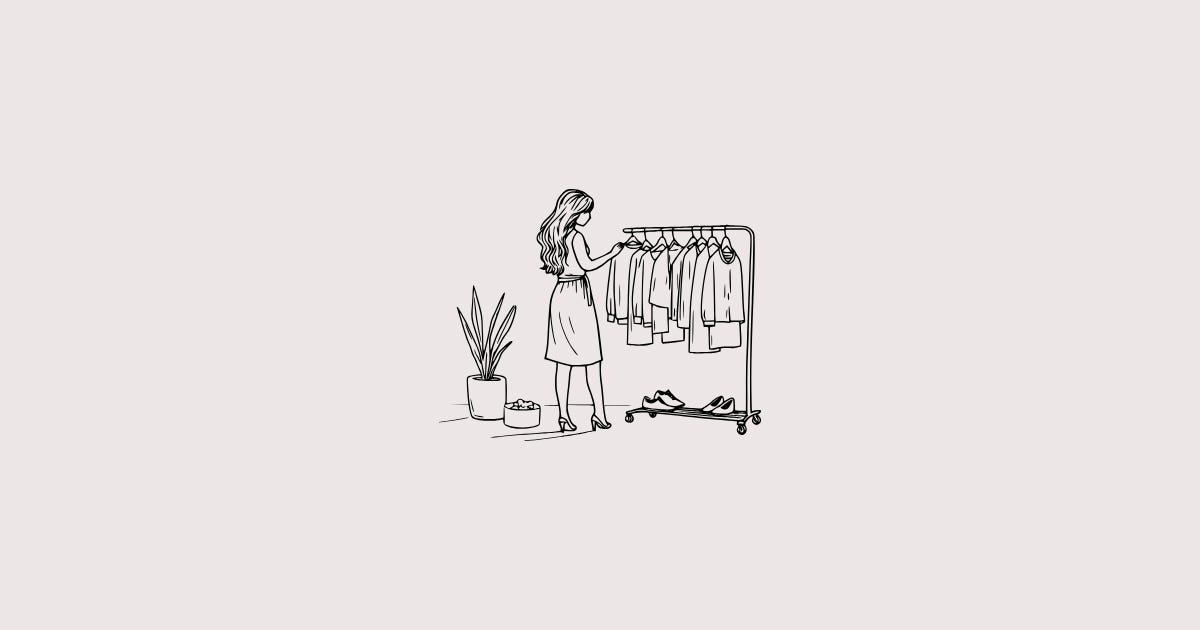
My wardrobe was the clearest proof it was working.
I had stripped things back to what I considered the essentials: neutral tones, timeless basics, and pieces I could reach for again and again. Everything had a place and a purpose.
Opening my wardrobe was now a calming experience rather than an overwhelming one. I no longer had that familiar feeling of standing in front of a wardrobe full of clothes and somehow feeling like I had nothing to wear. There were no forgotten purchases with tags still attached, no pieces bought for some fantasy version of myself.
Yes, I’d built exactly the wardrobe I’d spent years aspiring to: simple, timeless, effortless.
But then something unexpected happened.
Right as I was standing there thinking I’m finally getting somewhere, I heard a tiny little voice pipe up. One that had been very quiet for a very long time, and apparently had a lot saved up to tell me.
She told me that she longed for colour.
That she craved pattern.
That she secretly had her eye on a vintage cottagecore cardigan that made absolutely no sense with anything else in her wardrobe.
My first instinct was to silence that little voice. To explain why she was wrong. To remind her how much effort had gone into creating this beautifully intentional life.
But after years of telling her to be quiet, I found myself wondering whether she might have something worth saying…
There is a particular passage in Michael Singer’s The Surrender Experiment about his own inner work that stopped me in my tracks.
He described being incredibly disciplined with himself – constantly observing his thoughts, trying to move beyond his emotions, and holding himself to a very high standard. Eventually, he realised that there was a part of himself he had essentially locked away. A part that was emotional, vulnerable and human, but that he had spent years judging and trying to control.
He describes the moment he finally turned up at that door with kindness instead of judgement and said:
“You can come out now.”
What followed was a huge emotional release. He realised that this part of himself wasn’t something to overcome or silence. It was a part of him with feelings, thoughts, hopes, fears and dreams. It had just been waiting to be let out.
That idea has not left me alone since.
Because I think most of us have a version of that room. Parts of ourselves we shut the door on because they don’t fit the person we’re trying to become.
For me, that was the part that loved pink but decided it was “too girly.” The part that was a classic 90s Sims girlie, despite the years since convincing myself that building a virtual house and raising a virtual family was time “wasted.” The part that wanted clothes because they filled her with joy, not because they slotted neatly into a capsule wardrobe spreadsheet.
She wasn’t gone. She had just been sitting twiddling her thumbs, waiting for permission to exist again.
When you start to become more self-aware, it makes you question everything.
You start noticing how much of who you are was shaped by things outside of you – your upbringing, your culture, your environment, the expectations quietly placed on you before you were even old enough to push back. And suddenly even the smallest things feel weighted.
I remember genuinely wondering: are my favourite colours actually my favourite colours? Or just colours I’ve learned to like? Am I drawn to these things because they’re me, or because of a hundred small messages I absorbed about what’s beautiful, acceptable, desirable?
Self-awareness is a wonderful thing. It’s how you notice the patterns you’d otherwise sleepwalk through. But somewhere along the way, mine tipped over into something else – I stopped just liking things and started interrogating why I liked them, as if enjoyment wasn’t allowed until I’d proven it was earned.
But a preference doesn’t stop being real just because you can trace where it came from. I probably like some things because of the world around me, and other things because they just bring me joy, and honestly it’s most likely both at once.
Sometimes you just like something. That’s the whole explanation. That’s allowed to be enough.
I know this can sound like a fairly frivolous thing to spend this many words on.
There are bigger conversations happening in the world – the environment, what we consume, the impact we have on everything around us. Those things matter. A lot.
But I’m not sure this is completely separate from that.
Because the way we treat ourselves – the parts of our personality we quietly file under “not acceptable,” the things we dismiss before we even let ourselves want them – takes up energy. And that’s energy we don’t have left over for the bigger things.
As Anita Moorjani puts it:
“I can’t say this strongly enough, but our feelings about ourselves are actually the most important barometer for determining the condition of our lives!”
The relationship you have with yourself quietly runs the whole show – the choices you make, the opportunities you let yourself go after, the way you show up for other people and the world around you.
So recently, I’ve been making space for the parts of myself I’d pushed aside.
I’ve spent an unreasonable number of hours on Vinted bringing colour and pattern and personality back into my wardrobe. I still care about buying thoughtfully. I’m just done pretending “thoughtful” only ever means “practical.” Sometimes a thing is just beautiful. Sometimes it’s just fun. Sometimes it’s a little bit unnecessary, and that’s the whole point.
I stopped asking will this go with everything and started asking do I LOVE this?!
I’ve been letting myself enjoy things without demanding they justify themselves. I started baking again, making the sort of cakes that would have delighted my younger self and horrified the version of me who logged everything into MyFitnessPal. I let myself sleep in when I have the chance, no guilt attached. I even started playing the Sims again, and my gosh did I have fun!
None of this made me less intentional.
It made me feel more like myself. Which, funnily enough, was the entire point of doing any of this in the first place…
We tend to picture personal growth as becoming someone new – a more disciplined version, a more impressive version, a better version.
But sometimes growth is just welcoming the parts of yourself you quietly closed the door on.
I was rereading the Tao Te Ching recently, and noticed that a lot of attention is given to the concept of balance – to things naturally finding their way back to the centre.
Minimalism was my pendulum swinging exactly where it needed to go – it helped me question my relationship with consumption, become more intentional, and appreciate the freedom that comes from needing less.
But once that lesson had been absorbed, the answer was never going to be more discipline or more restraint. It was about letting things find their way back towards the middle – the place where we stop forcing and start flowing.
It was letting some softness in.
Some colour. Some playfulness. Some things that don’t need a permission slip.
I’m not going to pretend I’ve landed on the perfect, balanced version of myself who’s figured it all out – I don’t think that version exists either!
But there is certainly more to life than beige.
Sophie x
I just wanted to say a big thank you for all the love on Ko-Fi the past couple of weeks! Here is me at a cafe with my iced latte working hard on Intentional View, courtesy of you guys 🥰☕️
P.S. Before you go… could I ask a tiny favour? If you enjoyed this piece, please click the 💟 LIKE button below. It takes less than a second, but it really helps my writing to be found by more like-minded people. I’d appreciate this SO much! 🥰
Upgrading to a paid subscription or buying me a virtual coffee is another lovely way to support my writing.
Comments
Nothing yet. Say the first thing.
Sign in to join the conversation.