
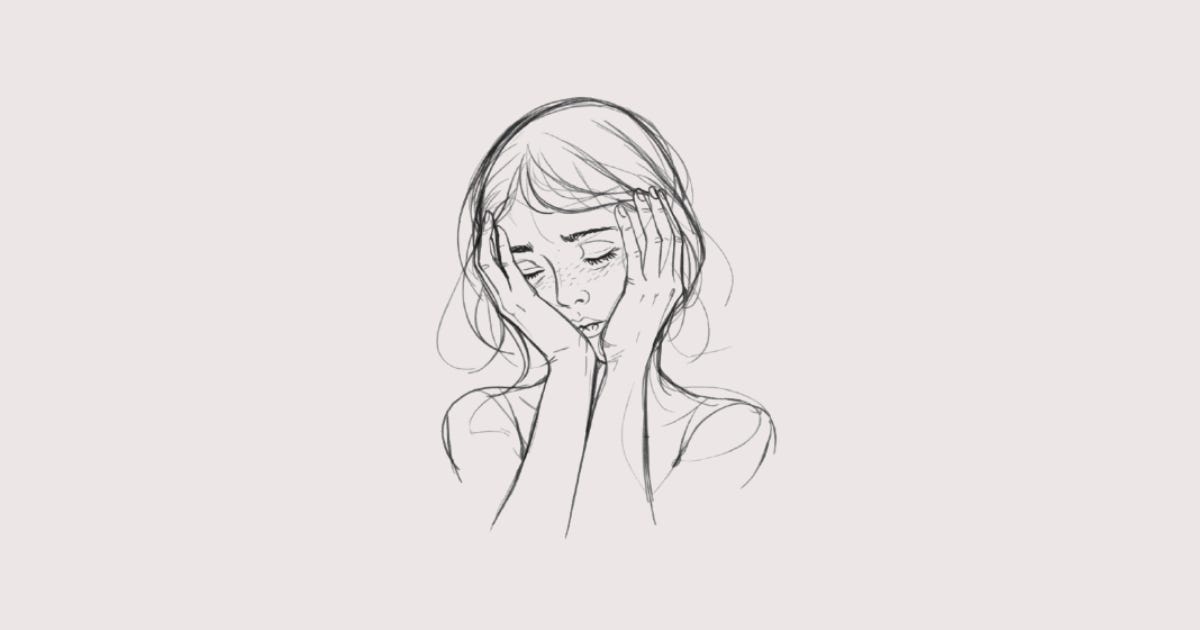
This piece discusses personal experiences with OCD and anxiety. Some readers may find these topics difficult or triggering.
I am not a doctor or mental health professional—just someone who has been through my fair share of struggles and is sharing my story.
It’s a vulnerable thing to put into words, but I believe there is strength in speaking about it. When you bring your demons out into the light, they don’t hold the same power over you that they once did.
If you are currently struggling, or have struggled with mental health challenges, please know you are not alone. Don’t suffer in silence or feel ashamed. Talk to someone you trust, and consider seeking professional help.
And please… always be kind. People can look like they have it all together on the outside but you never know what they may be going through. 🤍
“Once you are no longer drowning inside, a whole other life becomes possible for you.”
—Michael A. Singer
It’s safe to say that I was a highly sensitive child. I cried non-stop for the first two years of my life, and my parents tell me I had meltdowns over the smallest of things.
As a toddler I once screamed and howled because I refused to walk through a gate when a butterfly landed on it.
I can still remember being in reception class when the teacher said that the following week we would be drawing frogspawn in art. That weekend, I was flooded with fear that I wouldn’t be able to do it right—something most children wouldn’t have even thought twice about.
Another time I was walking to the car carrying a cake I had made at school, and I accidentally dropped it. Instead of simply being upset in the way a child might normally be, I immediately started berating myself.
When I think about that story now, it isn’t the dropped cake that matters, but the speed with which I learned to turn on myself.
I don’t know exactly when my OCD began, I would guess around seven or eight. I remember lying in bed and feeling intense dread about the thought of dying. Maybe that was the catalyst—that primal fear. It felt too big, too scary, too much.
Then came the rituals.
I felt compelled to tap objects a certain number of times, repeating the action until it felt “right”. My favourite number was eight, so I would start by tapping each toy at the end of my bed eight times.
Then something inside me would decide that wasn’t enough, and that I needed to tap each toy eight lots of eight times—sixty-four taps per toy.
The brief relief at the end of each cycle would quickly be replaced by the urge to multiply everything I had just done by eight again, and the numbers would quickly become absurdly large. I would spend what felt like hours doing this before I could fall asleep.
What is strange about OCD is that there is often a part of you that knows the thoughts are irrational. Even when I was young, I was aware that none of it really made logical sense, and yet that awareness did not free me from it. If anything, it made the experience even more isolating, because I felt trapped between understanding and compulsion. I didn’t feel able to talk about it, and that shame stayed with me for a long time.
The anxiety didn’t disappear as I grew older. It simply changed its shape.
During a family holiday in Greece, I became convinced that I had a herb stuck in my throat after dinner. My parents took me to a doctor, who of course found nothing wrong. From there, I started to hyper-fixate on every small sensation I noticed in my body, living with a persistent background fear that I might be dying from some undiagnosed illness.
I made the mistake of obsessively Googling my symptoms online, while also alternating between avoiding doctors and seeking reassurance from them, only to not fully believe them when they told me I was fine. It became a particularly ironic and vicious cycle.
By university, the anxiety had shifted again, morphing into obsessive fears around germs and sexually transmitted diseases. I washed my hands repeatedly until they were red raw, yet they never felt clean enough.
I moved into the world of work. I remember being terrified by the knowledge that there was asbestos in the roof of the building I worked in. When I changed jobs, I carried that very same fear into the next building.
The fear was not only in my mind; it showed itself physically as well. I developed IBS and severe eczema that spread across my entire body, which only seemed to reinforce what I already believed—that something was fundamentally wrong with me.
Panic attacks became relatively common, and much of my twenties were spent trying to avoid situations that my mind had labelled as dangerous—which meant, in practice, avoiding a large part of life.
I share my story not to invite pity or to sensationalise my experience, but simply to illustrate something I have learned firsthand: how dangerous the mind can be when it turns inward on itself, like an ingrown toenail.
I know this because I have lived in that space.
I have seen how much havoc it can create, even when there is nothing in the outside world to justify it. Thoughts and emotions can feel completely overwhelming and undeniably real, even when there is no objective reality behind them.
Yet amid all of that noise, something else remained constant—a small space of awareness that the catastrophic voice in my head was not me. Because if it was, who was it inside me that was noticing?
That tiny psychological distance turned out to be incredibly important.
Many people go through their entire lives completely identifying with the voice inside their head. But for me, there was always a strange duality. I could clearly see that the thoughts I had were irrational, and yet emotionally they still felt powerful.
For a long time I tried to manage anxiety by arguing with it, analysing it, or trying to neutralise every frightening thought that appeared. Sometimes this worked temporarily, but the anxiety would always shape-shift and simply return in another form.
Eventually I realised that trying to reason with it was a bit like trying to negotiate with a power-mad dictator. No matter how politely you protest, or how logically you present your case, their behaviour is never going change.
Healing didn’t begin with trying to defeat the thoughts; it began when I started stepping out of the argument altogether.
I love this analogy from Michael A. Singer:
“If you relax your hands during a tug-of-war, the struggle will immediately be over. No more rope. No more pull. No matter how strong the pull is, if you relax your hands, you can go home and have lunch. That’s all you really wanted to begin with. Who said you had to take the whole football team home with you? Just relax and let go, and the whole struggle will be over. That’s exactly what it’s like to surrender. You’re in there, and the energy is pulling you into it. Please don’t fight it. Just relax your inner hands and let go. If this sounds very Zen, good, because it is. You don’t need to be strong; you need to be wise. The blocked energy can’t take you anywhere if you simply relax and let go.”
Looking back, I am strangely grateful for living through these emotional extremes. The intensity of my suffering forced me to pay attention to my inner world in a way I might never have done otherwise.
It taught me not to get too caught up in the mind’s commentary. Whatever it was saying was simply the product of past experiences, learned fears, and patterns my brain had built over time.
I realised there was an incredibly anxious, neurotic person living inside there with me.
I started thinking about that part of myself like a frightened child who was trying very hard to keep me safe by worrying about everything. Instead of trying to silence that voice, I learned to let her speak. I’d listen to the worries and acknowledge the intention behind them, the care they were trying to show, without blindly accepting them as truth.
In one exercise, I pictured the younger version of myself—the child who spent hours tapping the toys at the end of her bed, convinced that something terrible would happen if she failed to follow the rules her mind had created. And then I imagined sitting down beside that little girl, pulling her close, and telling her that adult Sophie was here now. She was safe. She was going to be okay.
The first time I did this, I felt so overwhelmed with compassion I broke down crying. It felt deeply healing, like something inside me had finally been laid to rest after years of tension.
I began repeating a kind of mantra to myself: I love myself. I trust myself. I’m a good person. I wrote it in my diary and said it often enough that it eventually became automatic.
It didn’t remove intrusive thoughts. It just gave me somewhere else to place my attention when fear started to rise.
These days the words that feel even more honest are simpler still: I can handle this. Whatever is happening, I can handle this.
Most people are still 8-year-olds trapped inside adult bodies, pushing away difficult thoughts and emotions because somewhere inside we believe we cannot handle them.
One way we can begin to learn that we are able to handle our inner experience is by observing the mind from a distance, rather than becoming completely absorbed by it. This is often described as witness consciousness—the simple act of noticing that you are the one who is aware of the thoughts moving through you.
Through deep breathing and meditation, I learned to sit with my fear instead of immediately trying to push it away. At first this felt unnatural, because everything inside me wanted to escape. But over time I realised that emotions pass through whether you resist them or not. And if you simply let them, they lose a lot of their original power.
If you don’t recognise yourself in my story, that’s completely fine. You don’t need to. But I’m sure you still know what it’s like to be pulled into thoughts, worries, or inner narratives that feel difficult to escape. In different ways and to different degrees, we all struggle at times beneath the weight of our own minds.
I have a sneaking suspicion that many of us have been approaching life the wrong way round—trying to fix the outside world before tending to our inner world first.
“One who looks around him is intelligent, one who looks within him is wise.”
—Matshona Dhliwayo
That has been the central shift in my life.
My mind used to be filled with all sorts of internal drama—constant worrying, scanning for danger, believing I could overcome irrational fears by micro-managing everything around me. It’s amazing how much of my attention was consumed by that.
When the inner struggle began to ease, that same energy and attention became available for other parts of life. There was simply more space and clarity for things that felt meaningful to me.
Nothing external became magically perfect. Circumstances still change, uncertainty still exists, difficult emotions still arise. What changed was my relationship with my own mind and my own fear.
You do not have to win every argument your mind begins.
You do not have to silence every worry.
You do not have to wait for the outside world to become perfect before you allow yourself to feel okay in there.
You can decide, quietly and without ceremony, that your inner world is your home for the rest of your time on Earth—and that it will be the central endeavour of your life to make it a beautiful place to live.
P.S. If this piece resonated, consider passing it on to someone you think might enjoy it. You can also leave a comment—I am delighted to read and respond to every message.
Upgrading to a paid subscription or buying me a virtual coffee is another lovely way to show your support.
Comments
Nothing yet. Say the first thing.
Sign in to join the conversation.