
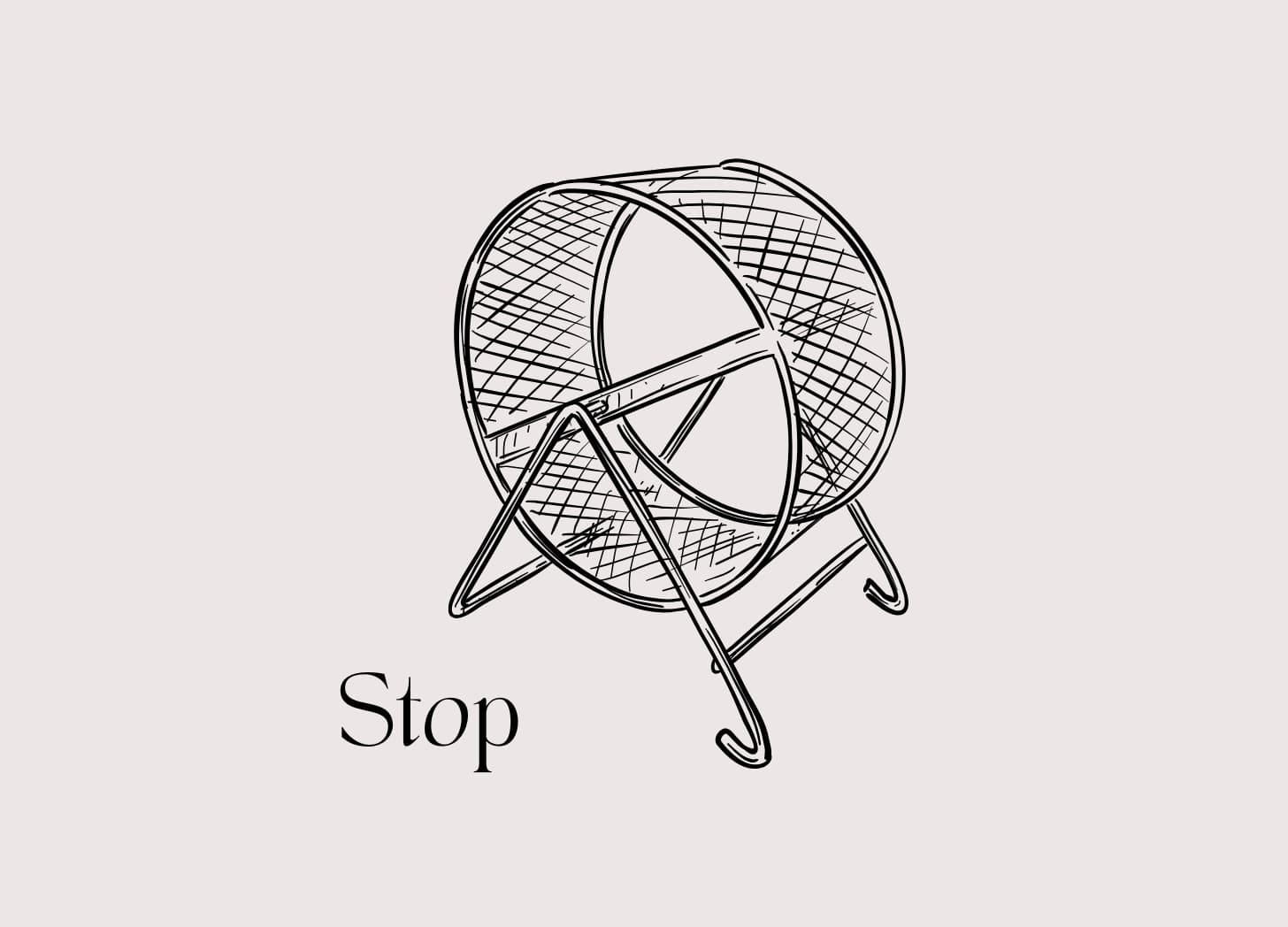
Picture a hamster on a wheel.
It runs as hard as it can, spinning constantly.
The wheel just keeps turning beneath its feet.
If we asked the hamster what it’s doing, it would probably huff a little defensively and say:
“Can’t you see I’m getting somewhere! I’m climbing! Just a little further!”
Of course, from our vantage point, we can see clearly—poor thing—that it will be running for as long as it likes and still getting absolutely nowhere.
But if we stop to really think about it, the truth is uncomfortable and unavoidable:
This is exactly what most of us do every single day of our lives.
We live in a state of constant inner motion. The mind is always running, planning, worrying, comparing, wanting something, and trying to avoid something else.
We tell ourselves that once we get what we want, or once what we fear goes away, then we’ll finally relax.
But when you look back over your own life, you can see the pattern clearly: you get what you wanted and soon after you want something else; you avoid one problem only to find another one waiting.
The content changes, but the cycle never does.
The wheel keeps spinning.
At its simplest, the first step in intentional living is stepping off autopilot—deciding that you don’t have to chase the things you’ve always chased, and choosing for yourself what truly matters, rather than defaulting to society’s ready-made value system.
For me, that looked like leaving an anxious, stressed-out career climbing the corporate ladder and starting Intentional View. At the time, it genuinely felt like freedom. I was finally doing something that felt aligned, something that mattered to me.
But over time I had to admit something that was uncomfortable to see: in many ways I had just swapped one hamster wheel for another.
The old one was about promotions, targets, and survival in a job I didn’t love. The new one was about growth, reach, impact, and whether Intentional View was becoming “successful” quickly enough (whatever that was supposed to mean).
My mind simply found a new story to run on, and it ran just as relentlessly as before.
The result was familiar. I struggled to switch off. I felt driven, restless, and eventually burnt out, even though I was doing something I cared about deeply.
It was a powerful lesson in the pull of the wheel.
Simply put, you can escape a life that doesn’t suit you and still remain trapped in the same inner machinery of wanting and fearing, just wearing different clothes.
There is a famous saying, often attributed to Einstein, that insanity is doing the same thing over and over again and expecting different results.
The idea points to something deeply human. We keep running the same mental programs, even though our own direct experience shows us that it has never worked.
We’ve been doing it for as long as we can remember. And here we are.
It’s like chasing the end of a rainbow. Scientifically, a rainbow doesn’t have a real, reachable endpoint at all—it’s an optical illusion created by the angle between light, water droplets, and your eyes. You could walk toward it forever and never arrive, because it keeps shifting as you move.
Yet the mind keeps promising that peace is just a little further ahead, just after this goal, just after that problem is solved. And so we keep running.
But at some point, something has to give.
Not because you are morally wrong, or broken, or failing at life, but simply because you begin to see, with a kind of unshakable clarity, that this way of living doesn’t actually bring the peace it promises.
That recognition is the real beginning of the intentional path.
It’s not dramatic and it’s not heroic—it’s just honest.
You look at your own experience and say:
I have years of proof.
I have gathered enough evidence.
This formula does not—and has never—worked.
I am not willing to keep following the same program.
I will do whatever is required to find another way.
But what is the alternative, you may be wondering. What does it mean to step off the wheel?
The first step is recognising that your mind is, in many ways… neurotic.
It has said the same things every single day of your entire life, insisting you must have this or avoid that, and most of it is simply not true.
The mind isn’t inherently right or wrong. It’s essentially like a pre-programmed computer, built from your own unique blend of life experiences. It can only recycle what has already happened, regurgitating the same wants, fears, and patterns over and over again.
That’s why we all have different voices inside us—why two different people can look at the exact same world and feel like they need wildly different things from it in order to be happy.
Most of the underlying desires the mind constantly chases fall into a few broad categories:
Strength / Power – The desire to feel capable, in control, and able to influence the world around you.
Significance – The need to be seen as someone important, to feel noticed and recognised for your presence or your achievements in the world.
Acceptance – The desire to maintain harmony with others, to keep relationships smooth, and ensure everyone gets along.
Approval – The drive to be liked, validated, or affirmed by others.
Intelligence – The need to be recognised as competent, smart, or insightful.
Pity – The pull to elicit sympathy, care, or emotional support from others.
Our patterns are often picked up from childhood experiences—either the ways we learned to feel safe, recognised, or valued, or the ways we tried to avoid pain, rejection, or discomfort.
Everyone tends to have a dominant need—I think for me, it would be a combination of intelligence and significance. Recognising your dominant needs can be incredibly helpful, because when that familiar voice in your head starts insisting, you can see where it’s coming from and be better prepared for what it will say.
The important thing to remember is that everyone has these urges. They are part of being human. And yet, you are whole and worthy without giving in to them.
Your peace, clarity, and sense of self don’t depend on fulfilling the mind’s constant list of wants.
Stepping off the wheel doesn’t mean you stop participating in life, stop doing meaningful work, or stop caring about anything.
It means something much more subtle and much more radical: you stop letting the voice in your head dictate whether you are okay.
The mind will continue to talk. It will continue to try and persuade you of what it wants and what it doesn’t want. But you no longer have to run after every thought as though your very survival depends on it.
Of course, this is easy to understand in theory, but far more difficult to put into practice.
You’ve been at your mind’s beck and call for as long as you can remember—listening to it is as automatic and familiar as brushing your teeth.
Breaking that pattern takes conscious effort and a sincere desire to do something different.
At first, the mind doesn’t like being ignored. It protests loudly, like a child throwing a temper tantrum. It insists that its demands are urgent, that you’ll regret not listening, that you’re making a BIG mistake.
You don’t need to fight it or push it down. Simply let it speak, and choose not to follow.
Over time, like a child who realises that screaming no longer gets the desired response, the mind begins to quiet. Not because it has been defeated, but because it is no longer being fed by your constant attention and energy.
When you stop getting involved with your internal drama, you’ll notice something interesting: you suddenly have a lot more energy.
That scattered mental energy that was constantly being pulled in a million and one different directions is now free, and your presence is more centred, more solid.
“The secret of change is to focus all of your energy, not on fighting the old, but on building the new.”
—Dan Millman
With this space, your intuition can finally be heard, and new thoughts and possibilities can emerge.
For the first time, you can respond to life with clarity rather than reacting out of habit.
You begin to see things for what they actually are, with a discernment that isn’t clouded by your judgments of how things should or shouldn’t be.
Ironically, from this place of stillness and detachment, you make better decisions than you ever could while caught up in the constant soap opera of the mind.
Whatever helps you practice getting off the hamster wheel, whether it’s meditation, yoga, prayer, or simply pausing and noticing—do it.
The aim isn’t to silence the mind completely—the mind is an amazing instrument when used properly, capable of creativity, problem-solving, and insight.
The point is to stop letting it dictate your sense of well-being, to stop letting it run riot in there.
Freed from its automatic demands, the mind can finally serve you, rather than run your life.
You may worry that you are giving something up, as though you are losing your drive or your edge. You might think, surely the mind has some useful things to say, though.
And it can—but for now, you can’t see the wood for the trees.
Begin by simply getting to know stillness—observe your inner chatter from a point of detachment and create space away from the mind’s constant demands.
Only then can you begin to use it as it was truly intended to be used—to solve real problems, to create, to compose music, to design businesses, to imagine new futures—instead of endlessly replaying old re-runs of the Sophie Show.
What remains is a clearer, calmer way of being in the world, one in which you can still engage fully without being owned by your thoughts.
None of this requires you to have it all figured out. I certainly don’t. I still catch myself stepping back onto the wheel, especially when I start listening too closely to the part of my mind that tells me I have to constantly achieve things in order for me to feel okay.
But more and more, I notice it sooner, and I remind myself that I don’t have to keep running.
Part of stepping off the wheel is admitting that you don’t know exactly where this different way of being will lead. You simply acknowledge that the old way is about as useful as flogging a dead horse (not that we should be flogging any horses 🙃).
So, I dare you, stop running—just for a moment—and see what happens.
Try it as an experiment, just to see.
What I have found is that the world keeps spinning, situations keep unfolding, exactly as they always have.
Nothing has to change for life to be lived differently.
The difference is simply the place you’re standing from.
P.S. If this piece resonated, consider passing it on to someone you think might enjoy it. You can also leave a comment—I am delighted to read and respond to every message.
Upgrading to a paid subscription or buying me a virtual coffee is another lovely way to show your support. 🤍
P.P.S. If you’ve become a paying member, I just wanted to say a huge thank you! It means the world and helps me to keep writing and developing my ideas. 🙏
Comments
Nothing yet. Say the first thing.
Sign in to join the conversation.