
A woman I have been working with for the past several months inherited well over a million dollars and she still felt broke.
I’m not talking about “I should probably be more careful” broke or “let me check the balance before I book the flight” broke. The real thing. The tight-chest, don’t-touch-it, what-if-it-runs-out kind of broke that has almost nothing to do with what is actually in the account.
Here is what led up to it.
She spent most of her adult life teaching. Then her father started needing more help than could be arranged around a school schedule, so she left the classroom to take care of him. That went on for years. When he passed, three things landed in roughly the same window: the caregiving ended, the inheritance arrived, and her kids finished college and started launching into their own lives.
She did not recognize her own life.
She came into one of our meetings with something she had clearly been turning over for a while. A business she wanted to build. Real thought behind it, real energy in her voice.
And within about ninety seconds of describing it, she had talked herself most of the way back out.
Could she earn enough to cover her expenses? What if it took longer to get going than she expected? What if she was not actually good at it? What if she spent down the money her father left her chasing something that did not work?
Every one of those questions sounded practical. None of them were. They were the same question wearing four different outfits: am I allowed to do this?
So I told her something that landed like a foreign language.
She did not need the business to produce an income.
Based on her actual financial picture, we could position a portion of her portfolio to supplement her income, and let the rest keep growing to fund her retirement. The business could just be a business. It did not also have to be a rescue.
This is not a complicated strategy. It is fairly ordinary financial planning. Any advisor reading this is nodding along.
But she had spent her entire adult life inside one model and it’s a very common model. Money comes from work. Work comes with a paycheck. No paycheck, no money. That was not a philosophy she had chosen. It was just the water she swam in, for fifteen years, as a teacher and then as a full-time caregiver with no income at all.
Nobody had ever told her that assets can do work. That a portfolio is not just a number you protect and apologize to. That there is a difference between spending money and putting money to work on your behalf.
So when I said the strategy out loud, she could not hear it. The belief got there first.
That is the part I want you to sit with. The strategy was available to her the whole time. It had been sitting there since the day the inheritance cleared. What was missing was not a spreadsheet. It was the ability to consider that a life like that might be hers.
We started modeling it.
Not talking about it. Modeling it. Real numbers, her real expenses, her real timeline. What comes out of the portfolio, what stays invested, what that looks like in five years and fifteen and thirty. What happens if the business earns nothing at all. What happens if it earns a little. What happens if the market has a bad stretch right when she starts.
Watching it on the screen did something no amount of reassurance from me was going to do.
Because a limiting belief is remarkably good at surviving encouragement. You can tell a woman she is going to be fine as many times as you want. What a limiting belief cannot survive is being made specific and then tested. The vague dread of “what if it runs out” has enormous power. “Here is the year it would run out, under these assumptions, and here is what we would change before that ever happened” has almost none.
She is building the business now. Not because she has to. Because she wants to. Those are two entirely different companies, run by two entirely different women.
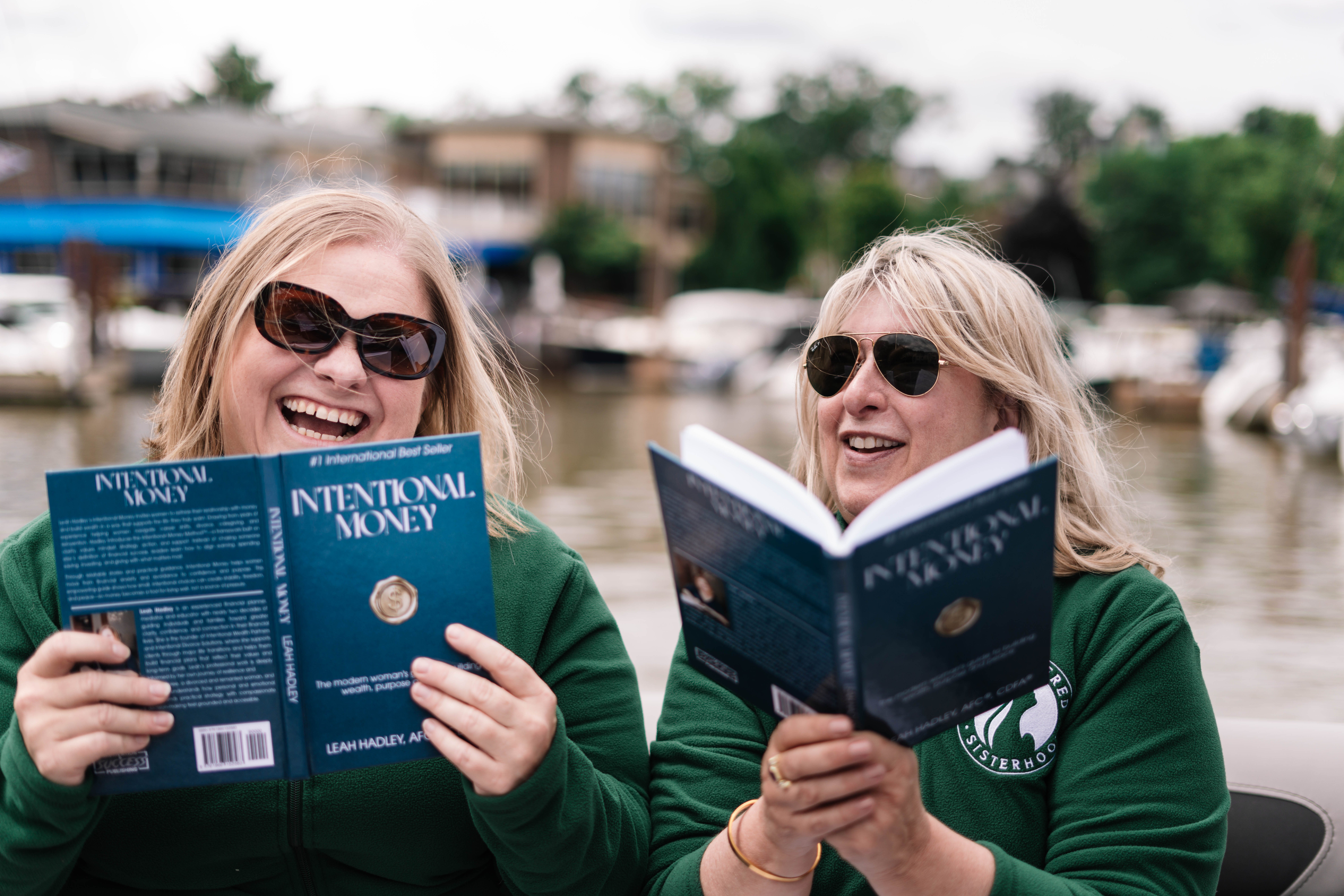
I wrote about this in Intentional Money: The Modern Woman’s Guide to Building Wealth, Purpose, & Peace, and it is the principle I return to more than any other:
Strategy without mindset does not work. Mindset without strategy is just a wish.
Both matter, and most of us are only doing one of them.
The strategy-only version is the woman with a beautifully built plan she will not follow, because underneath it she still believes she is one mistake away from losing everything. The plan is correct. She cannot act on it. I have watched more good financial plans die of that than of bad assumptions.
The mindset-only version is the woman doing the inner work, saying the affirmations, believing in abundance, and never once opening the statement. She feels better. Nothing in her actual life is different. Believing you are capable of building wealth without ever modeling what that would take is not confidence. It is hope with better branding.
My client needed both, in that order and at the same time. The mindset work opened the door enough for her to hear a strategy she had been dismissing without realizing it. The strategy then gave her something concrete enough to override the fear the next time it showed up. Neither one would have done it alone.
Write down the sentence you are actually operating on.
Not the polished version. The real one, the one that runs underneath the decision you keep not making. If I stop earning, it disappears. I am not the kind of person who invests. I cannot spend any of this, it is all I have. I should be further along than this by now.
Then treat that sentence as a claim to be tested rather than a fact to live around. Run it. What would have to be true for it to hold? What do the actual numbers say? If you have an advisor, bring them the sentence, not just the question. If you do not, build the simplest version yourself: what comes in, what goes out, what you hold, and what it would take to change the answer.
You may find out the belief was right and you have real work to do. That is useful. You may find out, like she did, that the life you have been ruling out has been sitting there available to you for a while.
Either way, you stop negotiating with a ghost.
This is exactly the kind of thing we get into inside the Empowered Sisterhood. Not just the strategy, and not just the mindset, but the two of them in the same room, with women who are somewhere in the middle of a transition and figuring out what comes next.
Join us in the Empowered Sisterhood →
And I want to hear from you on this one. What is the sentence you have been operating on? Hit reply and tell me. I read every one, and I have a feeling more of us are running the same script than any of us realize.
This post is for educational and informational purposes only and does not constitute personalized investment, legal, or tax advice. Client details have been changed to protect confidentiality. Nothing here should be construed as a recommendation to buy, sell, or hold any security. Investing involves risk, including possible loss of principal, and past performance does not guarantee future results. Leah Hadley is the founder of Intentional Wealth Partners, a fiduciary financial advisory firm. Opinions expressed are her own and are subject to change without notice. Please consult a qualified financial, tax, or legal professional before making decisions based on this content.
Comments
Nothing yet. Say the first thing.
Sign in to join the conversation.