
Let me ask you something. When you picture selling the house and renting for a while, what’s the first feeling that shows up?
For most of the women who bring this up in The Empowered Sisterhood, it isn’t relief. It’s closer to embarrassment.
This question comes up in the group more than almost anything else, and it comes up with more energy than almost anything else. Someone says she’s thinking about selling and renting for a year or two, and within a few replies there are two camps. One says don’t do it, you’ll never get back in. The other says I did it, and I sleep at night now, and I haven’t thought about a water heater in two years.
Both camps are made up of smart, capable women. Both are right about something. Neither answer transfers, because the question underneath isn’t which one is better. It’s what your housing needs to do for you in the season you’re in right now.
That’s a different question, and it has a different answer depending on whether your life is steady or in motion.
When women say renting feels like going backward, they’re not typically talking about the math. They’re talking about status, and identity, and the sense that being a homeowner was proof things were going the way they were supposed to.
Notice what that belief is measuring. It measures your life against a picture of how it was meant to go. Marriage, house, stay in the house. When the marriage ends, or the job ends, or the diagnosis comes, or the person you built the house around dies, the house becomes the last visible piece of that picture. Selling it feels like admitting the picture is gone.
The picture was already gone. The house is just where you can still see it.
The opposite belief is every bit as sticky, and it gets challenged a lot less. Some women rush to sell because staying feels like clinging and they want to prove they’ve moved on. Same story running backward, and it costs real money when it turns into a fast sale in a bad month.
Neither “I have to keep it” nor “I have to get out” is a financial position. They’re both grief wrapped in a spreadsheet.
Separate them. Give yourself the space to grieve the life. Then run the numbers on the house as a housing decision, not as a verdict on how you’re doing.
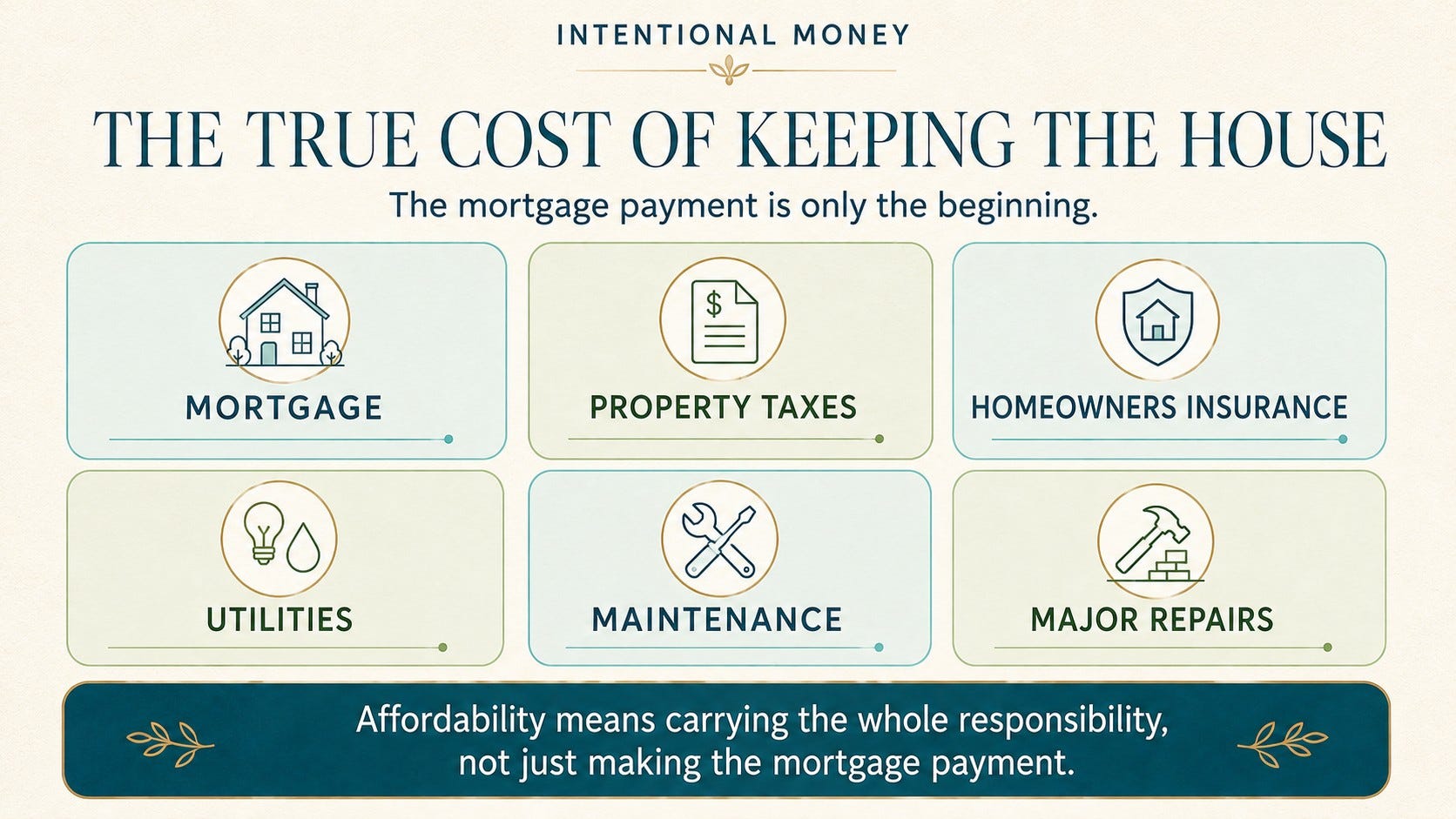
Ownership gets credit for building equity, and that credit is earned. It’s also incomplete.
The mortgage payment is the part everyone sees. Underneath it sit property taxes, insurance, and maintenance, and the usual rule of thumb is to budget somewhere between one and four percent of the home’s value each year for upkeep, with older homes at the high end. On a $400,000 house that’s $4,000 in a quiet year and $16,000 in the year the roof goes.
Then there’s the cost of getting in and getting out. Closing costs when you buy commonly run 2-5% of the purchase price, and selling costs, once commissions and fees are counted, usually run higher. In other words, a house has to appreciate a meaningful amount before you break even on the round trip.
Zillow’s June analysis puts the national buy versus rent breakeven at about 5.9 years with 5 percent down and 6.0 years with 20 percent down. Six years, not six months. Sell before you get there and the transaction costs eat the equity you built.
Two caveats on that number, because a national average hides a lot. It swings hard by market. Columbus breaks even in roughly 3.5 years, while at today’s prices San Francisco, San Jose, and New Orleans don’t break even at all across a full thirty-year horizon. And Zillow’s model leaves out the tax treatment of ownership, which helps buyers who itemize, so for some households the real breakeven arrives sooner than the headline.
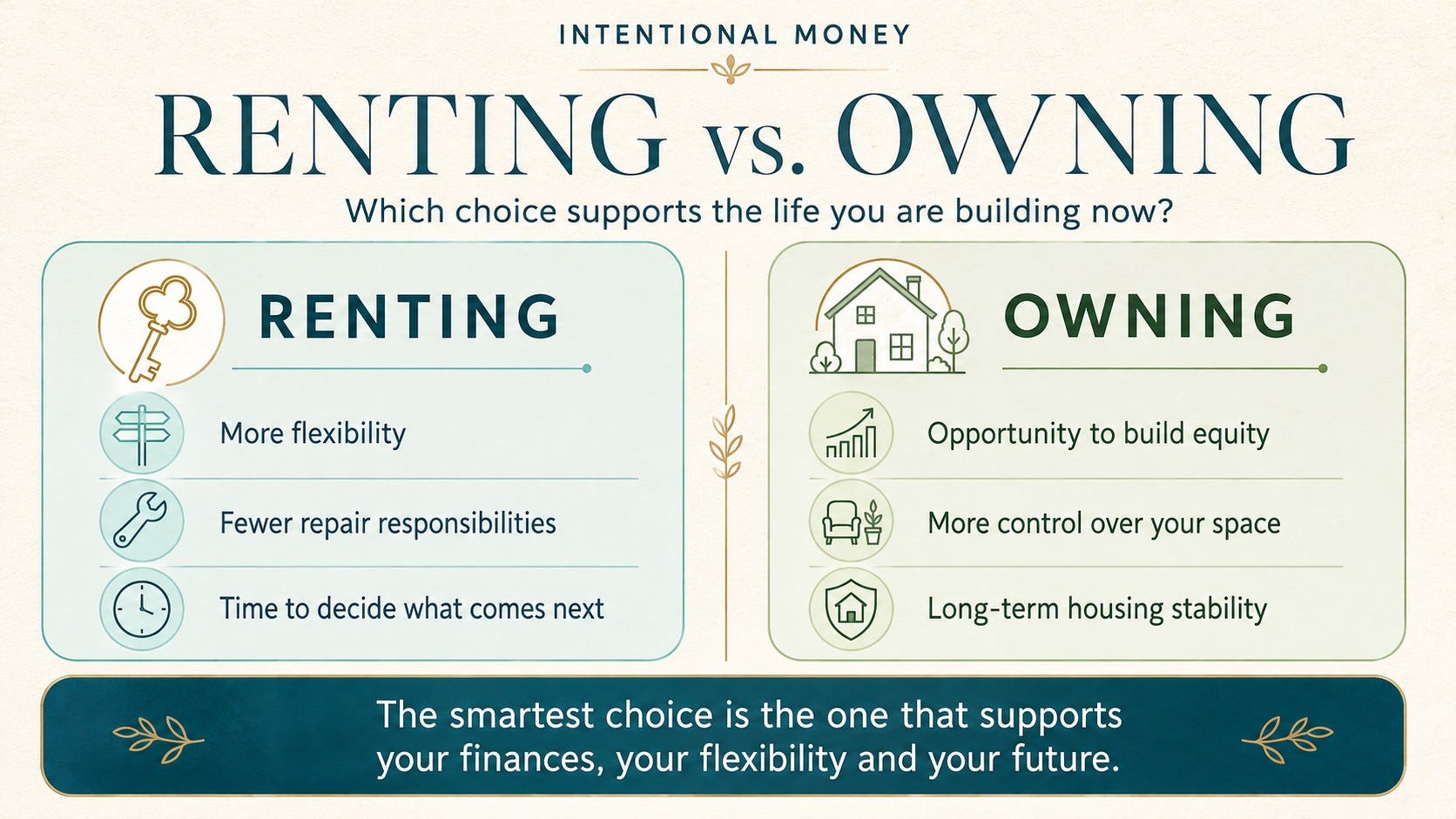
None of that is an argument against owning. Past the breakeven, ownership does what people say it does. It locks your largest monthly expense in place while rents keep climbing, it builds an asset you can borrow against or sell, and over thirty years Zillow’s own numbers put the homeowner well ahead of the renter. It’s an argument about timing. Ownership is a long-horizon instrument, and its advantages need years to show up.
Renting deserves the same honesty.
You’re not building equity. Every payment buys you that month and nothing else. Over decades that matters, and the women in the group who worry about it aren’t being irrational.
You also don’t control your housing cost. Your landlord can raise the rent, sell the building, or decline to renew, and you can be forced to move at a moment that isn’t of your choosing. The stability renting buys is real, but it’s a specific kind: your monthly number is predictable, your address is not.
And you carry no leverage. Homeownership is one of the few places ordinary people get to use borrowed money to buy an appreciating asset. Sit out of a rising market for a decade and re-entry gets hard. That fear the group voices is not paranoia.
What renting buys is optionality and cash flow certainty. You know what next month costs. You’re not one furnace away from a five-figure surprise. If your income changes you can move somewhere cheaper in sixty days instead of nine months. And the money that would have gone to a down payment stays liquid and invested, which is a real line on the renter’s side of the ledger, not a consolation prize.
Every argument for owning quietly assumes stability. It assumes you’ll stay long enough for appreciation to outrun transaction costs, income steady enough to absorb the year the HVAC and the driveway go together, and the bandwidth to manage a property.
Mid-divorce, six months into a new business, in treatment, or in the first year after losing someone, you may have none of the three. And that’s not because you failed. Because that’s what a transition is.
The affordability math lands in the same place. Redfin reported in February that you need to earn about $111,000 to afford the typical home for sale, compared with about $76,000 to afford the typical rental. That gap has narrowed to the smallest it’s been in three years, and it’s still 46%, and it falls hardest on the woman whose income just got cut in half or hasn’t settled yet.
Buying into instability does not create stability. I’m going to say that again. Buying into instability does not create stability. It usually converts a flexible problem into a much more rigid one. The house you can’t carry in year two isn’t an anchor, it’s an obligation you have to sell under pressure, on someone else’s timeline, at whatever price the market hands you that quarter.
The reverse holds too. If your income is steady, your timeline is long, you have reserves, and staying put is what you want, then renting because it feels safer can quietly cost you a decade of equity.
Write the answers down. The ones you can’t answer are usually the ones telling you something.
Not how long you hope. How long you can commit, given custody arrangements, a job that may not exist in eighteen months, aging parents, a business that may need you somewhere else. If the honest answer is under five years, the math leans toward renting in most markets.
Not the optimistic version. The one where the settlement drags, or the business ramps slower, or you cut back your hours. Can that version carry the mortgage, taxes, insurance, and a bad maintenance year?
A down payment that empties your reserves turns your safety net into drywall. In a steady season that’s a calculated risk. In an unsteady one it’s the thing that forces the sale.
Sometimes the answer is a school district, and that’s worth paying for. Sometimes the answer is proof to yourself and everyone watching that you’re fine. That one costs a lot and it doesn’t work.
Rent for three years while the market runs and you’ve lost some appreciation and you’re annoyed. Buy and have to sell in year two and you’ve lost transaction costs, possibly principal, and you’ve made a forced move during a hard season. Those two mistakes are not the same size, and for most women in transition that asymmetry is the most useful line on this page.
If you know the numbers and still can’t move, it isn’t a strategy problem. It’s a mindset one, and no calculator is going to unstick it.
Before you look at a single listing or a single rent comp, write down one date: the earliest date you could commit to staying in one place.
That date decides more than any other input. Under about five years, transaction costs generally make renting the better financial choice no matter what the housing narrative in your head is saying. Past it, ownership starts earning its keep. Everything after that is negotiation with a number you already have.
Renting during a transition is a tool matched to a season. So is owning, in a different season. You are not behind for needing a different one than you had.
If you want to think this through alongside women asking the same question, that’s what The Empowered Sisterhood is for. These threads start there, and you’ll find women a year or two ahead of you on the same decision.
I’d like to hear from you. Which direction is your gut pulling, and what’s the belief sitting under it? Reply and tell me.
Comments
Nothing yet. Say the first thing.
Sign in to join the conversation.