
I am now also on Instagram!! So, if you are a regular on Insta, you can connect here: https://instagram.com/abhishekbasumallick
My preferred poison in the social media milieu continues to be Twitter (X never caught on with me!!) and Substack.
“What we call luck is often not purely random, but rather the delayed byproduct of consistently putting yourself in good positions.” – James Clear
By the early 1980s, the Swiss watch industry was widely considered finished. Too expensive, too slow, steamrolled by Japanese quartz watches. A Swiss watch, back then, stood for precision, craftsmanship, provenance – value defined by what was inside. A proven model, suddenly obsolete. The obvious response to the competition from Asia would have been to build cheaper watches: better versions of what Japan was already offering.
Nicolas Hayek rejected that path entirely – and deliberately. He didn’t just build a cheaper Swiss watch. He broke with the fundamental assumption that a watch had to be a status symbol to be desirable. Instead, he created something categorically different: a watch as a fashion accessory, a talking piece, as cultural statement. Something you collect, swap, give as a gift – not hand down to your children. Affordable and desirable at the same time.
In 1985, Swatch launched its first artist watch – featuring Kiki Picasso, not at a watch fair, but at an art exhibition in Paris. Not a product launch. An art event.
What followed were four decades of disciplined execution: Keith Haring, Mimmo Paladino, Vivienne Westwood, and many more. The MoMA, the Guggenheim, the Uffizi, the Tate, the Louvre. Botticelli and Pollock, Monet and Lichtenstein – on a plastic watch, available at the store around the corner. Great art that would otherwise live behind museum walls or in private collections, now on every wrist, without a price barrier.
All of which points to a simple truth: there are two paths to pricing power. One controls supply through scarcity, barriers to entry, engineered exclusivity. The other controls demand: people want something because it carries meaning, not because it’s rare.
Casinos operate on the simple principle that gambling, over time, is a losing endeavour. They ensure it. Your loss is the casino’s gain.
Why is that? They design the games to favor the house, not the player. Anyone can place a bet, beat the odds, and win. The casino expects to lose on some bets in the short term.
But over thousands of spins of the wheel or rolls of the dice, your bankroll gets ground down to nothing and the casino comes out ahead.
That fact doesn’t stop people from gambling, though. Some combination of entertainment, ignorance, overconfidence, optimism, and dumb luck keeps people gambling and casinos in business.
The same reasons explain why people speculate in markets. Unfortunately, the outcome is the same.
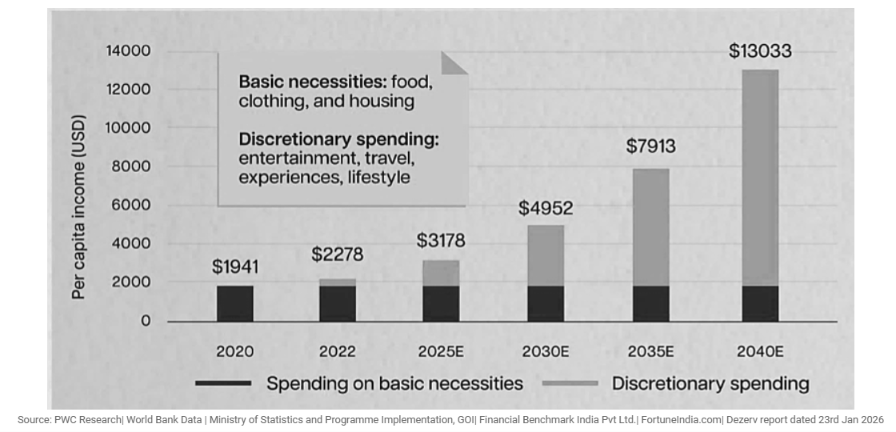
As per capita spending goes up, spending gets focused on discretionary items
The video uses the rise and collapse of Leo Aschenbrenner’s hedge fund, Situational Awareness, to explain why investment conviction can be useful but dangerous when taken too far.
The fund made exceptionally high returns—about 367% from August 2025 to 19 June 2026—but then lost roughly 43% of total fund value within weeks and was liquidated.
Its basic bet was that AI would grow rapidly: it bought companies expected to benefit from AI infrastructure and bet against businesses likely to be disrupted by AI.
The central problem was not necessarily believing in AI. The problem was treating a risky, uncertain AI theme as though it were nearly certain, including reportedly borrowing very heavily to increase the bet.
Why investors become overconfident
Investors may feel highly confident because they believe they have better information, better analysis, deeper industry knowledge, or have identified a clear pricing error.
However, intelligence, a prestigious education, strong self-confidence, and recent success can all lead to excessive confidence. A winning streak may be luck rather than lasting skill.
Portfolio impact
Conviction affects two major decisions: position size (how much money is allocated to a single investment) and leverage (using borrowed money or similar instruments to increase exposure).
More conviction normally leads to a more concentrated portfolio and more leverage; lower conviction should lead to more diversification and less leverage.
Leverage magnifies both gains and losses. It can turn a wrong investment view into a permanent loss because the investor may be forced to sell at the worst time.
Young vs mature firms
Young, high-growth businesses have greater uncertainty because their future earnings, competition, regulation, and business model are difficult to predict.
Therefore, portfolios focused on startups or early-stage technology companies should generally be more diversified and use less debt than portfolios focused on mature, stable companies.
Three main lessons
Match risk to confidence: Do not take large, borrowed, concentrated positions in investments where the outcome is still highly uncertain.
Do not ignore momentum: The fund’s returns may have reflected market momentum—rising AI-related shares and falling software shares—as much as special AI insight. Momentum can reverse quickly.
Prefer “humble money” to “smart money”: The speaker prefers managers who admit uncertainty, recognise luck, accept mistakes, and control risk rather than those who claim exceptional certainty and charge high fees.
Final message: being smart and having a strong thesis is not enough. Long-term investing requires humility, diversification where uncertainty is high, and restraint in the use of leverage.
Investments in the securities market are subject to market risks. Read all the related documents carefully before investing.
Founder, Intelsense Capital, SEBI Registered RA (Cupressus Enterprises Pvt Ltd - INH000013828)
Co-founder & Fund Manager, Shree Rama Managers PMS (INP300007341)
Registration granted by SEBI and certification from NISM do not guarantee the intermediary's performance or provide any assurance of returns to investors.
No posts
Comments
Nothing yet. Say the first thing.
Sign in to join the conversation.