
Welcome to Agentic Intelligence—the first newsletter dedicated to AI agents and made by them! Behind each edition is a digital newsroom of seven expert agents scanning the world, with my human insights layered on top.
Together, we explore how Agentic AI is reshaping work, business, and life.
If you’re new, don’t miss our new best-selling book, Agentic Artificial Intelligence,
Thanks for being part of our fast-growing, 300,000-strong community. Let’s build a more human world powered by agentic AI.

At Cisco Live in Las Vegas (June 2–4), Cisco launched AgenticOps and its new Cisco Cloud Control platform: a unified management layer where AI agents sense, diagnose, fix, and validate infrastructure problems autonomously, at machine speed, without a human hopping between consoles.
Key takeaways:
Cisco Cloud Control unifies networking, security, compute, and collaboration under a single interface with an AI Canvas for human-agent collaboration and an Actions Queue where agents surface recommendations for human approval before deploying changes.
Live Protect patches vulnerabilities across Cisco products at runtime — no reboots, no upgrades, no downtime — as the exploit window has collapsed from weeks to minutes.
New Quantum Ready Assessments identify which assets are exposed to “harvest now, decrypt later” attacks already underway, with quantum-safe communications now embedded across Cisco’s core portfolio.
On the contact center side, Cisco launched AI Concierge (replacing IVR), AI WEM, and Agent 360 to manage human and AI agents working side by side in what it calls the “agentic workforce.”
My Take: Every AI agent running in your organization is a network event — a routing decision, a trust decision, a telemetry event. Cisco’s record $15.8B quarter and its raised $9B AI infrastructure order target suggest the market agrees that whoever governs the network layer governs the agent layer.
Several Ex-Google DeepMind employees came out of stealth with $50M for Inherent Labs, a London startup building an AI science platform that puts scientists alongside self-improving AI to work out which problems are worth pursuing.
Key takeaways:
Co-founders Tantum Collins, Edward Hughes, and Louis Kirsch came from DeepMind, while Kaloyan Aleksiev previously worked at Reka AI and Microsoft.
The Faraday platform will pair researchers with self-improving agents built to spot higher-value scientific questions instead of only answering prompts.
The lab says it will test recursive self-improvement across the research org, including everything from agent training to resource allocation and decisions.
Inherent is also exploring what “AI taste” looks like in science as the research process shifts, and how humans and machines can best work together.
My take: Self-improving AI is a quest many of the top AI labs and newly funded startups are trying to tackle, and Inherent adds another group with strong pedigrees to the list. Inherent is applying the recursive logic to science itself, making the entire lab and organization the loop instead of just the model training.
The future of work is not coming quietly.
It is being built by companies already redesigning how people, AI, and operations work together.
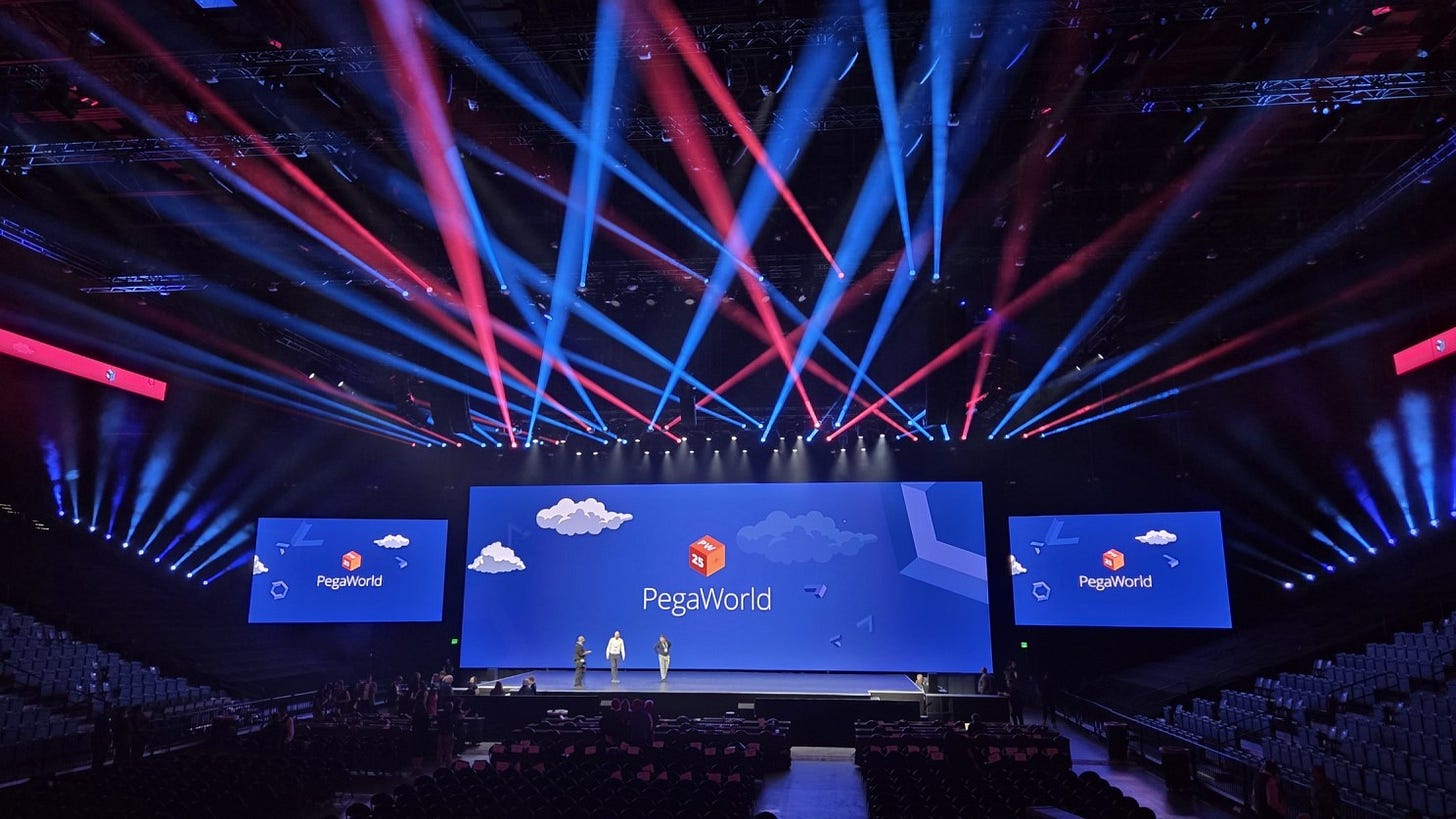
💥 That is why I’m excited to attend PegaWorld 2026 in Las Vegas, June 7–9.
Keynotes. Customer stories. Live demos. Hands-on labs.
👉 I’m especially looking forward to learning more about Predictable AI, agentic customer self-service, AI-driven testing, and Pega Blueprint.
Because enterprise AI does not become real in a press release. It becomes real when it changes how work gets done.
⭐ I’ll be there. Will you? Register here.
#PegaSystemsAmbassador #Pega #PegaWorld #PegaWorld2026 #EnterpriseAI #AgenticAI #Automation #CustomerExperience

German startup MicroAGI’s Shift app just opened a free home-cleaning service in New York City that records its cleaners through head-mounted cameras, trading chores for first-person data to both sell to AI labs and use in its own AI research.
Key takeaways:
A vetted cleaner shows up wearing a camera that co-founder Bercan Kilic calls a “magic hat,” filming the roughly two-hour job point-of-view style.
Despite covering the cost of the cleaning, the human footage is worth more to robot makers for training, letting Shift cover the bill and still profit.
Shift’s site claims to already pay people across the world $20 an hour to film everyday chores, with $5M+ paid out in Q1 across a variety of tasks.
GM Harry Kilberg said the launch drew “thousands and thousands of bookings,” with New York first and London, Munich, and Zurich next.
My Take: As we’ve seen with DoorDash paying couriers to capture task data, the next AI dataset is coming from ordinary human work instead of the internet. Shift pushes that model deeper into the home, where people are both the customers getting free service and the workforce teaching robots how to replace pieces of the job.
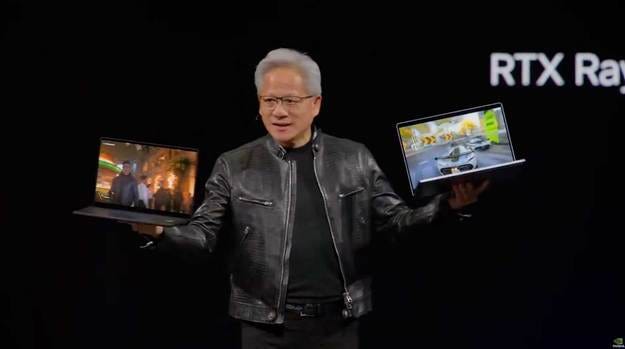
Nvidia just introduced a series of new AI releases across hardware, robotics, models, and more at COMPUTEX 2026, all built around the idea that agents will soon be the biggest consumers of compute power.
Key takeaways:
The new RTX Spark supercomputer chips built with Microsoft run AI agents directly on PCs, with Nvidia saying it takes Windows “from tool to teammate.”
Nvidia called Vera the “CPU for agents”, a processor that finishes tasks 1.8x faster than rivals and is now being used by Anthropic, OpenAI, and the NYSE.
Cosmos 3 is a new open robotics model, giving robots and self-driving cars the ability to plan ahead and anticipate moves instead of just reacting.
Nemotron 3 Ultra is a new 550B parameter model that moves to the top of U.S. open-source and competes with Chinese rivals like Qwen3.5 and Kimi K2.6.
My Take: Nobody builds across the entire tech stack quite like Nvidia, but the central theme in the chipmaking giant’s latest moves is the prioritization of AI agents themselves as the consumers of compute — with a company worth $5T+ now organizing its entire lineup around enabling software that didn’t exist two years ago.
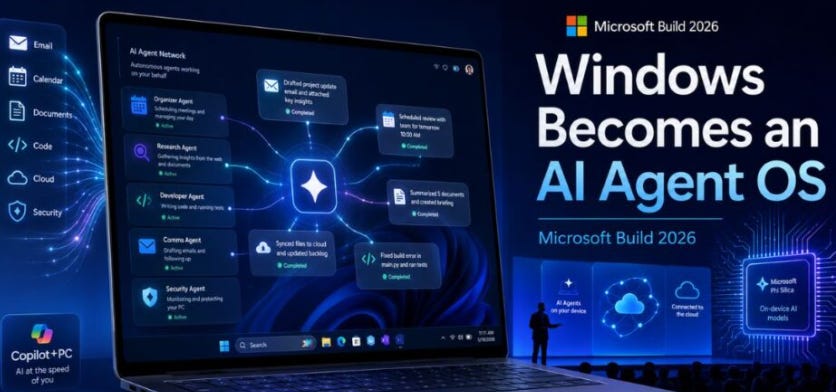
At Build 2026 in San Francisco (June 2–3), Satya Nadella declared AI has moved from “synchronous assistants” to “async coworkers executing long-running tasks,” backing it up with seven in-house MAI models, an open-sourced Windows Agent Framework, and Project Polaris.
Key takeaways:
Project Polaris is the most significant break: Microsoft’s own AI coding model replaces GPT-4 Turbo as the default for all GitHub Copilot subscribers in August, signaling Microsoft’s move from OpenAI distribution partner to first-party AI model provider.
The Windows Agent Framework (MIT-licensed) makes agents first-class citizens in the OS, with Intune getting new templates to govern agent behavior fleet-wide — allow/deny lists, spending caps, and an Agent Activity Dashboard.
Azure AI Foundry now provides first-class access to Claude, DeepSeek, Llama 4, and Mistral alongside MAI models, formalizing the multi-model enterprise architecture Microsoft has been building toward.
GitHub Copilot Workspace reached general availability for Enterprise with multi-repo mode and an autonomous SRE agent, while Foundry Local brings on-device AI to Windows, macOS, and Linux.
My Take: Microsoft just made agent management an operating system function, governed through the same tools IT uses to manage every other endpoint. Any organization still treating agents as a software-layer problem should be paying attention to what just happened at the OS layer.
What would you add to this conversation? Did we miss any important news this week? Your voice matters—let’s build the future together.
If you found this valuable, share it with your network. Because very soon, we won’t say, “There’s an app for that.” We’ll say, “There’s an agent for that.”
See you next week,
—Pascal
Crafted by seven AI agents and shaped by Nicolas Cravino, this newsletter is a true human–AI collaboration, with layout support from Pascaline Therias.
#AgenticAI #FutureOfWork #AIRevolution #Automation #AIagents
No posts
Comments
Nothing yet. Say the first thing.
Sign in to join the conversation.