
Welcome! I’m Tom Griffin and this is my intelligence history newsletter. Feel free to share this article with the button below. If this email is truncated, please check the website.
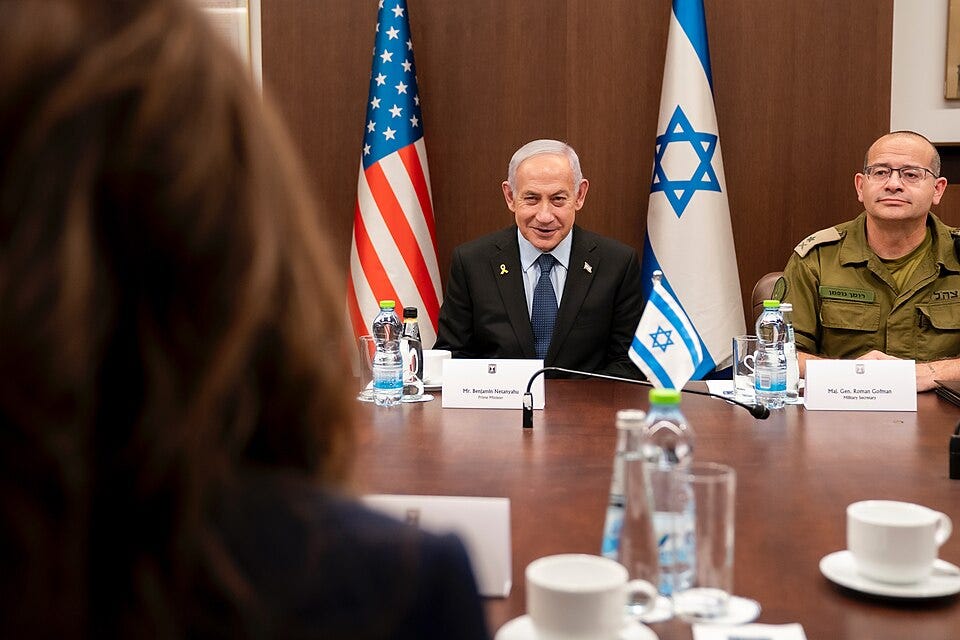
Benjamin Netanyahu and his then military secretary Roman Gofman meeting former US Homeland Security Secretary Kristi Noem on 25 May 2025 (Department of Homeland Security, public domain).
The appointment of Roman Gofman as head of Mossad at the start of this month marked a milestone. All of Israel’s intelligence chiefs have now been appointed since the October 7 attacks.
Several of the departing chiefs left under a cloud because of their failure to predict the Hamas attack on southern Israel, yet the man picking their replacements has largely avoided accountability for his own role. Instead, the intelligence blame game has replicated some of the political tensions that contributed to Israel’s vulnerability in the first place.
In the months leading up to the attack, the government’s aroused mass opposition by attempting to reform the judiciary while Prime Minister Benjamin Netanyahu was facing an ongoing corruption trial. In March 2023, defence minister Yoav Gallant called for a halt to the legislation, warning that ‘he growing rift in our society is penetrating the IDF and security agencies.’1 In the following months, the IDF’s military intelligence directorate, Aman, sent Netanyahu four separate warnings that political divisions were emboldening Israel’s enemies.2
Aman research chief Amit Saar reportedly wrote in a letter of 16 July that ‘all the players in the [security] system note that Israel is in a serious, unprecedented crisis, which threatens its cohesion and weakens it. For our main enemies — Iran, Hezbollah and Hamas — this weakness is an expression of a linear process ending with Israel’s collapse, and the current situation is an opportunity to accelerate and deepen its troubles.’3
Netanyahu would later dismiss the significance of such warnings because they failed to identify the threat that was ultimately realised - a cross-border attack from Gaza. Saar’s boss, Aman chief Aharon Haliva was the first of the pre-October 7 intelligence leaders to depart in 2024.
In a leaked recording, Haliva acknowledged his own role stating ‘for such a tragic event and such a catastrophic national disaster, there is enough responsibility for everyone to go around… Everyone should be sent home.’ He included Netanyahu in this, arguing that the Prime Minister’s strategy had strengthened Hamas.
‘He wants Hamas, which is much worse than the PA [Palestinian Authority]. Why does he want Hamas? Because the PA has international status. Hamas is an organization that you can fight freely, it has no international justification, it ‘has no legitimacy, you can fight it with a sword.’4
In this context intelligence emphasising the threat from the Hamas was potentially challenging the basis of government policy. The resulting assumptions have been compared to the ‘conception’, the fixed paradigm which governed Israeli analysis of Egypt before the historic intelligence surprise of the Yom Kippur War.5
Such pressures are too common to be a simple excuse for intelligence failure, but do suggest a case for political accountability.
Haliva’s replacement at Aman was Shlomi Binder, who himself faced questions over October 7, during which he was head of the IDF’s Operations Division. Netanyahu reportedly considered firing him but may instead have exploited his vulnerability another way. While his own job was still in the balance, Binder testified on Netanyahu’s behalf at his corruption trial, stating that three daily evidence sessions a week were affecting the Prime Minister’s ability to govern.6
The Aman changeover was a picture of relative continuity compared to the other major agency exposed by October 7, the security service Shin Bet. Like Haliva, director Ronen Bar had given warnings about escalating polarisation in the months before the attacks, arguing that settler violence in the West Bank was bolstering Hamas and Islamic Jihad.7
In the aftermath, Bar acknowledged his own responsibility, but delayed his resignation, reportedly in order to secure the return of hostages and a state commission of inquiry. He also sought to ensure he would be succeeded by one of his deputies.8
The latter two goals were bitterly resisted by Netanyahu who fired Bar on 6 March 2025, beginning a legal and political standoff which lasted for several weeks until Bar announced his resignation on 28 April.9
Bar’s replacement, Maj. Gen. David Zini was himself resident in the Golan Heights at the time of his appointment.10 In recent months, he has dismissed settler violence as friction rather than terrorism, prompting concerns from former Shin Bet officers about politicization of an agency whose security remit has always included Jewish extremists as well as Palestinians.11
As a foreign intelligence agency, Mossad was under less pressure in the post-mortem recriminations, but the trajectory has been similar nonetheless. Netanyahu appointed David Barnea at the end of his previous premiership in 2021, in part because of his aggressive approach to Iran.12 During this year’s war, the two men worked closely on plans for regime change.13
Yet Barnea was no more successful than Bar in securing his choice of successor. Both of the internal candidates he recommended were rejected in favour of Gofman, then Netanyahu’s military secretary.14 Among Gofman’s first acts was to sack one of those nominees, the deputy Mossad chief known to the public by the Hebrew initial ‘Aleph.’15
Netanyahu has succeeded in reshaping an intelligence leadership that he regarded as part of a hostile establishment, while suppressing questions about his own role in the October 7 intelligence failure. Those questions may now be re-opened anyway.
In an article for RUSI Journal last year, security scholars Clive Jones and Robert Geist Pinfold concluded that any inquiry would likely find that ‘intelligence agencies fell in line with political priorities dictated by the Prime Minister’s Office, who believed that Hamas was contained and refused to accept any evidence to the contrary. This is because that containment strategy served a wider political purpose of freezing and prolonging the status quo. As a result, Israel is now trapped in an escalation cycle it did not initiate or plan for.’16
In the months since, the Iran War has brought that cycle to a new pitch of intensity, and the Trump administration’s increasing divergence from Israel over the settlement of the conflict has brought renewed scrutiny to Netanyahu’s leadership. Likud’s poll numbers have taken a sharp dip ahead of elections which are due by October this year.
A State Commission of inquiry is supported by two key opposition blocs, the Together alliance of Naftali Bennett and Yair Lapid, and the Yashar grouping led by former IDF chief of staff Gadi Eisenkot. Supporters of the latter group include Yoram Cohen, the head of Shin Bet, who claims that during his own tenure from 2011 to 2016, Netanyahu asked him to revoke Bennett’s security clearance.17 The move would have forced Bennett out of the security cabinet at a time when he was at odds with Netanyahu over the 2014 Gaza War.18
Bennett was and remains a hardliner. Although his coalition partner Lapid is more dovish, he has said that the peace process with the Palestinians is ‘not a priority.’19 Similarly, Eisenkot has said that ‘a Palestinian state is not relevant after October 7’, adding that ‘we should make our considerations from a position of strength, take our time, and not decide from one moment to the next, certainly not talk about it now.’20
There seems little hope, then, of early progress with the Palestinians whoever forms the next Israeli government. But a Commission of Inquiry into October 7 may show the consequences of a policy aimed at undermining the Palestinian Authority at all costs. That could be a chance to end the tacit collusion of extremes which has driven the cycle of escalation across the Middle East.
Comments
Nothing yet. Say the first thing.
Sign in to join the conversation.