
By Lisa Bollow, MA, LPC-R, NCC®, EMDR PT-I®
Founder, The Integrated Life Project
In my previous article, Slow-Wave Sleep May Help Protect Emotional Regulation in Later Life, I explored new research suggesting that reduced slow-wave sleep may help explain why brain aging is associated with greater next-day anxiety. The findings raised an important practical question: if deep sleep supports emotional recalibration and cognitive functioning, can we do anything to protect or improve it?
The answer is not tied to a single supplement, wearable, or bedtime trick. Deep sleep is shaped by the broader sleep system—including circadian timing, physical activity, sleep continuity, medical conditions, stress physiology, alcohol, pain, medications, and untreated insomnia. This follow-up looks at the lifestyle, clinical, and therapeutic factors most likely to support restorative sleep, while separating stronger evidence from promising but still preliminary approaches.
Slow-wave sleep is influenced by age, brain health, sleep pressure, circadian timing, physical activity and the degree to which sleep remains uninterrupted. The most evidence-based approach is therefore not to chase a particular sleep-stage percentage. It is to identify and reduce the factors that fragment sleep, weaken circadian signaling or keep the nervous system in a state of elevated arousal.
Before adding supplements or elaborate nighttime routines, it is important to rule out conditions that repeatedly interrupt sleep.
Obstructive sleep apnea is especially relevant in later life. Breathing interruptions, oxygen fluctuations and repeated micro-arousals can prevent the brain from sustaining consolidated non-REM sleep. Positive airway pressure treatment is recommended for appropriately diagnosed obstructive sleep apnea, and research indicates that effective treatment can improve sleep continuity and aspects of sleep architecture.
Other potential disruptors include:
Chronic pain
Restless legs or periodic limb movements
Nocturia
Reflux
Hot flashes and night sweats
Depression, anxiety or trauma-related hyperarousal
Alcohol use
Medication side effects
Sedative dependence
Circadian-rhythm disruption
The goal is not simply to become unconscious for more hours. It is to create the physiological conditions in which the brain can move through non-REM sleep with fewer interruptions.
For chronic insomnia, cognitive behavioral therapy for insomnia, or CBT-I, remains the leading evidence-based behavioral treatment.
CBT-I is more comprehensive than general sleep-hygiene advice. It may incorporate stimulus control, carefully structured time-in-bed restriction, cognitive restructuring, relaxation training and stabilization of sleep-wake timing. The American Academy of Sleep Medicine recommends multicomponent CBT-I for adults with chronic insomnia and advises against relying on sleep hygiene as a stand-alone treatment.
I have used CBT-I with a few clients and some have found partial relief from waking episodes.
Time-in-bed restriction can initially sound counterintuitive. Its purpose is not to chronically deprive someone of sleep, but to reduce prolonged periods of wakefulness in bed, consolidate sleep and strengthen sleep pressure.
A small pilot intervention in older adults found that structured time-in-bed restriction increased slow-wave activity. More recent research in older adults receiving CBT-I or its component therapies also found that within-person increases in slow-wave activity were associated with improved memory performance. These findings are promising, although they do not yet establish CBT-I as a direct slow-wave sleep treatment.
Because sleep-restriction protocols require clinical judgment, they should be used cautiously in people with bipolar disorder, seizure disorders, untreated sleep apnea, elevated fall risk or occupations in which temporary daytime sleepiness could create a safety concern.
Exercise is one of the more consistently supported nonpharmacological strategies for improving sleep.
Across studies, regular exercise has been associated with better sleep quality, improved sleep efficiency, shorter sleep-onset latency and, in some circumstances, greater slow-wave sleep. The effects vary according to exercise type, intensity, timing, baseline fitness and whether the individual already has a sleep disorder.
A practical program may include:
Moderate aerobic exercise, such as brisk walking, cycling or swimming
Resistance training two or more times per week, when medically appropriate
Mobility, balance and flexibility work
Mind-body movement such as yoga, qigong or Tai Chi
Tai Chi is particularly interesting for older adults because it combines physical activity, attentional regulation, breathing and autonomic downshifting.
In a 2026 randomized trial, 67 adults ages 65 to 75 with mild sleep disturbance were assigned to either usual activity or 12 weeks of Tai Chi performed five days per week for 60 minutes. The Tai Chi group demonstrated better sleep efficiency, shorter sleep-onset latency, increased delta-wave power and a reported 23.1% increase in the proportion of N3 sleep. These findings are notable, although the study was relatively small and the exercise dose was substantial. Replication in larger and more diverse samples is needed.
Exercise should be scheduled according to individual response. Some people sleep better after late-afternoon or early-evening activity, while vigorous exercise close to bedtime may be activating for others.
Compliance is the greatest issue I have with assigning exercise as a treatment. Even with evidence, clients often reject the potential benefit because they equate exercise solely with weight loss.
Deep sleep is governed partly by sleep pressure, the biological need for sleep that accumulates during waking, and partly by the circadian system that coordinates sleep timing.
Maintain a consistent wake time.
A relatively stable morning wake time anchors the sleep-wake rhythm more effectively than trying to force an exact bedtime when the person is not sleepy.Obtain bright light early in the day.
Morning light provides a strong time signal to the brain’s central circadian clock. Studies in older adults suggest that appropriately timed bright-light exposure can strengthen circadian rhythms and improve sleep efficiency or sleep quality, although results vary across populations and protocols.Reduce intense light late in the evening.
Bright overhead lighting and highly stimulating screen use may delay the biological transition toward sleep, particularly in light-sensitive individuals.Avoid long or late naps.
Napping is not inherently unhealthy, but extended afternoon naps can reduce the sleep pressure available at night. When nighttime sleep is fragmented, nap timing and duration should be evaluated as part of the complete sleep pattern.
Caffeine can remain biologically active much longer than people subjectively feel stimulated.
In one controlled study, 400 milligrams of caffeine disrupted sleep even when consumed six hours before bedtime. A later systematic review estimated that a typical coffee may need to be consumed approximately nine hours before bedtime to avoid measurable reductions in total sleep time, although caffeine metabolism varies considerably among individuals.
For someone experiencing poor sleep, morning anxiety or diminished deep-sleep estimates, an earlier caffeine cutoff may be a useful personal experiment.
Alcohol presents a different problem. It may shorten the time required to fall asleep, but sedation is not the same as restorative sleep. Alcohol changes normal sleep architecture and can contribute to later-night fragmentation, autonomic activation, REM disruption, snoring and worsening sleep apnea. Its apparent early-night increase in slow-wave sleep should not be interpreted as a health benefit because the sleep that follows can be less stable and less restorative.
No single food has been shown to reliably produce deep sleep. The broader dietary pattern is more relevant.
In a controlled laboratory study, greater fiber intake was associated with more slow-wave sleep, while greater saturated-fat intake was associated with less slow-wave sleep. Higher sugar intake was associated with more sleep arousals. The study was small, so these findings should be understood as suggestive rather than prescriptive.
A practical sleep-supportive pattern emphasizes:
Vegetables and fruit
Beans, lentils and other fiber-rich foods
Nuts and seeds
Fish and other quality protein sources
Minimally processed carbohydrates
Unsaturated fats
Regular, adequately nourishing meals
Mediterranean-style dietary patterns are consistently associated with better self-reported sleep quality, but much of the evidence remains observational. It cannot yet prove that adopting the diet will directly increase slow-wave sleep.
Large, high-fat or highly stimulating meals close to bedtime may also interfere with sleep through reflux, elevated body temperature or digestive discomfort. Meal timing should be individualized, especially for people with diabetes, reflux or nighttime hunger.
The body normally releases heat through the hands and feet as it prepares for sleep. A warm bath or shower may support this process by producing a subsequent decline in core body temperature.
A systematic review found that warm bathing or showering approximately one to two hours before bedtime was associated with faster sleep onset and improvements in aspects of sleep quality. This is better understood as a sleep-initiation strategy than as a proven method for directly increasing N3 sleep.
The sleep environment should also be:
Dark enough to minimize unwanted light exposure
Quiet or protected from unpredictable noise
Comfortably cool
Physically supportive
Associated primarily with sleep rather than prolonged work, television viewing or worry
Environmental changes are unlikely to reverse age-related changes in sleep architecture, but they can reduce avoidable arousals.
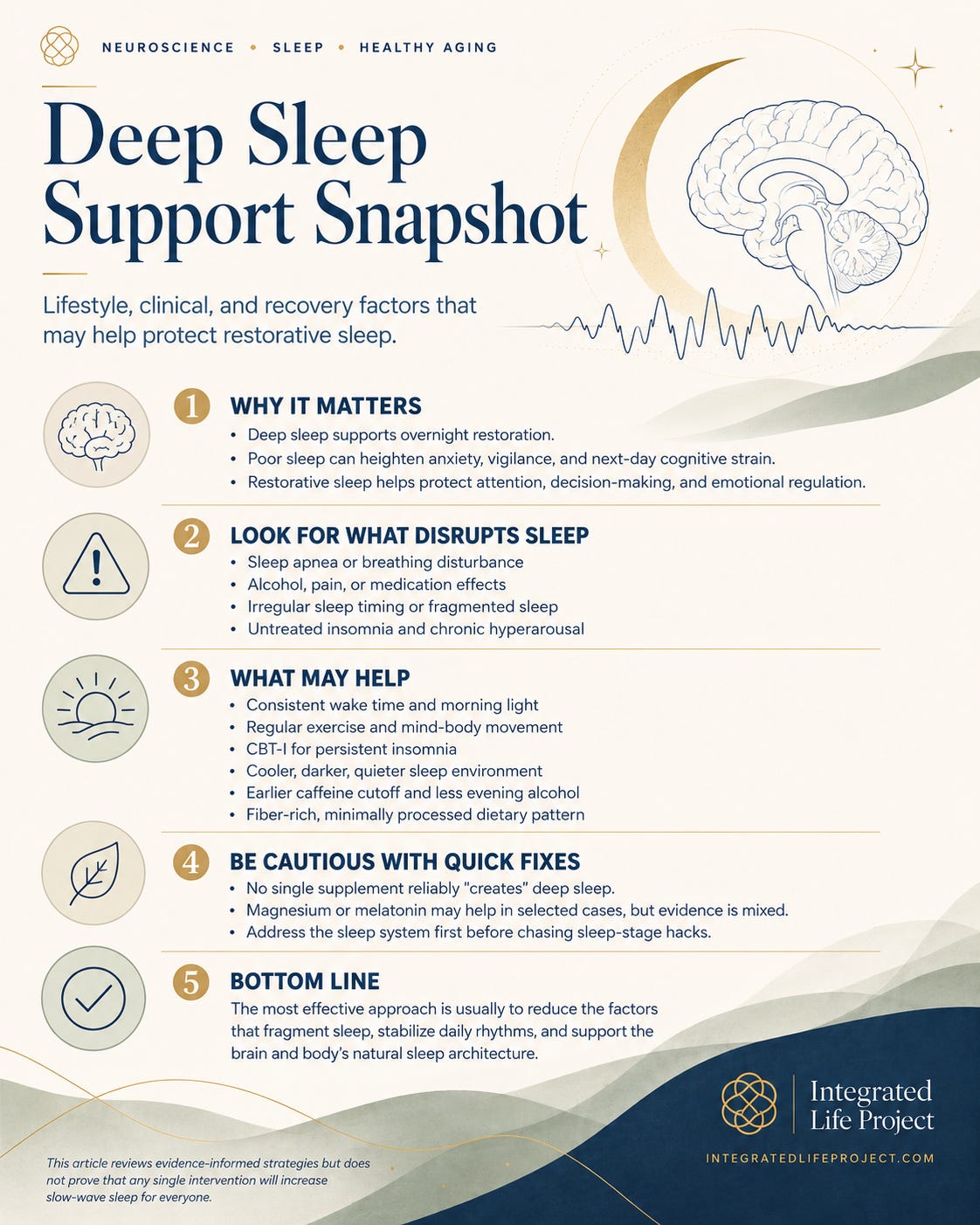
The supplement evidence is there but avoid being pulled in by influencer marketing.
Magnesium: Magnesium is involved in neural signaling and may be useful when dietary intake is inadequate or a deficiency is present. Some trials in older adults with insomnia have reported modest improvements in sleep onset. However, systematic reviews describe the overall clinical evidence as limited, inconsistent and generally low-certainty. Magnesium has not been established as a reliable slow-wave sleep enhancer.
Melatonin: Melatonin primarily signals biological night and can be useful for circadian-timing problems, jet lag and selected sleep-onset difficulties. It should not be described as a sedative that reliably increases deep sleep. Dose, timing and formulation matter, and inappropriate timing can shift the circadian rhythm in an undesired direction.
Glycine: Small studies have reported subjective sleep benefits from glycine taken before bedtime, but the evidence base is limited and does not establish a meaningful effect on deep sleep in older adults.
Nutrient deficiencies: Vitamin D, iron, vitamin B12 and other nutrient abnormalities may contribute indirectly to fatigue, restless legs or disrupted sleep in selected individuals. Supplementation is most defensible when guided by symptoms, dietary assessment, laboratory findings and medical history—not by the assumption that more supplementation produces deeper sleep.
Supplements can interact with medications and may carry additional risks for people with kidney disease, cardiovascular conditions or complex medication regimens. Always check with your doctor or pharmacist before adding supplements to your routine if you are taking other medications. “Natural” does not mean neurologically inactive.
Researchers are investigating closed-loop acoustic stimulation, in which precisely timed sounds are delivered during non-REM sleep to strengthen naturally occurring slow oscillations.
Laboratory studies suggest that acoustic stimulation can enhance slow-wave activity under carefully controlled conditions. Clinical trials are now examining whether these changes translate into meaningful improvements in memory, daytime functioning or cognitive aging. The technology remains investigational and should not be confused with ordinary white-noise machines or consumer “deep-sleep” audio tracks.
For most people, the highest-value sequence is:
Screen for sleep apnea and other sources of sleep fragmentation.
Treat chronic insomnia with CBT-I rather than relying only on sleep-hygiene tips.
Maintain regular waking, light-exposure and activity patterns.
Exercise consistently, including both aerobic and strength or mind-body movement.
Reduce evening alcohol and move caffeine earlier.
Use a fiber-rich, minimally processed dietary pattern.
Consider supplements only when there is a defensible indication.
The central principle is that deep sleep is more likely to emerge from a well-regulated sleep system than from an isolated nighttime intervention.
We cannot completely prevent the normal age-related decline in slow-wave activity. We can, however, reduce many of the conditions that further erode sleep continuity and make restorative non-REM sleep more difficult to sustain.
Lisa Bollow is a therapist, neuroscience-informed performance strategist, and founder of Integrated Life Project. Her work examines how nervous system regulation, emotional clarity, and cognitive capacity shape leadership, decision-making, well-being, and sustainable performance, integrating clinical insight, neuroscience, and practical strategies for high-functioning individuals and leaders.

Research source: Ben Simon, E., Shah, V. D., Murillo, O., Zsofia, Z., et al. (2026). Impaired slow-wave sleep accounts for brain aging-related increases in anxiety. Communications Psychology, 4, Article 34.
This article is for educational purposes and does not provide medical diagnosis or individualized treatment recommendations. Persistent sleep disruption, morning anxiety, excessive daytime sleepiness, snoring or nighttime breathing difficulties should be discussed with a qualified healthcare or sleep-medicine professional.
Comments
Nothing yet. Say the first thing.
Sign in to join the conversation.