
Warning: This post contains spoilers for The Batman (2022), Joker (2019), and The Dark Knight Rises (2012).
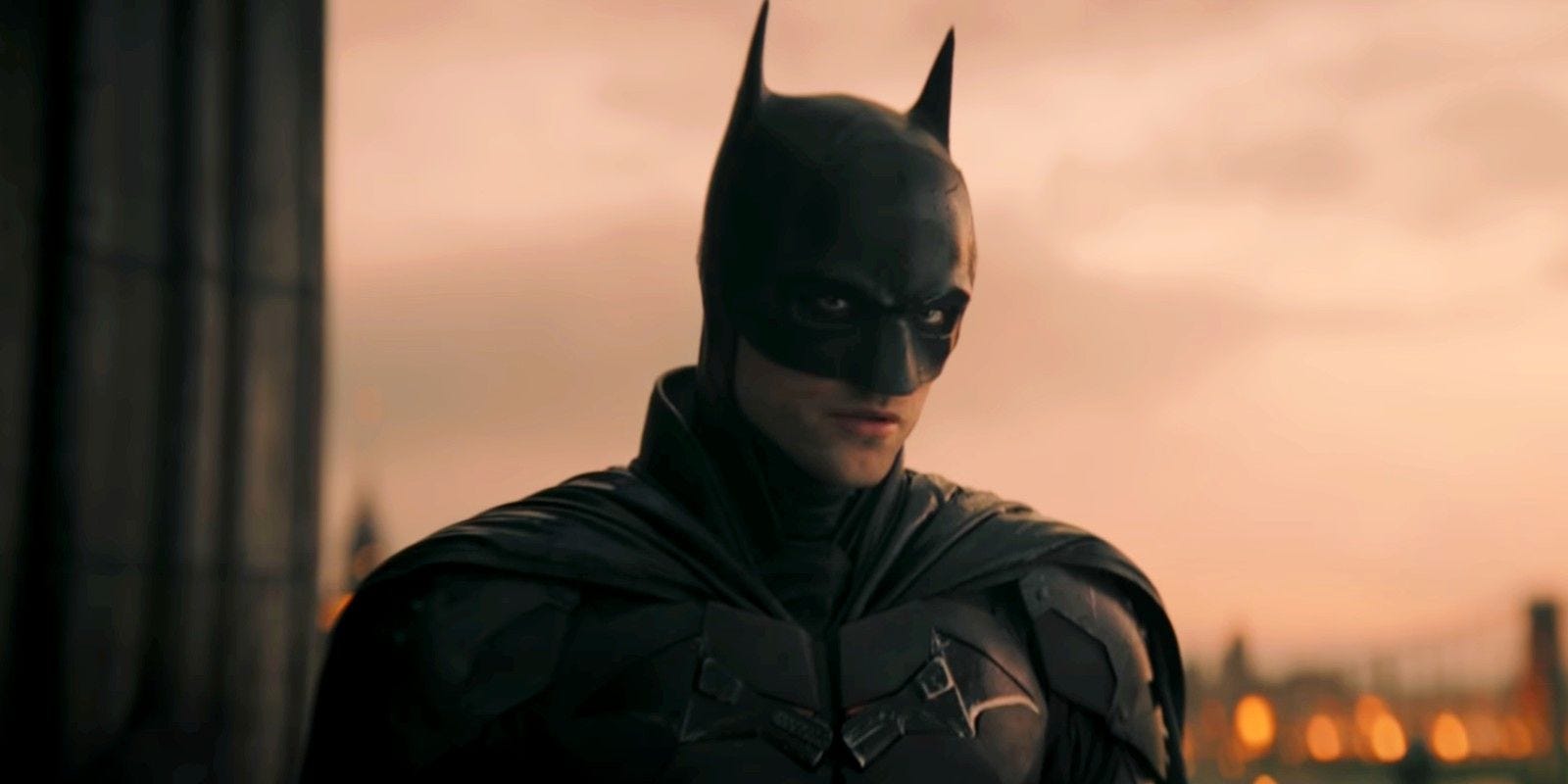
It is notable that, until the release of Matt Reeves’s The Batman this year, the most interesting recent entry in the Batman franchise, Todd Philips’s Joker (2019), was set during Bruce Wayne’s childhood, depicting him only fleetingly as a very peripheral character. Indeed, in the last decade Batman has become such a tainted brand that audiences would be forgiven for avoiding the character’s latest big screen outing. And yet, Reeves’s slate-cleaning reboot is a commercial and critical success, earning notices that threaten to overshadow Christopher Nolan’s vaunted Dark Knight trilogy (2005-12). Nonetheless, the film must be regarded as a failure — albeit a wildly entertaining and brilliantly made failure — undermined not by aesthetic deficiency, but, as is so often the case with Batman, by ideological shortcomings.
Since Nolan reinvented the franchise in 2005, all Batman films have flirted with a kind of superficial moral complexity; it is the source of the films’ much admired ‘darkness’ or ‘edginess’, qualities which supposedly set them apart from more childish superhero fare (not least Joel Schumacher’s brace of primary-coloured, high-camp Batman films in the mid-1990s). But none have had the courage to address honestly the structural injustice undergirding Batman’s very existence. Police officers and politicians denounce Batman as a menace to public order; Batman confronts the possibility that his emergence as a costumed adventurer has catalysed the rise of the carnivalesque psychopaths he battles; we survey the limits of justice and order in a collapsing moral universe. All well and good, but these critiques relate only to Batman, not to Bruce Wayne, still less to previous generations of the Wayne dynasty.
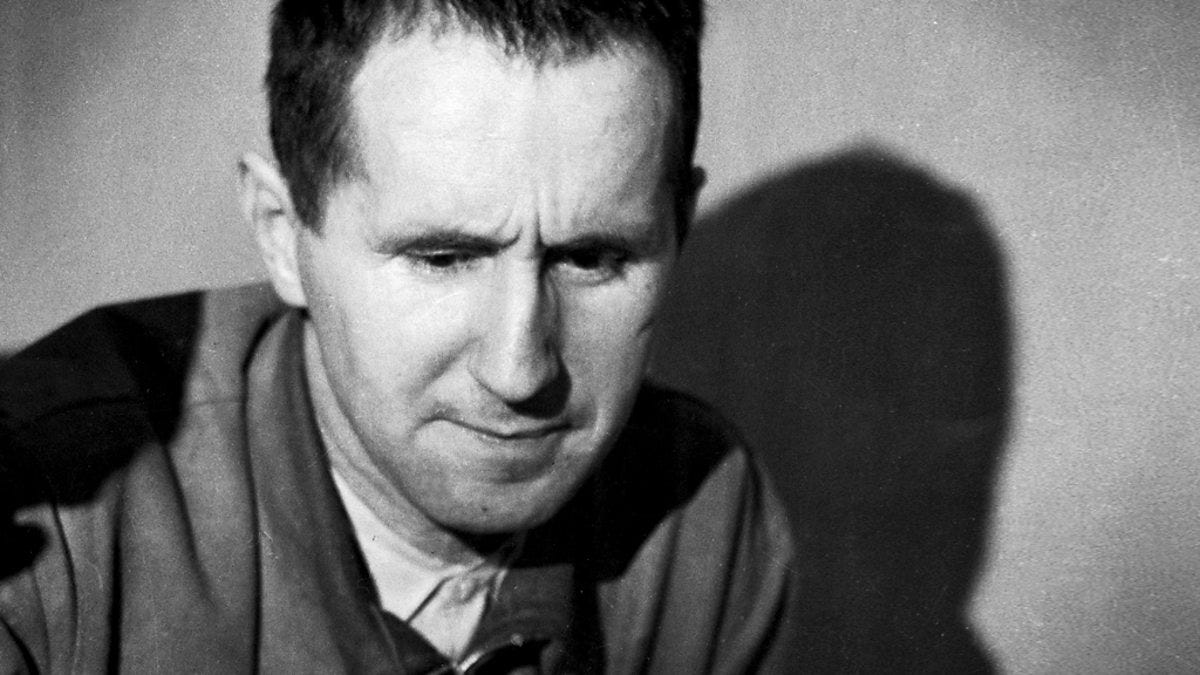
The strongest criticism we see of Wayne, from both those who know of his alter ego and those who do not, is that he neglects his public duties as a philanthropist. Even Bella Reál, Gotham’s disruptive, progressive young mayoral candidate, whom we first see attacking the ineffective (and, it will turn out, completely corrupt) Wayne-bequeathed Gotham Renewal fund from the television debate stage, is desperate for a meeting with Bruce Wayne, though apparently has nothing stronger to say to him when she gets it than some gentle chiding about his failure to sufficiently honour his father’s civic legacy. The fundamental suspension of disbelief required for the enjoyment of any Batman tale is not the comparatively trivial acceptance that a wealthy playboy (or, in Reeves’s rendering, recluse) moonlights as a vigilante in cape and cowl — that is priced in to the cost of admission. Rather it is the wilful denial of the fact that it would be impossible to build a fortune on the scale of the Waynes’, in a city as grotesquely unequal and as endemically corrupt as Gotham, in a society as rooted in slavery, genocide, colonialism, dispossession and exploitation as the United States, without committing crimes, both historical and ongoing, that would make the mayhem wreaked by Joker or The Riddler et al appear trivial by comparison. In The Threepenny Opera (1922), Bertolt Brecht provocatively asks, ‘What is the robbing of a bank compared to the founding of a bank?’, and this question haunts all depictions of Batman. The achievement of Reeves’s The Batman is that it might be the first Batman film to raise Brecht’s question; the film’s failure is the cowardice with which it attempts to deflect it.
The Riddler’s series of gruesome and increasingly byzantine murders eventually leads Batman to the door of his own Wayne Tower (emblazoned, Trump-style, with his name) when the dark side of his father, Thomas Wayne, the martyred icon of Gotham's patriciate, is publicly exposed. The image of Wayne Snr that emerges at The Batman’s midpoint is, fittingly for the current moment, that of an oligarch: a billionaire leveraging his exorbitant personal wealth to enter the world of politics, and his connections to the criminal underworld to permanently silence critics who might impede his rise, namely an independent-minded journalist with a scoop on long-buried Wayne family secrets.
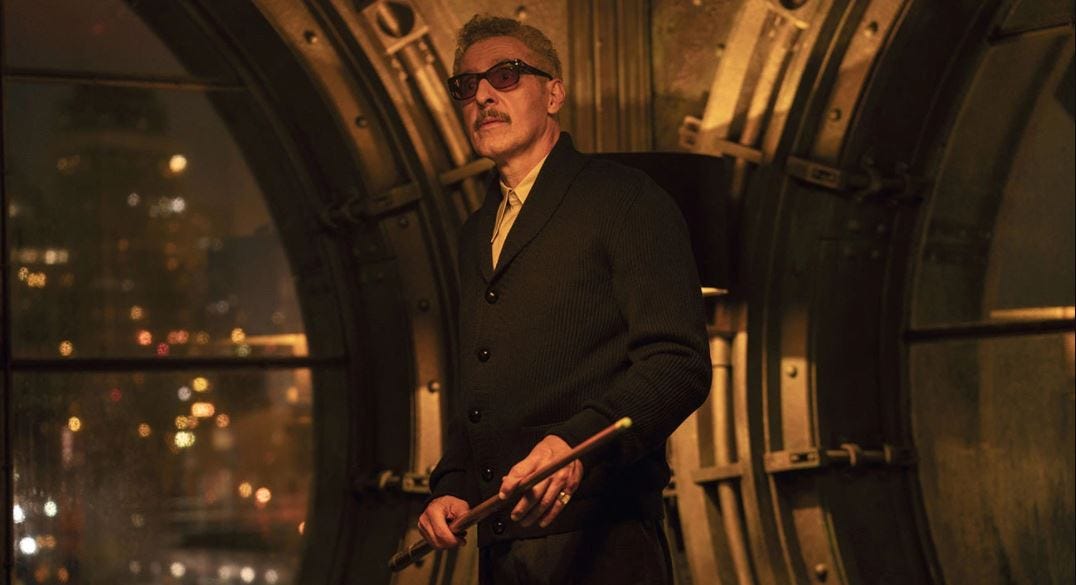
In a pivotal scene, John Turturro's mob boss Carmine Falcone outlines the transaction he brokered with Thomas Wayne, while we see the implications of Falcone's revelations play out across Pattinson's haunted face. More than any of its brilliantly choreographed action set pieces or fight sequences, this is the film’s most thrilling moment, because it invests the obligatory exchange in which the villain confronts the hero with their inherent kinship ('We're not so different, you and I', etc.) with the radical, ruptural potentiality of Brecht’s question. The scene transcends cliché by confronting Bruce Wayne and the audience with the possibility that it is not just what Wayne does with his inherited wealth that is morally questionable, but the wealth itself — even, perhaps, the very idea of inherited wealth. What The Riddler threatens to unravel isn't just the nexus of corrupt cops, crooks and politicians who really run Gotham, but the social logic that justifies any unaccountable individual having unchecked power over others' lives, whether that power takes the form of a plutocrat's largesse (the Gotham Renewal fund) or of his son’s nocturnal vigilantism (the Batman).
That the film must eventually retreat from this ideological precipice should not surprise or disappoint us excessively. Just as in Joker it is established that Thomas Wayne isn't actually the cruel philanderer of Penny Fleck's delusions, so too in The Batman Bruce Wayne must be emphatically reassured by the family's steadfast butler and confidant, Alfred Pennyworth, that his father was an honourable man whose only mistakes were a too zealous effort to protect his family and a naïve underestimation of Carmine Falcone. What is truly disappointing is that this reverse happens not eventually but instantly: the scene with Pennyworth immediately follows the scene with Falcone. This is the true index of the film’s cowardice and failure: that in a film as long as The Batman (nearly three hours), Reeves can't allow the audience to contemplate the political and ethical implications of The Riddler and Falcone's revelations about Thomas Wayne for more than a few moments before restoring the manichean moral status quo ante by establishing those revelations as self-serving smears. By placing the scenes so close together, the film nips in the bud any radical critique of social power relations it threatened to develop.
(It’s worth noting in passing that there remain some pretty serious unanswered questions about the connections between Falcone and Wayne Snr, and that the viewer would be forgiven for finding Falcone’s version of events more convincing than Pennyworth’s, but predictably the film doesn’t press this line of enquiry any further.)
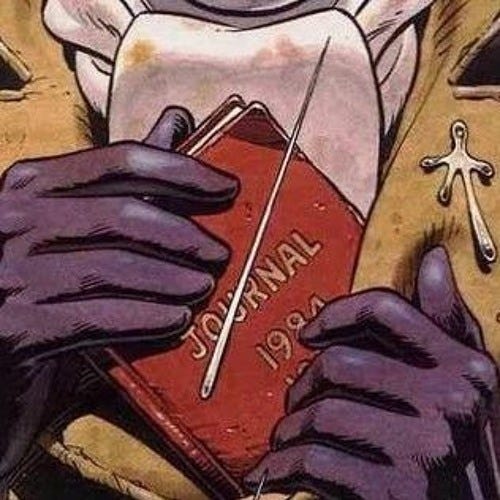
In place of any meaningful reckoning with the ethico-political problem of Batman, in its climactic sequence the film gives us Batman as a humanitarian and Bruce Wayne implicitly resolved to better discharge his plutocratic duties as a philanthropist. (It was the mismanagement of the Gotham Renewal fund that led to corruption, not, of course, the fund itself.) In an opening monologue that could have been lifted directly from the pages of Walter Kovacs’s journal, delivered over a montage demonstrating the panopticon effect of the Batsignal on the city’s criminals and malcontents, Batman extols the disciplinary virtues of fear and identifies himself as rather than in Gotham’s shadows. In his closing monologue, he waxes Obaman about how Gotham’s citizens need hope as well as (not, significantly, instead of) fear, as he acts as the literal beacon of that hope, leading survivors from the wreckage of The Riddler’s apocalyptic coup de grâce by flare-light. This, then, is The Batman’s solution to the Batman problem.
In its most succinct, but simplistic expression, the Batman problem is that, far from a hero, even a morally ambiguous and complex one, Bruce Wayne is essentially a billionaire fascist. Batman satisfies the same libidinal urge that empowers all authoritarian figures, the desire for a man (inevitably a man) who refuses to defer to the effete and hypocritical pieties of a decadent liberal order too emasculated even to honestly name its social ills, let alone cure them. Rules are broken, results got. This might explain why some of the most powerful and inarguably the most influential Batman stories in the canon were produced by the deeply reactionary American comic book writer Frank Miller, Miller’s own self-deceiving self-identification as a libertarian notwithstanding. (In any class society, libertarianism is always the obverse rather than the opposite of authoritarianism.) But, as the end of The Batman illustrates, Batman’s designation as a fascist doesn’t quite fit. So much recent liberal and left-wing wolf-crying about fascism, whether directed at Trump, Duterte, Putin or Batman, is designed to other rather than to analyse political formations and impulses it finds distasteful and threatening, formations and impulses which are symptomatic of rather than external to capitalism. It enables the political class and commentariat to proclaim sententiously ‘This is not who we are’, thus denying the discomfiting genealogical links and family resemblances between classical liberalism and historical fascism. Hitler, of course, modelled his thousand year Reich on the British Empire, and his antisemitic race laws on Jim Crow.
This, perhaps, is the real Batman problem: that he represents not fascism but rather the excess of violence that can neither be fully eradicated from nor assimilated into capitalist society, because it is the necessary condition of its possibility. Bruce Wayne’s sin in The Batman is not what he does qua Batman, but what he fails to do qua Bruce Wayne. Contemporary capitalism requires not the vulgar strongman who can’t help saying the quiet parts out loud, but the enlightened yet ruthless leader who knows to observe society’s rules in public and to break them behind closed doors. Just as Barack Obama was the urbane avatar of a progressive, post-racial America who simultaneously expanded the nation’s drone warfare and targeted assassination programmes in the developing world, so the new Bruce Wayne will play the role of the sophisticated and benevolent philanthropist among Gotham high society, while the Batman continues to mete out extralegal violence to the poor and dispossessed.
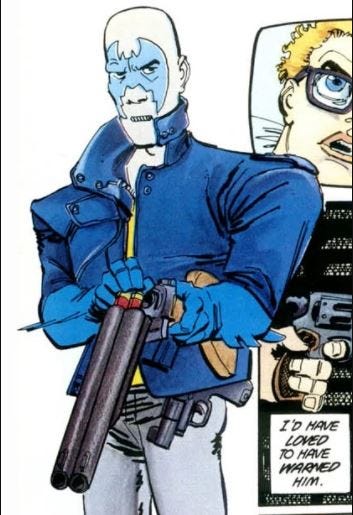
This elitist political logic can perhaps most clearly be seen not in how the Batman films depict their protagonist, but in how they depict the people of Gotham. It is revealing that we consistently see the crowd rally to Batman’s antagonists, whether that be the credulous revolutionaries who rush to Bane’s barricades in The Dark Knight Rises (2012); Joker’s clown-faced rioters disinhibited by Arthur Fleck’s acts of rage against an uncaring world; or the protestors brandishing The Riddler’s glyph outside Mayor Don Mitchell Jr’s memorial service in The Batman. It might seem implausible that Batman himself is never the object of such a popular cult, but in fact this is exactly what we should expect from the political logic of these films. The masses are imagined here either as impotent, downtrodden drudges to be saved, or as a seething, irrational rabble, liable at any moment to be swept up in destructive bouts of seditious hysteria, yet stubbornly, ignorantly hostile to the forces that really protect them — and that must, consequently, also discipline and control them. (It is to the credit of Frank Miller, a sincere and committed right-wing populist rather than a liberal elitist, that he saw clearly the galvanising popular appeal an authority figure like Batman would have when he created the Sons of Batman militia in The Dark Knight Returns (1986).)
If Gotham is to suppress and domesticate the inchoate ressentiment of the mob, it requires both Bruce Wayne, the socially responsible billionaire, and Batman, the nocturnal purveyor of ‘wild justice’. When Selina Kyle tries to convince Batman to leave Gotham with her in the film’s final scene, she insists that the city will never fundamentally change. She is probably right about that, of course; her mistake is thinking that Batman wants it to.
No posts
Comments
Nothing yet. Say the first thing.
Sign in to join the conversation.