
We launched Factory Settings, a newsletter focused on lessons learned from the CHIPS Program Office, which was tasked with deploying $39 billion in public money to reshore semiconductor manufacturing. Subscribe for weekly insights on industrial policy and state capacity from the original CHIPS leadership team: Mike Schmidt, Todd Fisher, and Sara Meyers.
We also relaunched the Macroscience newsletter, now helmed by Andrew Gerard. Read the launch essay from Andrew about his vision for a community metascience blog. And read the first piece in the new era from Tim Hwang about doing metascience in dangerous times.
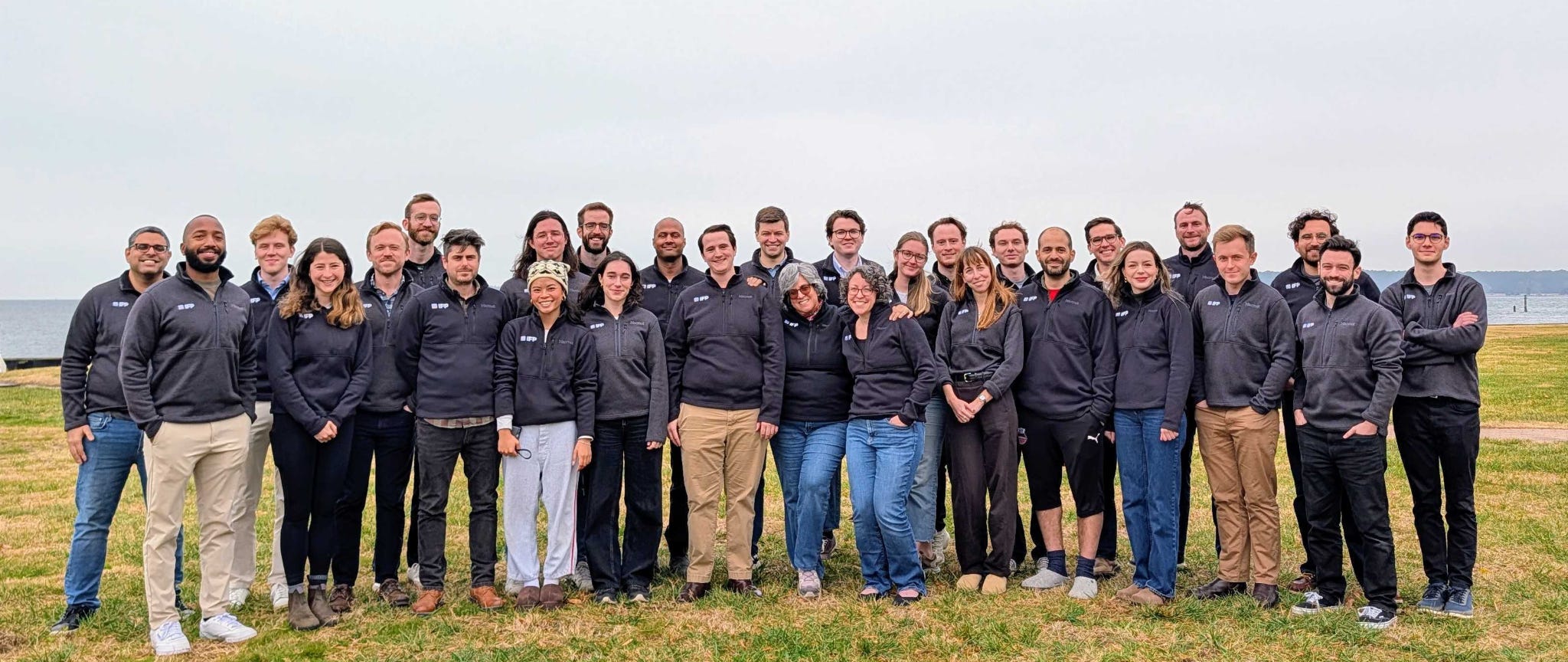
Connor O’Brien joined IFP as a Fellow on our High-Skilled Immigration team. Connor most recently worked on immigration and industrial policy at the Economic Innovation Group. And here’s the whole IFP squad at our recent team retreat on the Eastern Shore of Maryland!
IFP experts and research on AI chip export controls have been cited recently in The Financial Times, The Wall Street Journal, Foreign Policy, and The Information. Saif Khan and Georgia Adamson also went on CSIS’s AI Policy Podcast to discuss export controls on China.
IFP’s work on high-skilled immigration has been cited recently in Bloomberg Law, City Journal, and multiple Nature articles.
Andrew Gerard participated in a discussion published by Issues in Science and Technology on why taxpayers should care about scientific cooperation. You can read Andrew’s contribution here.
Lab-Directed R&D at the National Labs. Dan Turner-Evans and Charles Yang examine DOE’s Lab-Directed Research and Development model, which gives national labs flexible funding for high-risk, early-stage research. LDRD funded early CRISPR work that contributed to a Nobel Prize and now backs emerging technologies like AI-driven autonomous laboratories. The report argues this decentralized approach could be expanded to universities and other agencies.
Introducing Factory Settings. The inaugural CHIPS leadership team explains why they’re launching this project. The $39 billion program catalyzed a 20x increase in semiconductor construction spending and awarded $34 billion across 20 deals. They argue that successful government execution should be the norm, not the exception.
No (Process) Risk, No Reward. Mike Schmidt explores how CHIPS navigated process risk versus execution risk, abandoning the traditional “grant conclave” model for continuous engagement with applicants, while running an open process that created a “Hunger Games” dynamic, pushing companies to put their best offers forward.
Hiring: Damned If You Do, Damned If You Don’t. Sara Meyers explains how the CHIPS team hired staff in 67 days on average versus the 100+ day government norm, using special hiring authorities, strategic placement within NIST, and a centralized hiring tracker.
Industrial Policy: When Is Business the Government’s Business? Todd Fisher lays out a framework for when industrial policy is justified: when an industry is strategically critical, compromised by dangerous concentration, calcified in ways markets won’t self-correct, and correctable by bounded intervention. Leading-edge logic semiconductors, with >90% produced by TSMC in Taiwan, hit all four criteria.
We are grateful to the Recoding America Fund for providing the financial support to make this project possible.
How to Run New York City. Maria Torres-Springer, who spent 20 years in NYC government and most recently served as first deputy mayor, discusses the coalitions behind City of Yes, why NYCHA apartment turnovers take over a year, and how different mayors governed differently.
How Diplomacy Works in Africa. Judd Devermont, former NSC Senior Director for African Affairs, talks about the importance of senior-level engagement with foreign leaders, what went wrong with Niger in 2024, and how Ukraine and Gaza consumed Biden administration bandwidth.
Should the Feds Bail Out Chicago? David Schleicher of Yale Law School talks about America’s municipal pension crisis. Chicago now spends 40% of its budget on debt and pensions, with some funds only 18% funded. Schleicher explains the legal constraints on reform and what the feds should do when cities come asking for bailouts.
How to Save Science Funding. Pierre Azoulay (MIT) and Dan Gross (Duke) talk about their research on indirect cost recovery. Their study found that universities receive much less overhead than negotiated rates suggest, and institutions hit hardest by proposed cuts are those whose research most often leads to new drugs and breakthroughs.
Statecraft Gift Guide 2025. Santi’s annual recommendations for the policy wonk in your life, featuring books from Statecraft guests plus gift ideas from the IFP team.

Strap Rail. Brian explores strap rail, a forgotten 1840s technology that attached thin iron plates to wooden timbers instead of using solid iron rails. It cut costs dramatically but came with rapid decay and dangerous “snakeheads.” A case study in how local constraints shape technological development.
What Is a Production Process? Brian breaks down the fundamentals of manufacturing using light bulb production as a case study, from hand-blown bulbs at 150 per hour to the Corning ribbon machine producing 120,000 per hour by the 1980s.
How ASML Got EUV. Brian explains how EUV lithography was developed through decades of US research at DARPA, Bell Labs, and the National Labs, but ultimately commercialized by a single Dutch firm. A case study in the gap between R&D and commercialization success.
How a Government Think Tank Trained the First Generation of US Software Developers. Brian tells the story of the System Development Corporation, which by 1959 employed roughly half of the US programming workforce. With 20% annual attrition, SDC alumni seeded the entire field of electronic data processing.
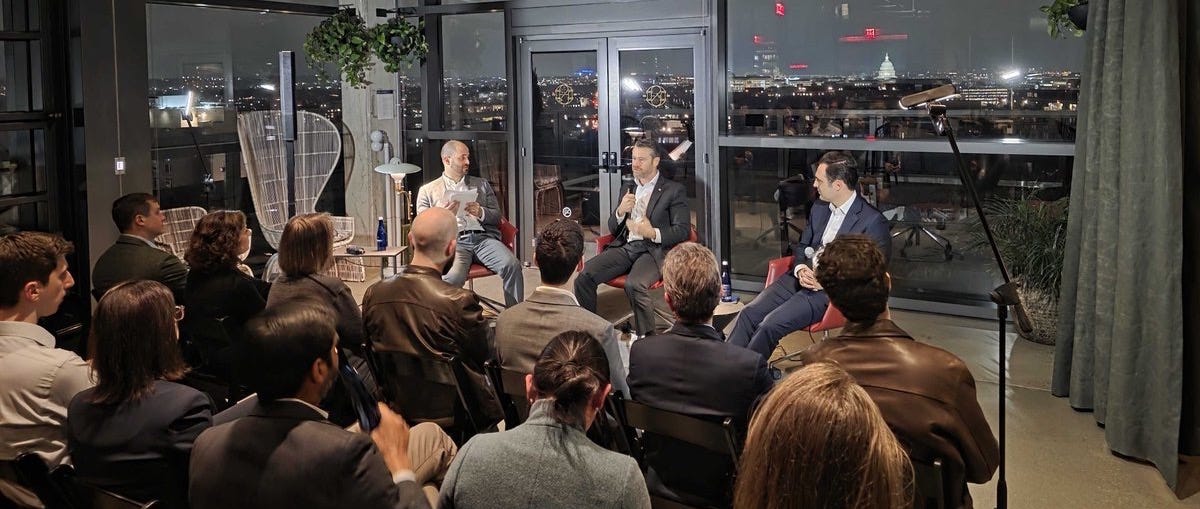
We hosted a launch party for Factory Settings, including a live interview with Senator Todd Young and Mike Schmidt.
Tim Fist spoke on a panel at Progress Conference on “AI in the Machinery of Government. You can watch the video here.
We published The Launch Sequence — our collection of ambitious ideas in AI-for-science and AI-for-security — in physical form and hosted a book party with many of the project contributors.
We also hosted another edition of our Moonshots happy hour series with our friends at the Foundation for American Innovation.
Comments
Nothing yet. Say the first thing.
Sign in to join the conversation.