
Hi, I’m Lily. I live in the world of distribution, where for years AI stayed behind the glass: forecasting, recommending, flagging, but never quite touching the work. The dashboard told you what to do, and a person still had to go do it. That gap is closing fast. AI is reaching past the screen and picking up the actual tools: the welding torch, the trailer loader, the gripper on the pick face. The jobs that resisted automation because they are physical and unpredictable are the ones changing now. So let’s dive in.

Tate, a 120-year-old maker of data-center infrastructure, handed the welding torch to 58 AI-guided cobots and watched per-welder throughput climb twelvefold. No structural component leaves its plants hand-welded anymore. When a century-old manufacturer lets AI run its hardest manual craft, the tools have officially changed hands.

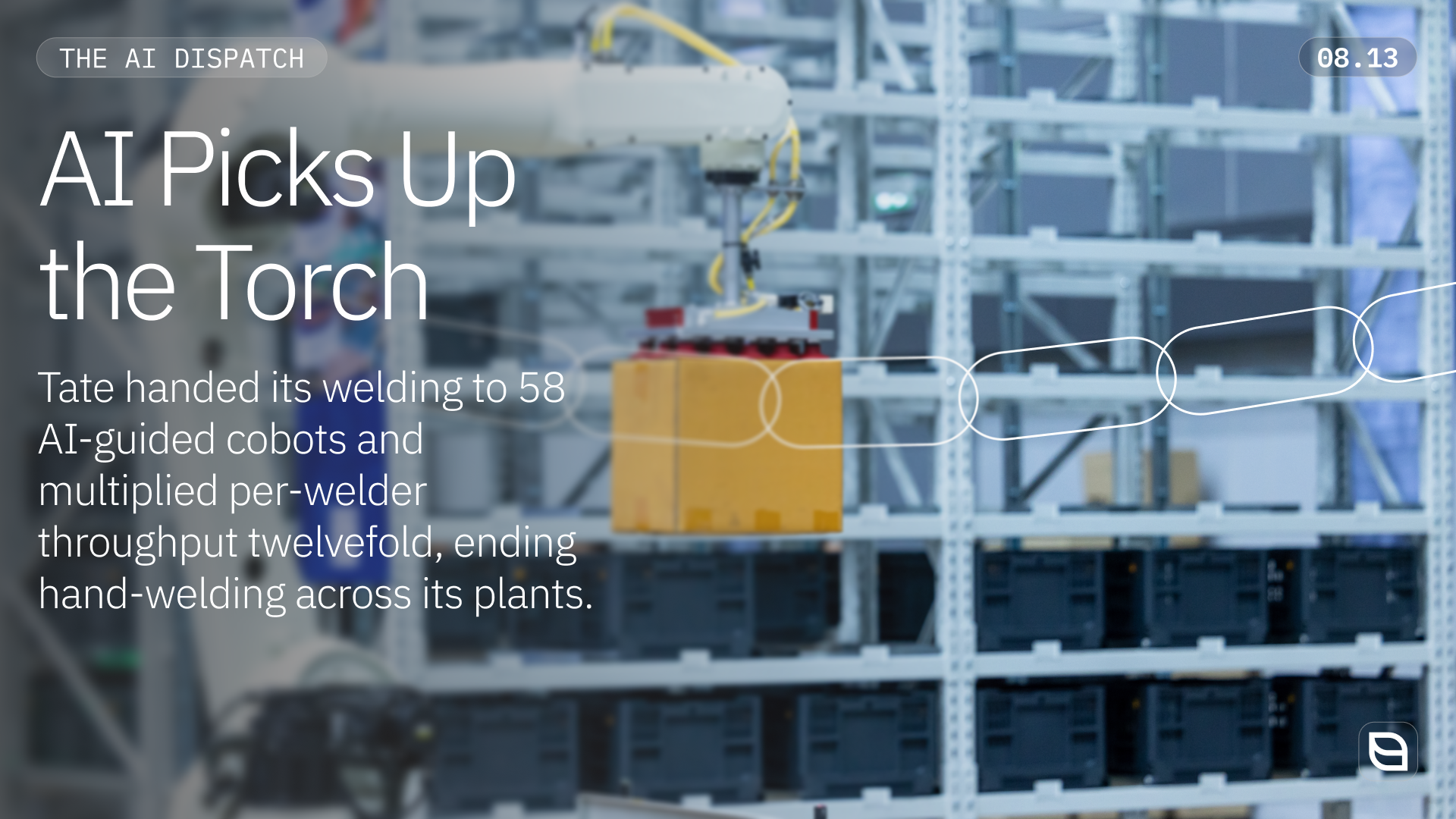
Parcel’s two biggest names moved on robotic arms the same week, and both bets are physical. FedEx installed Dexterity’s dual-armed Mech systems at its Hagerstown, Maryland hub, guided by a Foresight AI model that decides how to stack a shifting mix of boxes, and aims to reach thousands of dock doors across more than 20 U.S. hubs. Amazon plans to more than double its fleet of Cardinal and Sparrow picking arms in 2026, atop the million-plus robots it has run since 2012. For a mid-market operator, scale is beside the point: dexterous, AI-run handling has gone from demo to catalog item, and the vendors selling it will be at your door next. Read more here
Tate spent decades making structural ceilings and now builds data-center infrastructure, work that lives or dies on weld quality. Facing a shortage of certified welders, the company put 58 Hirebotics cobot welders on its lines across Arkansas, Virginia, and Kentucky, programmed from a tablet through a cloud platform. Per-welder throughput on critical assemblies rose twelvefold, and the welder-to-welder inconsistency that drove costly rework went away. Those numbers come from the vendor, so read the multiple as directional. Even discounted, the shift is real: hand-welding is no longer how Tate builds anything. Read more here
The Distribution Strategy Group’s Atlanta AI Forum put hard numbers behind where distributors are getting returns, and much of it is physical. Autonomous picking systems are posting efficiency gains above 75%, while machine-learning demand planning is trimming inventory more than 10% and lifting turns 40%. Even the desk work is moving over, with accounts-receivable automation cutting manual effort more than 75% and shortening payment cycles 20 to 35%. No single distributor is named, so treat this as directional field data, not one company’s proof. The pattern holds anyway: distributors are handing AI the tools, not just the spreadsheets. Read more here

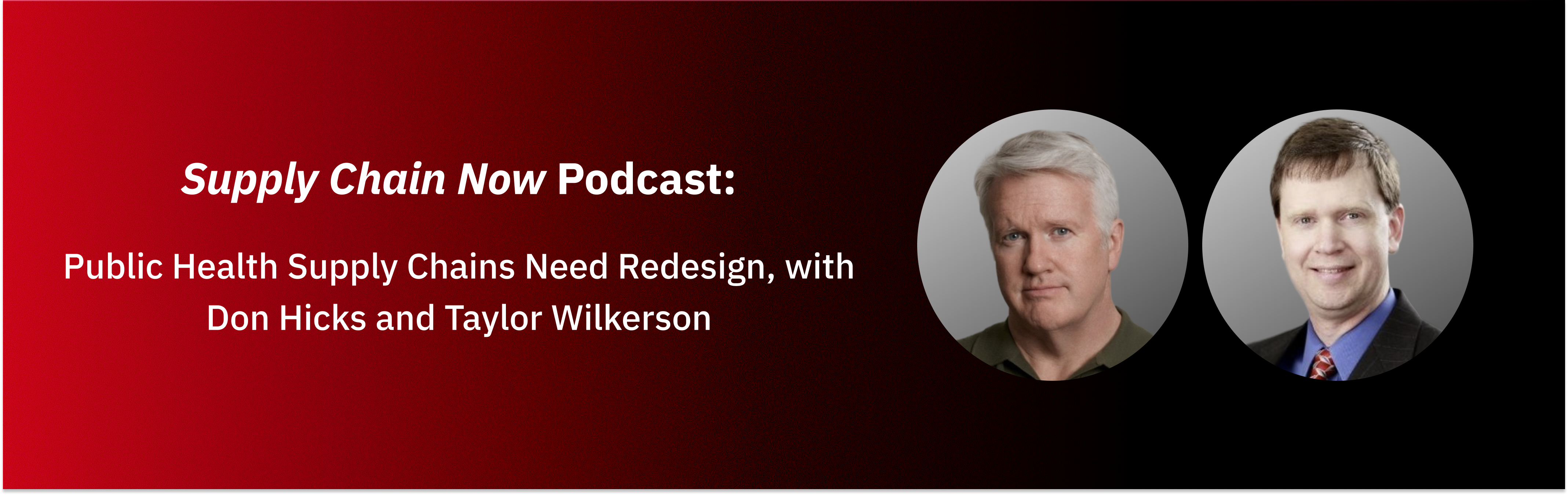
In this episode of Supply Chain Now, Don Hicks, CEO of Optilogic, and Taylor Wilkerson, Executive Director of Design for Life, argue that fixing public health supply chains takes redesign, not bigger band-aids. It earns your time even if you never ship a vaccine: the network-design thinking travels to any thin-margin operation. Listen for how AI lets local teams model scenarios in plain language, why one stockout compounds downstream, and why resilient design starts before the crisis. Listen here

Set the week’s stories side by side and the same motion runs through all of them. A welding torch in Arkansas, a trailer in Maryland, a picking arm in an Amazon aisle, a distributor’s order queue; the thing changing hands is the tool itself, not the advice about how to use it. For a decade AI sat one layer removed from the physical job, and that layer is where its limits lived. Grasping an unfamiliar box, laying a clean weld, stacking a trailer that never packs the same way twice, this was supposed to be the part machines couldn’t do. Over the next year, the operators who pull ahead won’t be the ones with the smartest dashboards. They’ll be the ones who worked out which tool to set down first. AI spent ten years telling us how to work. Now, it is reaching for the tools.

Real industry knowledge can’t be faked or outsourced. At We are very excited to welcome as our new Head of Distribution, he’ll help us focus on the problems that matter most to distributors, manufacturers, and other operationally intensive industries, and keep us close to operators as we scale.
Until next week—keep your systems learning!
— Lily @ InstaLILY AI
Thank you for reading! Have feedback? Email me, Lily, directly. I read every email.

No posts
Comments
Nothing yet. Say the first thing.
Sign in to join the conversation.