
IN Brief
Insulation packaging waste pulled into dedicated take-back and recycling loop.
Jobsite LLDPE film consolidated at installer depot for Trex feedstock.
Pilot hints at future EPR-style packaging obligations for construction supply chains.
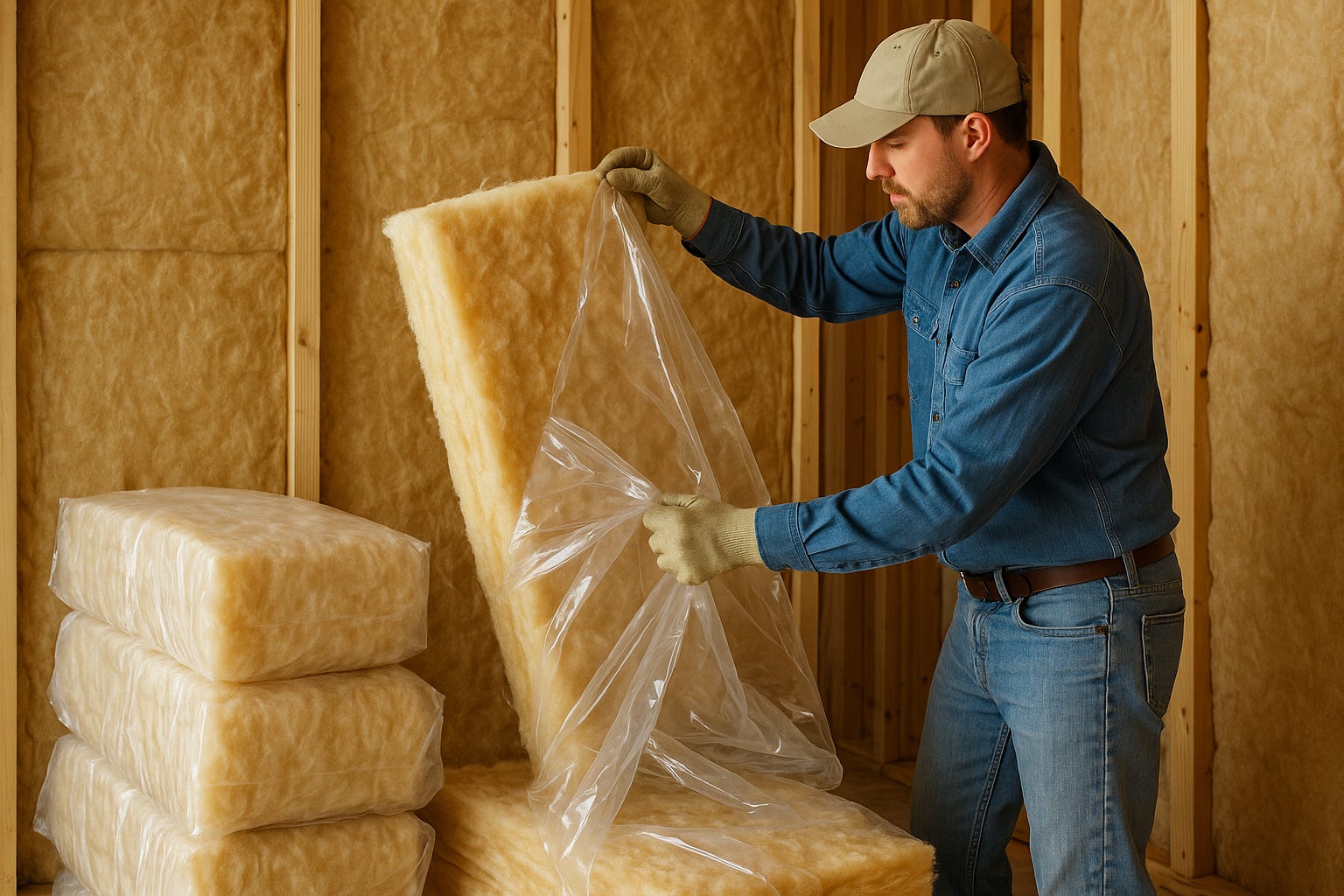
Insulation packaging is finally getting its own recycling pilot. A new scheme in Georgia will see plastic film wrap from fiberglass insulation collected on site, returned to a central depot, and turned into composite decking, in a small but telling example of how US construction supply chains are starting to tackle awkward plastics.
The “Plastic Take Back Program,” led by the North American Insulation Manufacturers Association (NAIMA) and installer Installed Building Products (IBP), focuses on Linear Low-Density Polyethylene (LLDPE) film — the flexible plastic used to encase fiberglass batts for transport and handling. On most projects that packaging is stripped off, thrown into mixed skips, and ultimately landfilled, because municipal recycling systems are not set up to handle thin film that snarls up material recovery facility equipment.
Under the pilot, IBP crews working in the Atlanta area will bring used insulation film back to the company’s warehouse in Duluth, Georgia. There, the plastic is baled and sent on to manufacturers such as Trex, which uses reclaimed plastic film as a feedstock for composite decking. NAIMA’s major members — CertainTeed, Knauf, Johns Manville, Owens Corning, and Rockwool — all serve the metro region and are expected to contribute packaging to the scheme.
For an industry where fiberglass and mineral wool account for the bulk of residential insulation, the underlying waste stream is not trivial. Every pallet of factory-wrapped batts arriving on site represents another batch of LLDPE that, without some form of segregation and backhaul, will disappear into general construction and demolition waste. NAIMA is attempting to show that a simple logistics change at installer level is enough to keep that material clean, separated, and commercially useful.
The association is also keen to position the move as a natural extension of insulation’s role in energy-efficient housing. “At its core, the home insulation industry is about sustainability,” said Abbey Patterson, Director of Sustainability for NAIMA. “Our products not only help homeowners save money on their energy bills but also reduce pollution and have a lighter impact on the environment. It’s only natural for us to also want to focus on making every aspect of the industry environmentally friendly.”
There is, however, a harder-edged policy backdrop. Across the US, states are steadily advancing extended producer responsibility models for packaging, pushing more of the cost and accountability for waste back onto manufacturers and brand owners. NAIMA’s own language acknowledges that reality, describing the pilot as a proof point for “strategic industry partnerships” at a time when lawmakers are actively looking to cut single-use packaging to landfill.
Still, the Georgia experiment does two useful things. First, it tests whether installers can realistically separate a specific plastic stream on busy jobsites without disrupting their programmes. Second, it uses existing distribution and warehouse infrastructure as the backbone for take-back, rather than relying on municipal systems that were never designed for this type of material.
What it does not do, at least yet, is touch the far larger volumes of mixed plastics, composites, and contaminated packaging leaving sites every day. As an industrial prototype for one well-defined waste stream it is sensible and overdue. As an answer to construction’s broader packaging problem, it is a reminder that the sector is still at the pilot-project stage while the regulatory clock keeps ticking.
No posts
Comments
Nothing yet. Say the first thing.
Sign in to join the conversation.