
Open USD matters because Visa, Mastercard, American Express, Stripe, BNY, BlackRock, Coinbase, Shopify and more than 140 other companies are not simply watching the stablecoin market from the sidelines. They are aligning around a model that could change who captures the economics of digital dollars.
The token itself is straightforward: a USD-pegged stablecoin called Open USD, operated by an independent company called Open Standard, with no minting or redemption fees for businesses, no artificial volume caps, collaborative governance, and a model designed to return most reserve-generated revenue to participating businesses after a management fee.
That design directly attacks one of the most important but least discussed features of the stablecoin market: reserve income. Circle and Tether both earn substantial economics from the cash and short-duration government assets backing their tokens. Circle already shares a large portion of those economics with Coinbase and other distributors, but via bilateral deals and a retained “issuer” take. Tether largely keeps the economics in-house. Open USD proposes to invert that model and make shared economics part of the product itself.
That is why Open USD threatens Circle more directly than Tether. USDC’s value proposition to regulated institutions, PSPs, fintechs, merchants and wallets overlaps almost exactly with the Open Standard coalition. USDT, by contrast, remains dominant in offshore trading, crypto-native liquidity and many emerging-market dollarisation corridors, where distribution economics alone may not be enough to unseat entrenchment.
Open USD is also not arriving in a vacuum. Paxos and Global Dollar Network have already shown that “shared reserve economics” can attract partners, and USDG has scaled to roughly $2.9 billion in circulation with official claims of returning up to 100% of reserve-based returns to network partners based on minting, custody and acceptance activity. Open USD looks like a broader, more ambitious version of that pattern, with a far larger launch coalition across cards, banking, commerce and crypto.
Several core facts remain undisclosed. Open Standard has not yet publicly named the legal issuer, reserve manager, custodian stack, board structure, chain launch sequence, or the exact formula by which reserve earnings will be allocated. Those unknowns matter. In stablecoins, the legal entity, reserve topology and redemption mechanics often matter more than the marketing concept.
Open USD is best understood as a consortium-governed settlement asset plus a reserve-income sharing network, not merely a new stablecoin ticker.
The core innovation is economic: turning reserve income into a distribution incentive for the firms that create demand, acceptance and liquidity.
This model is strategically most disruptive to Circle, because Circle’s business already depends on negotiated reserve-income sharing with distributors, most notably Coinbase.
Tether remains more insulated in the near term because its moat is offshore liquidity, exchange integration and emerging-market dollar utility, not just enterprise distribution.
Open USD’s upside is real, but so are the red flags: incomplete disclosure, governance complexity, regulatory scrutiny around partner revenue sharing, and the possibility that a logo-heavy coalition does not automatically translate into live minting, redemption, liquidity or transactional volume.
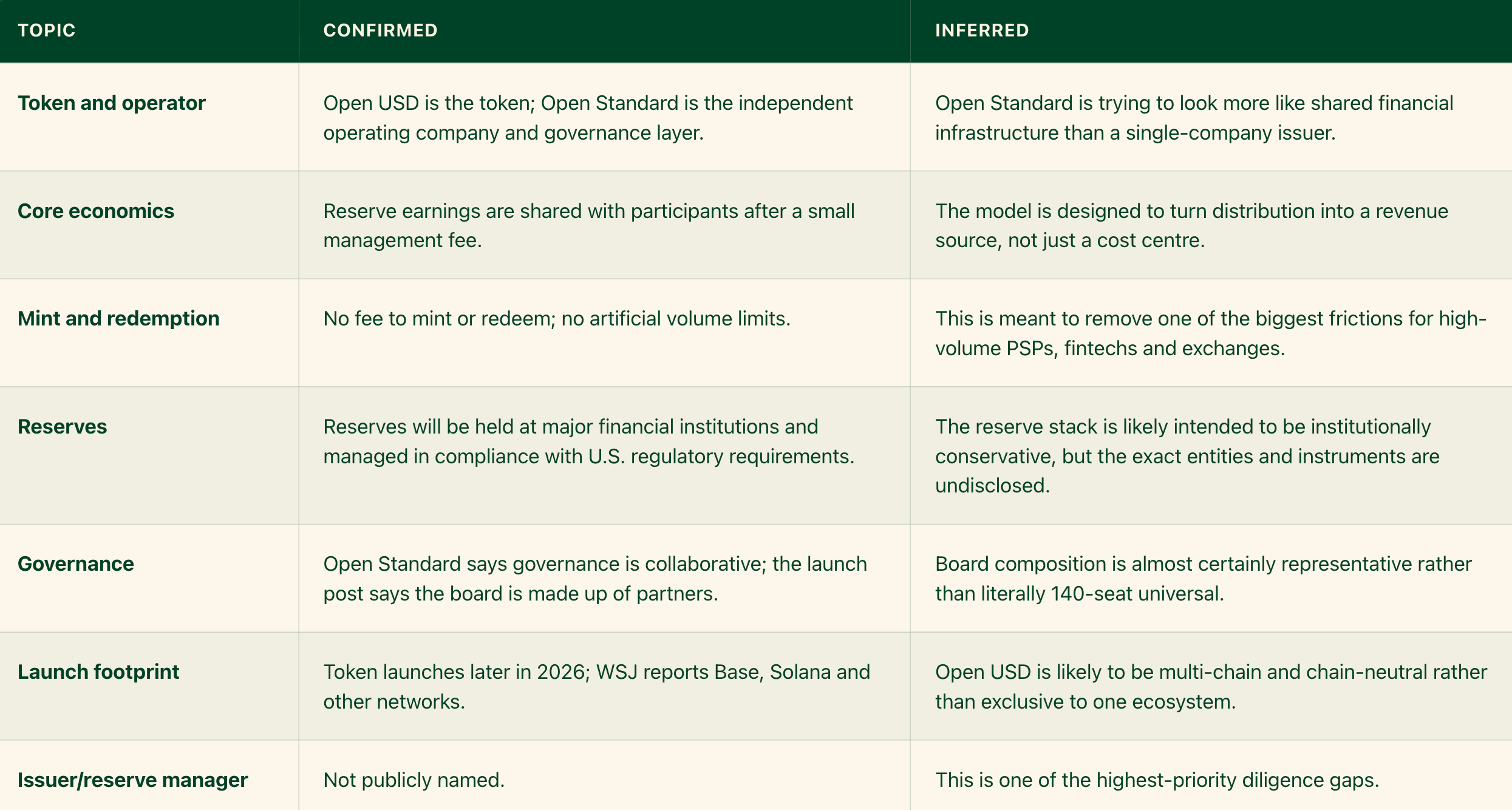
Open USD is the token. Open Standard is the operating and governance layer around it. The official website describes Open USD as “a shared stablecoin for global financial activity” and says Open Standard is an independent company with an ownership and corporate-governance structure designed so decisions are made “in the collective interest.” The launch post adds that Open Standard will operate Open USD with a board made up of partners, while the FAQ says governance will be collaborative and handled by Open Standard’s own management team. Taken together, the confirmed picture is that Open USD is simultaneously a stablecoin, a consortium-style operating model, and a distribution alliance.

Patrick Collison@patrickc
Delighted to partner with Visa, Mastercard, Coinbase, Cloudflare, Google, and many others, to introduce Open Standard, a new stablecoin designed for scale: joinopenstandard.com.
joinopenstandard.com
Open USD (OUSD) Stablecoin | Open Standard

1:19 PM · Jun 30, 2026 · 407K Views
153 Replies · 235 Reposts · 2.47K Likes
The line between what is confirmed and what is still opaque is unusually important here. Confirmed: businesses will be able to mint and redeem Open USD with no fees and without artificial volume limits; the model is designed to return most reserve-generated revenue to participants after a management fee; reserves are expected to be maintained at major financial institutions in compliance with U.S. regulatory requirements; and the token is scheduled to launch later in 2026. Not confirmed: the legal issuer, the reserve manager, the lead custodian, the precise governance mechanics, the detailed economics formula, and the chain-by-chain rollout.
There is also a subtle but revealing inconsistency in the public materials. The announcement says partners receive “all of the earnings” from reserves less a small management fee, while the FAQ says Open USD is designed to return “most revenue” generated from reserves after that fee. The direction is clear, but the precise waterfall is not. That ambiguity matters because a stablecoin’s economics can differ significantly depending on whether “all” means literally all net reserve income, or “most” means a large but discretionary share after additional issuer, custody, insurance or compliance costs.
In strategic terms, Open USD sits at the intersection of six functions. It is a payment stablecoin, a network for distributors, a governance framework, a reserve-income redistribution mechanism, a candidate enterprise settlement asset, and a coordination layer across payment and crypto infrastructure. That complexity is a feature, not a bug: Open Standard is explicitly trying to solve not only settlement speed, but also the political economy of stablecoin adoption.

Rob Hadick >|<@HadickM
I believe that the correct takeaway from OUSD is actually quite nuanced, both specifically to what it means for Circle / Tether / Paxos and more broadly about what it means for adoption and the likelihood of being successful (warning, very long post). First, on CRCL, I wonder if
11:48 AM · Jul 1, 2026 · 46K Views
30 Replies · 25 Reposts · 258 Likes
A useful historical lens is USDC’s original architecture. USDC launched in 2018 under the Centre Consortium, which Coinbase described at the time as an open consortium and governance framework for the mainstream adoption of fiat-backed stablecoins. In 2023, Circle and Coinbase dissolved Centre and brought governance and operations in-house at Circle. Open USD, in effect, revives the consortium concept, but with a much stronger economic proposition to partners than the old Centre model ever publicly offered.
A useful way to understand Open USD is not as a first attempt, but as a second attempt at a very old idea in digital money: a neutral, consortium-governed settlement asset for platforms, wallets, merchants and financial institutions. Libra, later Diem, already pointed in this direction. Its core insight was that a global payment asset becomes more powerful when it is not simply the product of one issuer, but the shared infrastructure layer beneath many competing user-facing businesses. Libra failed before that thesis could be tested at scale, largely because the regulatory and political environment was not ready for a Facebook-led money network.

Christian Catalini@ccatalini
1/ Today, more than 140 companies, most of which compete fiercely with one another, agreed to back the same stablecoin. The vehicle is @openstandard, a new and deliberately independent company launching Open USD, or OUSD, and positioning it not as anyone’s product but as neutral

3:55 PM · Jun 30, 2026 · 84.2K Views
33 Replies · 52 Reposts · 288 Likes
Open Standard revives a similar coordination thesis, but in a very different context: stablecoins are now institutionally familiar, U.S. payment stablecoin legislation has been enacted but is still moving through implementation, and the coalition is framed less around one dominant technology platform and more around a broad set of financial, payment, commerce and crypto participants.
This is also why Open USD should be read as a response to Circle’s strategic direction, not merely to USDC’s circulation. Circle is increasingly becoming a full-stack financial infrastructure company, with USDC, Circle Mint, Circle Payments Network, CCTP, Gateway and Arc all sitting around the same regulated dollar asset. That strategy is rational for Circle, but it creates a platform question for everyone else: if the issuer controls the asset, the network, the APIs and the conversion layer, participants may eventually become customers inside someone else’s margin stack.
Open Standard’s counter-positioning is therefore not simply “another stablecoin.” It is a governance and economics argument: the digital-dollar layer should be neutral enough for competitors to build on, and the economics should accrue to the companies that create adoption, balances and transactional demand.
The hard part begins after the announcement. A broad coalition can validate the market need, but it does not automatically create liquidity, redemption depth, governance discipline or regulatory durability. If Open USD is successful, it may start looking less like a conventional crypto issuer and more like a financial market infrastructure. That raises the bar. The relevant benchmark is not only whether the token is fully backed, but whether the system can meet institutional expectations around governance, operational resilience, settlement finality, risk management, transparency and participant accountability. In that sense, the Principles for Financial Market Infrastructures are a useful lens for evaluating Open Standard’s long-term credibility.
The deepest execution risk is that Open Standard has to coordinate companies that need to collaborate at the infrastructure layer while competing aggressively at the customer layer. This is the classic “frenemy network” problem.
Visa’s early history under Dee Hock is a useful analogy: a shared payment network only works when governance is strong enough to prevent capture, but flexible enough to let participants innovate and compete.
Open USD’s launch coalition suggests that the market wants a more open stablecoin standard. Whether it becomes one will depend on whether Open Standard can turn logo alignment into rules, liquidity, operational trust and durable institutional governance.
The partner list is the headline: more than 140 businesses, that does not mean all of these names have committed live volume. Public evidence points to a wide range of commitment levels. Stripe is the strongest signal: its president of technology and business said Open USD will be “the default stablecoin for businesses running on Stripe.” BNY was more cautious, saying it looked forward to “exploring ways” to support Open USD. Félix called the approach “interesting to us.” Shopify framed participation as compelling because it allows merchants to help shape the rules. This is better understood as a coalition of aligned interests than as 140 production launches on day one.
The most important reason these companies would join is not simply faster settlement. It is participation in the economics of float. Stablecoins backed by cash, Treasury bills, repo or money-market instruments produce reserve income. In a low-rate world that income is modest. In a 3% to 5% world, it becomes material. Open USD’s insight is that whoever controls distribution, checkout, treasury, payout, wallet placement and exchange liquidity should want a share of that income, because those firms are the ones creating the balances and flows in the first place.
Card networks and payment processors can use Open USD to participate in stablecoin upside without shouldering the political and regulatory burden of issuing a coin themselves. Visa already supports USDC settlement for U.S. issuer and acquirer partners, and Mastercard joined Paxos’ Global Dollar Network in 2025 to enable USDG, USDC, PYUSD and FIUSD across its network. Open USD gives those firms a potentially neutral, consortium-owned alternative.
Banks and custodians can support client demand for tokenised dollars while avoiding the need to build a proprietary stablecoin everywhere. That appeal may be strongest for institutions that want exposure to the growing payment-stablecoin perimeter but prefer shared governance. It also explains why BNY and BlackRock are especially notable: both already sit deep inside the USDC reserve stack, yet both joined Open Standard. In other words, the suppliers of trust inside the incumbent model are also willing to back the challenger model.
Consumer fintechs, neobanks and platforms can use Open USD for merchant settlement, treasury sweeps, payouts and cross-border disbursements, and, crucially, can monetise the balances they help accumulate. Chime, DoorDash and Shopify all described practical utility rather than speculative interest. That fits the thesis that Open USD is being positioned for embedded finance and commerce workflows, not only crypto exchange volume.
Crypto exchanges, wallets and onchain infrastructure providers can add Open USD as another liquid dollar rail, but with a more favourable economic relationship than a conventional issuer generally offers. Coinbase’s quote is telling: it signalled support for “the best options available – including Open USD and beyond,” which suggests Open USD could become one more institutional-grade dollar rail on top of, not instead of, USDC. Fireblocks’ statement similarly framed Open Standard as a move toward shared, regulated infrastructure rather than siloed buildouts.
Open USD brings together a broad set of participants across payments, banking, fintech, crypto infrastructure, market infrastructure and global money movement. The confirmed participant list is important, but the strength of commitment varies meaningfully across categories. In some cases, companies have made explicit public statements about potential use cases. In others, they are listed as ecosystem participants, which should be interpreted as strategic alignment or exploration rather than confirmed commercial deployment.
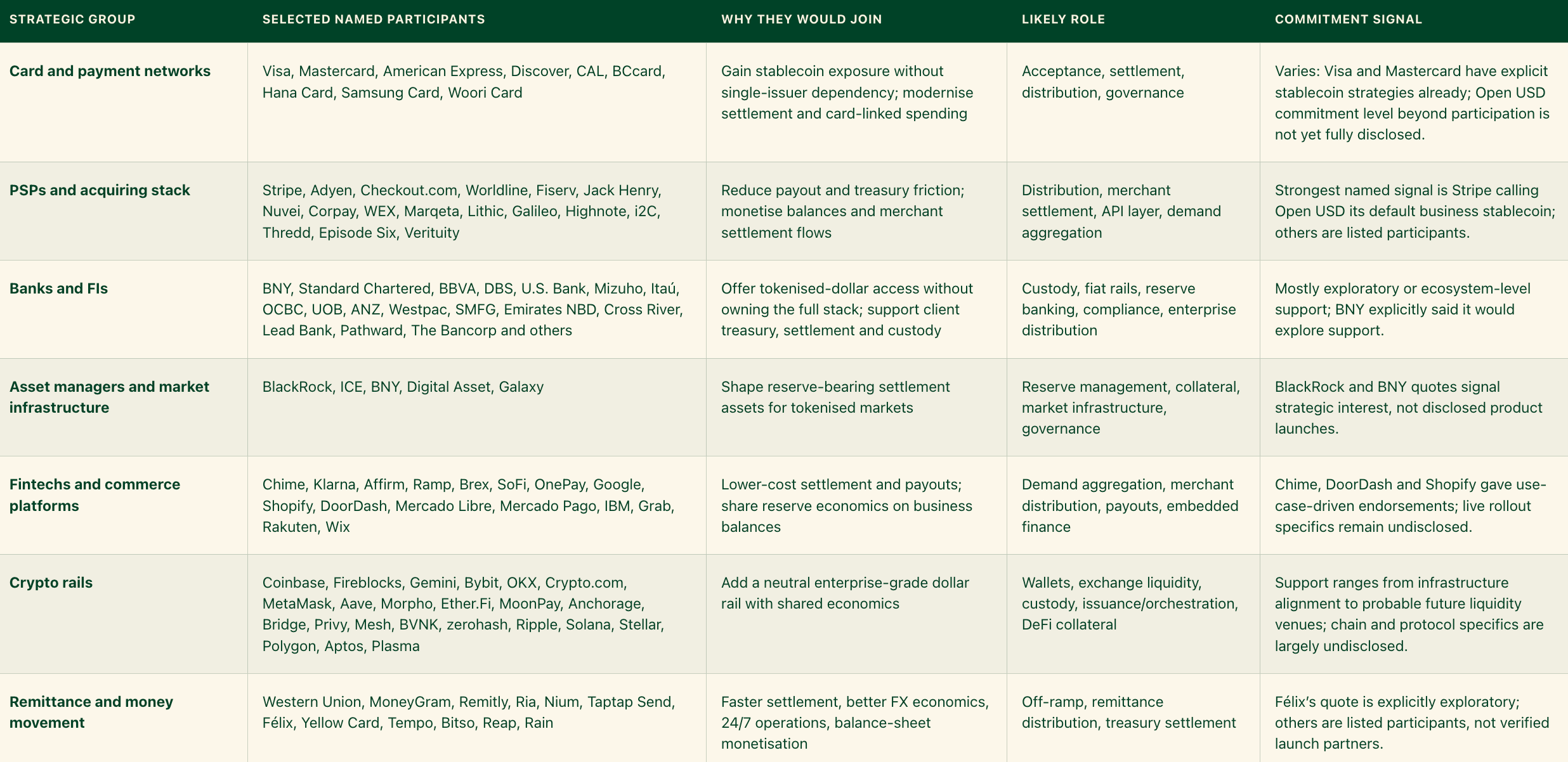
Card and payment networks include Visa, Mastercard, American Express, Discover, CAL, BCcard, Hana Card, Samsung Card and Woori Card. These companies would have a clear incentive to participate because Open USD gives them exposure to stablecoin based settlement and card linked spending without depending on a single issuer. Their likely role would sit around acceptance, settlement, distribution and governance. Visa and Mastercard already have explicit stablecoin strategies, while the depth of their Open USD commitment beyond participation has not yet been fully disclosed.
PSPs, acquirers and payment infrastructure providers include Stripe, Adyen, Checkout.com, Worldline, Fiserv, Jack Henry, Nuvei, Corpay, WEX, Marqeta, Lithic, Galileo, Highnote, i2C, Thredd, Episode Six and Verituity. For this group, the logic is mostly around reducing payout and treasury friction, monetising balances, and improving merchant settlement flows. Their likely role would be distribution, merchant settlement, API access and demand aggregation. The strongest named signal in this category is Stripe calling Open USD its default business stablecoin, while the others are listed participants.
Banks and financial institutions include BNY, Standard Chartered, BBVA, DBS, U.S. Bank, Mizuho, Itaú, OCBC, UOB, ANZ, Westpac, SMFG, Emirates NBD, Cross River, Lead Bank, Pathward, The Bancorp and others. Their incentive is to offer tokenised dollar access without having to own the full stablecoin stack themselves. They could support client treasury use cases, fiat rails, reserve banking, custody, compliance and enterprise distribution. Most of the signals here should be treated as exploratory or ecosystem level support, although BNY explicitly said it would explore support.
Asset managers and market infrastructure players include BlackRock, ICE, BNY, Digital Asset and Galaxy. This group is strategically relevant because Open USD could become part of the reserve bearing settlement layer for tokenised markets. Their potential role would be reserve management, collateral infrastructure, market infrastructure and governance. Public quotes from BlackRock and BNY suggest strategic interest, but they do not yet amount to disclosed product launches.
Fintechs and commerce platforms include Chime, Klarna, Affirm, Ramp, Brex, SoFi, OnePay, Google, Shopify, DoorDash, Mercado Libre, Mercado Pago, IBM, Grab, Rakuten and Wix. These companies would be interested in lower cost settlement, faster payouts and the ability to share in reserve economics on business balances. Their likely role is demand aggregation, merchant distribution, payouts and embedded finance. Chime, DoorDash and Shopify gave more use case driven endorsements, while the specifics of live rollout remain undisclosed.
Crypto rails and digital asset infrastructure participants include Coinbase, Fireblocks, Gemini, Bybit, OKX, Crypto.com, MetaMask, Aave, Morpho, Ether.Fi, MoonPay, Anchorage, Bridge, Privy, Mesh, BVNK, zerohash, Ripple, Solana, Stellar, Polygon, Aptos and Plasma. For this group, Open USD offers a neutral, enterprise grade dollar rail with shared economics. Their likely roles include wallet access, exchange liquidity, custody, issuance orchestration, DeFi collateral, onchain distribution and settlement infrastructure. The level of support likely ranges from infrastructure alignment to future liquidity venues, but chain specific and protocol specific deployment details are still largely undisclosed.
Remittance and money movement companies include Western Union, MoneyGram, Remitly, Ria, Nium, Taptap Send, Félix, Yellow Card, Tempo, Bitso, Reap and Rain. These companies would be drawn to Open USD because of faster settlement, better FX economics, 24/7 operations and potential balance sheet monetisation. Their likely role would be off ramp distribution, remittance flows, treasury settlement and regional liquidity. Félix has made an explicitly exploratory public statement, while the others are listed as participants rather than verified launch partners.
Overall, Open USD should be read less as a single company stablecoin launch and more as an attempt to coordinate a consortium style dollar rail across existing distribution points. The strongest near term signal is not simply the number of participant logos, but whether major PSPs, wallets, exchanges, banks and commerce platforms convert participation into live minting, redemption, settlement, liquidity and payout flows.
The conceptual economics are simple. A payment stablecoin typically holds reserves in cash, U.S. Treasury bills, repo and money-market instruments. Circle explicitly says its reserve return rate historically tracks close to prevailing SOFR, and USDC reserves currently include deposits, Treasury repo and sub-three-month Treasuries, including assets in the BlackRock-managed Circle Reserve Fund. Paxos says USDG and other Paxos-issued USD stablecoins are backed by U.S. dollar deposits, Treasuries and cash equivalents. Tether says its reserves are majority government-backed instruments and liquidity facilities, with around $141 billion of Treasury-bill exposure as of March 31, 2026.
Open Standard’s fee is not disclosed, so any unit economics model is illustrative. But the broad formula is clear:
Gross reserve income = stablecoin supply × reserve yield
Open Standard fee income = stablecoin supply × management fee
Partner economics pool = gross reserve income − management fee − any undisclosed operational deductions
The maths become compelling surprisingly quickly. At scale, even “small” basis-point changes matter.
The harder question is allocation. Open Standard has not published a formula, but there are only a handful of plausible mechanisms: pro rata by balances held on partner platforms; by mint/redemption activity; by payment and settlement volume; by acceptance activity at merchants; by regional or strategic contribution; by governance tier; or by negotiated commercial classes. GDN offers a clue. It says USDG economics are tied to minting, custody and acceptance activity, and some partners can receive up to 100% of returns generated by backing assets held on their platform. Circle’s own Coinbase arrangement is also instructive: economics are split by on-platform balances, issuer retention and a residual sharing pool. It would be surprising if Open USD did not use some hybrid of balances, direct distribution and acceptance metrics.
That, in turn, shapes use cases. If economics are balance-weighted, wallets, neobanks and exchanges become natural beneficiaries. If economics are acceptance-weighted, PSPs, card issuers and merchants gain more. If minting activity matters heavily, large treasury and off-ramp partners become central. Without the formula, investors should assume the network will be designed to reward the behaviours Open Standard most wants to scale, and that those behaviours may not be identical across participant classes.
On infrastructure, the public record remains partial. Open Standard has not formally named launch chains, but WSJ reported that Open USD will come to Base, Solana and other networks later this year. That report is plausible given the partner list, which includes Solana, Polygon, Stellar, Aptos Labs and Plasma, and because both Base and Solana are actively courting stablecoin and enterprise-payment issuers. Base is explicitly building for stablecoin payments and has introduced the B20 token standard with policy controls, freeze-and-seize, memos and supply caps for stablecoin issuers. Solana is marketed for institutional payments with sub-cent fees, around 400 millisecond block times and compliance-ready token extensions.
Since the initial announcement, Tempo CEO Matt Huang has said Open USD will be natively issued on Tempo from day one, with support for payments, liquidity, exchanges and DeFi. That is the strongest chain-specific signal so far. However, Open Standard has not yet clarified whether Tempo will be the exclusive native issuance venue at launch, nor has it published a definitive chain-by-chain rollout sequence.
Bridge is the most likely infrastructure influence, though not yet a formally disclosed operator. Zach Abrams is both Open Standard’s founding CEO and Bridge’s co-founder and CEO. Bridge explicitly sells orchestration and issuance APIs for stablecoins, including management of payment rails, smart contracts, reserves and banking integrations, as well as conversion between fiat and stablecoins. That does not prove Bridge is Open USD’s issuance stack, but it does make the inference natural.

At insights4vc, we pay attention to teams that are not just shipping products, but shaping categories.
Moto is one of them. The company is building a premium card experience positioned as an alternative to traditional incumbents such as Amex, combining a high-end user interface with more modern financial infrastructure.
Moto is currently expanding access to a limited testing group. If you would like to test the product please contact us at: office@insights4.vc

insights4vc@insights4vc
luxury starts with the product, but it never ends there Hermès sells patience. Greubel Forsey sells belonging to a very small room. Rexhep Rexhepi sells the kind of craft that becomes collector culture with a few exceptions, premium finance still mostly sells cards new
7:14 PM · Jul 1, 2026 · 3.71K Views
9 Reposts · 75 Likes

Sunrise
Claude Lorrain, 1646–47
insights4.vc and its newsletter provide research and information for educational purposes only and should not be taken as any form of professional advice. We do not advocate for any investment actions, including buying, selling, or holding digital assets.
The content reflects only the writer’s views and not financial advice. Please conduct your own due diligence before engaging with digital assets or related technologies, as they carry high risks and values can fluctuate significantly.
No posts
Comments
Nothing yet. Say the first thing.
Sign in to join the conversation.