

For decades, American electoral analysis has treated the “Latino vote” as a recognizable political constituency. The terminology is understandable. Latino voters share some experiences that distinguish them statistically from the electorate as a whole, and their rapid demographic growth has made their electoral behavior consequential. There were approximately 36 million Latino eligible voters by 2024, and Latino eligible voters are substantially younger than the electorate overall. However, the concept of a coherent Latino voting bloc has always obscured substantial internal differences involving national origin, generation, geography, socioeconomic status, education, religion, language, gender, and political identity. Those differences have become harder to ignore as Latino voting behavior has become more competitive.
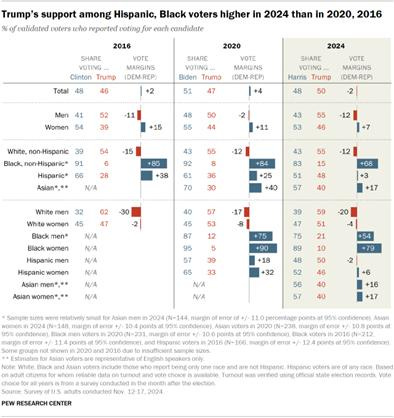
The 2024 presidential election appeared, at first, to provide straightforward evidence of a partisan realignment. Pew Research Center’s validated-voter analysis found that Donald Trump received 48% of the Hispanic vote, compared with 36% in 2020 and 28% in 2016. Kamala Harris received 51%, compared with Joe Biden’s 61% four years earlier. A constituency that had favored the Democratic presidential candidate by 25 percentage points in 2020 divided almost evenly four years later.
The temptation is to interpret this movement as evidence that Latinos are becoming Republicans. The available evidence supports a more complicated conclusion. The most useful analytical framework may not be realignment, in which Latino voters transfer their durable partisan allegiance from Democrats to Republicans, but dealignment, in which Latino ethnicity becomes less predictive of political behavior and a larger proportion of Latino voters become electorally contestable. Under this interpretation, Trump’s gains are real, but they do not necessarily imply the creation of a stable Republican Latino constituency. This distinction will be critical for understanding both the 2026 midterms and the 2028 presidential election.
The first analytical problem is the category itself. “Latino” aggregates populations whose political histories are profoundly different. Mexican Americans in Texas, Cuban Americans in South Florida, Puerto Ricans in Pennsylvania, Dominican Americans in New York, and Central American communities in Nevada do not share identical historical relationships with either American political party. Immigration generation introduces another source of variation, while geography places Latino voters within very different labor markets, media environments, political institutions, and partisan systems.
The composition of the Latino electorate changes more rapidly than that of older, more politically settled demographic constituencies. Equis estimated before the 2024 election that at least 30% of Latinos voting that year would not have voted in 2020, while fewer than 30% of Latinos registered in 2024 had participated in the 2008 election. An electorate experiencing that degree of generational replacement and new-voter entry should not be expected to maintain the partisan characteristics it exhibited twenty years earlier. This makes historical extrapolation particularly dangerous. Analysts who observed large Democratic margins among Latinos during the Obama era sometimes implicitly treated those margins as a demographic property of Latino voters. They may instead have reflected a particular configuration of candidates, issues, immigration politics, generational composition, turnout, and partisan identification.
The movement toward Trump was substantial enough that it cannot be dismissed as statistical noise. Equis’s post-election precinct analysis found movement toward Trump across geography, urbanicity, and national origin and concluded that the results looked sufficiently broad to justify describing them provisionally as a realignment. Its researchers also cautioned, however, against assuming that those gains would automatically transfer to other Republican candidates. Republican Senate and House candidates frequently underperformed Trump in heavily Hispanic precincts.
Pew’s validated-voter data provide an additional qualification. The 2024 change was not exclusively produced by Biden voters switching to Trump. Turnout composition changed as well. Among eligible Hispanic voters, 9% voted in 2020 but not 2024. That group had supported Biden 69% to 31%. Among Hispanics who voted in 2024 but had not voted in 2020, Trump won 60% to Harris’s 37%.
An aggregate movement from approximately 36% Republican support to 48% can be produced through at least three mechanisms: Democratic voters switching parties, Democratic-leaning voters abstaining, or new and intermittent voters entering the electorate with different preferences. The political implications differ considerably for each variable. Party switching suggests durable conversion. Differential turnout suggests mobilization problems. New-voter composition suggests that the electorate itself is changing.
There is evidence for all three mechanisms. Equis’s precinct analysis found areas consistent with both crossover voting and Democratic demobilization. It also noted that Republican congressional and Senate candidates frequently failed to reproduce Trump’s performance, suggesting a candidate-specific component to the shift. Trump may have demonstrated that Republican candidates can compete for Latino voters without demonstrating that Latino voters have become Republicans.
The strongest evidence for this interpretation comes from comparing vote choice with partisan identification. Pew’s July 2026 analysis found that the partisan composition of Hispanic adults changed relatively little between 2016 and 2024 despite Trump’s dramatic improvement in presidential vote share. Pew consequently warns against treating Hispanic Trump voters and Hispanic Republicans as interchangeable populations. The most recent partisan-identification data make the distinction even clearer. In Pew’s 2024 benchmark, Hispanic adults divided 53% Democratic or Democratic-leaning to 34% Republican or Republican-leaning. In 2026, the corresponding figures are 57% and 29%. Those figures do not describe an electorate undergoing a straightforward conversion to Republican identification.
Instead, presidential vote choice became substantially more Republican than underlying partisan identification. That is precisely what analysts should expect from an electorate undergoing dealignment. Party identification becomes less determinative, cross-pressured voters become more willing to defect, candidate characteristics become more important, and election outcomes become more sensitive to contemporaneous conditions such as inflation, employment, immigration, crime, and perceptions of government performance.
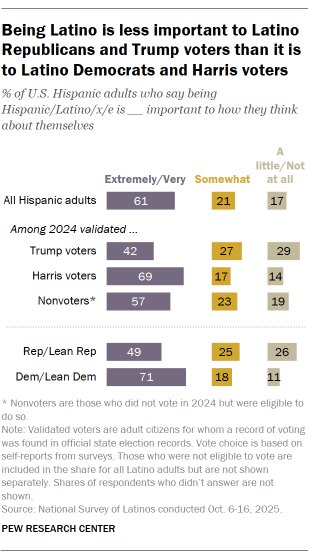
The Pew research also provides important evidence on this point. Among validated 2024 Hispanic voters, 69% of Harris voters said being Hispanic was extremely or very important to how they saw themselves, compared with 42% of Trump voters. Trump voters were also more likely to describe themselves primarily as “American,” and these differences persisted even after controlling statistically for immigrant generation, income, religion, age, gender, party affiliation, and state. That finding suggests something deeper than ordinary demographic heterogeneity. The political relevance of Latino identity itself varies among Latino voters.
This potentially creates an endogenous relationship between identity and politics. Analysts traditionally use ethnicity as an independent variable and vote choice as the dependent variable: How will Latinos vote? But if different Latino voters assign different political significance to their ethnicity, analysts should also ask whether the salience of ethnic identity helps determine how useful the category is for predicting their behavior. Generational assimilation may reinforce this process. Pew finds that the meaning and importance of Hispanic identity vary according to distance from the immigrant experience. As the U.S.-born share of the electorate expands, national origin, class, education, religion, gender, ideology, and geography may become comparatively more useful explanatory variables.
The broader transformation of American partisan politics provides important context for understanding changes in Latino voting behavior because educational attainment and class have become significant political cleavages, with Democratic coalitions becoming more heavily college educated while Republicans have improved among voters without four-year degrees. Pew’s 2024 validated-voter analysis found that 59% of voters lacked a college degree and documented the continuing educational divergence between the parties. Because Latino eligible voters are disproportionately younger and less likely than the electorate overall to possess four-year degrees, some electoral changes attributed to ethnicity may instead reflect broader political changes among working- and middle-class Americans. This does not mean that class explains Latino voting behavior independently of immigration, discrimination, language, or cultural identity, but it does suggest that analysts should distinguish ethnic effects from socioeconomic ones. The economic context of 2024 reinforces this interpretation. Equis found substantial economic dissatisfaction among Latino voters and identified perceptions of Trump’s previous economic performance as an important source of his appeal among persuadable voters, even as some voters who rated his economic record positively still preferred Harris because of immigration or perceptions that she better understood people like them. Gender further complicates aggregate analysis. Equis found Latino men approximately evenly divided between Harris and Trump before the election while Latino women favored Harris by roughly two-to-one, with especially pronounced differences among younger voters. If younger or working-class Latino men increasingly behave politically like similarly situated men from other racial and ethnic groups, ethnicity becomes less predictive of their electoral behavior. Analysts should be cautious about claims that “Latinos” moved toward one party when the aggregate movement may be concentrated among particular combinations of gender, age, education, and class.
The midterms provide the first major opportunity to distinguish realignment from dealignment. Current evidence does not show Latino voters behaving as a consolidated Republican constituency. Pew’s July 2026 survey found that 49% of Hispanic registered voters currently prefer the Democratic congressional candidate, compared with 26% preferring the Republican candidate. Another 24% either remain unsure or prefer another candidate. That last number deserves as much attention as the Democratic advantage. Almost one-quarter of Hispanic registered voters are not currently committed to either major-party congressional candidate. A large, uncommitted population is compatible with an electorate whose partisan attachments remain comparatively weak.
Trump’s standing among his own 2024 Latino voters has also deteriorated. In April, 66% of validated Latino Trump voters approved of his performance, down 27%age points from the beginning of his second term. Approval among non-Hispanic Trump voters declined considerably less. Earlier Pew research also found that 70% of Latinos overall disapproved of Trump’s performance by late 2025, while 65% disapproved of his immigration approach and 61% said his economic policies had worsened economic conditions.
None of these figures guarantees a corresponding Democratic vote in November. Approval, partisan identification, turnout intention, and actual vote choice are different variables. Indeed, their divergence is exactly what makes the electorate analytically interesting. South Texas may provide one of the clearest empirical tests. Republican redistricting strategies assumed some persistence in the GOP’s recent improvement among Latino voters, but several heavily Latino districts have subsequently become more competitive as Trump’s standing has weakened. Democratic-aligned organizations are consequently investing heavily in attempting to recover voters who supported Trump in 2024.
If Latino voters who backed Trump in 2024 support Republican congressional candidates in comparable proportions in 2026, the realignment hypothesis becomes stronger. If substantial numbers return to Democratic candidates, abstain, or split their tickets, the evidence would favor candidate-specific voting or dealignment.
No posts
Comments
Nothing yet. Say the first thing.
Sign in to join the conversation.