

American socialism has repeatedly influenced the nation’s political debate without ever establishing itself as a durable governing force. At the beginning of the twentieth century, figures such as Eugene V. Debs transformed socialism from a fringe intellectual movement into a national political cause, winning nearly one million votes in the 1912 presidential election while advocating public ownership of industry, expanded labor rights, and economic democracy. However, even at its high-water mark, socialism remained a minority movement constrained by America’s constitutional structure, federal system, two-party electoral rules, and a political culture that generally favored reform within capitalism rather than its replacement. The New Deal ultimately absorbed many of the movement’s economic concerns while denying it an independent political future, and the Cold War further marginalized socialism as an electoral identity. For more than a century, therefore, socialists have often succeeded in shaping public policy but have repeatedly failed to become a dominant political force in their own right. The recent resurgence of democratic socialism within the Democratic Party raises an important question: does this represent a genuine realignment in American politics, or merely the latest chapter in a long history of ideological influence constrained by electoral reality?
Support for democratic socialism has become substantially more influential within the Democratic Party, but the available polling shows a sharp distinction between ideological strength inside the party and electoral acceptance across the country. The Reuters/Ipsos data indicate that 71% of Democrats now identify as liberal, up from 55% in 2012, while the share calling themselves conservative has fallen from 33% to 16%. Liberal Democrats define their politics through a relatively coherent economic and social agenda as large majorities regard higher taxes on corporations and billionaires, expanded abortion access, and government-provided universal healthcare as essential liberal commitments. Opposition to U.S. support for Israel has also become a defining position for much of the party’s left, with only 16% of Democrats supporting continued military and economic assistance and more than 80% of liberal Democrats considering reductions in that support important or essential. These findings suggest that the Democratic Party’s ideological center of gravity has moved considerably leftward, especially on economic redistribution, healthcare, reproductive rights, and foreign policy.
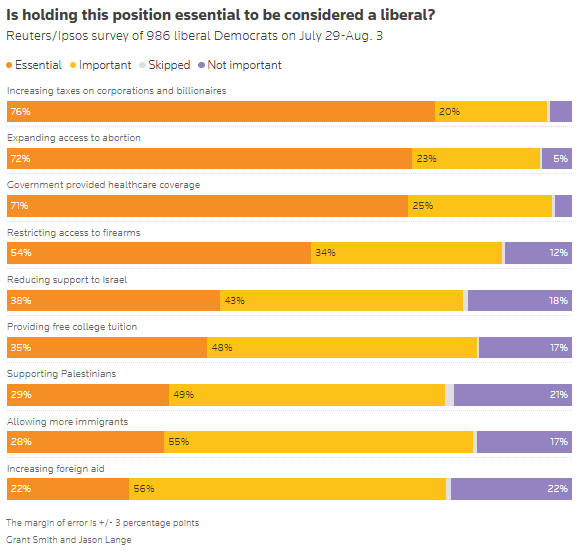
That shift has translated into greater organizational and electoral power for democratic socialists and allied progressives. Left-wing candidates have defeated establishment-backed Democrats in urban districts and in politically divided states such as Michigan and Wisconsin. The Democratic Socialists of America reports more than 120,000 dues-paying members across 220 chapters, giving the movement a permanent organizing infrastructure rather than a network activated only during elections. Its strength among younger voters, activists, and highly educated Democrats helps explain why socialist-backed candidates often perform especially well in low-turnout primaries, where ideological commitment, canvassing capacity, and volunteer enthusiasm matter disproportionately. What this means is that democratic socialism has become a meaningful faction capable of shaping candidate selection and forcing more moderate Democrats to respond to its policy priorities.
The national electorate, however, remains considerably more skeptical. Although roughly three-quarters of Democrats say they would consider supporting a democratic socialist for president, only 39% of all Americans say the same, while 55% would rule such a candidate out. A majority of independents (54%) also say they would not consider voting for one. Only 15% of Americans affirmatively like leaders who identify as democratic socialists, compared with 36% who dislike them and nearly half who express no strong view. Republicans are overwhelmingly hostile, but the more important electoral constraint is that independents and many weakly attached voters remain wary of the label even when they may support individual policies associated with it.
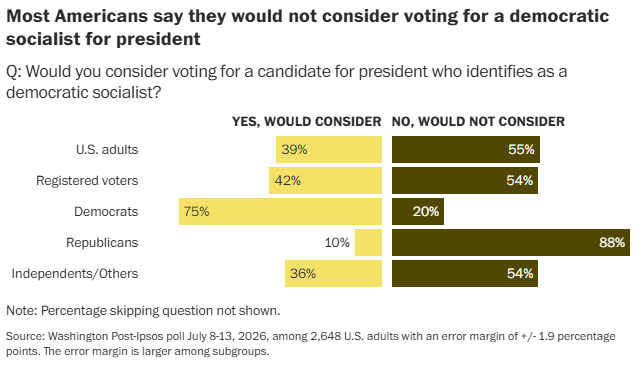
This distinction between policy preferences and ideological identity is essential. Proposals such as higher taxes on the wealthy, stronger labor protections, expanded healthcare coverage, and greater economic assistance can attract support well beyond self-identified socialists. Yet “democratic socialism” remains poorly defined in the public mind. Some voters associate it with Nordic social democracy and economic equality while others connect it to communism, centralized control, or indiscriminate redistribution. No single interpretation commands more than a small share of the public. Consequently, candidates who campaign primarily on concrete affordability and social-welfare policies may possess a broader electoral coalition than candidates who foreground the socialist label itself. The policies can travel further than the identity.
The demographic patterns also complicate claims that democratic socialism represents a straightforward working-class revolt. Younger voters are more receptive than older Americans, and postgraduate degree holders are substantially more willing to consider socialist candidates than voters without college experience. Higher-income Americans are, paradoxically, more open than lower-income Americans to considering such a presidential candidate, even though they are also more likely to express active dislike. White Democrats are considerably more likely than Black Democrats to say they like democratic socialist leaders, despite Black Americans overall showing meaningful openness to voting for one. These findings suggest that the movement’s most enthusiastic constituency is disproportionately young, highly educated, urban, and ideologically engaged—not necessarily identical to the broader multiracial, lower-income electorate it seeks to represent.
For U.S. politics, this will likely create a persistent divergence between Democratic primary incentives and general-election incentives. In safely Democratic cities and congressional districts, far-left candidates can continue defeating moderates because the decisive contest occurs in the primary and the electorate is younger, more liberal, and more receptive to economic transformation. In competitive statewide and presidential races, however, candidates must attract independents, older voters, suburban moderates, and less ideological working-class constituencies. A democratic socialist may be highly electable in New York City or a deep-blue House district while facing substantially greater difficulty in a Michigan Senate race, a Wisconsin gubernatorial election, or the Electoral College.
This does not mean far-left Democrats are inherently unelectable. Electability will depend on geography, candidate quality, the salience of economic conditions, and whether opponents can successfully define the candidate through unpopular ideological associations. A disciplined candidate who emphasizes healthcare costs, housing, wages, corruption, and concentrated corporate power may outperform the national popularity of the socialist label. Conversely, candidates closely associated with highly polarizing positions, activist rhetoric, or organizations perceived as culturally distant from ordinary voters may struggle to reunify Democrats after contentious primaries and may give Republicans an effective means of portraying the entire party as radical.
The likely result is a prolonged struggle over the direction of the Democratic Party. The left will continue shaping policy, winning selected primaries, and supplying much of the party’s organizing energy. Moderates will continue arguing that national power requires a broader coalition than the activist base alone can provide. Both claims contain truth as democratic socialists have become too influential to marginalize, but the national polling demonstrates a clear electoral ceiling that cannot be ignored. The central strategic challenge for Democrats will be determining whether they can translate the economic grievances powering democratic socialism into a majoritarian agenda without allowing an ideologically contested label to narrow their appeal before the general election begins.
No posts
Comments
Nothing yet. Say the first thing.
Sign in to join the conversation.