
Welcome, listeners, to the InsightBit podcast, where we dive deep into the stories shaping the global economy. Today, we’re unpacking the high-stakes US-China trade talks resuming in London, a critical moment as the world’s two largest economies grapple with export controls, tariffs, and the ripple effects threatening financial markets and global supply chains. Titled “Navigating a Fragile Truce,” this episode will explore the economic implications, competing policy perspectives, and what this means for businesses, consumers, and your personal finances. Let’s get started.
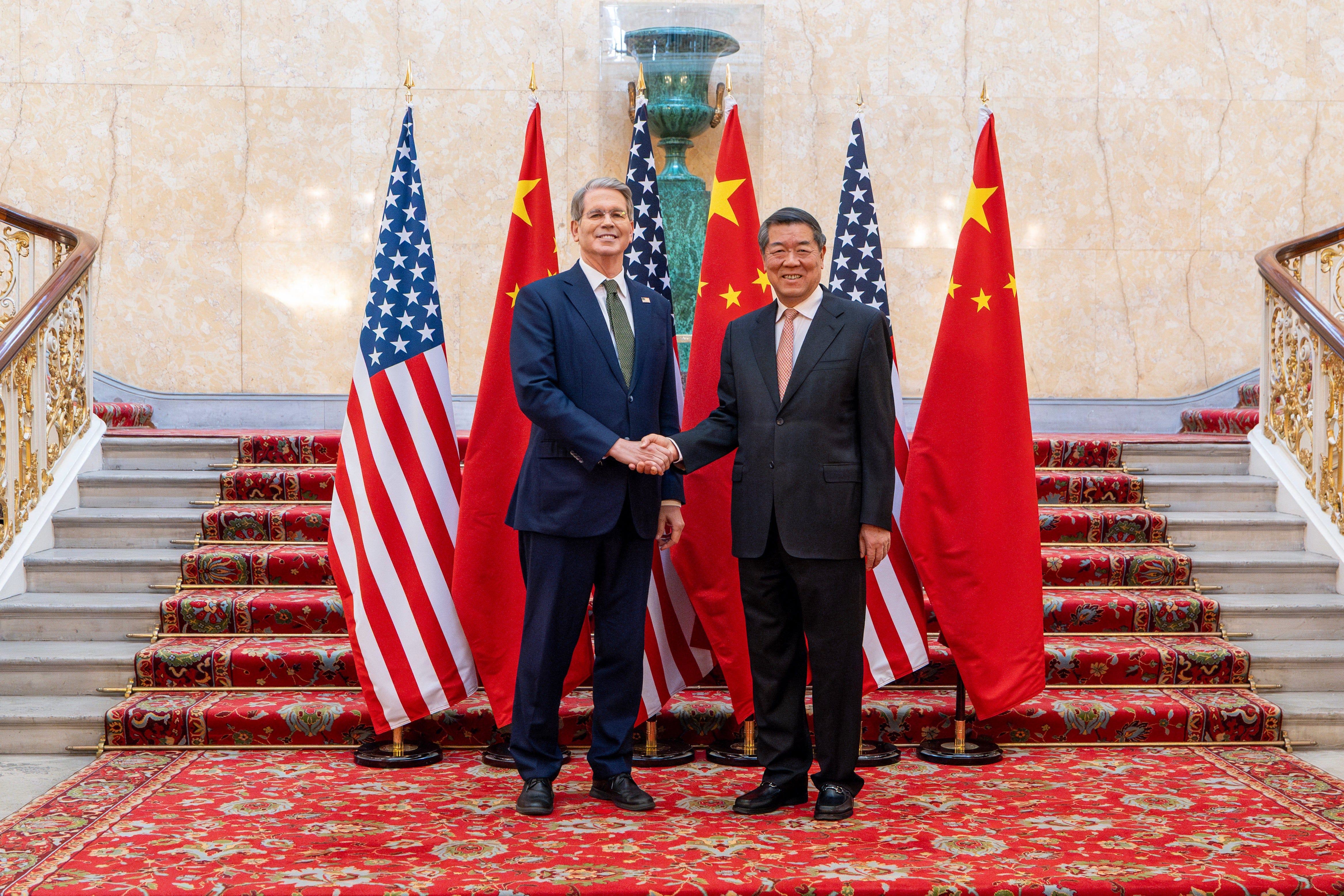
US treasury secretary Scott Bessent and Chinese vice premier He Lifeng pose for a photo during trade discussions at the Lancaster House in London on 9 June 2025 (AFP/Getty)
The US and China are at a pivotal juncture. On June 9, 2025, trade talks kicked off in London, led by US Commerce Secretary Howard Lutnick, Treasury Secretary Scott Bessent, and Trade Representative Jamieson Greer, with Chinese Vice Premier He Lifeng heading Beijing’s delegation. These talks, which extended into a second day on June 10, follow a 90-day truce struck in Geneva last month, aimed at de-escalating a trade war that has rattled global markets. The urgency stems from China’s April decision to suspend exports of rare earth minerals and magnets—critical components for industries like electric vehicles, semiconductors, and aerospace—prompting accusations from Washington that Beijing is weaponizing its near-monopoly on these resources.
President Donald Trump’s “Liberation Day” tariffs, announced on April 2, 2025, imposed a 10% baseline tariff on all US imports, with reciprocal duties as high as 145% on Chinese goods. China retaliated with 125% tariffs on US products and tightened export controls on critical minerals, sending shockwaves through global supply chains. Customs data reveals China’s exports to the US plummeted 34.5% in May, the sharpest drop since the COVID-19 pandemic, while US ports face congestion and businesses report billions in losses. The talks in London aim to stabilize this volatile situation, with both sides exploring concessions, such as the US potentially easing semiconductor export controls in exchange for China resuming rare earth shipments.
To set the stage, let’s ground this in data. According to the Bureau of Labor Statistics, US unemployment held steady at 4.1% in April 2025, but consumer confidence has taken a hit, with the Conference Board’s Consumer Confidence Index dropping to 65.2, reflecting tariff-related uncertainty. The Federal Reserve’s latest Beige Book noted “pervasive” trade uncertainty, with declining business sentiment in several regions. Meanwhile, the S&P 500, down 6.5% year-to-date as of April, rallied slightly after the Geneva truce but remains volatile. China’s economy, growing at a reported 5.4% in Q1 2025, faces its own challenges, with weak domestic demand and a property sector slump.
The US-China trade conflict has far-reaching consequences for inflation, GDP, employment, and financial markets. Let’s break it down.
Tariffs increase the cost of imported goods, which can fuel inflation. The EY estimates that a 60% tariff on Chinese imports and a 10% universal tariff could add 1 percentage point to US consumer price inflation (CPI) by Q4 2025, pushing CPI to around 3.5% from 2.5% in 2024. Federal Reserve Chair Jerome Powell has cautioned that while inflation shocks haven’t fully materialized, they could emerge by mid-2025 as inventories thin. For American households, this translates to higher prices for electronics, vehicles, and everyday goods, with disposable income potentially dropping by $1,145 on average, hitting lower-income families hardest.
China’s export restrictions on rare earths exacerbate these pressures. These minerals are vital for manufacturing high-tech products, and their scarcity could drive up costs for US automakers and tech firms, passing those costs to consumers. The Center for Strategic and International Studies (CSIS) highlights that China’s restrictions, retaliating against US tariffs, have already disrupted supply chains, with automaker Stellantis announcing 800-900 layoffs due to cost pressures.
The trade war threatens economic growth. EY projects that sustained tariffs could reduce US real GDP by 1% in 2025 and 1.4% in 2026, with global GDP growth curbed by 0.5% and 0.7%, respectively. The US economy contracted by 0.3% in Q1 2025, partly due to tariff-related trade disruptions, while the Atlanta Fed’s GDPNow model suggests continued weakness. China’s growth, while officially 5.4%, is questioned by economists, with declining export orders signaling trouble ahead.
For the US, reduced trade with China could shrink manufacturing output, particularly in sectors reliant on Chinese components. However, stockpiling ahead of tariffs temporarily boosted Q1 GDP, as businesses rushed to import goods. Long-term, prolonged disruptions risk stagflation—a toxic mix of stagnant growth and rising inflation—especially if the Federal Reserve tightens monetary policy to curb price pressures.
While US unemployment remains stable, cracks are appearing. April 2025 saw layoffs jump to 1.786 million, up 200,000 from March, and initial unemployment claims rose to 247,000, exceeding forecasts. The Challenger, Gray & Christmas report noted a 47% year-over-year increase in layoffs in May, driven by tariff-related uncertainty. Businesses, particularly retailers, are delaying inventory purchases for back-to-school seasons, fearing cost hikes.
China’s export slump could also lead to job losses in its manufacturing sector, though Beijing’s stimulus measures—such as cutting interest rates and reserve requirements—aim to cushion the blow. For the US, industries like automotive and tech, reliant on rare earths, face supply chain bottlenecks, potentially forcing production cuts and further layoffs.
Global markets have been on edge. The S&P 500’s 2.6% drop since April reflects investor fears of a trade-induced recession. US Treasury yields have risen, with 10-year notes hovering above 5%, signaling expectations of higher inflation and recession risks. The dollar, under pressure from trade uncertainty, weakened against the yen, complicating monetary policy for Asian economies. However, the Geneva truce and optimism around the London talks spurred a market rally, with the Nasdaq up 3% on May 13.
China’s restrictions on rare earths have heightened market volatility, as investors worry about supply chain shocks. The inclusion of Commerce Secretary Lutnick in London signals that export controls are a priority, with potential concessions on semiconductor software and aviation equipment. Yet, as Kelly Ann Shaw notes, restrictions on advanced AI chips are likely to remain, reflecting national security concerns.
The US-China trade war echoes historical trade conflicts, like the Smoot-Hawley Tariff Act of 1930, which deepened the Great Depression by choking global trade. Economic theory suggests tariffs can protect domestic industries but often raise consumer prices and provoke retaliation, reducing efficiency. The Cato Institute argues that free trade maximizes economic welfare by fostering competition and innovation, warning that Trump’s tariffs could distort markets and harm consumers. Conversely, the Economic Policy Institute (EPI) contends that strategic tariffs can protect jobs and counter China’s subsidies, though they acknowledge the risk of higher costs.
China’s “Made in China 2025” initiative, aiming for self-sufficiency in high-tech industries, underscores its long-term strategy to dominate global markets. The RAND Corporation notes that China’s success stems not from tariffs but from foreign investment and technology transfers, a model the US could emulate to boost manufacturing without heavy protectionism. The Federal Reserve faces a “conundrum,” balancing inflation risks with slowing growth, potentially pausing rate cuts as tariffs drive prices higher.
Conservative economists and policymakers, aligned with the Cato Institute and Trump’s advisors, view tariffs as a tool to correct trade imbalances and protect American industries. They argue that China’s subsidies and intellectual property practices justify aggressive measures. Treasury Secretary Scott Bessent has called high tariffs unsustainable but necessary to pressure China into fairer trade practices. The Heritage Foundation’s Project 2025 supports withdrawing from multilateral institutions like the IMF, favoring bilateral deals to prioritize US interests.
Conservatives see Trump’s sectoral trade pivot—focusing on semiconductors, critical minerals, and AI—as a way to secure supply chains and maintain US technological dominance. They argue that deregulation and tax incentives, as proposed by Trump’s team, will spur domestic manufacturing, citing the USMCA as a successful bilateral model. However, critics within this camp, like Elon Musk, warn that tariff-driven deficits could destabilize markets.
Progressive voices, echoed by the Brookings Institution and EPI, emphasize the risks of tariffs to consumers and global cooperation. They argue that higher prices disproportionately harm low-income households, with EY estimating a 1.6% disposable income loss for the bottom quintile. Progressives advocate for targeted subsidies and green investments to bolster domestic industries without disrupting trade. The Center for American Progress warns that IRS layoffs and reduced social spending could exacerbate inequality amid tariff-driven inflation.
Brookings suggests collaborating with allies like the EU and Japan to counter China’s dominance in critical minerals, rather than relying on tariffs. Progressives also stress the need for regulatory oversight to protect workers and the environment, citing concerns over weak standards in potential US-Indonesia mineral deals. They argue that government intervention, like China’s stimulus measures, can stabilize economies without escalating trade wars.
Business leaders are divided. Some, like automakers, face supply chain chaos from rare earth restrictions, with Stellantis’ layoffs a stark example. Others, like tech firms, welcome potential easing of semiconductor export controls but fear long-term uncertainty. Consumer advocacy groups warn that tariff-driven price hikes could erode purchasing power, urging Congress to protect credit card rewards programs, which face threats from proposed legislation like the Durbin-Marshall bill.
The London talks could shape future US policy. A successful deal might involve lifting some US export controls on semiconductor software and aviation equipment, with China resuming rare earth shipments. However, longstanding AI chip restrictions are likely to persist, reflecting national security priorities. The Trump administration is also probing critical mineral imports for national security risks, potentially leading to new tariffs.
Legislatively, some Republicans seek to curb Trump’s tariff authority, with a federal appeals court ruling that his April tariffs exceeded legal limits. Congress may push for oversight, as seen in a Senate resolution rebuking Canada tariffs. Progressives, led by figures like Senator Ron Wyden, advocate for hearings on trade impacts, while House committees explore bank mergers and Treasury market fragility.
Globally, allies like the EU and Japan are pursuing critical mineral deals to reduce reliance on China, with the US-India Joint Leaders’ Statement signaling deeper cooperation on semiconductors and AI. The Federal Reserve, maintaining independence, may delay rate cuts if inflation spikes, as signaled by Powell’s meeting with Trump.
The US-China trade talks in London represent a fragile opportunity to stabilize relations and avert a deeper economic rift. While a breakthrough on rare earths and semiconductors could ease supply chain pressures, the underlying tensions—driven by competing visions of economic dominance—persist. For the US, tariffs have sparked market volatility and inflation fears, with GDP and employment at risk. China faces its own challenges, balancing export declines with domestic stimulus.
For listeners, this saga underscores the stakes for your personal finances. Higher prices for cars, electronics, and household goods could strain budgets, especially for lower-income families. Businesses face tough choices on investment and hiring, while markets remain a rollercoaster. Stay informed, as these talks will shape monetary policy, trade agreements, and global economic stability.
We encourage you to reflect on how these policies affect you. Are tariffs worth the cost to protect US industries, or do they risk too much for consumers? Visit reputable sources like the Federal Reserve, Bloomberg, or the Treasury Department to dig deeper. This is InsightBit, where we empower you to navigate the economic landscape. Until next time, keep questioning and stay engaged.
#Economy #Finance #Markets #USChinaTrade #TradeTalks #Tariffs #RareEarths #Semiconductors #Inflation #GDP #Employment #MonetaryPolicy #FederalReserve #TreasuryDepartment #Bloomberg #S&P500 #ConsumerConfidence #SupplyChains #TradeWar #EconomicPolicy #ConservativeViewpoints #ProgressiveViewpoints #CatoInstitute #BrookingsInstitution #EconomicPolicyInstitute #BusinessLeaders #ConsumerAdvocacy #PersonalFinances #MarketVolatility #GlobalTrade #LondonTalks #ExportControls #Stagflation #USMCA #Manufacturing #PolicyResponses
Comments
Nothing yet. Say the first thing.
Sign in to join the conversation.