
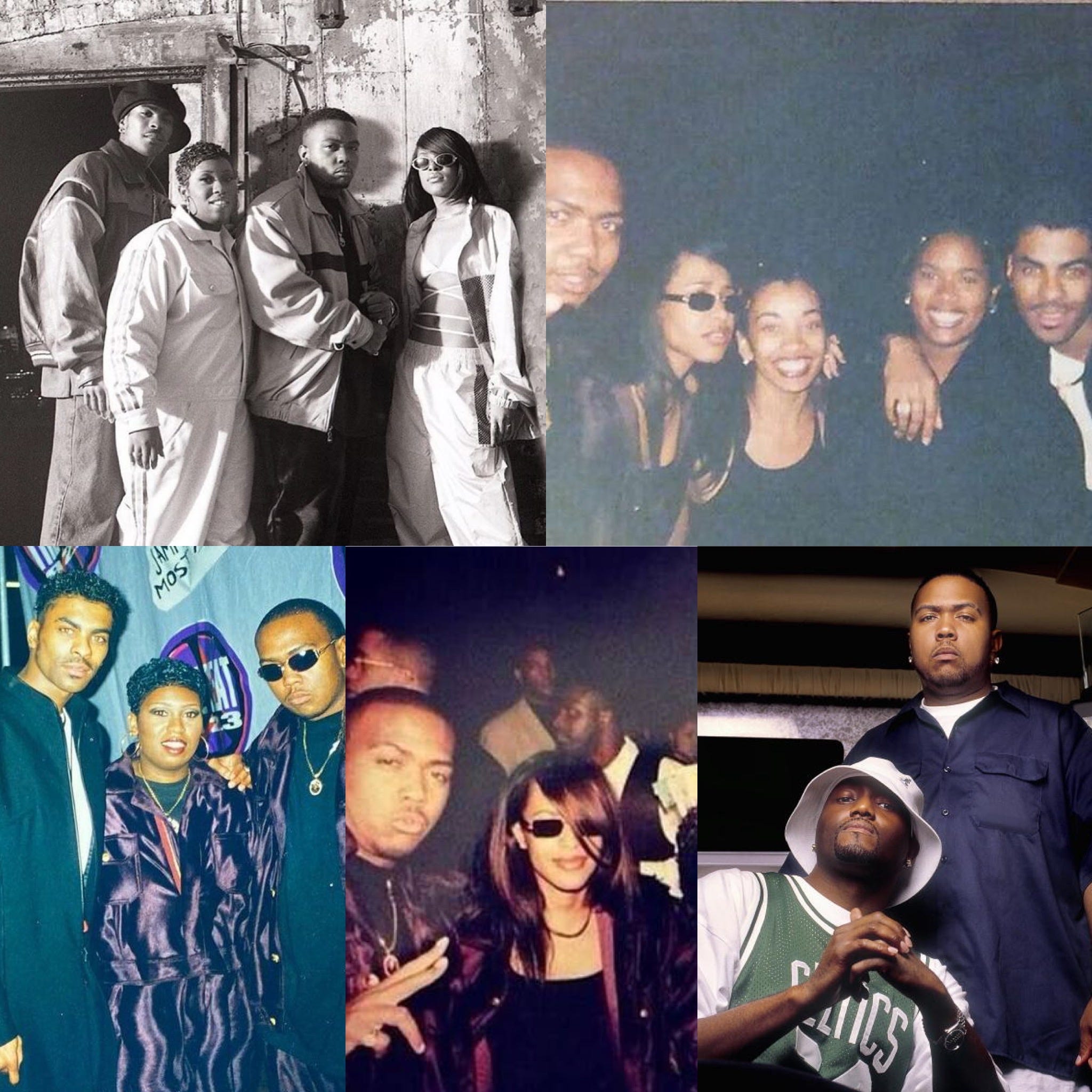
For this first edition of the Liner Notes subseries, writer John Noire fills in the historical subtext behind Miki’s deep credit dive!
Aptly, the song title of the opening track on Aaliyah and Timbaland’s debut album together (it was Aaliyah’s second album and Timbo’s actual first ever) One In A Million is “Beats 4 Da Streets.” The intro quite literally introduces the stilted and edgy beat that would eventually be recognized as Timbaland’s signature bounce. The drum sounds and hi hats feel like they are in a choreographed swordfight straight out of a Akiro Kurosawa film. Juxtaposed against Aaliyah’s glistening vocals, the tandem created what would become an everlasting sound.
On the title track, “One In A Million,” this sound reaches its early peak. An evening country by the creek fluttering noise and sparking synths merge with the signature bounce and uplift Aaliyah’s best vocal layering of the album to the stratosphere. While Aaliyah’s lyrics seem to on the surface be expressing the individualized love she has for a romantic partner, it almost feels like she’s actually singing to the beat itself about the symmetry she feels with it. While Aaliyah’s fully R.Kelly produced debut immediately grabbed national audience’s ears, this album is where she became mystical.
August 27, 2026 marks the 20 year anniversary of the album’s release which happened on the same date in 1996. It’s as important to look back on its everlasting tone as it is to see what a launchpad it was for Timbaland’s production beginnings. From there he was basically shot out of a cannon.
Greatness rarely occurs in a vacuum. The Neptunes had Teddy Riley, Ye had No I.D. and Timbaland came up from under the tutelage of Jodeci’s DeVante Swing.
Half a decade before the release of Aaliyah’s One In A Million, Timbaland, Pharrell and Magoo were in a high-school group called Surrounded By Idiots. However, it would be the time spent with DeVante Swing’s Da Bassment Cru between 1993 and 1995 that would prove most pivotal to the development of Timbaland’s sound. You don’t have to look much further than the demo version of “Peepin’ My Style” (with Missy Elliott and Static Major) to see the initial hallmarks of his production style. -John Noire
His next album added yet another sonic muse to the mix, Ginuwine. He and Timbaland’s shared work on Ginuwine…The Bachelor resulted in an astounding debut for the sensual crooner. That album, like Aaliyah’s before it, had its most inventive moment on its centerpiece single, “Pony.” While the majority of the rest of the album either lets Ginuwine fill the empty sonic space around Timbo’s choppy drums or follows the more traditional r&b cadences of the time, “Pony” feels like a surefire step forward. A driving sound, of what seems to be Timbaland’s voice warped through a vocoder and a synth, allows Ginuwine to channel his full sex symbol potential. This alignment is the reason the song has been timeless baby making music since its release.
Next, came Missy Elliott’s everlasting debut Supa Dupa Fly, which confirmed that Timbaland was gathering a set of Avengers. This is where his sound not only cemented, but also expanded in multiple facets over the course of a project. Missy’s left of center fusion rap and singing approach seemed to spur an experimental amalgamation for Timbo. The opening three tracks, after the intro with Busta Rhymes, are all staggering in their innovative sonic prowess. “Hit Em wit Da Hee” juxtaposes Lil Kim’s hard nosed swagger against Missy’s melodic playfulness, all chronicled by Timbo’s punchiest drums yet, outlined by sharp lyrical basslines. “Sock It 2 Me” feat. Da Brat (my personal favorite of the album) perfectly combines momentous horns, stank faced flow patterns both sung and rapped, knocking drums, tweety bird chirps, and staccato bass hits. Then, finally, Missy’s ultimate three track sequence closes with her still arguably most iconic single, “The Rain (Supa Dupa Fly).” The anamorphic bulging synth bass boosts the Timbo bounce like a trampoline, which Missy floats and tap dances all over. The rest of the album continues this progressiveness, solidifying an opening three-album run by a producer for the ages.
The two most surprising aspects of Timbaland’s production during this era were: (i) the age of some of his beats (such as “Pony” which is said to have been made sometime between 1988 and 1995) and (ii) the sample-driven nature of these early compositions. For example, at the risk of sample snitching, there is a direct link between Aaliyah’s “Heartbroken”, Da Bassment Cru’s “Baby I Know” and Sonder’s unreleased gem “Morning Rain”. I’ll leave you to figure out what that connection is. -John Noire
“How many songs on the radio you gonna hear that sound like mine,” Timbaland proclaims loudly on his next album with rapper Magoo. Welcome To Our World is the first album on which Timbo appears as the shared main artist with the vocalist. The project is also a tester for what would soon later become a fully realized producer compilation project. Missy, Ginuwine, and Aaliyah all appear at times throughout the project and help Timbo present himself as the don dada of a powerful collective. The new texture introduced on this album is southern blues laden bass and guitar lines on tracks like “Feel It,” “Clock Strikes,” and “15 After Da’ Hour.” Timbaland, Missy, and Magoo are all from Virginia, which is part of the south while still adjacent to the mid Atlantic geographically, so it was only a matter of time before Timbo mixed in some twang. This inherently moved his communal sound into a more rooted one, even while it remained larger than life.
The final full album for the collective came in the form of Timbaland producing for his first group, the legendary trio Playa. Static Major, the group’s lead, had already written major hits for Timbo’s crew including “Pony,” thus it was time for he and his band of smooth crooners to get some highlighting. Naturally, here, Timbo maneuvered that bluesy cadence, which with Magoo existed only in the underbelly, to be the more front and center tone. There was a clearly influential sound created here which feels like early 2000s hip-hop thump-laden r&b before that sound was central. Next, Timbaland at his most swaggered connected with Jay-Z for two singles at the top of the mountain on Vol.2…Hard Knock Life. Even hip hop’s front man at this time wanted access to the Virginia centered collective’s sauce.
Outside of Timbaland himself, the other two people responsible for his ‘classic’ sound are Missy Elliott and Static Major. Like Timbaland, these two individuals were discovered by DeVante Swing. Like Timbaland, these two individuals are some of the foundational architects of modern-day R&B. Together, the three of them created music which withstood the test of time as Static Major provided the witty lyrics relevant for its era (and beyond) while Missy Elliott harnessed hymn-like harmonies that hearkened back to a sonic source passed down generations. -John Noire
Timbaland not only bookended this run with his first official solo producer compilation project Tim’s Bio, he also got cinematic. He fully labeled the project Tim’s Bio: From The Motion Picture- Life from da Bassment. While on the surface it could be interpreted as Timbo’s take on self-referring to his creations as movie-like, what the project reads as in reality is more of a proof of concept. While still only two years into his career, Timbaland seemed on a mission to prove he could continue to push music forward while gathering a cast of superheroes similar to how movie soundtrack makers would with studio budgets. Beyond his core collective members, he was able to mix in Jay-Z, Nas, Ludacris, Twista and more.
What’s cool about this project is even though it arrived near the beginning of his career, it operates as a progressive throwback. Many of the beats go back to a more minimal style explored on his first three albums, but with new added tactics. There are vocal chops weaved within empty percussive spaces, layered multi-sounded percussive hits on shared downbeats, synths so evenly chopped they bleed into the percussion orchestration, and even chipmunk vocal filters foreshadowing much of what would come soon after.
Similar to the RZA, Timbaland’s early discography was all he needed to be considered as one of the greatest producers of all time. The amount of hit songs and classic albums that he was involved in during this brief period is proof of the sheer amount of talent that can exist within one person. A talent that was molded by a like-minded community (The Superfriends) and reached unbelievable heights because one artist (Aaliyah) gave him and Missy an opportunity. -John Noire
“I beef up the beat, snares everywhere” Timbaland declared on the intro to Tim’s Bio, stamping his now certified and cemented signature. The build to this moment took less than 2 years which in retrospect feels almost unimaginable. Especially with all the wild turns the super producer Timbaland has taken (some of which not very appealing recently), it’s important to remember the work he put in to initially build his stubborn obsession with what’s next. I hope this piece can function as a reminder of his roots, which chose community over robots and soulful progression over something more fabricated. On his “Outro” to Tim’s Bio, the legend proclaims, over what feels like a sharp pivot to a sneak peak of more pop adjacent production to come, “I love you all, but especially the dirty, dirty south…Can you feel me?…Put y’all hands up! Now bounce!” It feels like a commitment to his roots even though he knew he’d soon burst through the ceiling. I hope he can return to that ethos.
Playlists
No posts
Comments
Nothing yet. Say the first thing.
Sign in to join the conversation.