
How do they navigate across massive distances over unfamiliar terrain to find their way back home? Some are lost due to natural disasters, car wrecks, and theft. All of which would not have left a scent trail or breadcrumbs for a dog to follow. So how do they determine north, south, east, or west?
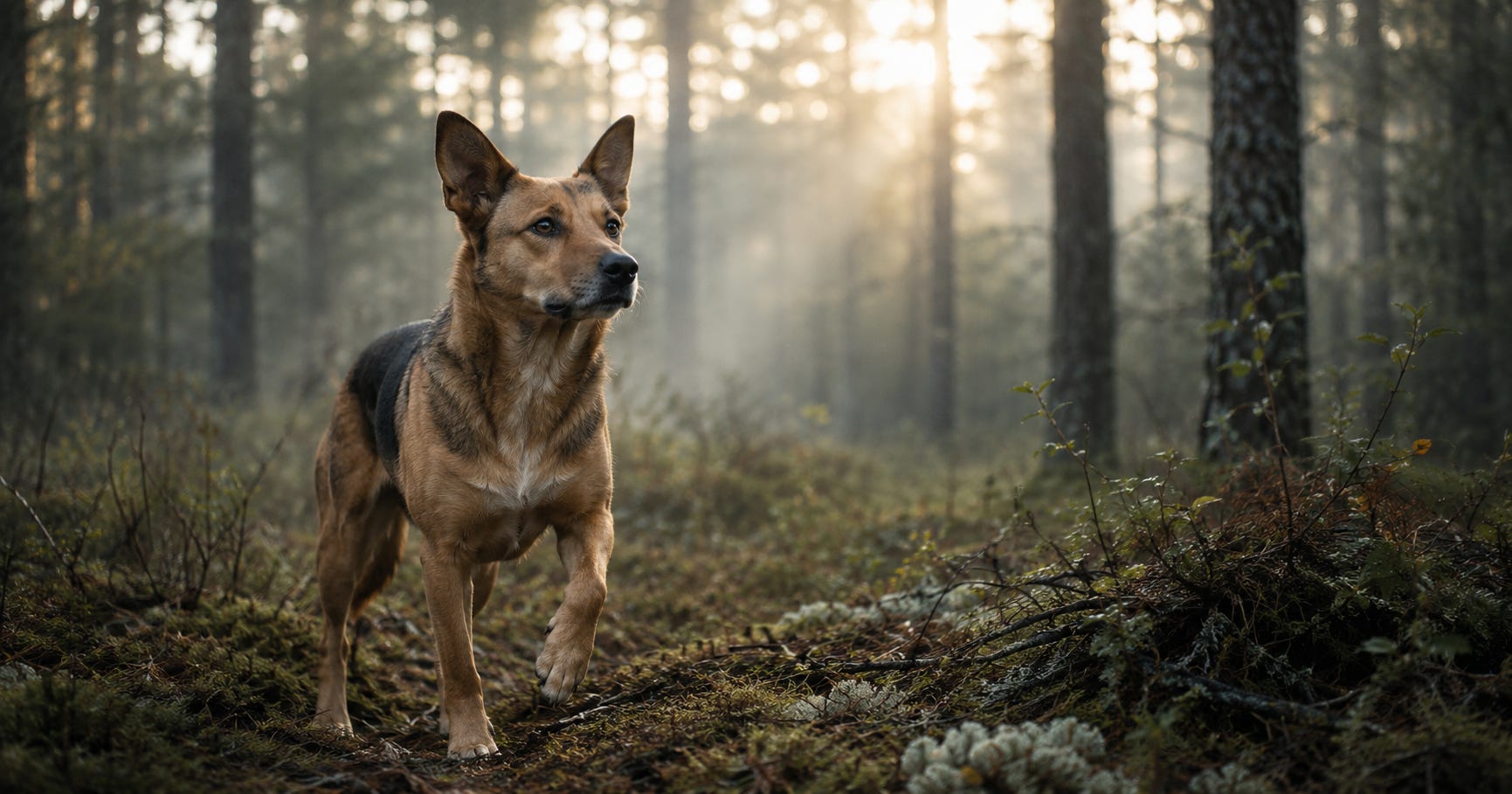
Scent is usually the first answer people give because the dog’s sense of smell is extraordinary. It’s true that a dog can extend its range far beyond a single trail by locating and chaining scent zones. As the dog travels, he moves from one familiar scent to the next. Under the right wind conditions, a dog can pick up a familiar scent from ten miles away. But scent is fickle and depends on things a dog cannot control, such as weather. So at some point, scent ceases to exist as the molecules break down and dissipate.
So how do dogs know which way is home? In 1924, a collie named Bobbie got separated from his family on a road trip in Indiana. Six months later, he walked through the front door of his family’s home in Silverton, Oregon. A 2,551-mile trek across plains, deserts, and multiple mountain ranges in winter. Stories like Bobbie’s have circulated for a century, treated as heartwarming anomalies. They have even been the cornerstone of several motion pictures. In “The Call of the West” (1924), Bobbie went to Hollywood and played himself in a silent feature film. The most recent are “A Dog’s Way Home” (2019), “Homeward Bound: The Incredible Journey” (1993), and “Lassie Come Home” (1943). New research suggests that these dogs are not anomalies at all. Dogs appear to run a multi-layered navigation system. When the primary system fails, the backup kicks in.
That is the exact scenario researchers at the Czech University of Life Sciences and Virginia Tech set out to test. They fitted 27 hunting dogs, representing 10 breeds: Fox Terrier, Miniature Dachshund, Beagle, Wirehaired Pointing Griffon, English Pointer, Welsh Terrier, Jagdterrier, Bavarian Mountain Hound, Hanoverian Scenthound, and Bloodhound, with GPS collars and action cameras, letting them roam freely. Then they tracked them on more than 600 return trips through forested terrain. Each time, a dog was released to roam somewhere unfamiliar to him. The owner would remain hidden out of scent range until the dog began his return. When returning, the dogs either traced their outbound path or took an entirely new route.
The dogs used one of two strategies to start their return home. Most, about 59 percent, retraced their outbound path, a strategy researchers call tracking. But roughly 33 percent of the dogs did something different. Instead of retracing their steps, they set off in an entirely new direction, a strategy called scouting. Scouting dogs found their way back to their owner significantly faster than dogs relying on scent alone. Tracking dogs switched from tracking to scouting when they had trouble detecting the scent trail.
Here is where it gets specific. Scouting dogs did not simply strike out in a random new direction. Before committing to their route home, most of them ran a short distance, about 20 meters, along a north-south line. Researchers dubbed this the compass run. It happened regardless of which direction actually led back to the dog’s owner. Researchers believe this short run lets a dog align its mental map with a magnetic compass, essentially resetting its internal sense of direction before choosing a route.
This sensory ability is called magnetoreception. It is built directly into his visual system, hidden in the retina. This cryptochrome 1 molecule is responsible for the ability to perceive and navigate using the Earth’s magnetic field. Researchers found it sitting in the blue-sensitive cone photoreceptors of a dog’s eye.
This flavoprotein contains a flavin cofactor, and that cofactor is what makes it act like a biochemical battery. When light hits it, something strange happens at the subatomic level. An electron hops loose, creating what scientists call radical pairs, and the spin of those electrons turns out to be sensitive to Earth’s magnetic field. So the field itself is quietly steering a chemical reaction happening inside your dog’s eye. As that field shifts, the reaction shifts with it, and what the dog actually sees changes along with it. North may appear darker, lighter, or subtly shaded compared to the south, east, or west, giving him a reference point built directly into the planet’s own grid lines.
This chemical reaction got me thinking about which other animals have the same protein that allows their eyes to function as a quantum compass. That same protein molecule shows up in dogs, wolves, foxes, bears, and badgers. Dogs and wolves, I was expecting, but what I found out next was rather surprising. It does not show up in cats, lions, or tigers. So I started thinking about how each hunts. A cat is an ambush predator, working a small, familiar territory it already knows by heart. A dog’s wild relatives are pursuit predators, running down prey across miles of unfamiliar ground. A long-range compass is only useful to the animal that needs to find its way back home.
I want to be honest about where the science stands. We have identified the hardware the dog uses. We have observed the dog navigate using a magnetic compass. What we still don’t know is how a quantum-level chemical reaction translates into an electrical nerve impulse sent to the brain. We have confirmed the molecule and its location in a dog’s eye. The behavior it produces is confirmed. The exact bridge between the two is still being worked out. In birds, researchers have studied this same mechanism closely enough to conclude they likely see the magnetic field itself. It appears as an overlay on their normal vision. This allows them to sense the field lines relative to the Earth’s surface. Dogs share the same molecule in the same part of the eye, so researchers suspect dogs may see something similar. However, that confirmation does not yet exist for dogs.
It stands to reason that this signal does not stop at the eye. The visual cortex, the entorhinal cortex, and the hippocampus are the brain’s confirmed navigation hubs. John O’Keefe, along with May-Britt Moser and Edvard Moser, won the 2014 Nobel Prize in Physiology or Medicine for discovering the specific cells inside these regions that build an internal map of space. Whether magnetic information specifically travels this same route in a dog has not been confirmed. But the architecture is already there, wired and waiting, in a part of the brain that science already knows is built for this kind of job.
When a dog embarks on a journey of hundreds or thousands of miles, his hardware maps out the route. But it’s the undeniable drive of the canine heart that provides the fuel. To a dog, I would imagine true north is always the scent of the person they truly love.
Sources
Benedíiktová, K., Adámková, J., Svoboda, J., Painter, M. S., Bartoš, L., Nováková, P., Vynikalová, L., Hart, V., Phillips, J., & Burda, H. (2020). Magnetic alignment enhances homing efficiency of hunting dogs. eLife, 9, e55080.
Nießner, C., Denzau, S., Peichl, L., et al. (2016). Cryptochrome 1 in retinal cone photoreceptors suggests a novel functional role in mammals. Scientific Reports, 6, 21848.
Ritz, T., Adem, S., & Schulten, K. (2000). A model for photoreceptor-based magnetoreception in birds. Biophysical Journal, 78(2), 707–718.
The Nobel Prize in Physiology or Medicine 2014. NobelPrize.org. Awarded to John O’Keefe, May-Britt Moser, and Edvard I. Moser “for their discoveries of cells that constitute a positioning system in the brain.”
© 2026 Lauren Duncan, PhD, and Inside the Canine Mind, LLC. All rights reserved.
Comments
Nothing yet. Say the first thing.
Sign in to join the conversation.